From the free course Information Systems - A Manager's Guide to Harnessing Technology on Lykke
Strategy and Technology: Concepts and Frameworks
Key concepts: Competitive Advantage · Resource-Based View · Barriers to Entry · Porter's Five Forces
Exploration of the relationship between business strategy and technology, focusing on frameworks used to achieve and sustain competitive advantage.
Strategy and Technology: Concepts and Frameworks
In the modern enterprise, the boundary between "business strategy" and "technological implementation" has effectively dissolved. For a firm to survive in an era defined by Moore’s Law and the "atoms to bits" transition, it must move beyond viewing Information Technology (IT) as a utility. Instead, technology must be leveraged as a primary driver of Competitive Advantage. This article explores the foundational frameworks—the Resource-Based View (RBV), Porter’s Five Forces, and the mechanics of Barriers to Entry—that allow managers to distinguish between fleeting tactical wins and sustainable strategic dominance.
The Nature of Competitive Advantage
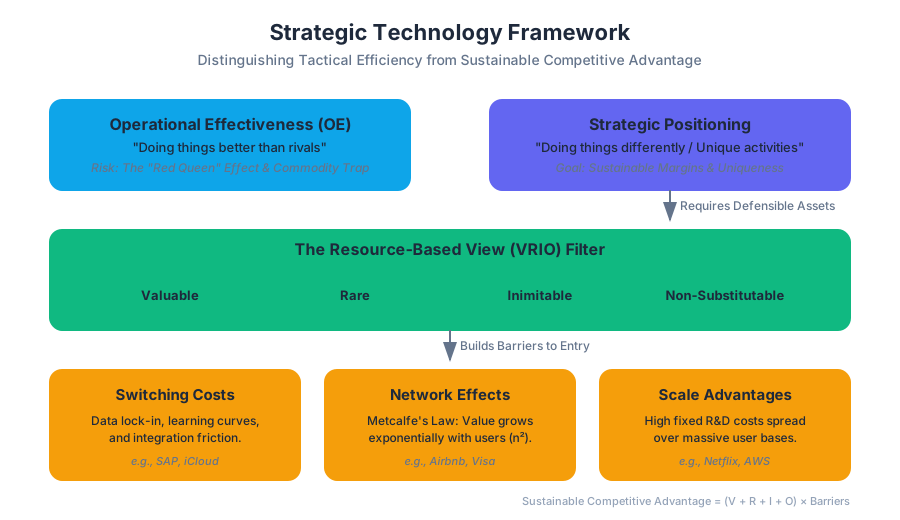
At its core, Competitive Advantage is the ability of a firm to outperform its industry peers by generating higher economic value. However, the tech industry is plagued by the "Red Queen" effect: running as fast as you can just to stay in the same place. To understand how to win, we must distinguish between two often-confused concepts.
Operational Effectiveness vs. Strategic Positioning
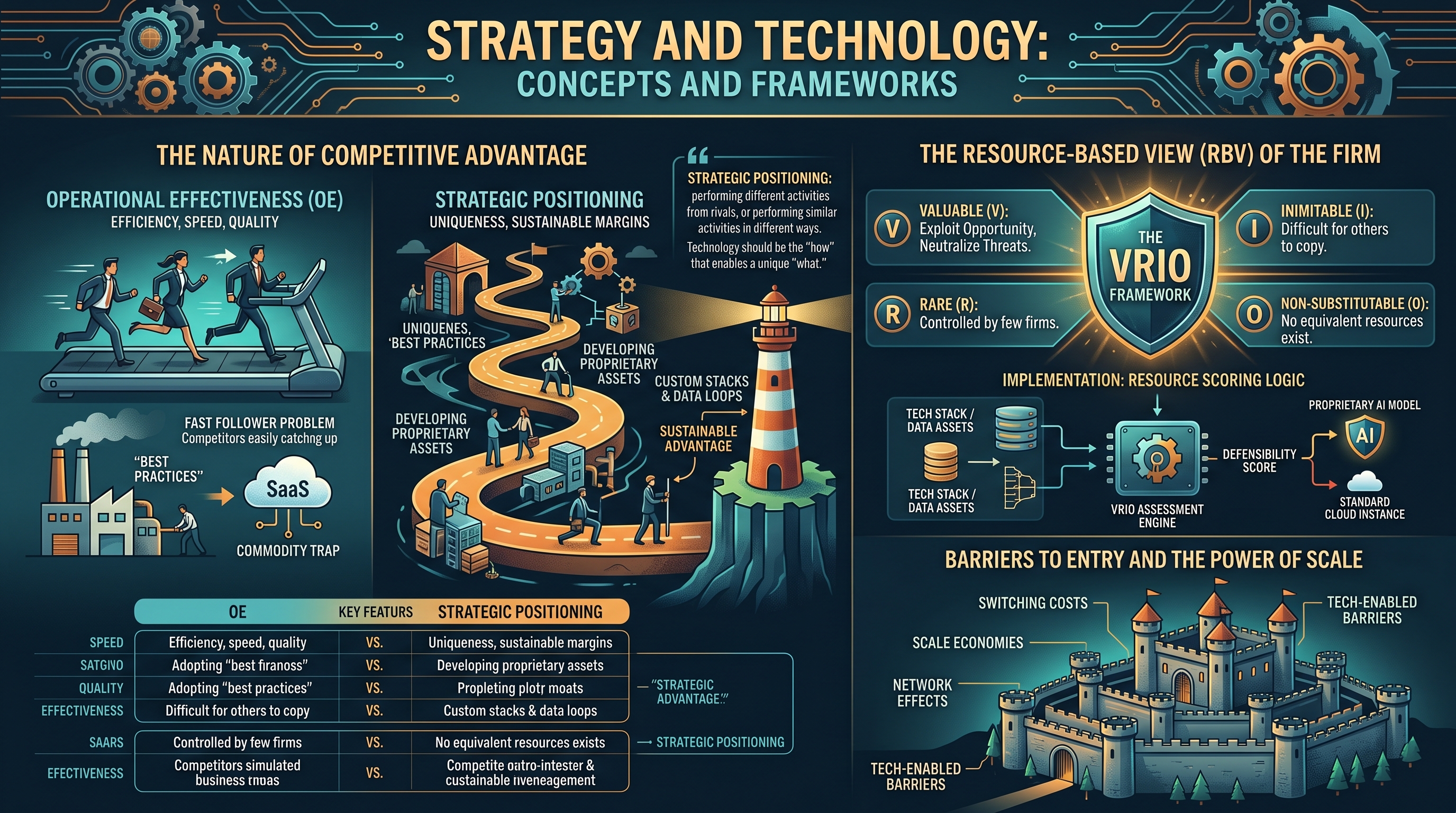
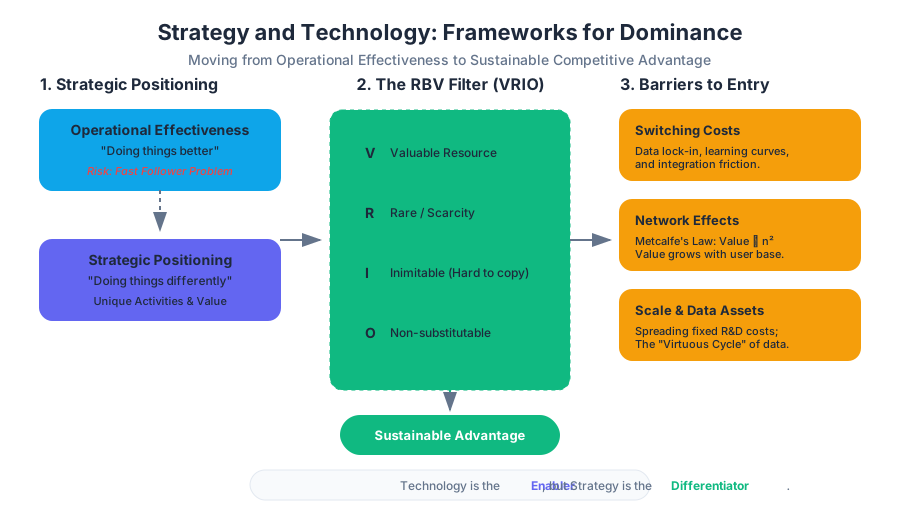
Most technological investments focus on Operational Effectiveness (OE)—performing similar activities better than rivals. While OE is necessary, it is rarely sufficient for long-term success because of Fast Follower problems. When a technology (like a new CRM or cloud infrastructure) is available to everyone, it becomes a commodity.
Definition: Strategic Positioning Strategic positioning refers to performing different activities from rivals, or performing similar activities in different ways. Technology should be the "how" that enables a unique "what."
| Feature | Operational Effectiveness (OE) | Strategic Positioning |
|---|---|---|
| Goal | Efficiency, speed, and quality. | Uniqueness and sustainable margins. |
| Mechanism | Adopting "Best Practices" and latest tools. | Developing proprietary processes/assets. |
| Risk | Commodity trap; price wars. | High initial R&D; market rejection. |
| Tech Role | Off-the-shelf software (SaaS). | Custom stacks, data loops, and integration. |
The Danger of the "Fast Follower"
When a firm relies solely on technology that can be purchased by competitors, it faces the Fast Follower Problem. Competitors can learn from the pioneer's mistakes, enter the market with newer versions of the same tech, and undercut prices because they didn't bear the initial R&D costs.
The Resource-Based View (RBV) of the Firm
To maintain a sustainable competitive advantage, a firm must possess resources that are not easily replicated. The Resource-Based View (RBV) provides a rigorous framework for evaluating whether an asset (technological, human, or physical) can serve as a foundation for long-term success.
The VRIO Framework
For a resource to provide a sustainable competitive advantage, it must meet four criteria:
- Valuable: Does the resource help the firm exploit an opportunity or neutralize a threat?
- Rare: Is the resource controlled by only a few firms?
- Imperfectly Imitable (Inimitable): Is it difficult for others to copy or buy?
- Non-substitutable: Are there no equivalent resources that can achieve the same result?
Barriers to Entry and the Power of Scale
Technology is a double-edged sword: it can lower the Barriers to Entry for new competitors (e.g., cloud computing removing the need for server rooms), but it can also be used to build massive moats.
Key Tech-Enabled Barriers
- Switching Costs: The cost a consumer incurs when moving from one product to another. This isn't just money; it's time, data loss, and learning curves.
- Network Effects: Also known as Metcalfe's Law. The value of a product increases as the number of users grows.
- Data Assets: Using historical data to improve algorithms (the "virtuous cycle" of data).
- Scale Advantages: Large firms can spread the fixed costs of software development across a massive customer base.
Mathematical Foundation: Metcalfe's Law
The value ($V$) of a network is proportional to the square of the number of connected users ($n$). This creates a massive barrier for new entrants who start with $n=1$.
V \propto n(n-1) \approx n^2
| Barrier Type | Technical Mechanism | Example |
|---|---|---|
| Switching Costs | Proprietary file formats, API lock-in. | Adobe Creative Cloud, Apple iCloud. |
| Network Effects | Two-sided marketplaces, social graphs. | Uber, Airbnb, Facebook. |
| Scale | High fixed cost of R&D, low marginal cost. | Netflix (Content spend / Subscribers). |
| Brand | Search engine dominance, trust. | Google (as a verb). |
Porter’s Five Forces: The Industry View
While the RBV looks inside the firm, Michael Porter’s Five Forces framework looks outside at the industry structure. Technology has radically shifted the balance of power in each of these forces.
1. Intensity of Rivalry Among Existing Competitors
In tech-heavy industries, rivalry is often intense because products can be easily compared online. However, features like "Fast Fashion" systems (e.g., Zara) allow firms to compete on speed rather than just price.
2. Threat of New Entrants
Digital distribution lowers barriers, but "winner-take-all" dynamics in platform markets (like App Stores) make it harder for new players to gain traction.
3. Threat of Substitute Products or Services
This is where "Atoms to Bits" is most visible. The substitute for a physical DVD (atom) was a digital stream (bit). Managers must constantly scan for technological substitutes that perform the same job for the customer.
4. Bargaining Power of Buyers
The internet gives buyers more information, increasing their power. However, loyalty programs and ecosystem lock-in (Switching Costs) can mitigate this.
5. Bargaining Power of Suppliers
If a firm relies on a single proprietary technology supplier (e.g., a specific chip manufacturer), the supplier has immense power. Open-source software and multi-cloud strategies are common ways to reduce this power.
| Force | Impact of Technology | Strategic Counter-move |
|---|---|---|
| Buyer Power | Price transparency via web. | Differentiation and Switching Costs. |
| Supplier Power | Global sourcing via B2B hubs. | Multi-sourcing and Open Standards. |
| New Entrants | Lowered CapEx (Cloud). | Network Effects and Brand. |
| Substitutes | Digital disruption (Streaming). | Cannibalize your own business first. |
Synthesis: The Strategic Feedback Loop
The frameworks discussed do not exist in isolation. A firm uses Porter's Five Forces to identify an attractive industry or a gap in the market. It then uses the Resource-Based View to develop the specific, inimitable assets (like a proprietary supply chain or data-driven design system) required to exploit that gap. These assets create Barriers to Entry that protect the firm's Competitive Advantage from rivals.
Common Pitfalls in Tech Strategy
- The "IT is a Commodity" Fallacy: Assuming that because you can buy a tool, it will give you an advantage. If your competitor can buy it too, your advantage is zero.
- Ignoring Switching Costs: Building a great product but making it too easy for customers to leave.
- Misjudging the Timing of "Atoms to Bits": Moving to digital too early (when infrastructure is lacking) or too late (when the market is gone).
- Confusing OE with Strategy: Being the most efficient player in a dying industry.
Key Insight: The Virtuous Cycle The most successful tech firms create a "flywheel" where more users lead to more data, which leads to better algorithms, which attracts more users, further increasing switching costs and scale advantages.
Summary of Frameworks
| Framework | Primary Question | Key Metric |
|---|---|---|
| RBV (VRIO) | Do we have the right "stuff" to win? | Rarity and Inimitability. |
| Five Forces | Is this a "good" neighborhood to do business in? | Industry Profitability. |
| Metcalfe's Law | Does our value grow as we scale? | $n^2$ (Network Value). |
| Switching Costs | How hard is it for our customers to fire us? | Churn Rate / Migration Effort. |
Source Materials
- 2: Strategy and Technology- Concepts and Frameworks for Understanding What Separates Winners from Losers
- 11: The Data Asset- Databases, Business Intelligence, and Competitive Advantage
- 4: Netflix- The Making of an E-commerce Giant and the Uncertain Future of Atoms to Bits
- 2.3: Barriers to Entry, Technology, and Timing
- 2.4: Key Framework- The Five Forces of Industry Competitive Advantage
- 1: Setting the Stage- Technology and the Modern Enterprise
- 6: Understanding Network Effects
- 7: Peer Production, Social Media, and Web 2.0
Study Information Systems - A Manager's Guide to Harnessing Technology on Lykke
This course page is free to open: signed out, you can read its first two sections, and signing in, on any plan, opens the rest. The free Lykke Chrome extension syncs your own Canvas courses, so ChatGPT, Claude and Muse can answer from your classes and deadlines. It only reads Canvas.
Add the free extensionSign in to open every sectionAll sections of Information Systems - A Manager's Guide to Harnessing Technology · Browse more course pages