From the free course Information Systems - A Manager's Guide to Harnessing Technology on Lykke
Software in Flux: Cloud and Open Source
Key concepts: Open Source Software (OSS) · Cloud Computing · Software as a Service (SaaS) · Virtualization
An examination of the shifting landscape of software delivery, focusing on open-source software, cloud computing, and virtualization.
Software in Flux: Cloud and Open Source
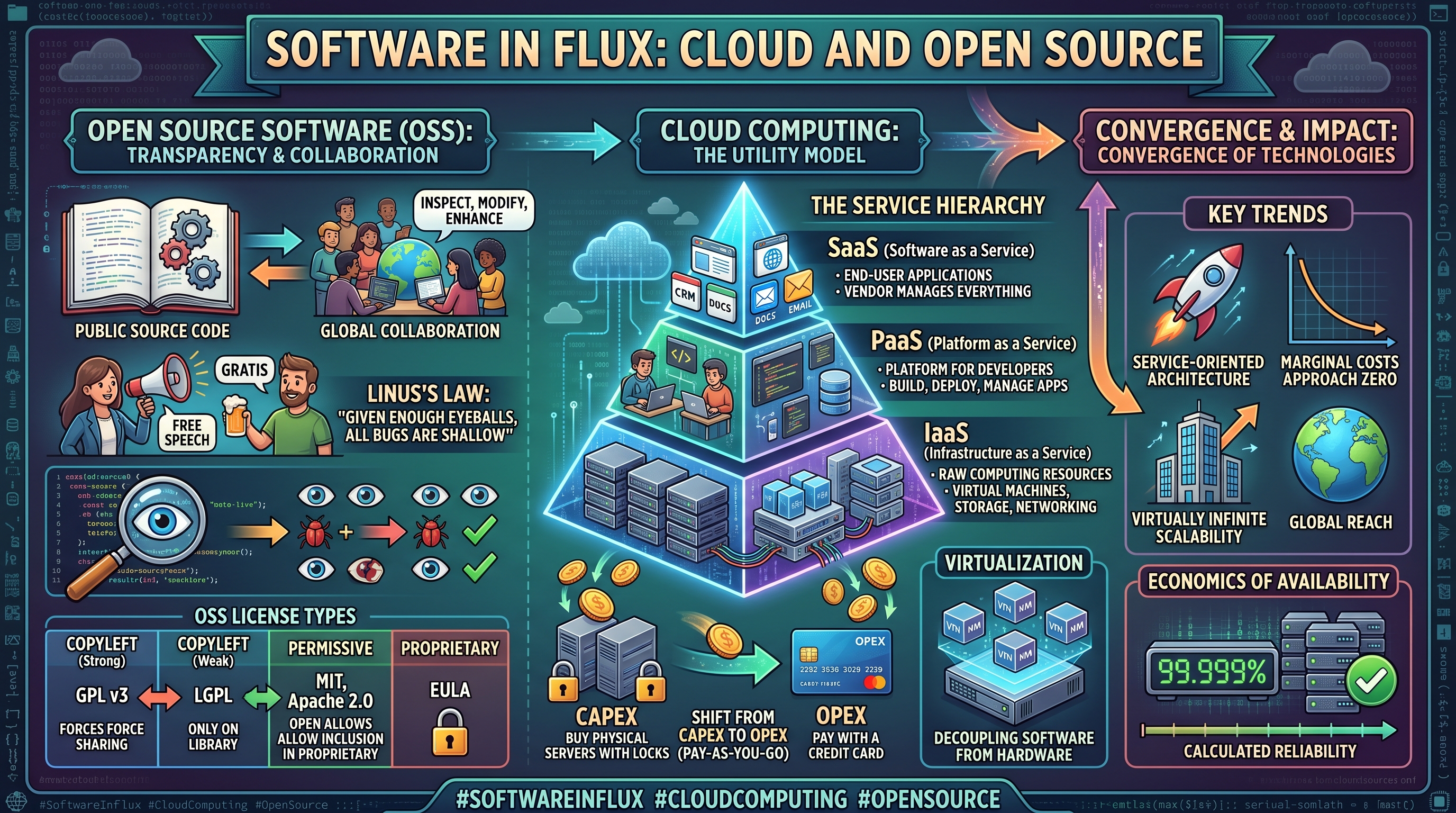
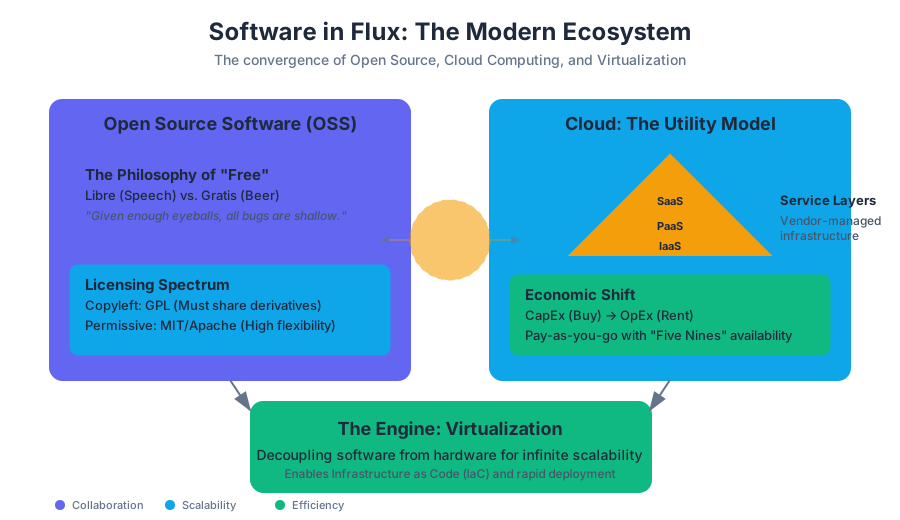
The traditional model of software production and distribution—characterized by proprietary code, high upfront licensing fees, and "shrink-wrapped" physical media—has undergone a radical transformation. This shift, often described as "Software in Flux," is driven by the convergence of Open Source Software (OSS), Cloud Computing, and Virtualization. Together, these technologies have decoupled software from hardware and ownership from utility, moving the industry toward a service-oriented architecture where marginal costs approach zero and scalability is virtually infinite.
Open Source Software (OSS)
Open Source Software (OSS) refers to software where the source code is made available to the public, allowing anyone to inspect, modify, and enhance it. Unlike proprietary software (e.g., Microsoft Windows or Adobe Photoshop), OSS is built on a foundation of collaboration and transparency.
The Philosophy of "Free"
In the context of OSS, "free" refers to liberty rather than price. Richard Stallman, a pioneer of the movement, famously distinguished between "free as in speech" (Libre) and "free as in beer" (Gratis).
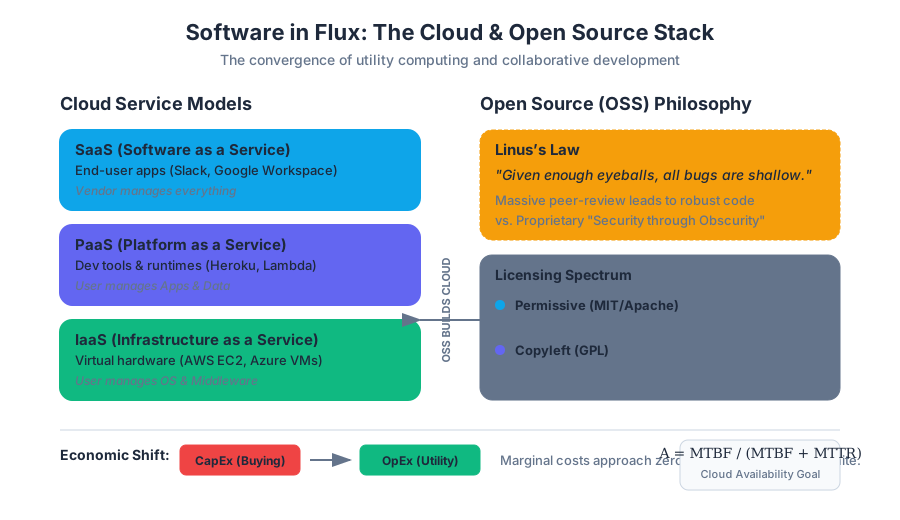
Linus’s Law: "Given enough eyeballs, all bugs are shallow." This principle suggests that the massive, distributed peer-review process of OSS leads to more robust and secure code than the "security through obscurity" model of proprietary firms.
Business Models and Licensing
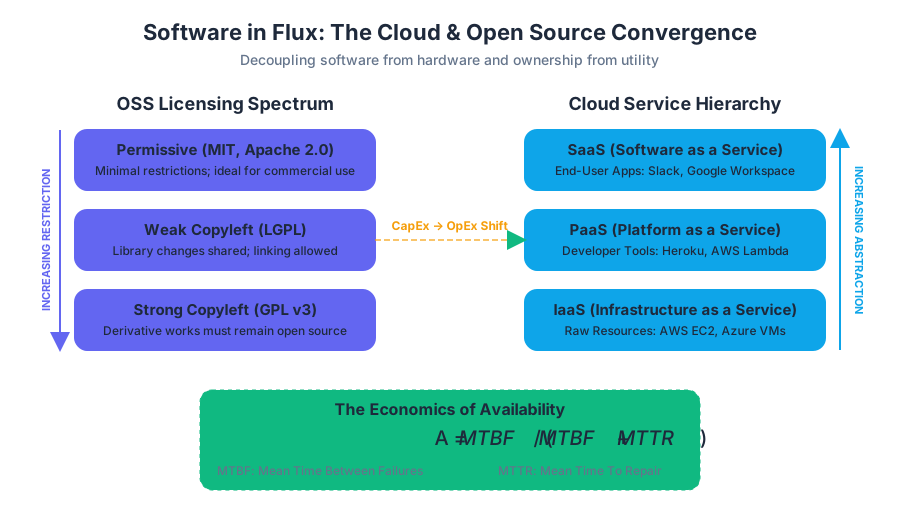
OSS is governed by various licenses that dictate how the code can be used and redistributed. These range from "copyleft" licenses, which require derivative works to also be open source, to "permissive" licenses, which allow the code to be integrated into proprietary products.
| License Type | Key Examples | Requirement for Derivative Works | Commercial Use |
|---|---|---|---|
| Copyleft (Strong) | GNU GPL v3 | Must be open source under the same license. | Allowed, but code must be shared. |
| Copyleft (Weak) | LGPL | Only modifications to the library itself must be shared. | Allowed; can link to proprietary apps. |
| Permissive | MIT, Apache 2.0 | No requirement to share modifications. | Fully allowed; very popular for startups. |
| Proprietary | EULA (Microsoft) | Modification and redistribution strictly forbidden. | Paid licensing/Subscription. |
Cloud Computing: The Utility Model
Cloud Computing is the delivery of computing services—including servers, storage, databases, networking, and software—over the internet ("the cloud"). It represents a shift from CapEx (Capital Expenditure, buying hardware) to OpEx (Operating Expenditure, paying for what you use).
The Service Hierarchy
Cloud computing is generally categorized into three distinct layers, often visualized as a pyramid.
- Software as a Service (SaaS): Delivering end-user applications over a browser (e.g., Salesforce, Google Workspace).
- Platform as a Service (PaaS): Providing a platform for developers to build, deploy, and manage applications without worrying about the underlying infrastructure (e.g., Heroku, Google App Engine).
- Infrastructure as a Service (IaaS): Providing raw computing resources like virtual machines, storage, and networks (e.g., AWS EC2, Microsoft Azure).
| Feature | SaaS | PaaS | IaaS |
|---|---|---|---|
| User | Business End-User | Software Developer | System Administrator |
| Management | Vendor manages everything | Vendor manages OS/Hardware | User manages OS/Apps |
| Flexibility | Lowest (Standardized) | Medium (Dev focus) | Highest (Full control) |
| Examples | Slack, Dropbox | AWS Lambda, Heroku | AWS EC2, Google Compute Engine |
The Economics of Availability
Cloud providers often guarantee "five nines" of availability (99.999%). This is calculated using the relationship between Mean Time Between Failures (MTBF) and Mean Time To Repair (MTTR).
\text{Availability} (A) = \frac{MTBF}{MTBF + MTTR}
To achieve high availability, cloud systems use Load Balancers and Auto-scaling Groups.
Virtualization: The Engine of the Flux
Virtualization is the fundamental technology that enables cloud computing. It allows a single physical machine to be partitioned into multiple Virtual Machines (VMs), each running its own operating system. This is achieved through a software layer called a Hypervisor.
Hypervisor Types
- Type 1 (Bare Metal): Runs directly on the host's hardware (e.g., VMware ESXi, Xen). It is highly efficient and used in data centers.
- Type 2 (Hosted): Runs as an application on top of an existing OS (e.g., VirtualBox, VMware Workstation). It is primarily used for development and testing.
Containers vs. Virtual Machines
While VMs virtualize the hardware, Containers virtualize the Operating System. Containers share the host's kernel but isolate the application processes.
| Attribute | Virtual Machines (VM) | Containers (e.g., Docker) |
|---|---|---|
| Isolation | Strong (Full OS isolation) | Process-level (Shared kernel) |
| Startup Time | Minutes (Booting OS) | Seconds (Starting process) |
| Size | Gigabytes (Includes OS) | Megabytes (App + Libs) |
| Efficiency | Lower (Hypervisor overhead) | Higher (Native execution) |
Strategic Implications for Management
The shift to OSS and Cloud is not merely a technical decision; it is a strategic one. Managers must weigh the benefits of agility and cost against the risks of dependency.
Total Cost of Ownership (TCO)
While OSS has no "license fee," its TCO includes support, maintenance, training, and integration. Similarly, Cloud Computing can become more expensive than on-premises hardware if resource usage is not strictly monitored (a phenomenon known as "Cloud Sprawl").
The Risk of Vendor Lock-in
Proprietary cloud features (like AWS DynamoDB or Azure Cosmos DB) offer high performance but make it difficult to migrate to another provider. This creates Switching Costs, a key concept in strategic management. To mitigate this, many firms adopt a Multi-cloud or Hybrid Cloud strategy.
Security and Compliance
In the cloud, security is a Shared Responsibility Model. The provider is responsible for the security of the cloud (physical data centers, hardware), while the customer is responsible for security in the cloud (data encryption, identity management, firewall rules).
| Strategic Factor | Advantage of Cloud/OSS | Potential Pitfall |
|---|---|---|
| Scalability | Handle "Flash Crowds" effortlessly. | Unexpectedly high monthly bills. |
| Time-to-Market | Deploy in minutes, not months. | Technical debt from rapid iteration. |
| Cost Structure | Low entry barrier for startups. | Complex billing and "hidden" data egress fees. |
| Innovation | Access to AI/ML tools as services. | Loss of control over the underlying stack. |
Strategic Insight: The transition from "Atoms to Bits" (physical distribution to digital) is accelerated by the cloud. Companies like Netflix survived this transition by moving their entire infrastructure to AWS, allowing them to focus on content and recommendation algorithms rather than managing data centers.
Common Pitfalls and Misconceptions
- "OSS is less secure because the code is public." As noted by Linus's Law, public code often leads to faster patching. The danger lies in unmaintained OSS libraries that are integrated into enterprise software without oversight (e.g., the Heartbleed or Log4j vulnerabilities).
- "The Cloud is always cheaper." For steady-state workloads with predictable demand, owning hardware can be significantly cheaper over a 3-5 year horizon. The cloud's value is in elasticity and agility, not just raw cost.
- "Virtualization is the same as Cloud." Virtualization is a technology; Cloud is a service model built upon that technology. You can have virtualization without having a cloud (e.g., a single server running three VMs in a closet).
- OSS: Software with publicly accessible source code, often developed through community collaboration.
- SaaS: Software delivered as a subscription service over the internet, requiring no local installation.
- IaaS: Cloud model providing raw infrastructure (servers, storage) as a utility.
- Hypervisor: Software that creates and runs virtual machines by isolating them from the underlying hardware.
- Containerization: A lightweight virtualization method that shares the host OS kernel to run isolated applications.
- TCO (Total Cost of Ownership): The comprehensive financial estimate including direct and indirect costs of a product or system.
- Copyleft: A licensing practice that allows others to freely use and modify code, provided they keep the derivative works open.
- Multi-tenancy: A cloud architecture where multiple customers share the same physical resources while keeping their data isolated.
-
Which license requires that any software derived from it also be released as open source?
- A) MIT
- B) Apache
- C) GNU GPL
- D) BSD Correct: C
-
In the Shared Responsibility Model of Cloud Computing, who is typically responsible for patching the Guest Operating System in an IaaS model?
- A) The Cloud Provider (e.g., AWS)
- B) The Customer
- C) Both A and B
- D) The Hardware Manufacturer Correct: B
-
What is the primary technical difference between a Container and a Virtual Machine?
- A) Containers require a Type 1 Hypervisor.
- B) VMs share the host's Operating System kernel.
- C) Containers share the host's Operating System kernel; VMs do not.
- D) VMs are only used for SaaS applications. Correct: C
-
Which concept explains why a firm might stay with a cloud provider despite rising costs?
- A) Marginal Cost
- B) Switching Costs / Vendor Lock-in
- C) Moore's Law
- D) Open Source Philosophy Correct: B
Summary of Key Themes
- The End of Ownership: Software is moving from a product you buy to a service you rent.
- The Power of Community: OSS leverages global talent to create infrastructure that rivals (and often exceeds) proprietary alternatives.
- Elasticity as a Competitive Weapon: The ability to scale resources up or down instantly allows firms to take risks without massive capital investment.
- Abstraction Layers: Virtualization and Containers allow developers to focus on code rather than the "plumbing" of hardware.
Critical Thinking Questions
- How does the "Atoms to Bits" transition change the barriers to entry for a new competitor in the media industry?
- If you were a CTO, under what specific conditions would you choose an on-premises data center over a public cloud provider?
- How does the use of OSS impact a company's "Sustainable Competitive Advantage" if their competitors have access to the same code?
Source Materials
- 10: Software in Flux- Partly Cloudy and Sometimes Free
- 5: Moore’s Law- Fast, Cheap Computing and What It Means for the Manager
- 9: Understanding Software- A Primer for Managers
- Front Matter
- 7: Peer Production, Social Media, and Web 2.0
- 11: The Data Asset- Databases, Business Intelligence, and Competitive Advantage
- Front Matter
- 1: Setting the Stage- Technology and the Modern Enterprise
Study Information Systems - A Manager's Guide to Harnessing Technology on Lykke
This course page is free to open: signed out, you can read its first two sections, and signing in, on any plan, opens the rest. The free Lykke Chrome extension syncs your own Canvas courses, so ChatGPT, Claude and Muse can answer from your classes and deadlines. It only reads Canvas.
Add the free extensionSign in to open every sectionAll sections of Information Systems - A Manager's Guide to Harnessing Technology · Browse more course pages