From the free course Information Systems - A Manager's Guide to Harnessing Technology on Lykke
Peer Production, Social Media, and Web 2.0
Key concepts: Peer Production · Web 2.0 · Crowdsourcing · Prediction Markets
How collaborative digital platforms and social media are transforming business communication and organizational decision-making.
Peer Production, Social Media, and Web 2.0
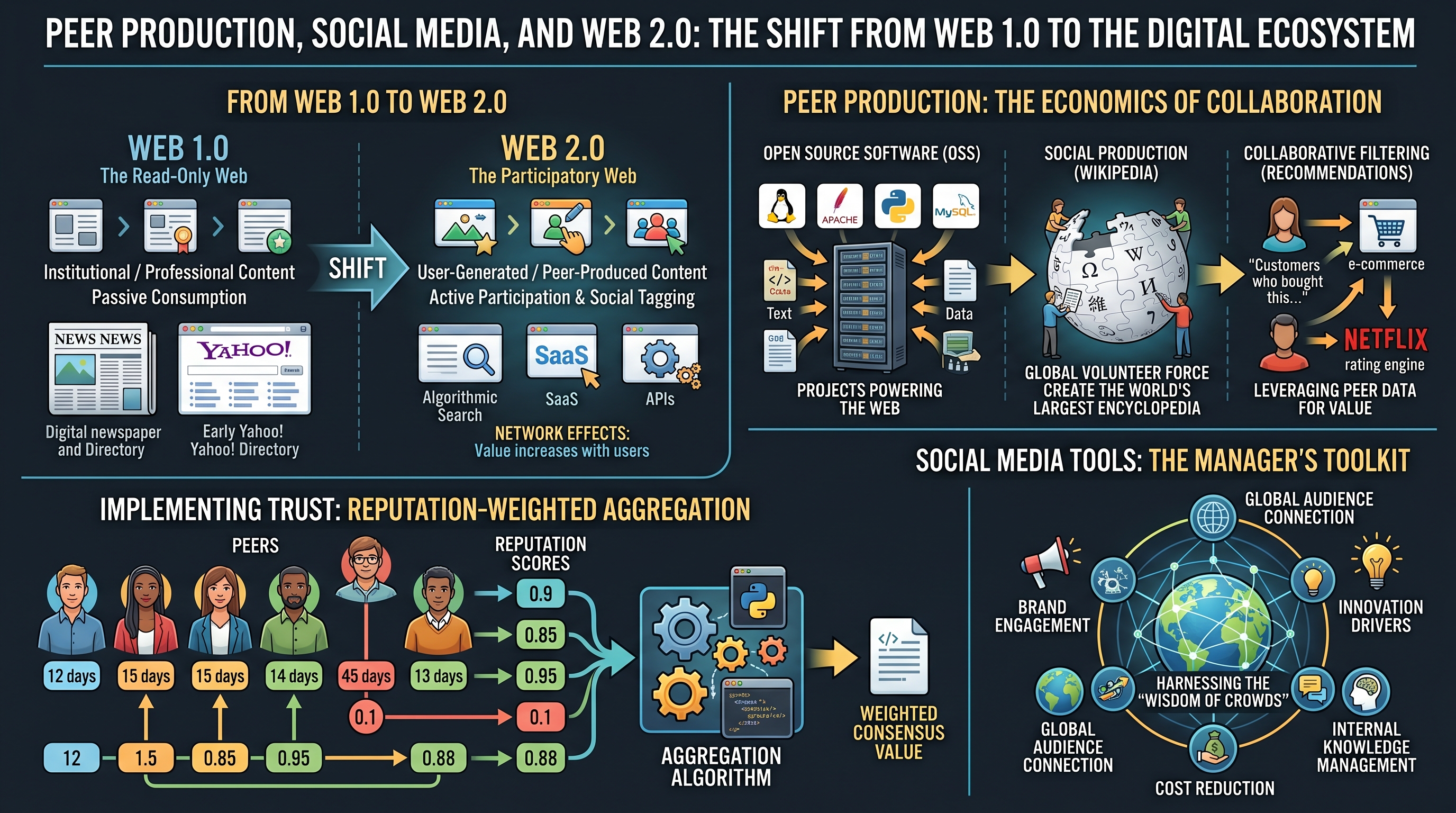
The transition from the early World Wide Web to the modern digital ecosystem is often described as the shift from Web 1.0 to Web 2.0. While Web 1.0 was characterized by static, "read-only" pages—essentially a digital version of a brochure or a newspaper—Web 2.0 represents a fundamental change in how information is created, shared, and consumed. This era is defined by interactivity, user-generated content, and the emergence of Peer Production.
In the modern enterprise, technology is no longer just a tool for internal efficiency; it is a platform for harnessing the "wisdom of crowds." Managers who understand these tectonic shifts can leverage social media and collaborative frameworks to drive innovation, reduce costs, and engage with a global audience in ways that were previously impossible.
Web 2.0: The Web as a Platform
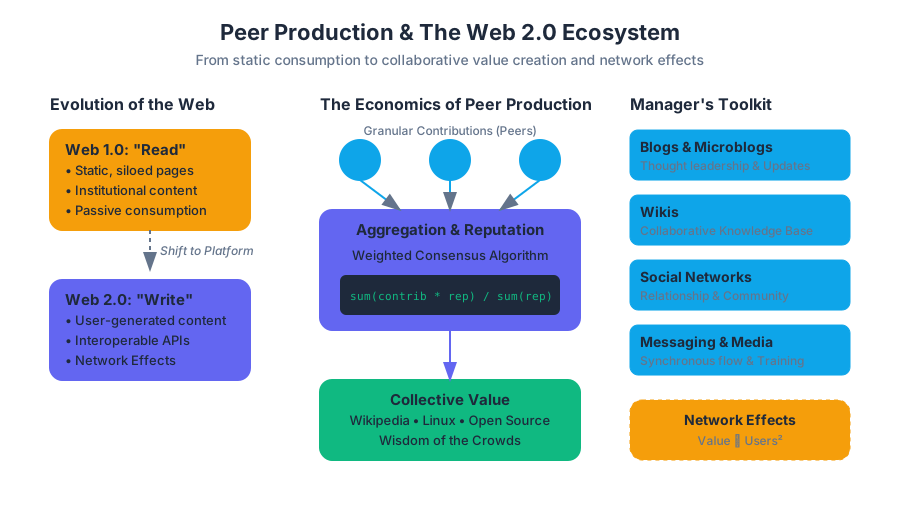
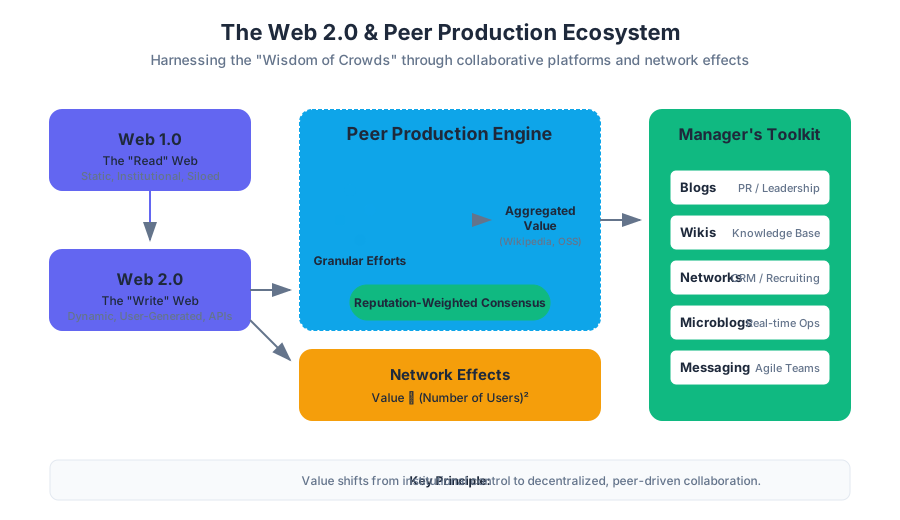
Web 2.0 is not a technical specification but rather a set of principles and practices that tie together a functional system. The core philosophy is that the value of a platform increases with the number of users and the amount of data they contribute—a phenomenon known as Network Effects.
Definition: Web 2.0 refers to internet services that foster collaboration and information sharing, characterized by user-generated content, usability, and interoperability. It treats the web as a platform where users contribute as much as they consume.
Key Characteristics of Web 2.0
| Feature | Web 1.0 (The "Read" Web) | Web 2.0 (The "Write" Web) |
|---|---|---|
| Content Origin | Institutional / Professional | User-Generated / Peer-Produced |
| Interaction | Passive consumption | Active participation and tagging |
| Architecture | Brittle, siloed, static | Flexible, API-driven, dynamic |
| Search/Discovery | Directories (e.g., early Yahoo!) | Algorithmic and Social (e.g., Google, Reddit) |
| Software Model | Packaged software (CD-ROMs) | Software as a Service (SaaS) |
Peer Production: The Economics of Collaboration
One of the most powerful manifestations of Web 2.0 is Peer Production. This is a socioeconomic system of production in which a large number of people work collaboratively, often without traditional financial compensation, to create products or services.
Why Peer Production Works
Traditional economic theory suggests that firms exist because the transaction costs of coordinating work through the open market are too high. However, the internet has lowered these costs to near zero. In peer production, individuals contribute small increments of effort (granular contributions) that are aggregated into a massive whole.
- Open Source Software (OSS): Projects like Linux, Apache, and MySQL power the majority of the web's infrastructure.
- Social Production: Wikipedia is the quintessential example, where a global volunteer force has created the world's largest encyclopedia, often with accuracy levels rivalling traditional sources like Britannica.
- Collaborative Filtering: Systems like Amazon's "Customers who bought this also bought..." or Netflix's recommendation engine leverage peer data to create value.
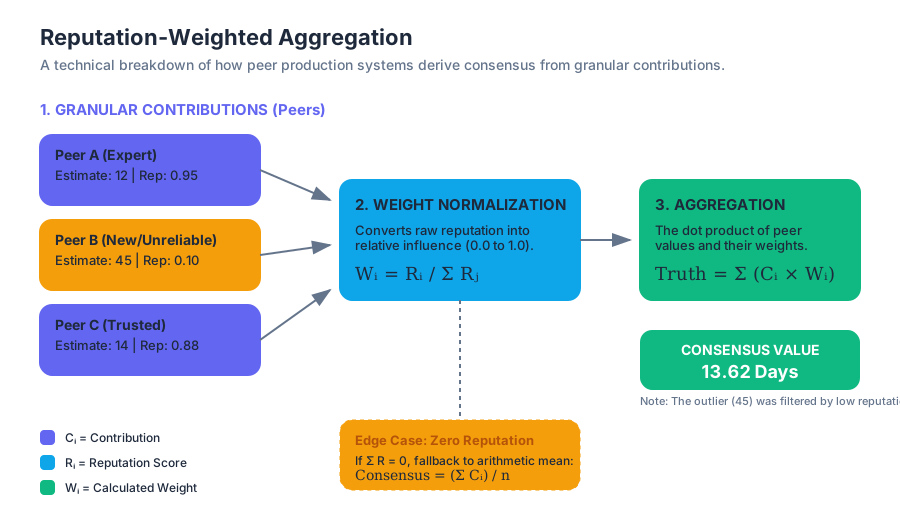
Implementing a Peer-Based Reputation System
In peer production environments, "trust" is the primary currency.
Social Media Tools: The Manager’s Toolkit
Social media is a subset of Web 2.0 that focuses on the creation and exchange of user-generated content. For managers, these tools are not just for marketing; they are essential for internal knowledge management and external brand building.
Taxonomy of Social Media Tools
| Tool Category | Primary Purpose | Key Business Value | Examples |
|---|---|---|---|
| Blogs | Long-form publishing | Thought leadership, direct-to-consumer PR | WordPress, Medium |
| Wikis | Collaborative knowledge base | Internal documentation, project management | MediaWiki, Notion, Confluence |
| Social Networks | Relationship building | Recruitment, professional networking, CRM | LinkedIn, Facebook |
| Microblogging | Real-time updates | Customer service, crisis management, news | X (Twitter), Mastodon |
| Messaging | Synchronous communication | Rapid team coordination, internal agility | Slack, Microsoft Teams |
| Media Sharing | Visual/Audio distribution | Content marketing, training, viral reach | YouTube, TikTok, Instagram |
The Wiki: A Deep Dive into Collaboration
A Wiki is a website that can be edited by anyone with access. From a managerial perspective, wikis solve the "siloed information" problem. Unlike email, where information is buried in threads, a wiki provides a "single source of truth" that evolves over time.
- Rollback: The ability to revert a page to a previous version if an error or vandalism occurs.
- Versioning: A complete history of every change made, by whom, and when.
- Searchability: All content is indexed and easily retrieved.
Crowdsourcing: Outsourcing to the Undefined
Crowdsourcing is the act of taking a job traditionally performed by a designated agent (like an employee or a contractor) and outsourcing it to an undefined, generally large group of people in the form of an open call.
Models of Crowdsourcing
- Crowd-solving: Using the crowd to solve a specific problem (e.g., the Netflix Prize for improving recommendation algorithms).
- Crowdfunding: Raising capital from a large number of people (e.g., Kickstarter, Indiegogo).
- Crowd-innovation: Soliciting new product ideas from customers (e.g., LEGO Ideas, Starbucks "My Starbucks Idea").
- Micro-tasking: Breaking a large project into tiny tasks that humans can do better than AI (e.g., Amazon Mechanical Turk).
The Git Workflow: A Real-World Peer Production Example
In the world of software, git is the primary tool for managing peer production. It allows thousands of developers to work on the same codebase simultaneously without overwriting each other's work.
Prediction Markets: Tapping Collective Intelligence
A Prediction Market is a diverse group of people "betting" on the outcome of an event. The market price reflects the crowd's collective estimate of the probability of that event occurring.
The Wisdom of Crowds: James Surowiecki argued that under the right conditions, a group's collective intelligence is superior to that of its smartest individual member.
Criteria for a "Wise" Crowd
To avoid "herd mentality" or "groupthink," a crowd must meet four criteria:
- Diversity of Opinion: Each person should have private information, even if it's just an eccentric interpretation of known facts.
- Independence: People's opinions should not be determined by those around them.
- Decentralization: People are able to specialize and draw on local knowledge.
- Aggregation: A mechanism exists for turning private judgments into a collective decision.
The Math of Prediction Markets
Prediction markets often use a Logarithmic Market Scoring Rule (LMSR) to provide liquidity. This ensures that even when there are few traders, there is always a price available.
C(q) = b \cdot \ln \left( \sum_{i=1}^{n} e^{q_i / b} \right)
Where:
- $C(q)$ is the cost function.
- $q_i$ is the number of shares held for outcome $i$.
- $b$ is the liquidity parameter (higher $b$ means the price moves more slowly).
- The price of a share for outcome $i$ is the partial derivative $\frac{\partial C}{\partial q_i}$.
Managerial Challenges and Pitfalls
While the benefits of Web 2.0 and peer production are vast, they introduce significant risks that managers must navigate.
1. The "Free Rider" Problem
In peer production, many people benefit from the resource (like Wikipedia or Open Source software) without contributing to it. If the ratio of consumers to contributors becomes too high, the project may stagnate.
2. Information Overload and Quality Control
The low barrier to entry in Web 2.0 means that the volume of content can be overwhelming. Managers must implement sophisticated filtering and curation mechanisms to ensure that high-quality information surfaces.
3. Reputation and Brand Risk
Social media gives every customer a megaphone. A single viral post can damage a brand's reputation overnight. Companies must move from a "command and control" communication style to one of "engagement and transparency."
4. The "Dark Side" of Crowds
Crowds are not always wise. They can be prone to:
- Griefers/Trolls: Individuals who intentionally disrupt collaborative efforts.
- Astroturfing: Creating fake "grassroots" support for a product or cause (e.g., fake reviews).
- Salami Slicing: Competitors using crowdsourced data to reverse-engineer proprietary strategies.
Summary of Strategic Frameworks
To effectively harness these technologies, managers should evaluate their strategy against the following matrix:
| Strategy | Goal | Key Metric | Risk |
|---|---|---|---|
| Peer Production | Lower R&D costs | Contribution rate / Code quality | IP ownership issues |
| Social Media | Customer engagement | Sentiment / Reach / Conversion | Public relations crises |
| Crowdsourcing | Problem solving | Solution diversity / Cost per unit | Quality inconsistency |
| Prediction Markets | Forecasting | Accuracy vs. Actual outcomes | Internal politics / Bias |
Conclusion: From Atoms to Bits
As the source material suggests, the transition from Atoms to Bits (physical to digital) is accelerated by Web 2.0. When products become digital, they can be peer-produced, crowdsourced, and shared at zero marginal cost. Managers who fail to adapt to this collaborative reality risk being disrupted by more agile, "crowd-powered" competitors.
Source Materials
- 7: Peer Production, Social Media, and Web 2.0
- 8: Facebook- Building a Business from the Social Graph
- 11: The Data Asset- Databases, Business Intelligence, and Competitive Advantage
- Front Matter
- 1: Setting the Stage- Technology and the Modern Enterprise
- 2: Strategy and Technology- Concepts and Frameworks for Understanding What Separates Winners from Losers
- 4: Netflix- The Making of an E-commerce Giant and the Uncertain Future of Atoms to Bits
- 5: Moore’s Law- Fast, Cheap Computing and What It Means for the Manager
Study Information Systems - A Manager's Guide to Harnessing Technology on Lykke
This course page is free to open: signed out, you can read its first two sections, and signing in, on any plan, opens the rest. The free Lykke Chrome extension syncs your own Canvas courses, so ChatGPT, Claude and Muse can answer from your classes and deadlines. It only reads Canvas.
Add the free extensionSign in to open every sectionAll sections of Information Systems - A Manager's Guide to Harnessing Technology · Browse more course pages