From the free course Information Systems - A Manager's Guide to Harnessing Technology on Lykke
Moore’s Law and Computing Economics
Key concepts: Moore's Law · Supercomputing · Grid Computing · E-waste
Understanding the business implications of the rapid increase in computing power and the corresponding decrease in costs.
Moore’s Law and Computing Economics
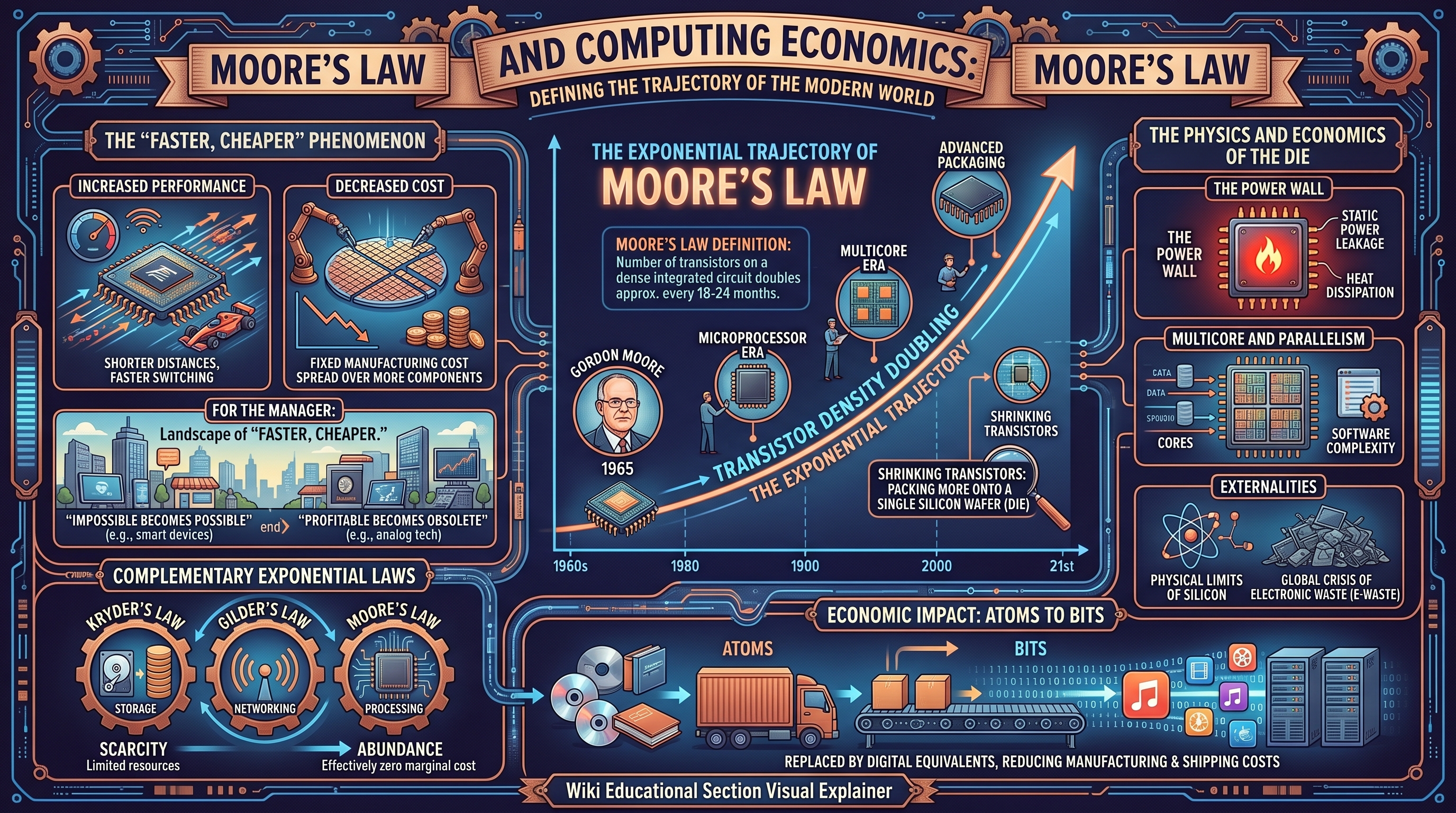
Moore’s Law is not a law of physics in the Newtonian sense, but rather an observation of industrial productivity and a self-fulfilling prophecy that has defined the trajectory of the modern world. Originally articulated by Gordon Moore, the co-founder of Intel, in a 1965 paper, the principle posits that the number of transistors that can be placed inexpensively on an integrated circuit doubles approximately every two years.
This exponential growth has resulted in a radical transformation of computing economics: as performance skyrockets, costs plummet. For the manager, this creates a landscape of "faster, cheaper" computing where the impossible becomes possible, and the profitable becomes obsolete with dizzying speed. However, this relentless march of progress brings significant externalities, ranging from the physical limits of silicon to the mounting global crisis of electronic waste (e-waste).
The Mechanics of Exponential Growth
At the heart of Moore’s Law is the Integrated Circuit (IC). By shrinking the size of a transistor—the fundamental "on/off" switch of digital logic—engineers can pack more components onto a single silicon wafer (the die).
The "Faster, Cheaper" Phenomenon
The doubling of transistor density yields two primary benefits:
- Increased Performance: Shorter distances between transistors allow for faster switching speeds and reduced latency.
- Decreased Cost: Since the cost of manufacturing a silicon wafer is relatively fixed, doubling the number of components on that wafer effectively halves the cost per component.
Moore’s Law Definition: The observation that the number of transistors in a dense integrated circuit doubles approximately every 18 to 24 months, leading to an exponential increase in processing power and a corresponding decrease in the cost of computing.
Beyond the CPU: Kryder’s and Gilder’s Laws
Moore's Law does not exist in a vacuum. It is complemented by similar exponential trends in storage and networking:
| Law | Domain | Observation |
|---|---|---|
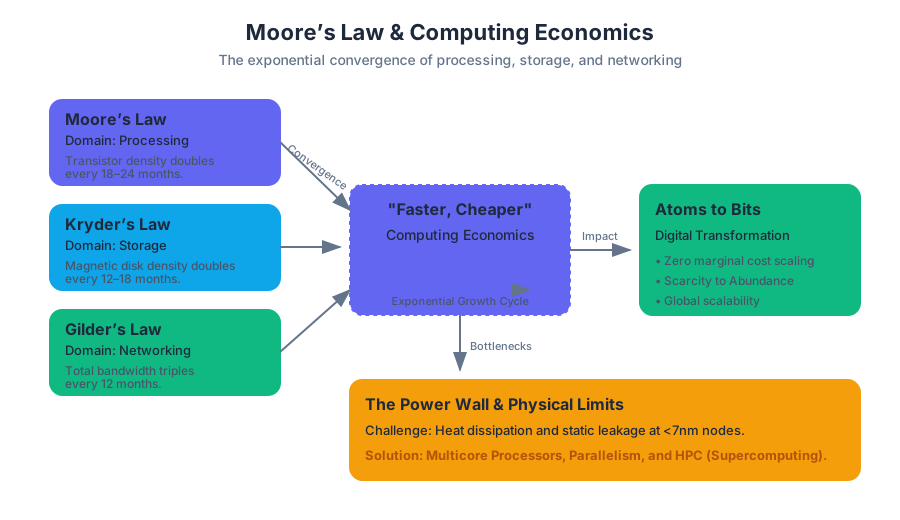
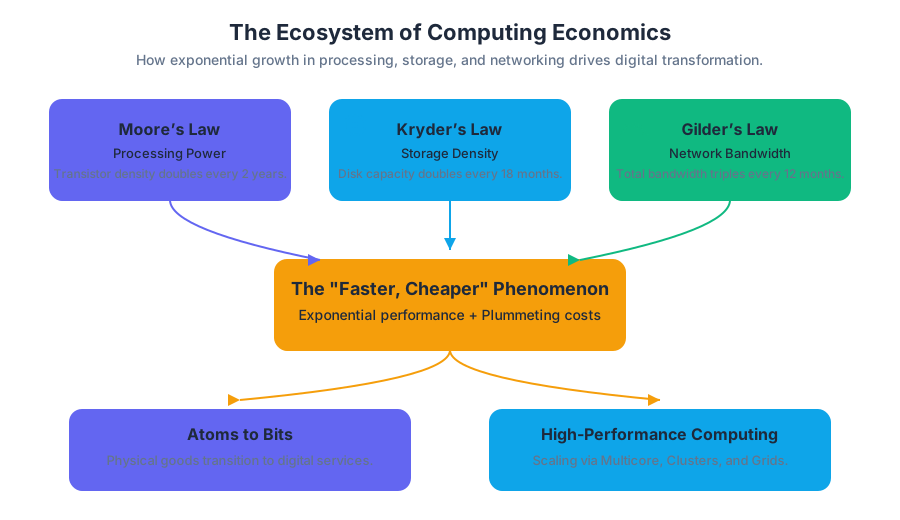
| Moore’s Law | Processing | Transistor density doubles every 18–24 months. |
| Kryder’s Law | Storage | The density of data on magnetic disks doubles every 12–18 months. |
| Gilder’s Law | Networking | Total bandwidth of communication systems triples every 12 months. |
The convergence of these three laws has shifted the business landscape from a world of scarcity (where computing power was a precious resource) to a world of abundance (where the marginal cost of processing a bit is effectively zero).
The Physics and Economics of the Die
As transistors approach the size of a few atoms, the industry faces the Power Wall. Traditionally, as transistors shrank, they became more power-efficient (Dennard Scaling). However, below the 7nm and 5nm nodes, static power leakage and heat dissipation have become major bottlenecks.
Multicore and Parallelism
To circumvent the heat limits of single-core clock speeds, the industry shifted toward Multicore Processors. Instead of one "super-fast" brain, a chip now has multiple "brains" (cores) working in parallel. This shift requires a fundamental change in software engineering, moving from linear execution to concurrent programming.
The Economic Impact: Atoms to Bits
The "Faster, Cheaper" trend enables the transition from Atoms to Bits. Physical goods (atoms) like CDs, DVDs, and books are replaced by digital equivalents (bits). This transition eliminates costs associated with manufacturing, shipping, and inventory, allowing companies like Netflix and Spotify to scale globally with minimal physical infrastructure.
High-Performance Computing: Supercomputing and Grid Computing
When a single computer—even a powerful multicore server—is insufficient, organizations turn to High-Performance Computing (HPC). This involves aggregating the power of thousands of processors to solve "Grand Challenge" problems.
Supercomputing
A Supercomputer is a single, massive machine designed for maximum throughput. Modern supercomputers utilize Massively Parallel Processing (MPP), where thousands of processors work in tight coordination.
- Metric: Performance is measured in FLOPS (Floating Point Operations Per Second).
- Use Cases: Nuclear fusion simulation, climate modeling, and cryptographic analysis.
Grid and Cluster Computing
While supercomputers are expensive, proprietary assets, Grid Computing and Cluster Computing offer a more modular approach.
| Feature | Cluster Computing | Grid Computing |
|---|---|---|
| Connectivity | High-speed local interconnects (InfiniBand). | Standard Internet/WAN connections. |
| Geography | Centralized in one data center. | Geographically distributed. |
| Homogeneity | Usually identical hardware/OS. | Heterogeneous (different hardware/OS). |
| Ownership | Single organization. | Often collaborative (e.g., SETI@home). |
Key Insight: Grid computing allows organizations to harness "dark silicon"—the idle processing power of thousands of desktop PCs—to perform massive calculations at a fraction of the cost of a supercomputer.
\text{Performance Gain (Amdahl's Law)} \\
S_{latency}(s) = \frac{1}{(1 - p) + \frac{p}{s}} \\
\text{where: } \\
s = \text{speedup of the part of the task that benefits from resources} \\
p = \text{proportion of execution time that the part benefiting from resources originally occupied}
The Dark Side of Moore’s Law: E-Waste
The flip side of "faster and cheaper" is obsolescence. Because technology improves so rapidly, the useful life of a device has plummeted. This has created a massive environmental challenge known as E-waste (Electronic Waste).
The Toxicity of Tech
Electronic components are a "toxic cocktail" of heavy metals and hazardous chemicals. When disposed of improperly, these substances leach into the soil and groundwater.
| Material | Component Location | Health/Environmental Impact |
|---|---|---|
| Lead | Solder, CRT glass | Neurotoxin, kidney damage. |
| Mercury | Backlights, switches | Brain and liver damage. |
| Cadmium | Resistors, batteries | Carcinogenic, kidney failure. |
| BFRs | Plastic casings, PCBs | Endocrine disruption. |
The Global Path of Waste
Much of the world's e-waste is exported from developed nations to developing countries (like Ghana, China, and India), where "informal" recycling operations use primitive methods (like burning plastic off wires) to extract precious metals like gold and copper. This creates devastating health outcomes for local workers.
Managerial Responsibility and the Circular Economy
Managers must look beyond the initial purchase price of technology and consider the Total Cost of Ownership (TCO), including disposal.
- Design for Disassembly: Choosing hardware that is easy to repair and recycle.
- Take-back Programs: Partnering with vendors who guarantee responsible recycling.
- Cloud Computing: By shifting workloads to the cloud, firms can reduce their physical hardware footprint, pushing the responsibility of hardware lifecycle management to hyper-scale providers like AWS or Azure, who have higher incentives for efficiency.
Strategic Managerial Implications
The economic reality of Moore’s Law forces a shift in strategic thinking. If computing power is effectively free in the future, how does that change your business model today?
1. The "Wait" Strategy
In some cases, it is more cost-effective to delay a project. If a task requires a level of processing power that is currently expensive, waiting 18 months might make the project feasible at half the cost.
2. Disruptive Innovation
Moore’s Law is the engine of disruption. It allows new entrants to use "cheap" tech to undermine established players who are tied to "expensive" legacy systems.
- Example: Digital photography (Moore's Law applied to sensors) destroyed Kodak, a company built on the chemistry of film (atoms).
3. Data as the New Capital
As processing becomes a commodity, the value shifts from the ability to process to the data being processed. This is why modern giants (Google, Meta, Amazon) focus on data acquisition; the hardware to analyze it will always get cheaper, but the data itself is a unique, non-depreciating asset.
Common Pitfalls and Misconceptions
- The "Law" Fallacy: Moore’s Law is an observation of human ingenuity and market competition. It can end if the economic incentive to shrink transistors vanishes or if physical limits (like the size of an atom) become insurmountable.
- Ignoring Latency: While processing power doubles, the speed of light remains constant. This means that as chips get faster, the "distance" to memory or other servers becomes a massive bottleneck (the Memory Wall).
- Underestimating E-waste: Many firms treat hardware disposal as an afterthought, ignoring the legal and reputational risks associated with toxic waste dumping.
Source Materials
- 5: Moore’s Law- Fast, Cheap Computing and What It Means for the Manager
- 4: Netflix- The Making of an E-commerce Giant and the Uncertain Future of Atoms to Bits
- 7: Peer Production, Social Media, and Web 2.0
- 10: Software in Flux- Partly Cloudy and Sometimes Free
- 11: The Data Asset- Databases, Business Intelligence, and Competitive Advantage
- Front Matter
- 1: Setting the Stage- Technology and the Modern Enterprise
- 2: Strategy and Technology- Concepts and Frameworks for Understanding What Separates Winners from Losers
Study Information Systems - A Manager's Guide to Harnessing Technology on Lykke
This course page is free to open: signed out, you can read its first two sections, and signing in, on any plan, opens the rest. The free Lykke Chrome extension syncs your own Canvas courses, so ChatGPT, Claude and Muse can answer from your classes and deadlines. It only reads Canvas.
Add the free extensionSign in to open every sectionAll sections of Information Systems - A Manager's Guide to Harnessing Technology · Browse more course pages