From the free course Information Systems - A Manager's Guide to Harnessing Technology on Lykke
Facebook: Building a Business from the Social Graph
Key concepts: Social Graph · Platform Strategy · Social Advertising · Privacy and Ethics
A case study on how Facebook leverages social connectivity and platform strategy to build a massive business ecosystem.
Facebook: Building a Business from the Social Graph
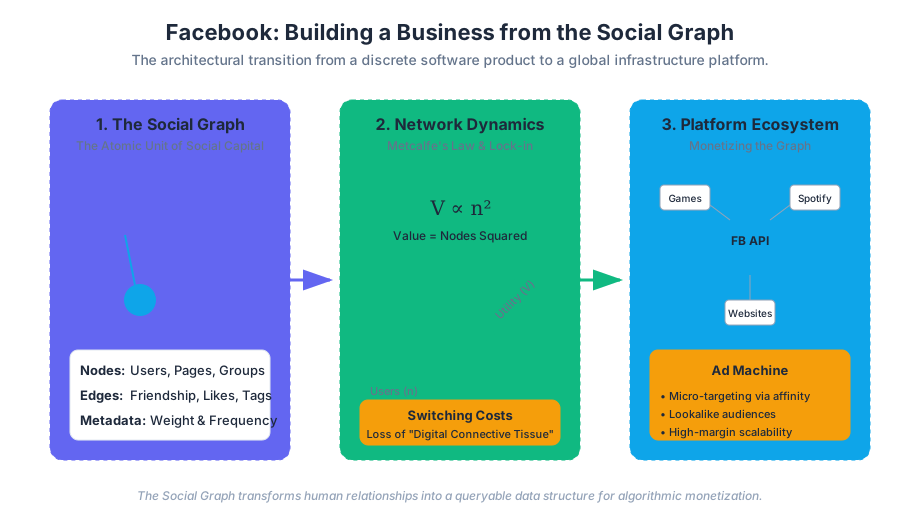
Facebook represents the definitive case study in the transition from a discrete software product to a global infrastructure platform. While early internet successes like Yahoo! were built on content curation and Google was built on the indexation of information, Facebook’s value proposition is rooted in the Social Graph: a digital map of every person and how they are related. By codifying human relationships into a queryable data structure, Facebook transformed the "atoms" of social interaction into the "bits" of a high-margin, scalable advertising machine.
This article explores the architectural underpinnings of the social graph, the strategic pivot to a platform model, the mechanics of social advertising, and the systemic ethical challenges inherent in monetizing private identity.
The Social Graph: The Atomic Unit of Social Capital
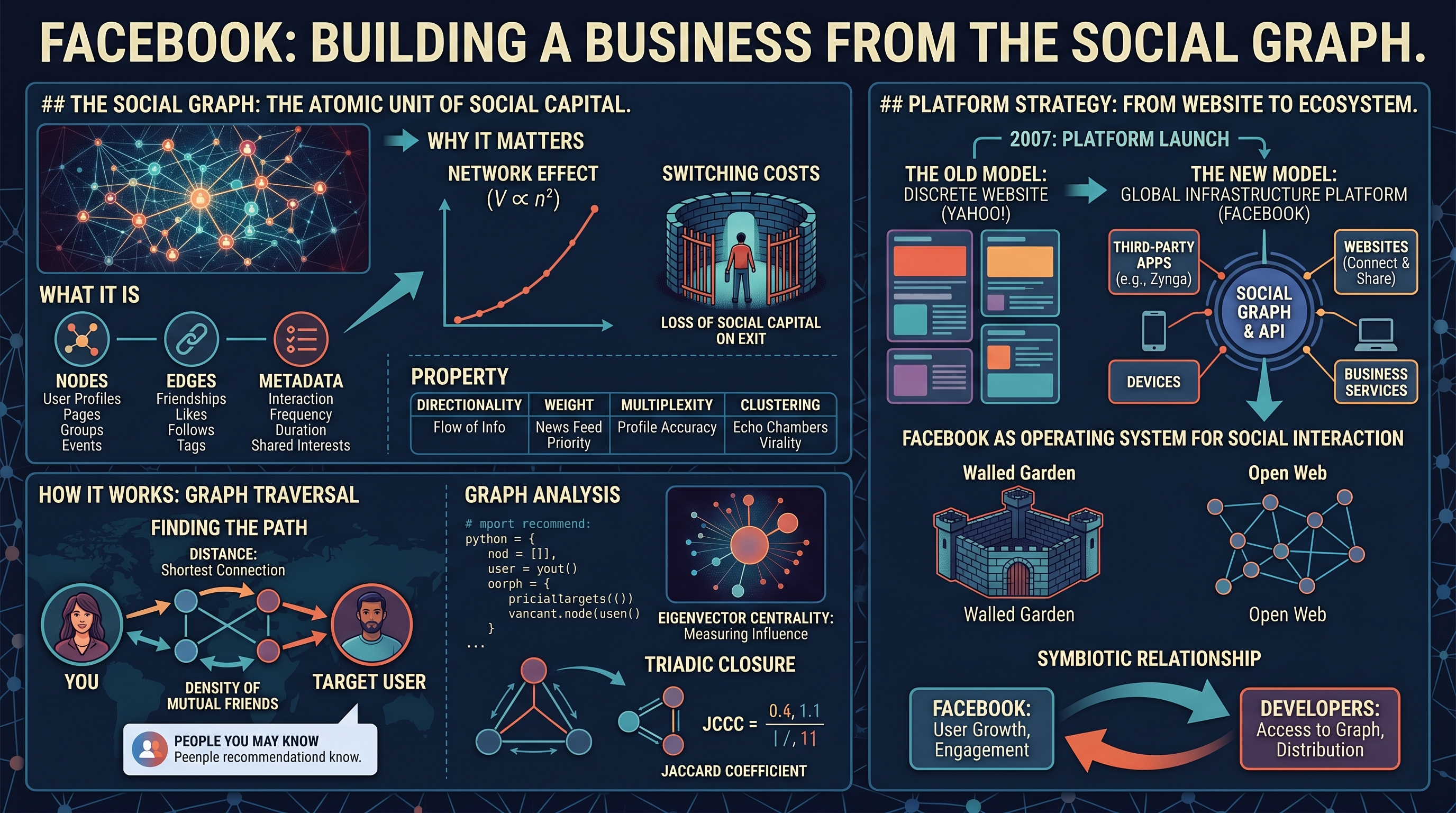
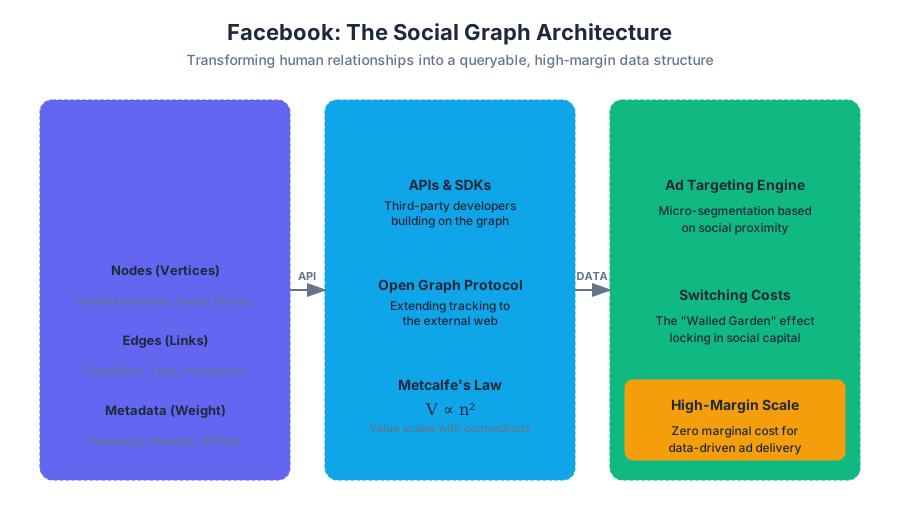
At its core, the Social Graph is a mathematical representation of the interconnectedness of a service's users. In graph theory terms, users are nodes (or vertices) and their relationships—friendships, likes, tags, or shared locations—are edges (or links). Unlike the "link graph" of the World Wide Web, which connects anonymous documents, the social graph connects verified identities.
What It Is
The social graph is not merely a list of friends; it is a multi-dimensional map of human intent, affinity, and influence. It encompasses:
- Nodes: Individual entities (Users, Pages, Groups, Events).
- Edges: The relationships between nodes (Friendship, Following, Member-of).
- Metadata: The attributes of those edges (How long they have been friends, frequency of interaction, common interests).
Why It Matters
The social graph creates a powerful Network Effect. According to Metcalfe’s Law, the value of a network is proportional to the square of the number of connected users ($V \propto n^2$). However, Facebook’s graph is even more potent because it creates Switching Costs. If a user leaves Facebook, they do not just lose a tool; they lose the "digital connective tissue" to their entire social circle. This creates a "walled garden" where the cost of exit is the loss of social capital.
| Property | Description | Business Impact |
|---|---|---|
| Directionality | Whether a relationship is mutual (Friend) or one-way (Follow). | Determines the flow of information and influence. |
| Weight | The strength of a connection based on interaction frequency. | Used by algorithms to prioritize the News Feed. |
| Multiplexity | The existence of multiple types of edges between the same two nodes. | Increases the accuracy of user profiling and ad targeting. |
| Clustering Coefficient | The degree to which nodes in a graph tend to cluster together. | Identifies "echo chambers" and viral potential. |
How It Works: Graph Traversal
To provide features like "People You May Know" or to rank the News Feed, Facebook must perform complex graph traversals. This involves calculating the distance between nodes and the density of mutual connections.
Platform Strategy: From Website to Ecosystem
In 2007, Facebook launched the Facebook Platform, a strategic move that allowed third-party developers to build applications that sat directly on top of the social graph. This shifted Facebook from being a destination to being an operating system for social interaction.
The "Walled Garden" vs. The Open Web
By providing APIs (Application Programming Interfaces), Facebook allowed developers to access user data (with permission). This created a symbiotic relationship: developers got access to a massive, authenticated user base, and Facebook got a library of features (games like FarmVille, utility apps, etc.) that it didn't have to build itself.
Key Insight: The Platform Pivot A platform is successful when the value of the things built on it exceeds the value of the platform itself. By opening the graph, Facebook ensured that every new app made the core Facebook account more indispensable.
The Open Graph Protocol
Later, Facebook introduced the Open Graph, which extended the social graph beyond the borders of Facebook.com. The "Like" button on external websites allowed Facebook to track user behavior across the entire web, effectively turning the whole internet into a data-collection sensor for the social graph.
\text{Network Value (V)} = n(n-1) \approx n^2
\\
\text{Where } n = \text{number of nodes (users)}
\\
\text{Social Graph Utility (U)} = \sum_{i=1}^{n} \sum_{j=1}^{n} w_{ij} \cdot a_{ij}
\\
\text{Where } w = \text{weight of interaction, } a = \text{affinity score}
Platform Evolution Table
| Era | Focus | Key Technology | Strategic Goal |
|---|---|---|---|
| Desktop Era (2004-2007) | User Growth | LAMP Stack, PHP | Critical Mass of Identity |
| Platform Era (2007-2010) | Ecosystem | F8, FBML (Facebook Markup Language) | Lock-in via 3rd Party Apps |
| Open Graph Era (2010-2014) | Ubiquity | "Like" Button, Social Plugins | Tracking the "Off-Facebook" Web |
| Mobile/AI Era (2014-Present) | Monetization | React Native, PyTorch, GraphQL | Maximizing Attention & Ad Yield |
Social Advertising: Monetizing Identity
Facebook's business model is almost entirely dependent on Social Advertising. Unlike Google, which captures Intent (what you are looking for right now), Facebook captures Identity (who you are, what you like, and who you know).
Precise Targeting and Lookalike Audiences
Because Facebook knows a user's age, location, interests, and relationship status, it can offer advertisers "surgical" targeting. The most powerful tool in this arsenal is the Lookalike Audience. An advertiser can upload a list of their current customers, and Facebook’s machine learning models will scan the social graph to find other users with similar "graph signatures."
The Ad Auction and News Feed Algorithm
Ads are not sold at a fixed price but through a real-time auction. The winner isn't just the highest bidder, but the one with the highest Total Value, a combination of:
- Bid Price: What the advertiser is willing to pay.
- Estimated Action Rates: How likely the user is to click or convert.
- Ad Quality/Relevance: How much the user will actually enjoy seeing the ad.
Comparison of Advertising Models
| Feature | Google Search (AdWords) | Facebook (Social Ads) |
|---|---|---|
| Primary Signal | Keyword (Explicit Intent) | Profile/Behavior (Implicit Interest) |
| User State | Hunting/Problem Solving | Browsing/Socializing |
| Targeting Basis | Search Query | Demographic, Interest, Connections |
| Ad Format | Text-heavy, Utility-focused | Visual, Native, "Social Proof" (e.g., "Friend X likes this") |
| Best For | Direct Response / Conversion | Brand Awareness / Discovery |
Privacy and Ethics: The Cost of the Graph
The very features that make Facebook a powerful business—data persistence, cross-site tracking, and deep profiling—create significant ethical and regulatory risks.
The Privacy Paradox
Users often state they value privacy, yet their behavior (sharing photos, location tagging, using "Login with Facebook") suggests they are willing to trade that privacy for convenience or social connection. This is known as the Privacy Paradox.
Cambridge Analytica and the "Data Leak"
The Cambridge Analytica scandal highlighted a fundamental flaw in the early Platform Strategy. By allowing apps to access not just a user’s data, but also the data of their friends, Facebook allowed a massive "scraping" of the social graph. This data was then used for psychographic profiling and political micro-targeting without explicit consent from the "friends" involved.
Regulatory Response: GDPR and CCPA
In response to these lapses, governments have introduced strict data protection laws:
- GDPR (General Data Protection Regulation): Requires "Privacy by Design" and gives EU citizens the right to data portability and the "right to be forgotten."
- CCPA (California Consumer Privacy Act): Gives users the right to opt-out of the sale of their personal information.
Theorem: The Transparency-Utility Trade-off As the transparency of data usage increases, the perceived utility of personalized services often decreases for the user (due to "creepiness"), while the operational complexity for the platform increases.
Common Pitfalls in Social Graph Strategy
- Over-reliance on Organic Reach: Businesses often build huge followings on Facebook, only to find that Facebook's algorithm eventually requires them to "pay to play" (boost posts) to reach their own followers.
- Data Siloing: Failing to integrate social graph data with internal CRM data, leading to fragmented customer views.
- Ignoring Negative Network Effects: As a network grows, it can become "noisy" or "toxic," leading high-value users to migrate to smaller, more curated "niche" graphs (e.g., Discord, Slack).
- Privacy Debt: Building features that rely on aggressive data collection without considering future regulatory changes. This "debt" comes due when laws like GDPR force massive, expensive re-architecting.
Summary of Key Concepts
- The Social Graph is the foundational data structure of Facebook, mapping nodes (users) and edges (relationships).
- Platform Strategy turned Facebook into an infrastructure, leveraging third-party developers to increase switching costs and network effects.
- Social Advertising uses identity and "Lookalike" modeling to provide higher targeting precision than traditional keyword-based ads.
- Privacy and Ethics remain the primary existential threat to the model, as the tension between data monetization and user autonomy continues to escalate.
By mastering the social graph, Facebook didn't just build a website; it built a digital ledger of human association, creating a business model that is as controversial as it is profitable.
Source Materials
- 8: Facebook- Building a Business from the Social Graph
- 11: The Data Asset- Databases, Business Intelligence, and Competitive Advantage
- 7: Peer Production, Social Media, and Web 2.0
- 14: Google- Search, Online Advertising, and Beyond
- 1: Setting the Stage- Technology and the Modern Enterprise
- 2: Strategy and Technology- Concepts and Frameworks for Understanding What Separates Winners from Losers
- 4: Netflix- The Making of an E-commerce Giant and the Uncertain Future of Atoms to Bits
- 5: Moore’s Law- Fast, Cheap Computing and What It Means for the Manager
Study Information Systems - A Manager's Guide to Harnessing Technology on Lykke
This course page is free to open: signed out, you can read its first two sections, and signing in, on any plan, opens the rest. The free Lykke Chrome extension syncs your own Canvas courses, so ChatGPT, Claude and Muse can answer from your classes and deadlines. It only reads Canvas.
Add the free extensionSign in to open every sectionAll sections of Information Systems - A Manager's Guide to Harnessing Technology · Browse more course pages