From the free course Information Systems - A Manager's Guide to Harnessing Technology on Lykke
The Data Asset: Databases and Business Intelligence
Key concepts: Data vs. Information vs. Knowledge · Business Intelligence (BI) · Data Warehouses and Data Marts · Customer Relationship Management (CRM)
How organizations transform raw data into actionable business intelligence to gain a competitive advantage.
The Data Asset: Databases and Business Intelligence
In the modern enterprise, the transition from "atoms to bits" has fundamentally reconfigured the basis of competitive advantage. As physical infrastructure becomes increasingly commoditized—driven by the relentless trajectory of Moore’s Law—the strategic focus has shifted from the ownership of hardware to the mastery of the data that flows through it. Data is no longer a mere byproduct of business operations; it is a primary asset, often carrying a valuation that exceeds the physical holdings of the firm.
This section explores the technical and managerial frameworks required to transform raw data into strategic intelligence. We will examine the hierarchy of knowledge, the architectural underpinnings of databases, the structural nuances of data warehouses, and the analytical engines that drive Business Intelligence (BI) and Customer Relationship Management (CRM).
The Hierarchy of Insight: Data, Information, and Knowledge
To manage the data asset effectively, one must first distinguish between its various states of evolution. These terms are often used interchangeably in casual conversation, but in Information Systems (IS), they represent distinct stages of value.
1. Data
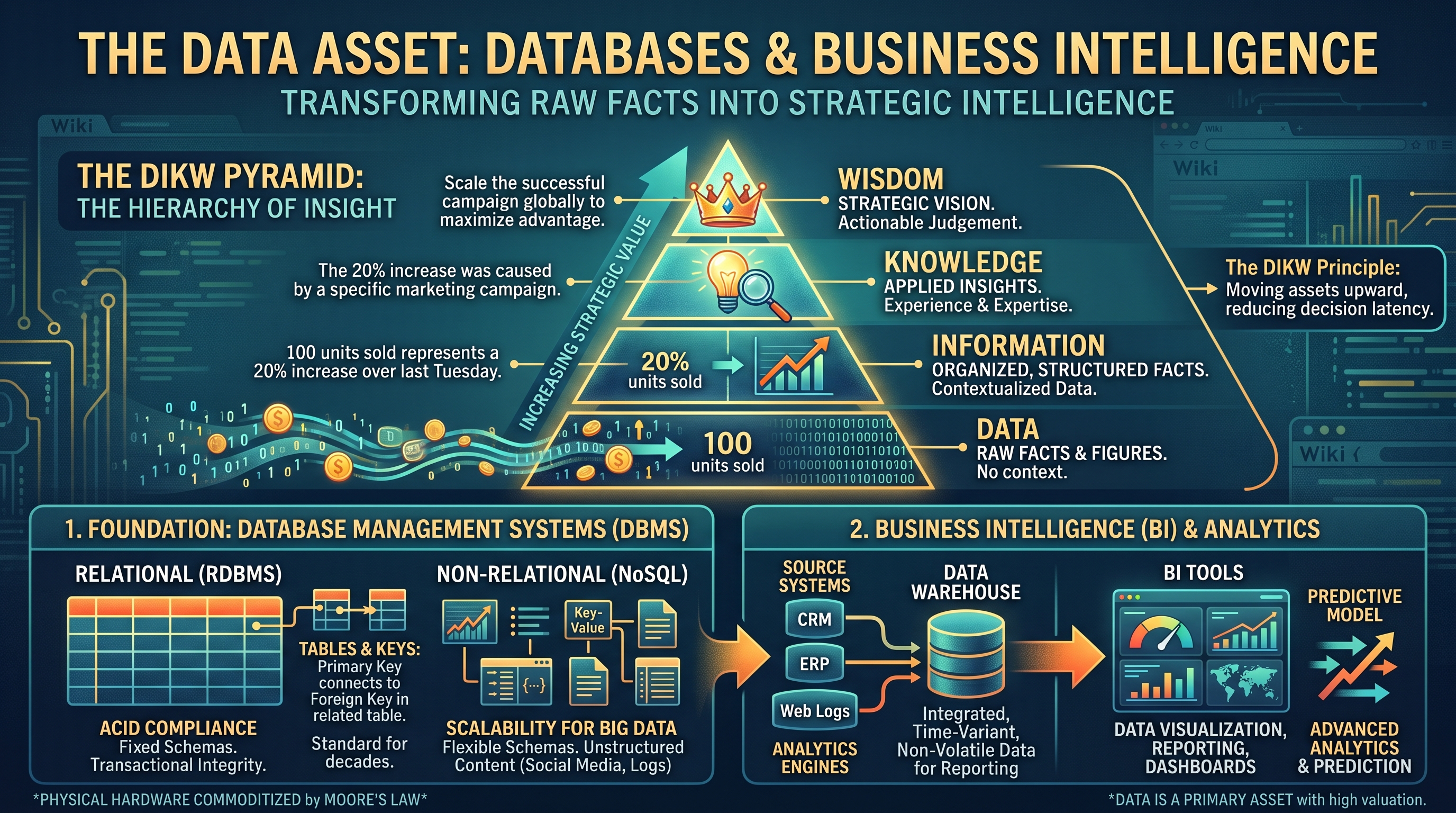
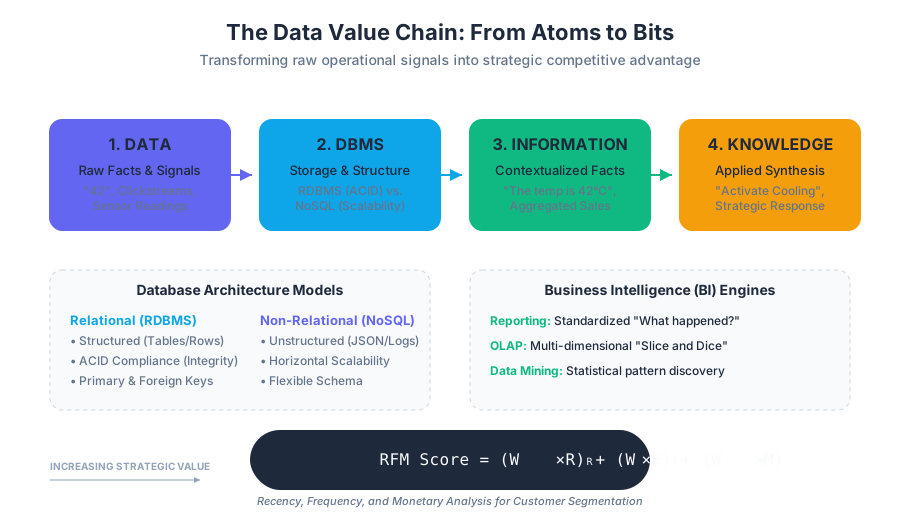
Data refers to raw facts and figures. In its primal state, data is devoid of context and utility. It represents a recorded signal—a transaction, a temperature reading, or a clickstream event. For a manager, data is the "ground truth" but provides no inherent direction.
2. Information
Information is data presented in a context that makes it useful for decision-making. By aggregating, calculating, or filtering data, we reveal patterns. If "100 units sold" is data, then "100 units sold represents a 20% increase over last Tuesday" is information.
3. Knowledge
Knowledge is the highest level of the hierarchy. It is the insight derived from experience, expertise, and the synthesis of information. Knowledge allows a firm to take action. It is the understanding that the 20% increase in sales was caused by a specific marketing campaign, leading to the decision to scale that campaign globally.
| Attribute | Data | Information | Knowledge |
|---|---|---|---|
| Nature | Raw, unorganized facts | Organized, structured facts | Applied, synthesized insights |
| Question | What? | Who, Where, When? | How, Why? |
| Value | Low (Potential) | Medium (Operational) | High (Strategic) |
| Example | "42" | "The temperature is 42°C" | "It is too hot for the server rack; activate cooling" |
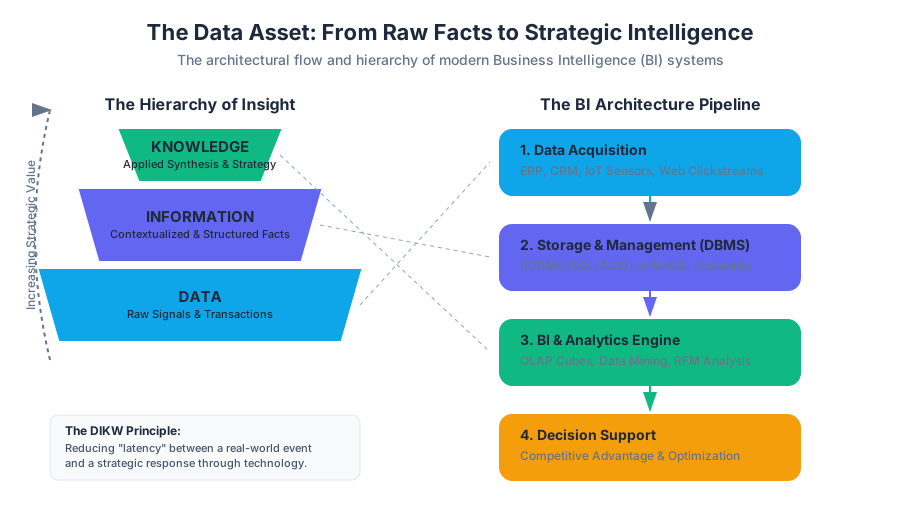
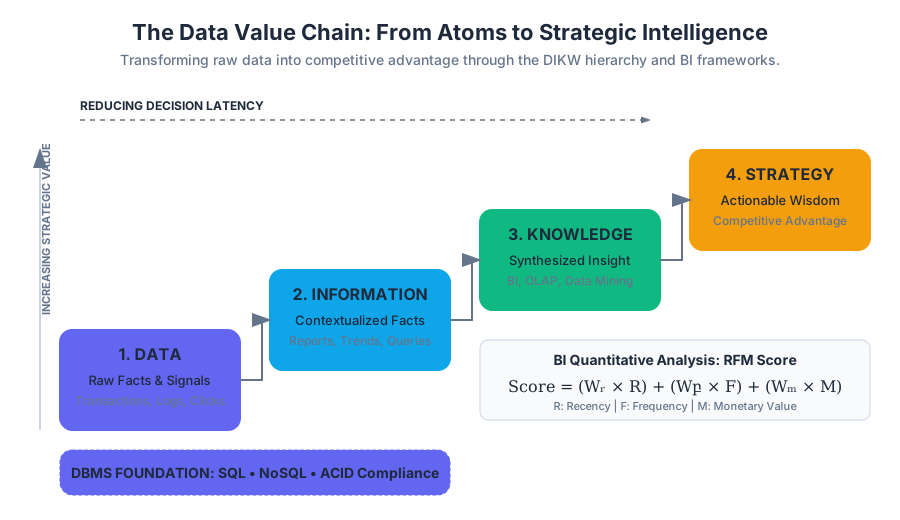
The DIKW Principle: The goal of Business Intelligence is to facilitate the upward migration of assets through the Data-Information-Knowledge-Wisdom hierarchy, reducing the "latency" between a real-world event and a strategic response.
The Foundation: Database Management Systems (DBMS)
At the heart of the data asset lies the Database, a structured collection of related data. However, the data itself is inert without a Database Management System (DBMS)—the software layer used to create, maintain, and manipulate the data.
Relational vs. Non-Relational Models
For decades, the Relational Database Management System (RDBMS) has been the enterprise standard. In an RDBMS, data is organized into tables (relations) with fixed schemas, linked by unique identifiers called Primary Keys and Foreign Keys. This structure ensures ACID compliance (Atomicity, Consistency, Isolation, Durability), which is critical for transactional integrity.
However, the rise of "Big Data" has popularized NoSQL (Not Only SQL) databases. These systems trade strict consistency for massive scalability and the ability to handle unstructured data (like social media posts or sensor logs).
Business Intelligence (BI) and Analytics
Business Intelligence (BI) is an umbrella term that includes the tools, infrastructure, and best practices that enable access to and analysis of information to improve and optimize decisions and performance.
The Mechanics of BI
BI systems typically operate on three levels:
- Reporting: Standardized views of "what happened."
- OLAP (Online Analytical Processing): A method of querying data that allows users to "slice and dice" information across multiple dimensions (e.g., viewing sales by region, then by product, then by time).
- Data Mining: Using statistical algorithms to discover hidden patterns and relationships in large datasets (e.g., market basket analysis).
Mathematical Foundation: RFM Analysis
A core technique in BI for customer segmentation is RFM Analysis (Recency, Frequency, Monetary). This provides a quantitative score for customer value.
\text{RFM Score} = (W_R \times R_{score}) + (W_F \times F_{score}) + (W_M \times M_{score})
Where:
- $R_{score}$: How recently a customer purchased (lower days = higher score).
- $F_{score}$: How often they purchase.
- $M_{score}$: How much they have spent in total.
- $W$: Weights assigned by the business based on industry importance.
| System Type | Primary Goal | Data Characteristics | User Base |
|---|---|---|---|
| OLTP (Transactional) | Record daily business events | High-volume, small transactions, normalized | Front-line staff, automated systems |
| OLAP (Analytical) | Support decision making | Aggregated, historical, denormalized | Managers, Data Scientists, Analysts |
Data Warehousing and Data Marts
As organizations grow, their data becomes fragmented across various functional "silos" (e.g., Marketing has one database, HR has another). To gain a holistic view, firms use Data Warehouses.
1. Data Warehouse
A Data Warehouse is a large, centralized repository that aggregates data from multiple sources across the entire organization. It is designed specifically for query and analysis rather than transaction processing.
2. Data Mart
A Data Mart is a subset of a data warehouse, usually oriented to a specific business line or team (e.g., a "Marketing Data Mart"). This allows for faster access and more relevant data structures for specific user groups.
The ETL Pipeline
The process of moving data into a warehouse is known as ETL (Extract, Transform, Load):
- Extract: Pulling data from source systems (CRMs, ERPs, flat files).
- Transform: Cleaning the data, resolving inconsistencies (e.g., "USA" vs "United States"), and applying business logic.
- Load: Writing the data into the warehouse schema.
Modern Infrastructure: Orchestrating the Pipeline
In modern "DataOps," these pipelines are managed as code.
Customer Relationship Management (CRM)
CRM systems are a specialized category of information systems designed to manage a firm's interactions with current and potential customers. While often viewed as a "sales tool," a true CRM is a strategic data asset that integrates touchpoints across sales, marketing, and customer support.
Why CRM Matters
The cost of acquiring a new customer is significantly higher than the cost of retaining an existing one. CRM systems enable Personalization at Scale. By tracking every interaction—from an email open to a support ticket—the firm can build a 360-degree view of the customer.
Concrete Example: Netflix and Zara
- Zara: Uses mobile devices in-store to feed customer feedback directly into their CRM and design systems. If customers ask for a specific hemline, that "data" becomes "information" for designers, who create "knowledge" about the next trend.
- Netflix: Their recommendation engine is essentially a massive, automated CRM/BI hybrid. By analyzing viewing habits (data), they predict what you want to watch next (information), and decide which original series to fund (knowledge).
Common Pitfalls in CRM Implementation
- Data Silos: If the CRM doesn't talk to the accounting system, sales reps might try to upsell a customer who hasn't paid their last three bills.
- Low Data Quality: "Garbage In, Garbage Out" (GIGO). If sales staff don't enter data accurately, the BI reports generated from the CRM are worthless.
- Focusing on Technology over Process: A CRM is a strategy, not just a software package. Buying Salesforce won't fix a broken sales culture.
The Rise of Big Data and Machine Learning
The "Data Asset" is currently undergoing a shift characterized by the 3 Vs:
- Volume: The sheer amount of data (Petabytes and Exabytes).
- Velocity: The speed at which data is generated and must be processed (Real-time streaming).
- Variety: The different forms of data (Social media, video, IoT sensors).
To handle this, firms are moving toward Data Lakes—repositories that store raw data in its native format until it is needed—and utilizing Machine Learning (ML) to automate the "Knowledge" layer of the DIKW pyramid.
Summary of Strategic Implications
For a manager, the data asset represents the difference between "guessing" and "knowing." However, the transition from a traditional firm to a data-driven one requires more than just hardware. It requires a cultural shift toward evidence-based decision-making and a rigorous understanding of the underlying technical architectures.
| Concept | Strategic Value | Key Risk |
|---|---|---|
| Database | Operational efficiency and ACID integrity | Single point of failure; scaling bottlenecks |
| Data Warehouse | Holistic "Single Version of the Truth" | High implementation cost; data staleness |
| Business Intelligence | Improved decision speed and accuracy | Misinterpretation of correlations as causation |
| CRM | Increased Customer Lifetime Value (CLV) | Privacy concerns and regulatory (GDPR) risk |
Source Materials
- 11: The Data Asset- Databases, Business Intelligence, and Competitive Advantage
- 1: Setting the Stage- Technology and the Modern Enterprise
- 13: Information Security- Barbarians at the Gateway (and Just About Everywhere Else)
- 8: Facebook- Building a Business from the Social Graph
- 12: A Manager’s Guide to the Internet and Telecommunications
- Front Matter
- 3: Zara- Fast Fashion from Savvy Systems
- 4: Netflix- The Making of an E-commerce Giant and the Uncertain Future of Atoms to Bits
Study Information Systems - A Manager's Guide to Harnessing Technology on Lykke
This course page is free to open: signed out, you can read its first two sections, and signing in, on any plan, opens the rest. The free Lykke Chrome extension syncs your own Canvas courses, so ChatGPT, Claude and Muse can answer from your classes and deadlines. It only reads Canvas.
Add the free extensionSign in to open every sectionAll sections of Information Systems - A Manager's Guide to Harnessing Technology · Browse more course pages