From the free course High School Chemistry on Lykke
Thermodynamics and Energy
Key concepts: Enthalpy · Endothermic vs. Exothermic · Specific Heat · Hess's Law
The study of heat, work, and energy changes in chemical systems.
Thermodynamics and Energy
In the study of chemical systems, energy is the fundamental currency. Thermodynamics is the rigorous framework we use to track the exchange, transformation, and conservation of this currency. While the first law of thermodynamics dictates that energy cannot be created or destroyed, it says nothing about the form that energy takes or the ease with which it moves. To understand chemical reactions, we must look beyond simple energy conservation and into the specific behavior of heat, work, and the internal state of matter.
Enthalpy: The Heat of the System
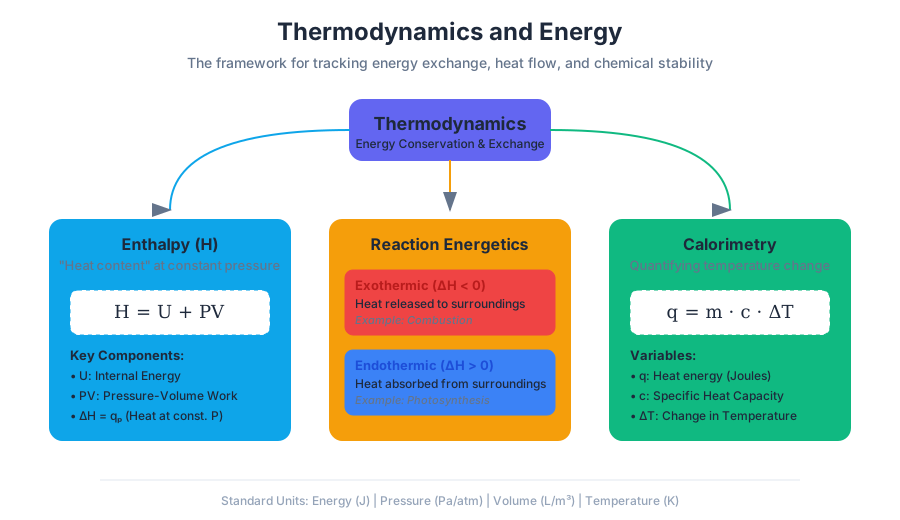
At the heart of chemical thermodynamics is Enthalpy ($H$). While internal energy ($U$) represents the sum of all microscopic kinetic and potential energies within a system, enthalpy is a specialized "bookkeeping" function designed for processes occurring at constant pressure—the standard condition for most laboratory and biological chemistry.
What it is
Enthalpy is defined mathematically as the sum of the system's internal energy and the product of its pressure and volume:
Definition: Enthalpy $$H = U + PV$$ Where $H$ is enthalpy, $U$ is internal energy, $P$ is pressure, and $V$ is volume.
In chemistry, we are rarely interested in the absolute value of $H$. Instead, we measure the Change in Enthalpy ($\Delta H$). For a process occurring at constant pressure, the change in enthalpy is exactly equal to the heat ($q$) added to or lost from the system: $$\Delta H = q_p$$
Why it matters
Enthalpy allows us to ignore the "expansion work" a system does against the atmosphere. When a reaction produces gas, it must push back the surrounding air to make room for itself. This requires energy. By using enthalpy, we bake that work into the state function, allowing us to focus solely on the heat flow.
Thermodynamic Variables Summary
| Variable | Symbol | Description | SI Unit |
|---|---|---|---|
| Internal Energy | $U$ | Total microscopic energy (kinetic + potential) | Joules (J) |
| Enthalpy | $H$ | Heat content at constant pressure ($U + PV$) | Joules (J) |
| Pressure | $P$ | Force exerted per unit area | Pascal (Pa) or atm |
| Volume | $V$ | Space occupied by the system | Cubic meters ($m^3$) or L |
| Temperature | $T$ | Average kinetic energy of particles | Kelvin (K) |
Exothermic vs. Endothermic Processes
Chemical reactions involve the breaking and forming of bonds. Since bond breaking requires energy and bond forming releases it, every reaction results in a net energy change. We classify these changes based on the direction of heat flow between the system (the reactants and products) and the surroundings (everything else).
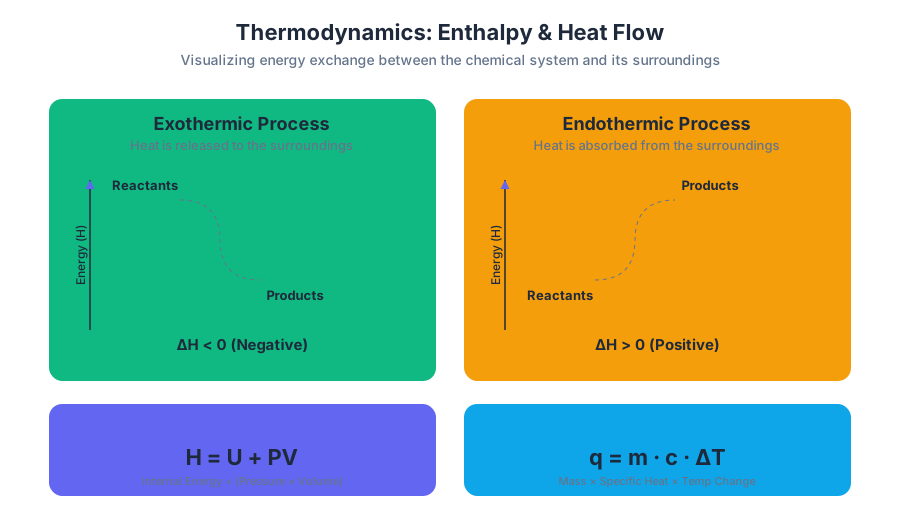
Exothermic Reactions ($\Delta H < 0$)
In an exothermic reaction, the energy released during the formation of new bonds in the products is greater than the energy required to break the bonds in the reactants. The "excess" energy is released as heat.
- Sign Convention: $\Delta H$ is negative.
- Observation: The surroundings feel hotter.
- Example: Combustion of methane ($CH_4 + 2O_2 \rightarrow CO_2 + 2H_2O$).
Endothermic Reactions ($\Delta H > 0$)
In an endothermic reaction, the system must absorb energy from the surroundings to break the reactant bonds, as the energy released by product formation is insufficient.
- Sign Convention: $\Delta H$ is positive.
- Observation: The surroundings feel colder.
- Example: Photosynthesis or the decomposition of calcium carbonate.
Comparison of Reaction Energetics
| Feature | Exothermic | Endothermic |
|---|---|---|
| Heat Flow | System $\rightarrow$ Surroundings | Surroundings $\rightarrow$ System |
| $\Delta H$ Sign | Negative ($-$) | Positive ($+$) |
| Relative Stability | Products are more stable (lower energy) | Reactants are more stable (lower energy) |
| Bond Energies | Product bonds > Reactant bonds | Reactant bonds > Product bonds |
| Common Examples | Combustion, Neutralization, Freezing | Melting, Evaporation, Thermal decomposition |
Specific Heat Capacity and Calorimetry
How much will a substance's temperature change when it absorbs heat? This is governed by the Specific Heat Capacity ($c$), an intrinsic property of matter that describes its thermal "inertia."
The Heat Equation
The relationship between heat ($q$), mass ($m$), specific heat ($c$), and temperature change ($\Delta T$) is given by: $$q = m \cdot c \cdot \Delta T$$
Theorem: Specific Heat Capacity The amount of heat required to raise the temperature of one gram of a substance by one degree Celsius (or one Kelvin).
Molar vs. Specific Heat
While engineers often use specific heat (per gram), chemists frequently use Molar Heat Capacity ($C_m$), which is the heat required to raise one mole of a substance by one degree. $$C_m = c \cdot \text{Molar Mass}$$
Specific Heat Values of Common Substances
| Substance | State | Specific Heat ($J/g \cdot ^\circ C$) |
|---|---|---|
| Water | Liquid | 4.184 |
| Ice | Solid | 2.03 |
| Aluminum | Solid | 0.897 |
| Iron | Solid | 0.449 |
| Gold | Solid | 0.129 |
| Ethanol | Liquid | 2.44 |
Hess's Law: The Additivity of Enthalpy
One of the most powerful tools in thermodynamics is Hess's Law of Constant Heat Summation. It is a direct consequence of the fact that enthalpy is a state function.
What it is
Hess's Law states that the total enthalpy change for a chemical reaction is the same regardless of whether the reaction occurs in one step or several steps.
Hess's Law $$\Delta H_{total} = \sum \Delta H_{steps}$$
Why it matters
Many reactions are difficult to measure directly in a calorimeter—they might be too slow, too dangerous, or produce unwanted side products. Hess's Law allows us to calculate the $\Delta H$ of these "target" reactions by combining the $\Delta H$ values of other, well-documented reactions.
Rules for Manipulating Equations
- Reversing a reaction: If you reverse the direction of a chemical equation, the sign of $\Delta H$ must be flipped.
- Scaling a reaction: If you multiply the coefficients of a reaction by a factor $n$, you must also multiply $\Delta H$ by $n$.
- Summation: When adding equations, species that appear on both the reactant and product sides cancel out.
Mathematical Derivation of Enthalpy Change
The change in enthalpy for any reaction can be calculated using the Standard Enthalpies of Formation ($\Delta H_f^\circ$) of the products and reactants.
\Delta H^\circ_{rxn} = \sum n \Delta H_f^\circ(\text{products}) - \sum m \Delta H_f^\circ(\text{reactants})
Where:
- $n, m$ are the stoichiometric coefficients.
- $\Delta H_f^\circ$ is the enthalpy change to form 1 mole of a compound from its elements in their standard states.
- By definition, $\Delta H_f^\circ$ for any element in its standard state (e.g., $O_2(g)$, $Fe(s)$) is zero.
Worked Example: Hess's Law in Action
Target Reaction: Calculate the enthalpy of combustion for Carbon Monoxide:
CO(g) + \frac{1}{2}O_2(g) \rightarrow CO_2(g) \quad \Delta H = ?
Given Data:
- $C(s) + O_2(g) \rightarrow CO_2(g) \quad \Delta H_1 = -393.5 \text{ kJ}$
- $C(s) + \frac{1}{2}O_2(g) \rightarrow CO(g) \quad \Delta H_2 = -110.5 \text{ kJ}$
Solution: To get the target equation, we need $CO(g)$ on the reactant side. We reverse Equation (2):
- $CO(g) \rightarrow C(s) + \frac{1}{2}O_2(g) \quad \Delta H = +110.5 \text{ kJ}$
Now, we add this to Equation (1):
- $CO(g) \rightarrow C(s) + \frac{1}{2}O_2(g) \quad \Delta H = +110.5 \text{ kJ}$
- $C(s) + O_2(g) \rightarrow CO_2(g) \quad \Delta H = -393.5 \text{ kJ}$
The $C(s)$ cancels out, and $\frac{1}{2}O_2$ cancels from the reactant side of (1), leaving:
- $CO(g) + \frac{1}{2}O_2(g) \rightarrow CO_2(g)$
- $\Delta H_{total} = 110.5 + (-393.5) = \mathbf{-283.0 \text{ kJ}}$
Real-World Application: Industrial Synthesis
In industrial chemical engineering, thermodynamics dictates the feasibility and cooling requirements of large-scale reactors. For instance, the Haber-Bosch process for synthesizing ammonia is highly exothermic.
Common Pitfalls and Misconceptions
- Temperature vs. Heat: Temperature is an intensive property (doesn't depend on amount), while heat is an extensive property (depends on mass). A cup of boiling water and a bathtub of boiling water are at the same temperature, but the bathtub contains significantly more heat.
- The "Cold" Fallacy: In thermodynamics, "cold" does not exist as a physical entity. There is only the absence of heat or the transfer of heat away from a system.
- State Functions: Students often forget that $\Delta H$ only cares about the start and end points. If you travel from the first floor to the third floor, your change in potential energy is the same whether you took the stairs or the elevator. Enthalpy works exactly the same way.
- Sign Errors: This is the most common mistake in Hess's Law. Remember: Breaking bonds is always endothermic (positive), and forming bonds is always exothermic (negative).
Source Materials
Study High School Chemistry on Lykke
This course page is free to open: signed out, you can read its first two sections, and signing in, on any plan, opens the rest. The free Lykke Chrome extension syncs your own Canvas courses, so ChatGPT, Claude and Muse can answer from your classes and deadlines. It only reads Canvas.
Add the free extensionSign in to open every sectionAll sections of High School Chemistry · Browse more course pages