From the free course High School Chemistry on Lykke
Stoichiometry and the Mole
Key concepts: The Mole · Avogadro's Number · Molar Mass · Stoichiometric calculations
Quantitative chemistry focusing on the mole concept and calculating relationships in chemical reactions.
Stoichiometry and the Mole
Stoichiometry is the quantitative engine of chemistry. Derived from the Greek words stoicheion (element) and metron (measure), it represents the mathematical framework used to relate the quantities of reactants and products in chemical reactions. At its core, stoichiometry is a system of chemical accounting that ensures the Law of Conservation of Mass is satisfied across every transformation of matter.
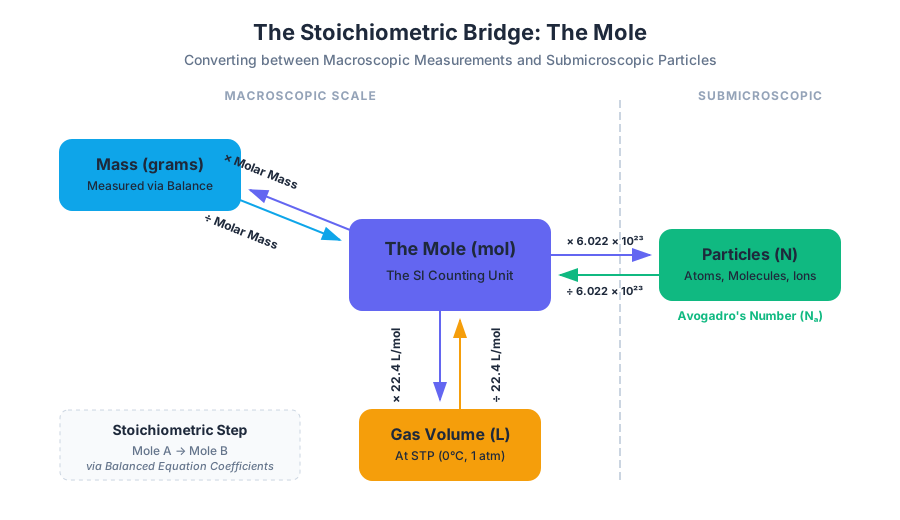
To master stoichiometry, one must navigate the transition between the submicroscopic scale—where individual atoms and molecules interact—and the macroscopic scale, where we measure substances in grams and liters. The bridge between these two worlds is the Mole.
The Mole: The Macroscopic Bridge
The fundamental challenge in chemistry is that atoms are too small to count individually. A single drop of water contains approximately $1.67 \times 10^{21}$ molecules. To handle such vast numbers, chemists use a counting unit called the Mole (abbreviated as mol).
Definition: The Mole A mole is defined as the amount of substance that contains exactly $6.02214076 \times 10^{23}$ elementary entities (atoms, molecules, ions, or electrons). This fixed numerical value is known as Avogadro’s Number ($N_A$).
Avogadro’s Number ($N_A$)
The value of $N_A$ was historically linked to the number of atoms in 12 grams of pure Carbon-12. However, as of the 2019 redefinition of the SI base units, the mole is defined by fixing the numerical value of the Avogadro constant.
| Concept | Value / Unit | Description |
|---|---|---|
| Avogadro's Number ($N_A$) | $6.022 \times 10^{23} \text{ mol}^{-1}$ | The number of particles in one mole. |
| Molar Volume (STP) | $22.414 \text{ L/mol}$ | Volume of 1 mole of ideal gas at 0°C and 1 atm. |
| Atomic Mass Unit (amu) | $1.6605 \times 10^{-24} \text{ g}$ | $1/12$ the mass of a single Carbon-12 atom. |
| The Mole (mol) | SI Base Unit | Represents a specific quantity of matter. |
Why the Mole Matters
Without the mole, chemical equations would remain qualitative "recipes" rather than quantitative instructions. The mole allows us to:
- Count by weighing: By knowing the mass of a sample, we can calculate the exact number of atoms present.
- Maintain proportionality: Chemical reactions occur in discrete ratios (e.g., 2 H₂ + 1 O₂ → 2 H₂O). The mole allows us to scale these ratios up to measurable laboratory quantities.
Molar Mass and Isotopic Abundance
While the mole tells us how many particles we have, Molar Mass ($M$) tells us the mass of those particles. Molar mass is expressed in grams per mole (g/mol).
Calculating Average Atomic Mass
The mass listed for an element on the periodic table is not the mass of a single atom, but a weighted average of all naturally occurring isotopes.
$$A_{avg} = \sum (f_i \times m_i)$$
Where $f_i$ is the fractional abundance of isotope $i$, and $m_i$ is the mass of that isotope.
From Formula to Molar Mass
To find the molar mass of a compound, we sum the atomic masses of all constituent atoms.
Example: Molar Mass of Calcium Nitrate $Ca(NO_3)_2$
- $Ca$: $1 \times 40.08 \text{ g/mol} = 40.08$
- $N$: $2 \times 14.01 \text{ g/mol} = 28.02$
- $O$: $6 \times 16.00 \text{ g/mol} = 96.00$
- Total: $164.10 \text{ g/mol}$
The Stoichiometric Pipeline: Mole-to-Mole Ratios
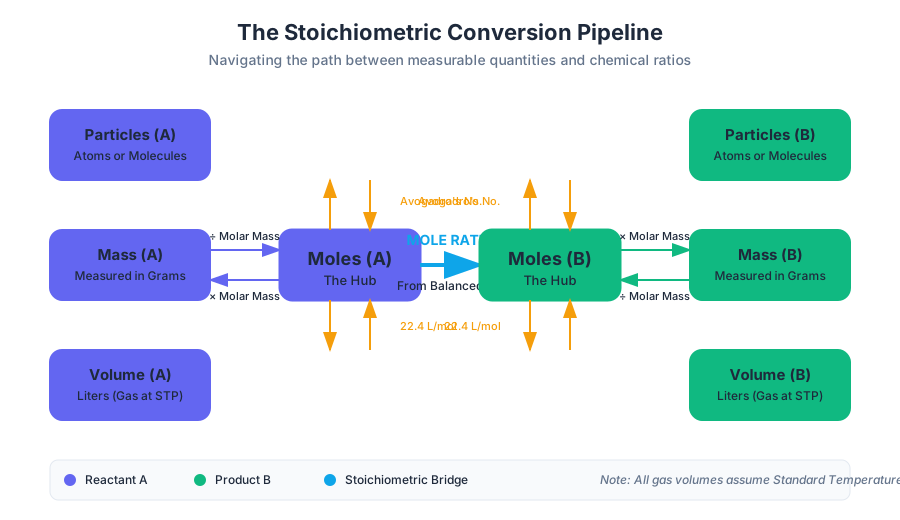
The heart of stoichiometry is the balanced chemical equation. The coefficients in a balanced equation represent the molar ratios between reactants and products.
The Law of Conservation of Mass
In a closed system, mass is neither created nor destroyed. Therefore, the number of atoms of each element must be identical on both the reactant and product sides of the equation.
The Mathematical Derivation of the Conversion Factor
To convert from a known quantity of substance A to an unknown quantity of substance B, we utilize the stoichiometric ratio derived from the balanced equation.
\text{Quantity B} = \text{Mass A (g)} \times \frac{1 \text{ mol A}}{\text{Molar Mass A (g)}} \times \frac{\text{moles B (coeff)}}{\text{moles A (coeff)}} \times \frac{\text{Molar Mass B (g)}}{1 \text{ mol B}}
This "dimensional analysis" ensures that all units cancel out except for the desired unit of the target substance.
| Step | Operation | Unit Transformation |
|---|---|---|
| 1 | Divide by Molar Mass of A | Grams A $\rightarrow$ Moles A |
| 2 | Multiply by Mole Ratio (B/A) | Moles A $\rightarrow$ Moles B |
| 3 | Multiply by Molar Mass of B | Moles B $\rightarrow$ Grams B |
| 4 | (Optional) Density/Molarity | Grams $\rightarrow$ Volume |
Limiting Reactants and Percent Yield
In real-world applications, reactants are rarely present in exact stoichiometric proportions. One reactant will inevitably be exhausted first, halting the reaction. This is the Limiting Reactant.
Identifying the Limiting Reactant
To identify the limiting reactant, calculate the amount of product that could be formed from each reactant independently. The reactant that produces the least amount of product is the limiting reactant.
Percent Yield
The Theoretical Yield is the maximum amount of product calculated via stoichiometry. The Actual Yield is the amount physically collected in the lab.
$$\text{Percent Yield} = \left( \frac{\text{Actual Yield}}{\text{Theoretical Yield}} \right) \times 100%$$
Insight: Why isn't yield 100%? Low yields often result from side reactions, incomplete reactions, loss of product during filtration/transfer, or the existence of chemical equilibrium.
Advanced Stoichiometry: Solutions and Gases
Stoichiometry extends beyond solids into the realms of liquids (solutions) and gases.
Solution Stoichiometry (Molarity)
Concentration is typically expressed as Molarity ($M$), which is moles of solute per liter of solution.
$$M = \frac{n \text{ (mol)}}{V \text{ (L)}}$$
When performing stoichiometry with solutions, the volume and molarity are used to find the number of moles: $n = M \times V$.
Gas Stoichiometry
For reactions involving gases, the Ideal Gas Law ($PV = nRT$) allows for the conversion between gas volume and moles. At Standard Temperature and Pressure (STP: 0°C, 1 atm), 1 mole of any ideal gas occupies 22.4 liters.
| Parameter | Symbol | Units |
|---|---|---|
| Pressure | $P$ | atm, kPa, mmHg |
| Volume | $V$ | Liters (L) |
| Moles | $n$ | mol |
| Gas Constant | $R$ | $0.0821 \text{ L}\cdot\text{atm/mol}\cdot\text{K}$ |
| Temperature | $T$ | Kelvin (K) |
Common Pitfalls in Stoichiometric Calculations
Even experienced chemists can make errors in complex stoichiometric pipelines. Understanding these common failure points is essential for accuracy.
| Pitfall | Description | Correction |
|---|---|---|
| Using Mass Ratios | Attempting to use the mass of reactants directly in the ratio (e.g., 2g H₂ reacts with 1g O₂). | Always convert mass to moles before using the stoichiometric ratio. |
| Unbalanced Equations | Forgetting to balance the equation before starting calculations. | Check that the number of atoms on both sides is equal. |
| Incorrect Molar Mass | Forgetting to account for subscripts (e.g., using 16.00 for $O_2$ instead of 32.00). | Double-check the molecular formula and atomic weights. |
| Sig Fig Errors | Losing precision by rounding too early in a multi-step calculation. | Keep all digits in the calculator until the final step. |
| STP Assumptions | Assuming $22.4 \text{ L/mol}$ when the reaction is not at 0°C or 1 atm. | Use $PV=nRT$ for non-standard conditions. |
Worked Example: The Combustion of Octane
Consider the combustion of octane ($C_8H_{18}$) in an engine:
2 C_8H_{18} + 25 O_2 \rightarrow 16 CO_2 + 18 H_2O
If we burn 100g of octane, how many grams of $CO_2$ are produced?
- Molar Mass of Octane: $(8 \times 12.01) + (18 \times 1.008) = 114.23 \text{ g/mol}$
- Moles of Octane: $100 \text{ g} / 114.23 \text{ g/mol} = 0.8754 \text{ mol}$
- Mole Ratio: $16 \text{ mol } CO_2 / 2 \text{ mol } C_8H_{18} = 8$
- Moles of $CO_2$: $0.8754 \text{ mol} \times 8 = 7.0032 \text{ mol}$
- Molar Mass of $CO_2$: $12.01 + (2 \times 16.00) = 44.01 \text{ g/mol}$
- Mass of $CO_2$: $7.0032 \text{ mol} \times 44.01 \text{ g/mol} = 308.21 \text{ g}$
This calculation shows that burning 100g of fuel results in over 300g of $CO_2$ gas, a non-intuitive result that highlights the importance of accounting for the oxygen consumed from the atmosphere.
Source Materials
Study High School Chemistry on Lykke
This course page is free to open: signed out, you can read its first two sections, and signing in, on any plan, opens the rest. The free Lykke Chrome extension syncs your own Canvas courses, so ChatGPT, Claude and Muse can answer from your classes and deadlines. It only reads Canvas.
Add the free extensionSign in to open every sectionAll sections of High School Chemistry · Browse more course pages