From the free course High School Chemistry on Lykke
States of Matter and Intermolecular Forces
Key concepts: Kinetic Molecular Theory · Intermolecular Forces (IMF) · Phase Changes · Hydrogen Bonding
Analysis of solids, liquids, and gases, and the forces that act between molecules.
States of Matter and Intermolecular Forces
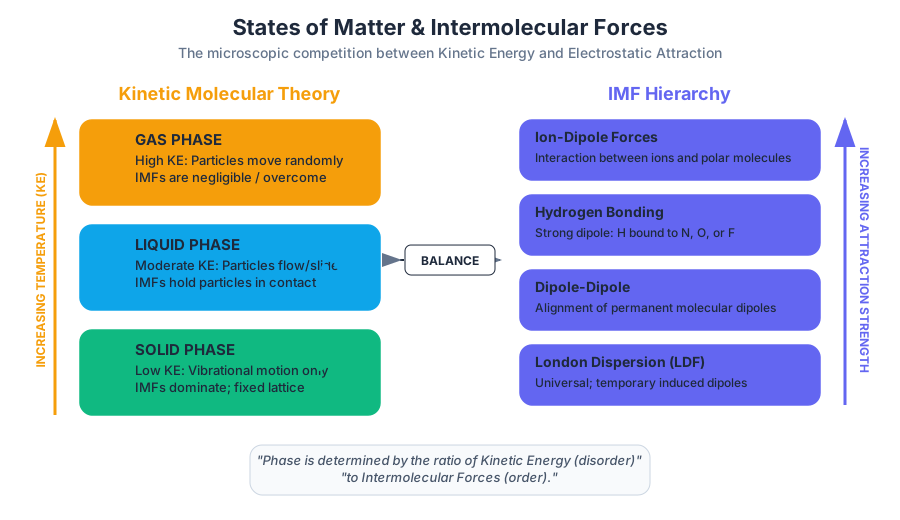
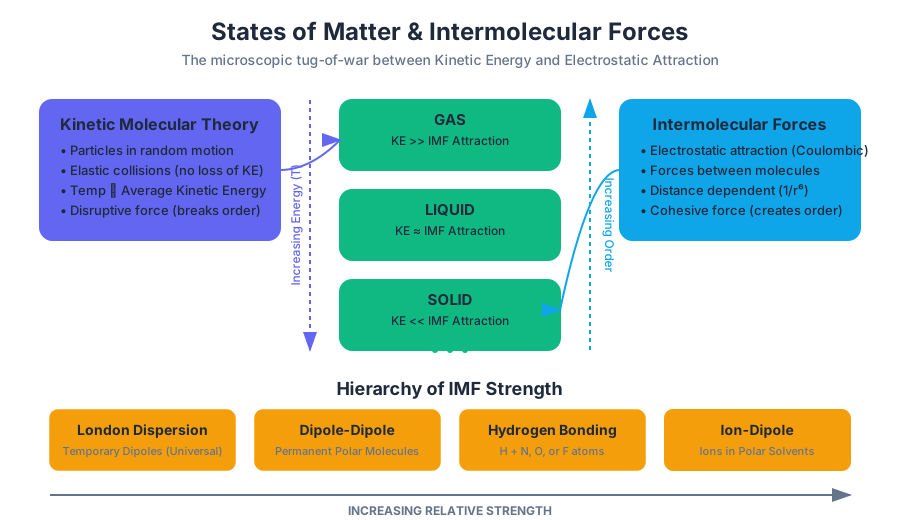
The macroscopic world we perceive—the rigidity of a diamond, the fluidity of a river, the invisibility of the air—is a direct consequence of a silent tug-of-war occurring at the nanometer scale. While chemical bonding (intramolecular forces) dictates the identity of a molecule, Intermolecular Forces (IMF) dictate its behavior in bulk. This section explores the Kinetic Molecular Theory (KMT) as the framework for understanding particle motion and the specific electrostatic interactions that determine the phase and physical properties of matter.
Kinetic Molecular Theory (KMT)
What it is
The Kinetic Molecular Theory (KMT) is a conceptual model used to explain the behavior of matter, particularly gases, by treating individual particles as point masses in constant, random motion. While originally developed for "Ideal Gases," its principles extend to liquids and solids by accounting for the decreasing mean free path between particles.
Why it matters
KMT provides the theoretical bridge between microscopic particle behavior (velocity, collisions) and macroscopic observables (temperature, pressure, volume). It allows us to derive the Ideal Gas Law ($PV = nRT$) and understand why substances change phase when energy is added or removed.
How it works: The Five Postulates
- Negligible Volume: The particles are so small compared to the distances between them that their individual volume is assumed to be zero.
- Random Motion: Particles move in straight lines in all directions until they collide.
- No Intermolecular Forces: In an ideal gas, particles do not attract or repel each other. (Note: This is the primary point where real matter diverges from KMT).
- Elastic Collisions: Kinetic energy is transferred between particles during collisions, but the total kinetic energy of the system remains constant.
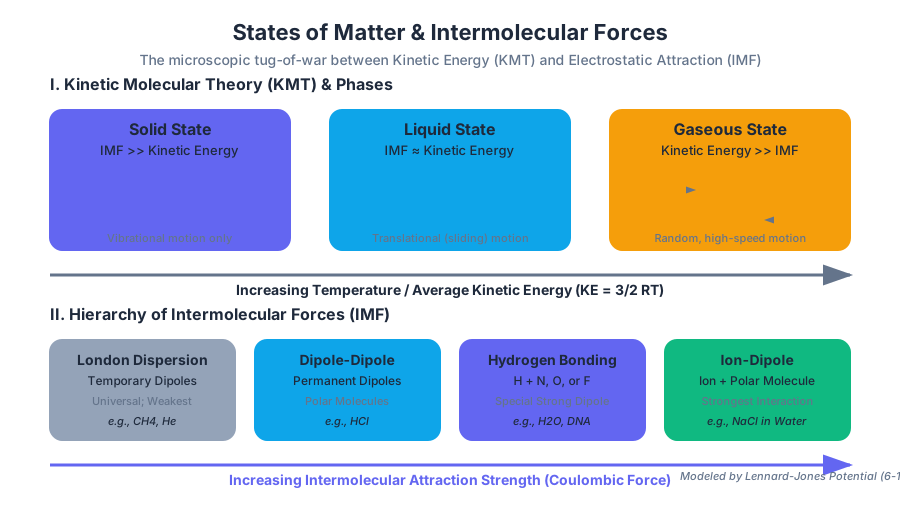
- Temperature as Kinetic Energy: The average kinetic energy ($KE_{avg}$) of a gas is directly proportional to its absolute temperature (Kelvin).
The Fundamental Equation of KMT: $$KE_{avg} = \frac{3}{2}RT = \frac{1}{2}mv_{rms}^2$$ Where $R$ is the gas constant, $T$ is temperature, $m$ is mass, and $v_{rms}$ is the root-mean-square velocity.
Common Pitfalls
A common misconception is that all particles in a sample move at the same speed. In reality, they follow the Maxwell-Boltzmann Distribution, a probability distribution where temperature shifts the peak (most probable speed) and spreads the curve.
Intermolecular Forces (IMF)
What it is
Intermolecular Forces are the attractive forces that exist between molecules. They are significantly weaker than intramolecular bonds (ionic or covalent) but are responsible for the existence of condensed phases (liquids and solids).
Why it matters
Without IMFs, the entire universe would be a gas. IMFs determine boiling points, melting points, viscosity, surface tension, and vapor pressure. In engineering, understanding IMFs is critical for material selection, lubricant design, and pharmaceutical drug delivery.
How it works: The Hierarchy of Strength
IMFs are essentially electrostatic in nature, governed by Coulomb's Law ($F = k \frac{q_1 q_2}{r^2}$). The strength depends on the magnitude of the charges and the distance between them.
| Force Type | Source | Relative Strength | Example |
|---|---|---|---|
| London Dispersion (LDF) | Induced/Temporary Dipoles | Weakest (but universal) | $CH_4$, $He$, $N_2$ |
| Dipole-Dipole | Permanent Dipoles | Moderate | $HCl$, $CH_3Cl$ |
| Hydrogen Bonding | H bound to N, O, or F | Strong | $H_2O$, $NH_3$, DNA |
| Ion-Dipole | Ion + Polar Molecule | Very Strong | $NaCl(aq)$ |
The Lennard-Jones Potential
The interaction between two non-bonded particles is often modeled using the Lennard-Jones 6-12 Potential. This mathematical representation accounts for both the attractive forces (Van der Waals) and the Pauli repulsion at very short distances.
V_{LJ}(r) = 4\epsilon \left[ \left( \frac{\sigma}{r} \right)^{12} - \left( \frac{\sigma}{r} \right)^{6} \right]
Where:
- $V$ is the intermolecular potential between the two particles.
- $\epsilon$ is the depth of the potential well (strength of attraction).
- $\sigma$ is the distance at which the potential is zero (particle size).
- $r$ is the distance between particles.
- The $r^{-12}$ term represents repulsion (electron cloud overlap).
- The $r^{-6}$ term represents attraction (dispersion forces).
Deep Dive: Hydrogen Bonding
What it is
Hydrogen Bonding is a specific, unusually strong type of dipole-dipole interaction. It occurs when a hydrogen atom is covalently bonded to a highly electronegative atom (N, O, or F), creating a significant partial positive charge on the hydrogen.
Why it matters
Hydrogen bonding is the reason water expands when it freezes (creating the open hexagonal lattice of ice), why DNA strands stay together but can be "unzipped," and why proteins fold into specific 3D shapes.
How it works: The "Perfect Storm" of Factors
- High Electronegativity: N, O, and F pull electron density away from H, leaving it nearly a "naked proton."
- Small Atomic Radius: Because H is small and the lone pairs on N, O, or F are concentrated in a small volume, the molecules can get very close to each other, maximizing the Coulombic attraction ($r$ is small in $1/r^2$).
Concrete Example: Boiling Point Anomalies
If we look at the boiling points of Group 16 hydrides ($H_2S, H_2Se, H_2Te$), we see a steady increase due to increasing LDFs. However, $H_2O$ is a massive outlier with a boiling point of 100°C, whereas $H_2S$ is -60°C. This "jump" is the signature of hydrogen bonding.
Phase Changes and Thermodynamics
What it is
A Phase Change is a physical transformation of a substance from one state of matter to another. These changes are nearly always isothermal (occurring at a constant temperature) as the energy added is used to overcome IMFs rather than increasing particle velocity.
How it works: Energy Calculations
To calculate the energy required to change the phase of a substance, we use the Enthalpy of Fusion ($\Delta H_{fus}$) for melting and the Enthalpy of Vaporization ($\Delta H_{vap}$) for boiling.
| Phase Change | Direction | Energy Change | Terminology |
|---|---|---|---|
| Solid $\rightarrow$ Liquid | Endothermic | $+\Delta H_{fus}$ | Melting / Fusion |
| Liquid $\rightarrow$ Solid | Exothermic | $-\Delta H_{fus}$ | Freezing / Crystallization |
| Liquid $\rightarrow$ Gas | Endothermic | $+\Delta H_{vap}$ | Boiling / Vaporization |
| Gas $\rightarrow$ Liquid | Exothermic | $-\Delta H_{vap}$ | Condensation |
| Solid $\rightarrow$ Gas | Endothermic | $+\Delta H_{sub}$ | Sublimation |
Worked Example: The Energy of Steam
How much energy is required to convert 50g of ice at -10°C to steam at 110°C? This requires a multi-step calculation using specific heat capacities ($c$) and enthalpies.
Phase Diagrams and the Critical Point
What it is
A Phase Diagram is a graphical representation of the physical states of a substance under different conditions of temperature and pressure.
Key Features
- Triple Point: The unique temperature and pressure where all three phases (solid, liquid, gas) coexist in equilibrium.
- Critical Point: The temperature and pressure beyond which the distinction between liquid and gas disappears, resulting in a Supercritical Fluid.
- The Phase Boundary Lines: Lines representing equilibrium between two phases (e.g., the boiling point curve).
Variations: The Water Anomaly
Most substances have a solid-liquid equilibrium line with a positive slope (increasing pressure favors the denser solid phase). Water is a rare exception; its line has a negative slope. Increasing pressure on ice can actually cause it to melt into liquid water because liquid water is denser than ice (due to the collapse of the hydrogen-bonded lattice).
Vapor Pressure and Volatility
What it is
Vapor Pressure is the pressure exerted by a vapor in thermodynamic equilibrium with its condensed phase (solid or liquid) at a given temperature in a closed system.
How it works: The Clausius-Clapeyron Equation
The relationship between vapor pressure and temperature is non-linear. As temperature increases, the fraction of molecules with enough kinetic energy to escape the IMFs of the liquid increases exponentially.
Clausius-Clapeyron Equation: $$\ln(P) = -\frac{\Delta H_{vap}}{R} \left( \frac{1}{T} \right) + C$$ This shows that a plot of $\ln(P)$ vs $1/T$ yields a straight line with a slope related to the heat of vaporization.
Atmospheric Pressure and Cooking
Boiling occurs when Vapor Pressure = Atmospheric Pressure.
- At sea level (1 atm), water boils at 100°C.
- At high altitudes (lower atmospheric pressure), water's vapor pressure reaches the atmospheric threshold at a lower temperature (e.g., 95°C in Denver). This is why "high-altitude cooking" instructions require longer boiling times—the water simply isn't as hot.
Summary of Physical Property Trends
The strength of IMFs dictates almost every physical property of a liquid.
| Property | Definition | Relationship to IMF Strength |
|---|---|---|
| Boiling Point | Temp where vapor pressure = external pressure | Direct (Stronger IMF = Higher BP) |
| Vapor Pressure | Pressure of gas above its liquid | Inverse (Stronger IMF = Lower VP) |
| Viscosity | Resistance to flow | Direct (Stronger IMF = More "sticky") |
| Surface Tension | Energy required to increase surface area | Direct (Stronger IMF = Higher Tension) |
| Volatility | Ease of evaporation | Inverse (Stronger IMF = Less Volatile) |
Source Materials
Study High School Chemistry on Lykke
This course page is free to open: signed out, you can read its first two sections, and signing in, on any plan, opens the rest. The free Lykke Chrome extension syncs your own Canvas courses, so ChatGPT, Claude and Muse can answer from your classes and deadlines. It only reads Canvas.
Add the free extensionSign in to open every sectionAll sections of High School Chemistry · Browse more course pages