From the free course High School Chemistry on Lykke
Nuclear Chemistry
Key concepts: Radioactive Decay · Fission vs. Fusion · Half-life · Alpha, Beta, and Gamma radiation
Advanced study of changes occurring within the nucleus of an atom.
Nuclear Chemistry
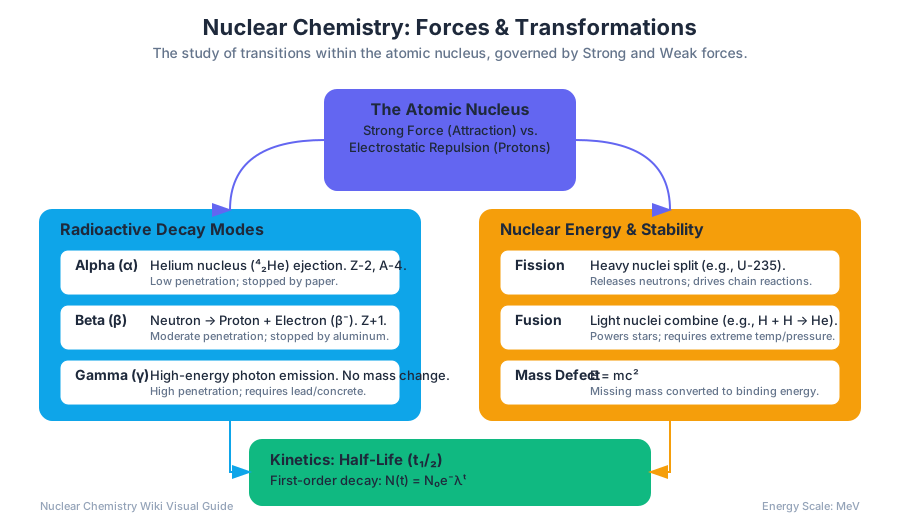
Nuclear chemistry is the study of transformations within the atomic nucleus. While traditional chemistry is governed by the behavior of valence electrons—dictated by the electromagnetic force—nuclear chemistry is dominated by the Strong Nuclear Force and the Weak Nuclear Force. The energy scales involved in nuclear transitions are typically six orders of magnitude greater than those in chemical reactions (Mega-electron volts [MeV] versus electron volts [eV]).
The Nature of Nuclear Stability
The stability of a nucleus is a delicate balance between the Strong Force (which attracts nucleons) and Electrostatic Repulsion (which pushes protons apart). For light elements, a 1:1 ratio of neutrons to protons ($N/Z = 1$) is generally stable. As the atomic number ($Z$) increases, an excess of neutrons is required to "dilute" the proton-proton repulsion, leading to a stable ratio of approximately 1.5:1 for the heaviest stable elements.
The Band of Stability: A graphical region representing the ratio of neutrons to protons that results in a stable nucleus. Nuclei outside this band are unstable and undergo radioactive decay to reach a lower energy, more stable state.
Binding Energy per Nucleon
The "mass defect" is the difference between the mass of a nucleus and the sum of the masses of its individual nucleons. This missing mass is converted into Nuclear Binding Energy according to Einstein’s equation $E=mc^2$.
| Feature | Chemical Reactions | Nuclear Reactions |
|---|---|---|
| Primary Actors | Valence Electrons | Protons and Neutrons (Nucleons) |
| Energy Change | Small (kJ/mol) | Massive (Millions of kJ/mol) |
| Conservation | Mass and Atoms conserved | Mass-Energy and Nucleons conserved |
| Influence | Temperature, Pressure, Catalysts | Independent of external conditions |
| Identity Change | Atoms rearranged into molecules | Elements change into different elements |
Radioactive Decay
Radioactive decay is a stochastic (random) process by which an unstable nucleus loses energy by emitting radiation. There are three primary modes of decay, each characterized by the type of particle or energy released.
Alpha ($\alpha$) Decay
In alpha decay, a nucleus ejects an alpha particle, which is essentially a Helium-4 nucleus ($^4_2\text{He}$). This occurs most frequently in heavy nuclei ($Z > 82$).
- Result: Atomic number decreases by 2; Mass number decreases by 4.
- Example: $^{238}{92}\text{U} \rightarrow ^{234}{90}\text{Th} + ^4_2\text{He}$
Beta ($\beta$) Decay
Beta decay involves the Weak Nuclear Force and comes in two primary forms:
- Beta-minus ($\beta^-$): A neutron transforms into a proton, an electron (the beta particle), and an antineutrino. This happens when the $N/Z$ ratio is too high.
- Beta-plus ($\beta^+$ or Positron Emission): A proton transforms into a neutron, a positron, and a neutrino. This happens when the $N/Z$ ratio is too low.
- Example ($\beta^-$): $^{14}_6\text{C} \rightarrow ^{14}_7\text{N} + e^- + \bar{\nu}_e$
Gamma ($\gamma$) Emission
Gamma decay is the emission of high-energy photons from an excited nucleus. It often follows alpha or beta decay when the daughter nucleus is left in a metastable state.
- Result: No change in atomic or mass number; only energy state changes.
Summary of Radiation Types
| Type | Symbol | Composition | Charge | Penetration Power | Shielding Required |
|---|---|---|---|---|---|
| Alpha | $\alpha$ | 2p, 2n | +2 | Very Low | Sheet of paper |
| Beta | $\beta$ | 1 electron | -1 | Moderate | Aluminum foil |
| Gamma | $\gamma$ | High-energy photon | 0 | Very High | Thick lead or concrete |
| Neutron | $n$ | 1 neutron | 0 | Extremely High | Water or paraffin |
Kinetics of Decay: Half-Life
Radioactive decay follows first-order kinetics. The rate of decay is proportional to the number of radioactive nuclei present.
The Mathematical Derivation
The rate law is expressed as: $$\frac{dN}{dt} = -\lambda N$$ Where $N$ is the number of nuclei and $\lambda$ is the decay constant.
\text{Integrating the rate law:} \\
\int_{N_0}^{N} \frac{dN}{N} = -\int_{0}^{t} \lambda dt \\
\ln\left(\frac{N}{N_0}\right) = -\lambda t \\
N(t) = N_0 e^{-\lambda t}
The Half-life ($t_{1/2}$) is the time required for $N$ to reach $N_0/2$. By substituting $N = N_0/2$ into the integrated rate law: $$\ln(0.5) = -\lambda t_{1/2}$$ $$t_{1/2} = \frac{\ln(2)}{\lambda} \approx \frac{0.693}{\lambda}$$
Worked Example: Carbon Dating
Suppose a wooden artifact is found to have a $^{14}\text{C}$ activity of 3.9 disintegrations per minute (dpm) per gram of carbon. Living wood has an activity of 15.6 dpm/g. Given $t_{1/2}$ for $^{14}\text{C}$ is 5,730 years, how old is the artifact?
- Find $\lambda$: $\lambda = 0.693 / 5730 \approx 1.21 \times 10^{-4} \text{ yr}^{-1}$
- Solve for $t$: $3.9 = 15.6 \cdot e^{-(1.21 \times 10^{-4})t}$
- $0.25 = e^{-(1.21 \times 10^{-4})t}$
- $\ln(0.25) = -(1.21 \times 10^{-4})t$
- $t \approx 11,460 \text{ years}$ (Exactly two half-lives).
Fission vs. Fusion
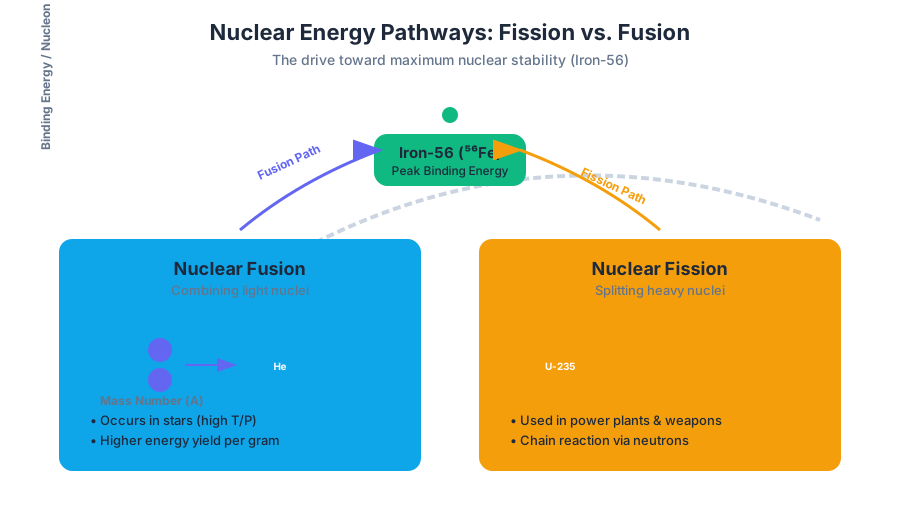
The Binding Energy Curve shows that Iron-56 ($^{56}\text{Fe}$) has the highest binding energy per nucleon, making it the most stable nucleus. Nuclei heavier than Iron can release energy by splitting (Fission), while nuclei lighter than Iron can release energy by joining (Fusion).
Nuclear Fission
Fission is the process where a heavy nucleus (like $^{235}\text{U}$) captures a neutron, becomes unstable, and splits into two smaller "fission fragments" and additional neutrons.
- Chain Reaction: If the emitted neutrons strike other fissile nuclei, a self-sustaining reaction occurs.
- Critical Mass: The minimum amount of fissile material needed to maintain a chain reaction.
Nuclear Fusion
Fusion is the process of combining light nuclei to form a heavier one. This powers stars via the Proton-Proton Chain or the CNO Cycle.
- The Challenge: Nuclei are positively charged and repel each other (Coulomb barrier). Fusion requires extreme temperatures (millions of degrees) to give nuclei enough kinetic energy to overcome this repulsion.
| Property | Nuclear Fission | Nuclear Fusion |
|---|---|---|
| Definition | Splitting heavy nuclei | Joining light nuclei |
| Fuel | Uranium, Plutonium | Hydrogen isotopes (Deuterium, Tritium) |
| Energy Yield | High | Extremely High (3-4x Fission) |
| Waste | Long-lived radioactive isotopes | Helium (Inert) |
| Status | Commercial power plants | Experimental (ITER, NIF) |
Modeling Decay
To understand the behavior of complex decay chains (where a parent decays to a daughter which is also radioactive), we use the Bateman Equations.
Common Pitfalls and Misconceptions
- Mass Conservation: Students often think mass is conserved in nuclear reactions. It is not. Mass-Energy is conserved. The "lost" mass is what provides the kinetic energy of the particles and the energy of the gamma rays.
- Half-life and Sample Size: A common mistake is thinking that a half-life means exactly half the atoms decay in that time. Because decay is a statistical process, this is only true for large populations. For a single atom, the half-life represents the time at which there is a 50% probability of decay.
- Radiation vs. Radioactivity: Radioactivity is the property of the nucleus (the "instability"). Radiation is the stuff that is emitted (particles or waves).
- Penetration vs. Ionization: There is an inverse relationship between penetration and ionization. Alpha particles have the lowest penetration but the highest Linear Energy Transfer (LET), meaning they do the most damage to biological tissue if ingested because they are highly ionizing.
Advanced Applications
Medical Isotopes and PET Scans
Positron Emission Tomography (PET) relies on $\beta^+$ decay. A patient is injected with a tracer like Fluorine-18 ($^{18}\text{F}$), which is incorporated into glucose. As the $^{18}\text{F}$ decays, it emits a positron. When this positron encounters an electron in the body, they annihilate, producing two gamma rays moving in opposite directions. Sensors detect these rays to map metabolic activity in the brain or tumors.
Nuclear Transmutation
Using particle accelerators, scientists can bombard stable nuclei with high-speed particles to create synthetic elements. This is how all transuranic elements (elements with $Z > 92$, like Americium used in smoke detectors) are produced.
Source Materials
Study High School Chemistry on Lykke
This course page is free to open: signed out, you can read its first two sections, and signing in, on any plan, opens the rest. The free Lykke Chrome extension syncs your own Canvas courses, so ChatGPT, Claude and Muse can answer from your classes and deadlines. It only reads Canvas.
Add the free extensionSign in to open every sectionAll sections of High School Chemistry · Browse more course pages