From the free course High School Chemistry on Lykke
Chemical Reactions and Predicting Products
Key concepts: Synthesis and Decomposition · Single and Double Replacement · Combustion · Law of Conservation of Mass
Identifying types of chemical reactions and predicting the outcomes of mixing different substances.
Chemical Reactions and Predicting Products
Chemical reactions represent the fundamental mechanism by which the universe rearranges matter. At the macroscopic level, we observe color changes, heat evolution, and the formation of new phases; at the microscopic level, reactions are the orchestrated breaking and reforming of chemical bonds, driven by the pursuit of lower Gibbs free energy. To master chemistry is to move beyond observing these changes to predicting them with mathematical and structural precision.
The Fundamental Axiom: The Law of Conservation of Mass
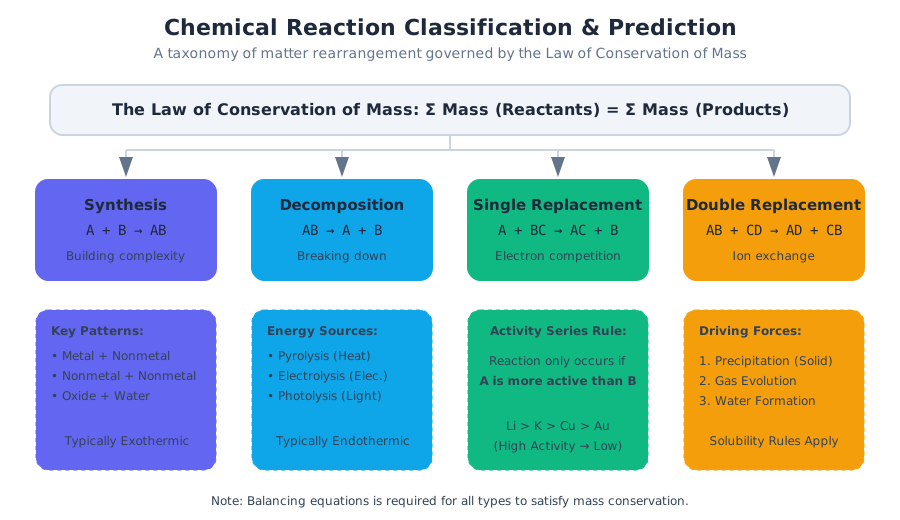
Before one can predict the product of a reaction, one must respect the physical constraints of the universe. The Law of Conservation of Mass, formalized by Antoine Lavoisier in 1789, states that mass is neither created nor destroyed in a chemical reaction.
The Law of Conservation of Mass: In a closed system, the mass of the reactants must exactly equal the mass of the products. Consequently, the number of atoms of each element must remain constant throughout the transformation.
This law necessitates the balancing of equations. A chemical equation is not merely a description; it is a balanced stoichiometric account. If we react hydrogen gas with oxygen gas to form water, the raw observation ($H_2 + O_2 \rightarrow H_2O$) violates this law. The balanced form ($2H_2 + O_2 \rightarrow 2H_2O$) satisfies it by ensuring four hydrogen atoms and two oxygen atoms exist on both sides of the arrow.
Mathematical Representation of Mass Balance
For any reaction $\sum \nu_i R_i \rightarrow \sum \nu_j P_j$, where $\nu$ represents the stoichiometric coefficient: $$\sum (m_{reactants}) = \sum (m_{products})$$
| Feature | Reactants | Products |
|---|---|---|
| Definition | Substances consumed during the reaction. | Substances produced by the reaction. |
| Placement | Left side of the yield arrow ($\rightarrow$). | Right side of the yield arrow ($\rightarrow$). |
| Mass Relationship | Total initial mass. | Total final mass (identical to initial). |
| Bonding State | Bonds are broken (requires energy). | Bonds are formed (releases energy). |
Synthesis and Decomposition: The Binary Logic of Matter
The simplest forms of chemical change involve the combination of multiple species into one, or the breakdown of one species into many.
Synthesis (Combination) Reactions
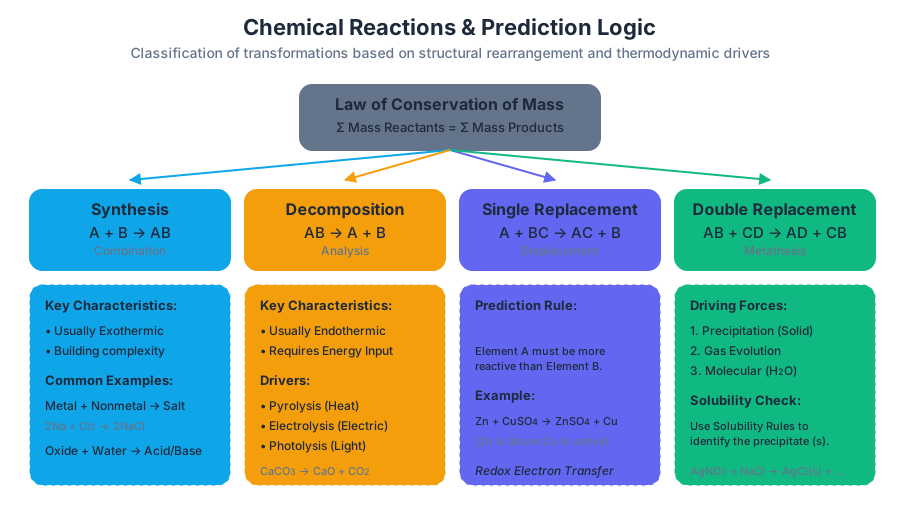
In a Synthesis reaction, two or more simple substances combine to form a more complex product. The general form is $A + B \rightarrow AB$. These reactions are typically exothermic, as the formation of new bonds releases more energy than is required to initiate the process.
- Metal + Nonmetal: Usually results in an ionic compound (e.g., $2Na + Cl_2 \rightarrow 2NaCl$).
- Nonmetal + Nonmetal: Results in a covalent compound (e.g., $S + O_2 \rightarrow SO_2$).
- Oxide + Water: Metal oxides form bases ($CaO + H_2O \rightarrow Ca(OH)_2$), while nonmetal oxides form acids ($SO_3 + H_2O \rightarrow H_2SO_4$).
Decomposition Reactions
Decomposition is the inverse of synthesis: $AB \rightarrow A + B$. Because these reactions involve breaking stable bonds, they almost always require an input of energy in the form of heat (pyrolysis), light (photolysis), or electricity (electrolysis).
- Carbonates: Decompose into metal oxides and carbon dioxide ($CaCO_3 \rightarrow CaO + CO_2$).
- Chlorates: Decompose into metal chlorides and oxygen gas ($2KClO_3 \rightarrow 2KCl + 3O_2$).
- Hydroxides: Decompose into metal oxides and water ($Mg(OH)_2 \rightarrow MgO + H_2O$).
Single Replacement: The Competition for Electrons
A Single Replacement (or displacement) reaction occurs when a more reactive element displaces a less reactive element from a compound: $A + BC \rightarrow AC + B$. These reactions are fundamentally Redox (Reduction-Oxidation) processes involving the transfer of electrons.
The Activity Series
To predict whether a single replacement reaction will occur, chemists utilize the Activity Series. An element can only replace an element listed below it on the series.
| Element Type | Reactivity Level | Examples | Behavior |
|---|---|---|---|
| Active Metals | High | $Li, K, Ca, Na$ | React with cold water to displace $H_2$. |
| Moderate Metals | Medium | $Mg, Al, Zn, Fe$ | React with steam or acids to displace $H_2$. |
| Noble Metals | Low | $Cu, Ag, Au, Pt$ | Do not react with water or most acids. |
| Halogens | Variable | $F > Cl > Br > I$ | Higher halogens displace lower ones. |
Worked Example: If a strip of Zinc ($Zn$) is placed in a solution of Copper(II) Sulfate ($CuSO_4$), will a reaction occur?
- Consult the Activity Series: $Zn$ is more active than $Cu$.
- Prediction: $Zn$ will displace $Cu$.
- Equation: $Zn(s) + CuSO_4(aq) \rightarrow ZnSO_4(aq) + Cu(s)$.
- Observation: The blue color of the solution fades as $Zn^{2+}$ ions form, and reddish-brown copper metal precipitates.
Double Replacement: The Metathesis Exchange
In Double Replacement reactions, the cations and anions of two different ionic compounds switch places: $AB + CD \rightarrow AD + CB$. These reactions typically occur in aqueous solutions.
Driving Forces
A double replacement reaction only occurs if one of the products is "removed" from the ion-exchange equilibrium. This happens through three primary driving forces:
- Precipitation: Formation of an insoluble solid.
- Gas Evolution: Formation of a gas (like $CO_2$ or $H_2S$).
- Molecular Formation: Formation of a stable molecular compound, most commonly water ($H_2O$) in an acid-base neutralization.
Solubility Rules
To predict the formation of a precipitate, one must apply the solubility rules:
| Soluble Compounds | Exceptions |
|---|---|
| Group 1 cations ($Li^+, Na^+$, etc.) | None |
| Ammonium ($NH_4^+$) | None |
| Nitrates ($NO_3^-$) and Acetates | None |
| Halides ($Cl^-, Br^-, I^-$) | $Ag^+, Pb^{2+}, Hg_2^{2+}$ |
| Sulfates ($SO_4^{2-}$) | $Ba^{2+}, Sr^{2+}, Pb^{2+}, Ca^{2+}$ |
Insoluble Compounds: Most Carbonates ($CO_3^{2-}$), Phosphates ($PO_4^{3-}$), and Hydroxides ($OH^-$) are insoluble unless paired with Group 1 metals or Ammonium.
Combustion: The Chemistry of Fire
Combustion is a rapid reaction between a fuel (usually a hydrocarbon) and an oxidant (oxygen gas) that produces heat and light.
Hydrocarbon Combustion
For any hydrocarbon of the form $C_xH_y$, the products of complete combustion are always carbon dioxide ($CO_2$) and water vapor ($H_2O$).
C_xH_y + (x + \frac{y}{4})O_2 \rightarrow xCO_2 + \frac{y}{2}H_2O
If oxygen is limited, incomplete combustion occurs, producing Carbon Monoxide ($CO$) or elemental Carbon (soot, $C$).
Combustion of Metals
Many metals also undergo combustion, which technically doubles as a synthesis reaction. For example, the combustion of magnesium:
2Mg(s) + O_2(g) \rightarrow 2MgO(s) + \text{light}
Algorithmic Prediction and Balancing
Predicting products requires a systematic pipeline:
- Identify Reactant Types: Are they elements or compounds?
- Classify Reaction: Use the structures ($A+B$, $AB$, $A+BC$, $AB+CD$, or $C_xH_y+O_2$).
- Determine Products: Use valency (charge balance) to write correct formulas.
- Check Feasibility: Use the Activity Series for single replacement or Solubility Rules for double replacement.
- Balance: Apply the Law of Conservation of Mass.
Balancing via Linear Algebra
While many balance equations by inspection, complex redox reactions are best solved using a system of linear equations where each element represents a constraint.
Theoretical Derivation: The Driving Force of Replacement
The spontaneity of a single replacement reaction can be derived from the standard reduction potentials ($E^\circ$). A reaction is spontaneous if the cell potential ($E^\circ_{cell}$) is positive.
E^\circ_{cell} = E^\circ_{cathode} - E^\circ_{anode}

For Zn + Cu^2+ -> Zn^2+ + Cu:
E^\circ(Cu^2+/Cu) = +0.34V
E^\circ(Zn^2+/Zn) = -0.76V
E^\circ_{cell} = 0.34 - (-0.76) = +1.10V (Spontaneous)
Real-World Application: Industrial Synthesis
In industrial chemical engineering, predicting products is the first step in process design. The Haber-Bosch process is a classic synthesis reaction where the yield is maximized by manipulating equilibrium.
Common Pitfalls in Prediction
- Ignoring Diatomic Elements: Students often write $H$ or $O$ instead of $H_2$ or $O_2$. Remember BrINClHOF (Bromine, Iodine, Nitrogen, Chlorine, Hydrogen, Oxygen, Fluorine).
- Incorrect Formulas: Predicting $NaCl_2$ because the reactant was $MgCl_2$. You must balance the charges of the new compound based on the oxidation states of the constituent ions.
- Forcing Reactions: Assuming a reaction occurs just because reactants are mixed. Always check the Activity Series and Solubility Rules.
- Balancing Subscripts: Never change the subscripts of a correctly written formula to balance an equation. Only change the coefficients.
Summary Table: Reaction Archetypes
| Reaction Type | Reactants | Products | Key Identifier |
|---|---|---|---|
| Synthesis | Two elements or simple compounds | One complex compound | $A + B \rightarrow AB$ |
| Decomposition | One complex compound | Two or more simpler substances | $AB \rightarrow A + B$ |
| Single Replacement | One element + one compound | One element + one compound | $A + BC \rightarrow AC + B$ |
| Double Replacement | Two ionic compounds | Two ionic compounds | $AB + CD \rightarrow AD + CB$ |
| Combustion | Hydrocarbon + Oxygen | $CO_2 + H_2O$ | Presence of $O_2$ and heat |
Source Materials
Study High School Chemistry on Lykke
This course page is free to open: signed out, you can read its first two sections, and signing in, on any plan, opens the rest. The free Lykke Chrome extension syncs your own Canvas courses, so ChatGPT, Claude and Muse can answer from your classes and deadlines. It only reads Canvas.
Add the free extensionSign in to open every sectionAll sections of High School Chemistry · Browse more course pages