From the free course High School Chemistry on Lykke
Chemical Bonding and Molecular Structure
Key concepts: Ionic Bonding · Covalent Bonding · Metallic Bonding · Lewis Structures · Bond Polarity
Detailed study of how atoms and ions interact to form ionic, covalent, and metallic bonds.
Chemical Bonding and Molecular Structure
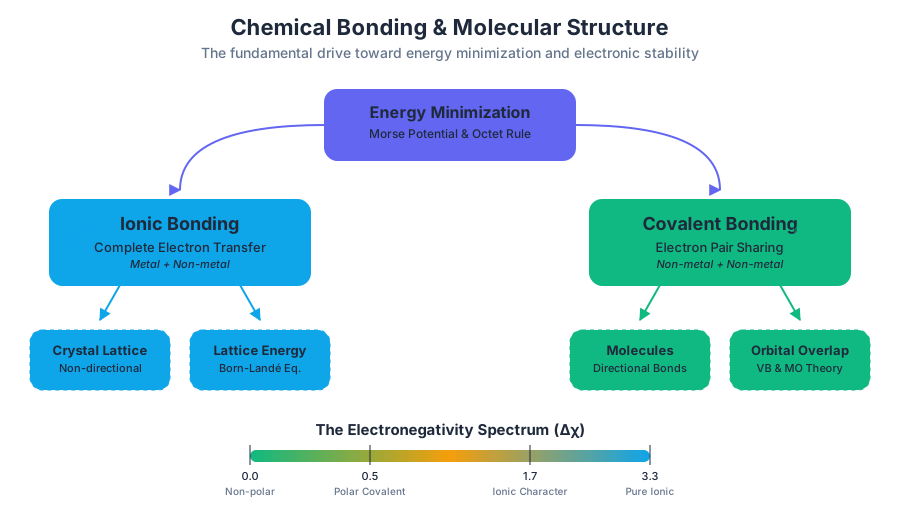
Atoms, in their elemental state, are rarely found in isolation under standard terrestrial conditions. The vast diversity of matter—from the silicon chips in a CPU to the hemoglobin in our blood—is the result of chemical bonding. At its most fundamental level, a chemical bond is a lasting attraction between atoms, ions, or molecules that enables the formation of chemical compounds. This attraction is driven by the universal physical principle of energy minimization: atoms bond because the resulting system has a lower potential energy than the sum of the individual, isolated atoms.
The Energetics of Bonding: Why Atoms Interact
The formation of a bond is governed by the interplay of electrostatic forces: the attraction between nuclei and electrons, and the repulsion between nuclei and between electrons. The Octet Rule serves as a useful heuristic for understanding this behavior, suggesting that atoms are most stable when they possess a full valence shell (typically eight electrons, mimicking the electron configuration of a noble gas).
Mathematically, the stability of a bond can be described by the Morse Potential or the Lennard-Jones Potential, which models the potential energy of a diatomic system as a function of internuclear distance.
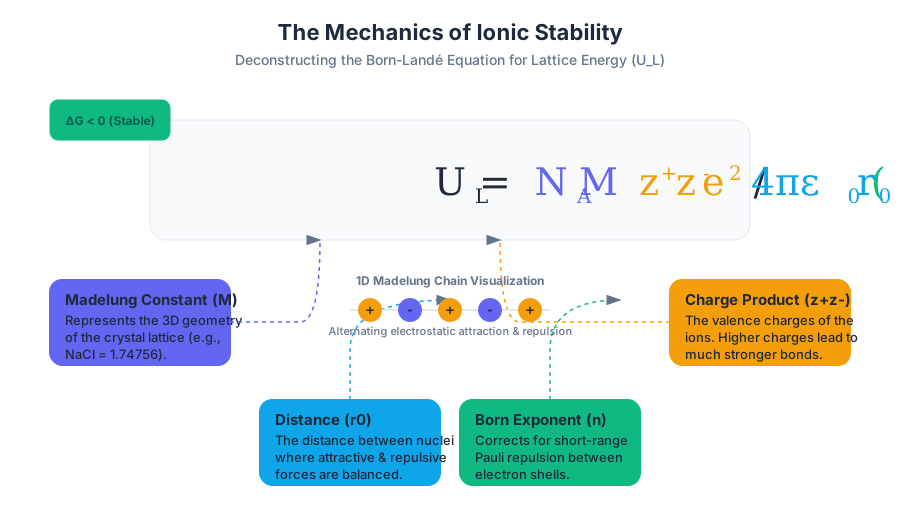
Key Insight: The Thermodynamic Drive A chemical bond forms when the change in Gibbs Free Energy ($\Delta G$) for the process is negative. This is primarily achieved through a decrease in enthalpy ($\Delta H$), as the electrostatic attractions release energy when the bond is established.
Ionic Bonding: The Electrostatic Lattice
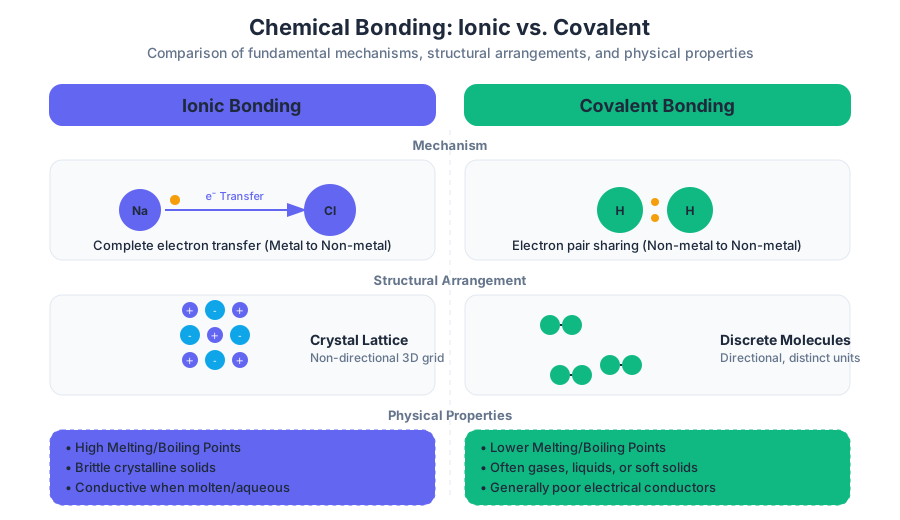
Ionic bonding occurs through the complete transfer of one or more electrons from one atom (typically a metal with low ionization energy) to another (typically a non-metal with high electron affinity). This transfer creates cations (positively charged) and anions (negatively charged), which are then held together by intense Coulombic attraction.
Mechanics of the Ionic Bond
Unlike covalent bonds, ionic bonds are non-directional. A single sodium ion does not "belong" to a single chloride ion; instead, they arrange themselves into a repeating 3D pattern known as a crystal lattice. The strength of this structure is quantified by its Lattice Energy ($U_L$), the energy released when gaseous ions combine to form one mole of an ionic solid.
The Lattice Energy can be approximated using the Born-Landé equation:
U_L = \frac{N_A M z^+ z^- e^2}{4\pi \epsilon_0 r_0} \left( 1 - \frac{1}{n} \right)
Where:
- $N_A$ is Avogadro's constant.
- $M$ is the Madelung constant, representing the geometry of the crystal.
- $z^+, z^-$ are the charges of the ions.
- $e$ is the elementary charge.
- $r_0$ is the equilibrium distance between ions.
- $n$ is the Born exponent.
Properties of Ionic Compounds
| Property | Characteristic | Physical Basis |
|---|---|---|
| Melting/Boiling Point | Very High | Requires breaking strong Coulombic forces throughout the lattice. |
| Brittleness | High | Stress shifts ion layers; like-charges align and repel, shattering the crystal. |
| Electrical Conductivity | Only in molten/aqueous state | Ions must be mobile to carry charge; they are fixed in the solid lattice. |
| Solubility | Often high in polar solvents | Ion-dipole interactions can overcome lattice energy (hydration). |
Covalent Bonding: The Shared Electron Model
Covalent bonding involves the sharing of electron pairs between atoms, typically non-metals. This sharing allows each atom to achieve a stable electron configuration. Unlike the electrostatic "clumping" of ionic bonds, covalent bonds are directional and result in the formation of discrete molecules.
Valence Bond Theory vs. Molecular Orbital Theory
- Valence Bond (VB) Theory: Proposes that a bond forms when the atomic orbitals of two atoms overlap. The shared electrons are localized between the two nuclei.
- Molecular Orbital (MO) Theory: Suggests that atomic orbitals combine to form new molecular orbitals that extend over the entire molecule. This explains phenomena like the paramagnetism of $O_2$ which VB theory fails to predict.
Bond Polarity and Electronegativity
Not all sharing is equal. The degree of sharing is determined by Electronegativity ($\chi$), a measure of an atom's ability to attract shared electrons.
- Non-polar Covalent: $\Delta\chi < 0.5$ (Equal sharing, e.g., $H-H$).
- Polar Covalent: $0.5 \le \Delta\chi \le 1.7$ (Unequal sharing, e.g., $H-Cl$).
- Ionic: $\Delta\chi > 1.7$ (Electron transfer, e.g., $Na-Cl$).
Theorem: The Dipole Moment A polar bond creates a bond dipole, quantified by the dipole moment $\mu = Q \times r$, where $Q$ is the partial charge and $r$ is the distance between charges. The net dipole of a molecule is the vector sum of all individual bond dipoles.
Lewis Structures: Mapping the Molecule
Lewis Structures are 2D representations used to visualize the bonding and lone pairs in a molecule. They are essential for predicting molecular geometry via VSEPR theory.
The Algorithm for Drawing Lewis Structures
- Count Valence Electrons: Sum the valence electrons for all atoms. Adjust for charge (add for anions, subtract for cations).
- Identify the Central Atom: Usually the least electronegative atom (never Hydrogen).
- Connect Atoms: Draw single bonds (lines) between the central atom and peripheral atoms.
- Distribute Remaining Electrons: Complete the octets of the peripheral atoms first, then place remaining electrons on the central atom.
- Satisfy the Octet Rule: If the central atom lacks an octet, move lone pairs from peripheral atoms to form double or triple bonds.
Formal Charge Calculation
To determine the most plausible Lewis structure among resonance contributors, we calculate the Formal Charge (FC) for each atom:
FC = [Valence Electrons] - [Non-bonding Electrons] - (1/2)[Bonding Electrons]
The most stable structure is the one where formal charges are closest to zero and negative charges reside on the most electronegative atoms.
Resonance and Exceptions
Some molecules cannot be described by a single Lewis structure. Resonance occurs when multiple valid structures exist; the actual molecule is a hybrid of these forms. Furthermore, some atoms violate the octet rule:
- Incomplete Octets: Boron and Beryllium often form compounds with fewer than 8 electrons (e.g., $BF_3$).
- Expanded Octets: Elements in Period 3 and below can use d-orbitals to hold more than 8 electrons (e.g., $SF_6$, $PCl_5$).
Metallic Bonding: The "Sea of Electrons"
Metallic bonding explains the unique properties of metals. In this model, metal atoms lose their valence electrons to a "delocalized sea" that surrounds a lattice of positive metal cations.
Band Theory
A more advanced view is Band Theory, which treats the delocalized electrons as occupying energy bands.
- Conduction Band: The range of electron energies enough to free an electron from binding with its atom to move freely within the atomic lattice.
- Valence Band: The highest range of electron energies in which electrons are normally present at absolute zero temperature.
- In metals, these bands overlap, allowing for high electrical and thermal conductivity.
Comparison of Bonding Characteristics
| Feature | Ionic | Covalent | Metallic |
|---|---|---|---|
| Bonding Particles | Cations and Anions | Atoms | Cations and Delocalized Electrons |
| Force of Attraction | Electrostatic | Shared electron pairs | Attraction between cations and electron sea |
| State at Room Temp | Solid | Gas, Liquid, or Solid | Solid (except Mercury) |
| Malleability | No (Brittle) | No | Yes |
| Conductivity (Solid) | Low | Low | High |
Common Pitfalls and Misconceptions
- The "Ionic vs. Covalent" Binary: Many students view bonds as either 100% ionic or 100% covalent. In reality, bonding exists on a continuum. Even "ionic" bonds like $Li-F$ have a small degree of covalent character.
- Octet Obsession: The octet rule is a guideline, not a law. Transition metals and heavy non-metals frequently ignore it.
- Geometry Confusion: Lewis structures are 2D. They do not represent the actual 3D shape. For instance, $CH_4$ is drawn as a cross but is actually a tetrahedron ($109.5^\circ$).
- Bond Breaking vs. Phase Change: Boiling water breaks intermolecular forces (Hydrogen bonds), not the intramolecular covalent $O-H$ bonds.
Advanced Representation: Chemical Data Structures
In computational chemistry, molecules are often represented as graphs or strings. The SMILES (Simplified Molecular Input Line Entry System) format is a standard for describing molecular structures in a way that a computer can process.
Summary of Molecular Geometry (VSEPR)
The Valence Shell Electron Pair Repulsion (VSEPR) theory predicts the 3D shape of a molecule based on the premise that electron pairs (bonding and lone pairs) will arrange themselves as far apart as possible to minimize repulsion.
| Steric Number | Bonding Pairs | Lone Pairs | Molecular Geometry | Example |
|---|---|---|---|---|
| 2 | 2 | 0 | Linear | $CO_2$ |
| 3 | 3 | 0 | Trigonal Planar | $BF_3$ |
| 4 | 4 | 0 | Tetrahedral | $CH_4$ |
| 4 | 3 | 1 | Trigonal Pyramidal | $NH_3$ |
| 4 | 2 | 2 | Bent | $H_2O$ |
| 5 | 5 | 0 | Trigonal Bipyramidal | $PCl_5$ |
| 6 | 6 | 0 | Octahedral | $SF_6$ |
Source Materials
Study High School Chemistry on Lykke
This course page is free to open: signed out, you can read its first two sections, and signing in, on any plan, opens the rest. The free Lykke Chrome extension syncs your own Canvas courses, so ChatGPT, Claude and Muse can answer from your classes and deadlines. It only reads Canvas.
Add the free extensionSign in to open every sectionAll sections of High School Chemistry · Browse more course pages