From the free course High School Chemistry on Lykke
Modern Atomic Theory and Periodicity
Key concepts: Bohr model · Quantum mechanical model · Electron configurations · Periodic table organization · Atomic spectra
Exploration of the transition from the Bohr model to the quantum mechanical model and how these theories explain periodic trends.
Modern Atomic Theory and Periodicity
The transition from a classical understanding of the atom to the modern quantum mechanical model represents one of the most significant paradigm shifts in scientific history. While the early 20th century viewed atoms as miniature solar systems, we now understand them as complex wave-functions governed by probability and quantization. This article explores the mechanics of the atom, the mathematical underpinnings of electron behavior, and how these microscopic properties manifest as the macroscopic patterns of the Periodic Table.
The Bohr Model and the Birth of Quantization
Before the advent of full quantum mechanics, Niels Bohr proposed a model in 1913 that bridged the gap between classical physics and the emerging evidence of energy quantization. Bohr’s model was a direct response to the "ultraviolet catastrophe" and the observed discrete lines in atomic spectra.
The Mechanics of the Bohr Atom
Bohr postulated that electrons travel in defined circular orbits around the nucleus. Unlike a planet orbiting a sun, which can exist at any distance, an electron can only occupy specific, quantized energy levels.
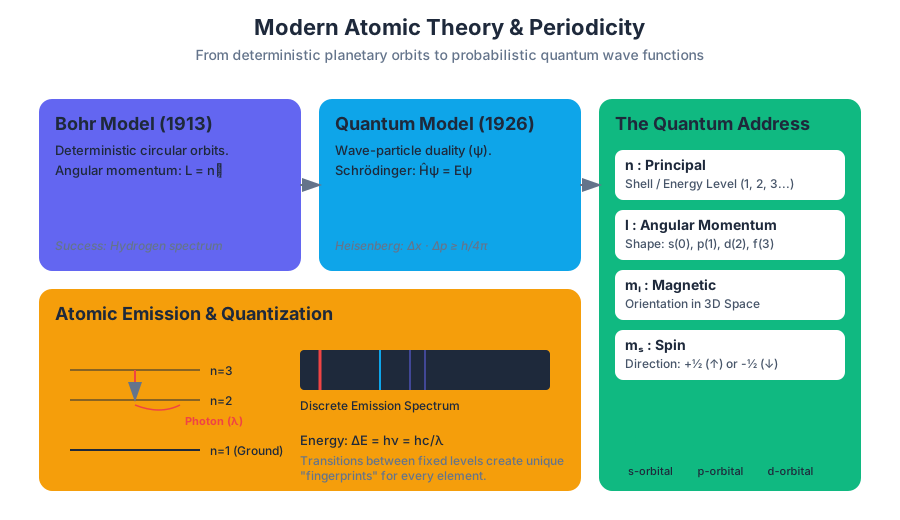
Bohr’s Postulate: The angular momentum of an electron is quantized in integral multiples of $\hbar$ (h-bar), expressed as $L = n\hbar$, where $n$ is the principal quantum number.
Atomic Spectra and Energy Transitions
When an atom absorbs energy (via heat or electricity), an electron is promoted from a ground state to an excited state. When it falls back to a lower energy level, it releases a photon with an energy exactly equal to the difference between the two levels. This is why elements produce distinct spectral lines rather than a continuous rainbow.
The energy of the emitted photon is calculated using the Planck-Einstein relation: $$E = h\nu = \frac{hc}{\lambda}$$
Where:
- $h$ is Planck's constant ($6.626 \times 10^{-34} \text{ J}\cdot\text{s}$)
- $\nu$ is frequency
- $c$ is the speed of light
- $\lambda$ is wavelength
Worked Example: The Rydberg Formula
| Feature | Bohr Model | Quantum Mechanical Model |
|---|---|---|
| Electron Path | Defined circular orbits | Probability distributions (orbitals) |
| Certainty | Position and momentum known | Heisenberg Uncertainty Principle applies |
| Energy Levels | Defined by $n$ only | Defined by $n, l, m_l$ |
| Success | Excellent for Hydrogen | Accurate for all elements |
The Quantum Mechanical Model
The Bohr model failed for atoms with more than one electron because it could not account for electron-electron repulsions or the wave-like nature of matter. In 1926, Erwin Schrödinger formulated the wave equation, treating the electron not as a particle, but as a wave function ($\psi$).
The Schrödinger Equation
The fundamental equation of quantum mechanics describes the evolution of a quantum system. For a non-relativistic electron in an atom, the time-independent Schrödinger equation is:
\hat{H}\psi = E\psi
Where:
- $\hat{H}$ is the Hamiltonian operator (representing the sum of kinetic and potential energy).
- $\psi$ (psi) is the wave function.
- $E$ is the energy of the state.
The square of the wave function, $|\psi|^2$, represents the probability density—the likelihood of finding an electron in a specific region of space. This region is what we call an orbital.
The Heisenberg Uncertainty Principle
A cornerstone of the quantum model is the realization that we cannot simultaneously know the exact position ($x$) and momentum ($p$) of a particle.
Heisenberg Uncertainty Principle: $\Delta x \cdot \Delta p \ge \frac{h}{4\pi}$
This principle effectively "smears" the electron into a cloud, replacing Bohr's trajectories with orbital volumes.
Quantum Numbers and Orbital Architecture
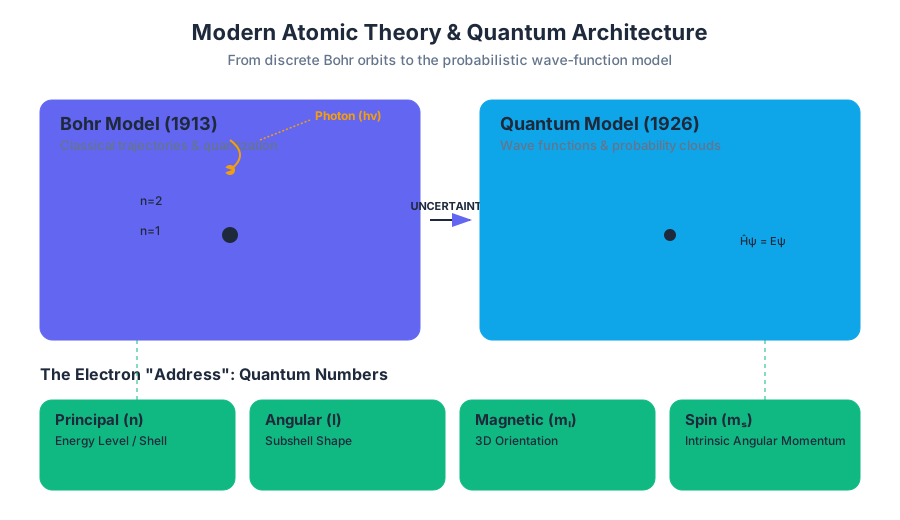
To describe the "address" of an electron within an atom, we use four quantum numbers. These numbers emerge naturally from the solutions to the Schrödinger equation.
1. Principal Quantum Number ($n$)
Indicates the main energy level or shell. As $n$ increases, the orbital becomes larger and the electron spends more time further from the nucleus.
- Values: $n = 1, 2, 3, \dots$
2. Angular Momentum Quantum Number ($l$)
Defines the shape of the orbital (subshell).
- Values: $0$ to $(n-1)$
- Mapping: $0=s, 1=p, 2=d, 3=f$
3. Magnetic Quantum Number ($m_l$)
Defines the orientation of the orbital in 3D space.
- Values: $-l$ to $+l$
4. Spin Quantum Number ($m_s$)
Describes the intrinsic angular momentum (spin) of the electron.
- Values: $+1/2$ (spin up) or $-1/2$ (spin down)
| Subshell ($l$) | Shape | Number of Orbitals | Max Electrons |
|---|---|---|---|
| s (0) | Spherical | 1 | 2 |
| p (1) | Dumbbell | 3 | 6 |
| d (2) | Cloverleaf/Complex | 5 | 10 |
| f (3) | Complex | 7 | 14 |
Electron Configurations: The Aufbau Process
Electron configuration is the distribution of electrons among the various orbitals. The "filling" of these orbitals follows three strict principles:
- Aufbau Principle: Electrons occupy the lowest energy orbitals first (e.g., 1s before 2s).
- Pauli Exclusion Principle: No two electrons in an atom can have the same four quantum numbers. Therefore, an orbital can hold a maximum of two electrons with opposite spins.
- Hund’s Rule: For degenerate orbitals (orbitals with the same energy, like the three 2p orbitals), electrons fill them singly first with parallel spins before pairing up.
The Madelung Rule (n + l Rule)
The order of filling is generally determined by the sum of $n + l$. If two orbitals have the same $n + l$, the one with the lower $n$ is filled first.
Noble Gas Notation
To simplify configurations for heavy elements, we use the previous noble gas as a "core" shortcut.
- Sodium (Na): $1s^2 2s^2 2p^6 3s^1 \rightarrow [Ne] 3s^1$
- Iron (Fe): $1s^2 2s^2 2p^6 3s^2 3p^6 4s^2 3d^6 \rightarrow [Ar] 4s^2 3d^6$
Exceptions to the Rule
Transition metals like Chromium (Cr) and Copper (Cu) deviate from the standard Aufbau order to achieve the stability of half-filled or fully-filled d-subshells.
- Cr expected: $[Ar] 4s^2 3d^4$
- Cr actual: $[Ar] 4s^1 3d^5$ (Half-filled stability)
Periodicity and the Organization of the Table
The Periodic Table is not merely a list; it is a map of electron configurations. The layout is divided into blocks ($s, p, d, f$) corresponding to the subshell being filled in the valence shell.
Effective Nuclear Charge ($Z_{eff}$)
The core concept driving periodic trends is Effective Nuclear Charge. While the nucleus has a positive charge ($Z$), the inner-shell electrons "shield" the outer electrons from the full pull of the nucleus.
Formula: $Z_{eff} = Z - S$ Where $Z$ is the atomic number and $S$ is the screening constant (number of core electrons).
Periodic Trends Summary
| Trend | Definition | Direction (Across Period) | Direction (Down Group) |
|---|---|---|---|
| Atomic Radius | Distance from nucleus to valence shell | Decreases (higher $Z_{eff}$ pulls tighter) | Increases (more shells) |
| Ionization Energy | Energy required to remove an electron | Increases (stronger nuclear pull) | Decreases (further from nucleus) |
| Electronegativity | Ability to attract electrons in a bond | Increases (except Noble Gases) | Decreases |
| Electron Affinity | Energy change when an electron is added | Becomes more negative (generally) | Becomes less negative |
Deep Dive: Ionization Energy ($IE$)
Ionization energy provides a direct measurement of how tightly an atom holds its electrons. Successive ionization energies ($IE_1, IE_2, IE_3$) show massive jumps when an electron is removed from a core shell.
Example: Magnesium (Mg)
- $IE_1$: 738 kJ/mol (Remove $3s^1$)
- $IE_2$: 1451 kJ/mol (Remove $3s^2$)
- $IE_3$: 7733 kJ/mol (Remove $2p^6$ — Huge Jump!)
The jump at $IE_3$ confirms that Magnesium has two valence electrons.
Common Pitfalls and Misconceptions
- The "Solar System" Fallacy: Students often visualize electrons moving in tracks. In reality, an electron is "everywhere and nowhere" within its orbital until measured.
- 4s vs 3d Energy: While 4s fills before 3d (Aufbau), once the 3d subshell begins to fill, the energy levels shift. When transition metals form ions, they typically lose 4s electrons before 3d electrons.
- Atomic Radius and $Z$: It is counter-intuitive that adding more protons and electrons (moving right across a period) makes the atom smaller. This happens because the increased $Z_{eff}$ pulls the electron cloud closer, and no new shells are added to counteract the pull.
Summary of Modern Atomic Theory
The modern atom is a balance of electrostatic forces and quantum probabilities. The nucleus provides the central potential, while the electrons arrange themselves into quantized states that minimize energy and maximize stability. This arrangement—the electron configuration—is the fundamental "source code" of the universe, dictating how every element bonds, reacts, and exists.
- Bohr Model: A model of the atom where electrons occupy fixed circular orbits with quantized energy.
- Orbital: A mathematical function describing the 3D region where there is a high probability of finding an electron.
- Aufbau Principle: The rule stating that electrons fill the lowest-energy orbitals first.
- Effective Nuclear Charge ($Z_{eff}$): The net positive charge experienced by an electron in a multi-electron atom.
- Ionization Energy: The minimum energy required to remove an electron from a gaseous atom or ion.
- Degenerate Orbitals: Orbitals that have the same energy level (e.g., the three $p$ orbitals in a single shell).
- Heisenberg Uncertainty Principle: The fundamental limit to the precision with which certain pairs of physical properties, such as position and momentum, can be known.
-
Why does the atomic radius decrease as you move from left to right across a period?
- A) The number of energy shells increases.
- B) The effective nuclear charge increases, pulling electrons closer.
- C) Electrons repel each other more strongly.
- D) The mass of the nucleus decreases. (Correct: B)
-
Which quantum number determines the shape of an orbital?
- A) $n$
- B) $l$
- C) $m_l$
- D) $m_s$ (Correct: B)
-
What is the correct noble gas configuration for Sulfur (S, Atomic No. 16)?
- A) $[Ne] 3s^2 3p^4$
- B) $[Ar] 3s^2 3p^4$
- C) $[Ne] 3s^2 3p^6$
- D) $[He] 2s^2 2p^6 3s^2 3p^4$ (Correct: A)
-
According to Hund's Rule, how are electrons placed in degenerate orbitals?
- A) They pair up immediately to minimize space.
- B) They fill the highest energy orbital first.
- C) They fill each orbital singly with parallel spins before pairing.
- D) They are placed randomly. (Correct: C)
-
A transition from $n=4$ to $n=2$ in a hydrogen atom emits light. Compared to a transition from $n=3$ to $n=2$, the emitted light will have:
- A) Longer wavelength, lower energy.
- B) Shorter wavelength, higher energy.
- C) The same wavelength.
- D) No color (infrared). (Correct: B)
Mastery Checklist:
- Derive the energy of a photon given its wavelength.
- Explain why the Bohr model is considered "semi-classical."
- Write the full and condensed electron configurations for any element up to $Z=54$.
- Identify the four quantum numbers for the valence electron of Potassium.
- Predict the relative ionization energy of two elements based on their position in the Periodic Table.
- Explain the "jump" in successive ionization energies for Group 2 vs Group 13 elements.
- Describe the physical significance of the square of the wave function ($|\psi|^2$).
Source Materials
Study High School Chemistry on Lykke
This course page is free to open: signed out, you can read its first two sections, and signing in, on any plan, opens the rest. The free Lykke Chrome extension syncs your own Canvas courses, so ChatGPT, Claude and Muse can answer from your classes and deadlines. It only reads Canvas.
Add the free extensionSign in to open every sectionAll sections of High School Chemistry · Browse more course pages