From the free course Finance Theory I on Lykke
Market Efficiency and Behavioral Finance
Key concepts: Efficient Markets Hypothesis (EMH) · Behavioral Finance · Adaptive Markets Hypothesis (AMH) · Market Anomalies · Psychology of Risk
A critical look at how information is processed by markets and the psychological factors that influence investor behavior.
Market Efficiency and Behavioral Finance
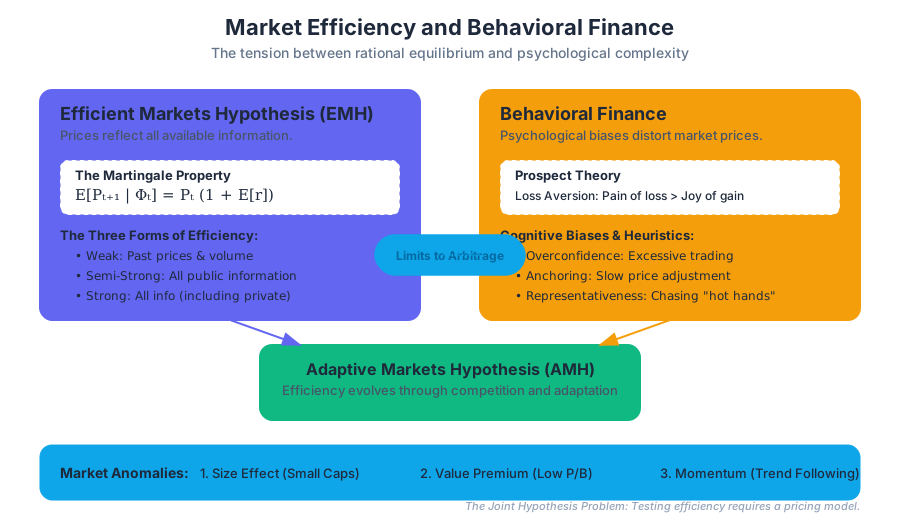
In the study of financial economics, the tension between market efficiency and human psychology represents one of the most profound intellectual divides. Traditional finance, rooted in the Efficient Markets Hypothesis (EMH), views market participants as rational "Expected Utility Maximizers" and prices as the unbiased reflection of all available information. Conversely, Behavioral Finance draws on psychology and sociology to argue that cognitive biases and emotional responses systematically distort market prices.
The modern synthesis, the Adaptive Markets Hypothesis (AMH), reconciles these views by applying the principles of evolutionary biology to financial interactions. This section explores the mechanics of these theories, the mathematical foundations of market efficiency, the psychological drivers of risk, and the empirical anomalies that continue to challenge our understanding of capital markets.
AI_SVGI_SVG## The Efficient Markets Hypothesis (EMH)
The Efficient Markets Hypothesis, formalized by Eugene Fama in 1970, asserts that financial markets are "informationally efficient." In such a market, the current price of a security is the best estimate of its intrinsic value, given the information available to the public.
1. Mathematical Foundation: The Martingale Property
At its core, the EMH implies that price changes (returns) should be unpredictable. If a price change were predictable, rational investors would trade on that information immediately, shifting the price until the advantage disappears. Mathematically, this is often expressed via the Martingale Property:
Definition: The Martingale Property A stochastic process ${P_t}$ is a martingale with respect to a sequence of information sets ${\Phi_t}$ if: $$E[P_{t+1} | \Phi_t] = P_t$$ In finance, we adjust this for the required rate of return $r$: $$E[P_{t+1} | \Phi_t] = P_t(1 + E[r])$$
This implies that the best predictor of tomorrow's price is today's price, adjusted for the expected return. Any deviation from this is "noise" or "news" ($ \epsilon_{t+1} $), which by definition is uncorrelated with past information: $$P_{t+1} = P_t(1 + E[r]) + \epsilon_{t+1}$$ where $E[\epsilon_{t+1} | \Phi_t] = 0$.
2. The Three Forms of Efficiency
Fama categorized market efficiency into three levels based on the composition of the information set $\Phi_t$:
| Form | Information Set ($\Phi_t$) | Implication |
|---|---|---|
| Weak-Form | Past prices and trading volume. | Technical analysis (charting) cannot produce alpha. |
| Semi-Strong Form | All publicly available information (earnings, news, macro data). | Fundamental analysis is already "priced in." |
| Strong-Form | All information, including private/insider information. | Even insiders cannot consistently achieve abnormal returns. |
3. The Joint Hypothesis Problem
A critical pitfall in testing the EMH is the Joint Hypothesis Problem. To determine if a market is efficient, you must use an asset pricing model (like the CAPM) to determine what the "correct" price should be. If you find an anomaly, you cannot know if the market is inefficient or if your pricing model is simply wrong.
Behavioral Finance: The Psychology of the Market
Behavioral Finance argues that because markets are populated by humans, they are subject to human frailty. It challenges the Homo Economicus model of perfect rationality.
1. Prospect Theory and Loss Aversion
Developed by Daniel Kahneman and Amos Tversky, Prospect Theory replaces the standard Utility Function with a Value Function.
- S-Shaped Curve: People are risk-averse regarding gains but risk-seeking regarding losses.
- Loss Aversion: The pain of losing $1,000 is psychologically twice as powerful as the joy of gaining $1,000.
2. Cognitive Biases and Heuristics
Investors use mental shortcuts (heuristics) that lead to systematic errors.
| Bias | Description | Market Impact |
|---|---|---|
| Overconfidence | Overestimating the precision of one's information. | Excessive trading volume and price volatility. |
| Anchoring | Over-relying on the first piece of information offered (e.g., purchase price). | Prices adjust too slowly to new information. |
| Representativeness | Assuming a small sample represents the whole (e.g., "hot hand" fallacy). | Overreaction to short-term performance (bubbles). |
| Conservatism | Being too slow to update beliefs in the face of new evidence. | Underreaction to earnings announcements. |
3. Limits to Arbitrage
If some investors are irrational, why don't rational "arbitrageurs" trade against them and push prices back to efficiency? Behavioral finance points to Limits to Arbitrage:
- Fundamental Risk: The "mispricing" might get worse before it gets better.
- Noise Trader Risk: Irrational traders may push prices even further from equilibrium, forcing arbitrageurs to liquidate positions due to margin calls.
- Implementation Costs: Commissions, bid-ask spreads, and short-sale constraints.
"The market can remain irrational longer than you can remain solvent." — John Maynard Keynes
Market Anomalies
Anomalies are empirical results that seem to contradict the EMH. They suggest that certain strategies can consistently earn "abnormal" returns (returns in excess of what is predicted by the CAPM).
1. The Size Effect (Small-Firm Effect)
Historically, small-cap stocks have outperformed large-cap stocks, even after adjusting for Beta. This suggests that the CAPM might be missing a "size risk" factor.
2. Value Premium
Stocks with low Price-to-Book (P/B) or Price-to-Earnings (P/E) ratios (Value stocks) tend to outperform stocks with high ratios (Growth stocks).
3. Momentum
The tendency for stocks that have performed well in the recent past (3–12 months) to continue performing well in the near future. This directly contradicts the Weak-Form EMH, as it implies that past prices can predict future returns.
4. Post-Earnings Announcement Drift (PEAD)
When a company releases surprisingly good earnings, the price doesn't jump to the new equilibrium immediately. Instead, it "drifts" upward for several weeks. This is a classic example of Underreaction.
AI_DEMOI_DEMO--
The Adaptive Markets Hypothesis (AMH)
Proposed by Professor Andrew Lo, the Adaptive Markets Hypothesis provides a framework to reconcile EMH with Behavioral Finance. Instead of viewing efficiency as an all-or-nothing state, AMH views it as a variable that changes over time based on the "ecology" of the market.
1. Core Principles of AMH
- Individuals are neither always rational nor always irrational; they are biological entities whose behavior is shaped by evolution.
- Individuals display biases and make sub-optimal decisions, but they learn and adapt.
- Competition, adaptation, and natural selection drive market dynamics.
- Market efficiency is not a law of nature but a product of the number of "species" (types of investors) and the resources (profit opportunities) available.
2. The Evolutionary Mechanism
In the AMH framework, investment strategies are like species. A strategy that works in a low-interest-rate environment (e.g., "Carry Trade") might go "extinct" when macro conditions change.
- Profit Opportunities: These are the "food" for investors.
- Competition: As more investors adopt a successful strategy, the "food" becomes scarce, and the market becomes more efficient.
- Innovation: When the environment changes, new strategies must evolve to survive.
3. Comparison of Frameworks
| Feature | EMH | Behavioral Finance | AMH |
|---|---|---|---|
| Market State | Always Efficient | Often Inefficient | Dynamic/Changing |
| Human Behavior | Rational | Biased/Irrational | Heuristic/Adaptive |
| Risk/Reward | Linear/Stable | Psychologically Distorted | Evolutionary/Contextual |
| Market Crashes | External Shocks | Pathological Failures | Evolutionary Adaptation |
Implementation: Simulating Market Dynamics
To understand the difference between a "Random Walk" (EMH) and a "Trending/Momentum" market (Anomaly), we can model price paths in Python.
import numpy as np
import matplotlib.pyplot as plt

def simulate_market(days=252, drift=0.0005, vol=0.01, momentum_factor=0.1):
    """
    Simulates two price paths:
    1. Pure Random Walk (EMH)
    2. Momentum-biased Walk (Behavioral/Anomaly)
    """
    # Initialize price arrays
    p_emh = np.zeros(days)
    p_mom = np.zeros(days)
    p_emh[0] = p_mom[0] = 100

    # Generate random shocks
    shocks = np.random.normal(drift, vol, days)

    for t in range(1, days):
        # EMH: Price depends only on the current shock
        p_emh[t] = p_emh[t-1] * (1 + shocks[t])

        # Momentum: Current return is influenced by the previous return
        prev_ret = (p_mom[t-1] - p_mom[t-2]) / p_mom[t-2] if t > 1 else 0
        p_mom[t] = p_mom[t-1] * (1 + shocks[t] + (momentum_factor * prev_ret))

    return p_emh, p_mom

# Visualization
emh_path, mom_path = simulate_market()
plt.figure(figsize=(10, 5))
plt.plot(emh_path, label='Efficient Market (Random Walk)')
plt.plot(mom_path, label='Momentum Market (Adaptive/Behavioral)')
plt.title("Market Efficiency vs. Momentum Anomaly")
plt.legend()
plt.show()
The Psychology of Risk
Risk is not just a mathematical standard deviation ($\sigma$); it is a physiological experience.
1. Neurofinance
Research shows that financial gains stimulate the same reward centers in the brain (the nucleus accumbens) as food or drugs. Conversely, financial losses or the threat of a crash activate the amygdala, the brain's fear center.
2. Risk vs. Uncertainty (Knightian Uncertainty)
- Risk: The outcomes are unknown, but the probability distribution is known (e.g., a roulette wheel).
- Uncertainty: The probability distribution itself is unknown (e.g., a geopolitical crisis).
Behavioral finance suggests that humans are "Ambiguity Averse"—we prefer a known risk over an unknown uncertainty, which often leads to "panic selling" during unprecedented events where probabilities cannot be calculated.
3. The Disposition Effect
This is the tendency for investors to sell winning stocks too early (to "lock in" a gain, satisfying the risk-averse part of the Prospect Theory curve) and hold losing stocks too long (to avoid "realizing" a loss, staying in the risk-seeking part of the curve).
Common Pitfalls in Market Analysis
- Confusing Luck with Skill: In a random walk, some "monkeys" will inevitably throw darts that hit the bullseye. This is the Survivor Bias.
- Data Mining: If you test enough variables against historical stock prices, you will find a "pattern" that worked in the past but has no predictive power for the future.
- Ignoring Transaction Costs: Many anomalies (like high-frequency momentum) disappear once you account for the costs of trading and taxes.
- Over-reliance on Beta: Assuming $\beta$ is the only measure of risk. The existence of the Size and Value premiums suggests that risk is multi-dimensional.
AI_QUIZI_STUDY_GUIDE--
AI Study Guide: Market Efficiency and Behavioral Finance
Key Formulas to Master
- Martingale Expectation: $E[P_{t+1} | \Phi_t] = P_t(1 + r)$
- Abnormal Return (Alpha): $\alpha_i = R_i - [R_f + \beta_i(R_m - R_f)]$
- Sharpe Ratio: $S = \frac{E[R_p - R_f]}{\sigma_p}$ (Used to evaluate if an anomaly provides better risk-adjusted returns).
Concept Checklist
- Can you explain why the "Joint Hypothesis Problem" makes it impossible to definitively prove market inefficiency?
- Do you understand the difference between "Weak-form" and "Semi-strong form" efficiency?
- Can you describe the S-shaped value function of Prospect Theory?
- How does the Adaptive Markets Hypothesis explain the disappearance of certain market anomalies over time?
- What is the "Disposition Effect" and how does it relate to loss aversion?
Summary of the "Great Debate"
- EMH (Fama): Prices are right; you can't beat the market; risk and return are linearly related.
- Behavioral (Thaler/Kahneman): Prices are wrong because people are biased; arbitrage is limited; psychology drives bubbles.
- AMH (Lo): Efficiency is an ecosystem; it fluctuates based on competition and environmental changes; "rationality" is an adaptive trait.
Source Materials
Study Finance Theory I on Lykke
This course page is free to open: signed out, you can read its first two sections, and signing in, on any plan, opens the rest. The free Lykke Chrome extension syncs your own Canvas courses, so ChatGPT, Claude and Muse can answer from your classes and deadlines. It only reads Canvas.
Add the free extensionSign in to open every section