From the free course Finance Theory I on Lykke
The Future of Finance and Society
Key concepts: AI Financial Advisors · Fiduciary Responsibility · Financial Literacy · Healthcare Finance · Global Decarbonization
Exploration of the evolving role of finance in addressing global challenges and the impact of technology.
The Future of Finance and Society
Overview
In the traditional pedagogical framework of Finance Theory I, the discipline is often presented as a set of tools for maximizing shareholder value or optimizing individual portfolios. However, as we move into the mid-21st century, the scope of financial engineering has expanded. Led by the insights of Professor Andrew Lo and the evolution of the Adaptive Markets Hypothesis (AMH), finance is increasingly viewed as a "functional" technology—a mechanism for coordinating human behavior to solve "wicked problems" that are too large for any single government or corporation to tackle alone.
This section explores the frontier where quantitative finance meets societal evolution. We examine the transition from human-centric fiduciary models to AI-driven financial advisory, the elevation of financial literacy to a fundamental human right, and the application of structured finance to existential challenges like oncology R&D and global decarbonization.
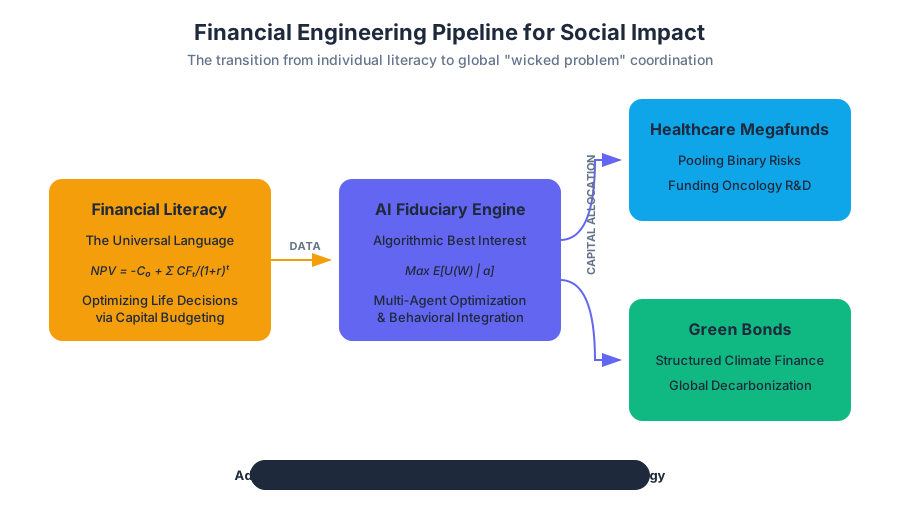
AI_SVGI_SVGThe Infographic depicts the "Financial Engineering Pipeline for Social Impact," showing the flow from individual financial literacy to AI-mediated capital allocation, leading to large-scale funding for healthcare (Megafunds) and climate (Green Bonds).*
AI Financial Advisors and the Evolution of Fiduciary Responsibility
The democratization of finance has historically been limited by the "advice gap"—the high cost of human financial advisors makes professional wealth management inaccessible to the bottom 90% of the wealth distribution. Artificial Intelligence (AI) promises to close this gap, but it introduces a profound legal and ethical challenge: Fiduciary Responsibility.
What it is
A Fiduciary Duty is a legal obligation of one party (the fiduciary) to act in the best interest of another (the principal). In finance, this traditionally involves the Prudent Person Rule, requiring advisors to manage assets with the care, skill, and diligence that a "prudent person" would exercise.
The Mechanics of AI Fiduciary
An AI financial advisor is not merely a chatbot; it is a multi-agent system that integrates a client's Utility Function $U(W)$ with real-time market data. The challenge lies in translating "best interest" into a mathematical constraint within an optimization algorithm.
Definition: The Algorithmic Fiduciary Constraint An AI agent $A$ satisfies the fiduciary constraint if, for every action $a \in \mathcal{A}$, the expected utility $E[U(W) | a]$ is maximized subject to the client's risk tolerance $\sigma_p \leq \sigma_{max}$ and specific ethical constraints (e.g., ESG preferences), without regard to the agent's own fee structure.
Comparison of Advisory Models
| Feature | Traditional Human Advisor | Robo-Advisor (Static) | AI Financial Advisor (Generative/Adaptive) |
|---|---|---|---|
| Scalability | Low (1:100 clients) | High (1:Millions) | High (1:Millions) |
| Personalization | High (Qualitative) | Low (Standardized Portfolios) | Hyper-High (Behavioral Integration) |
| Fiduciary Basis | Legal/Ethical Code | Programmatic Rules | Dynamic Optimization + Explainability |
| Cost | 1.00% - 1.50% AUM | 0.25% - 0.50% AUM | < 0.10% AUM |
| Bias | Cognitive/Emotional | Selection Bias in Data | Algorithmic/Black-box Risk |
Common Pitfalls: The "Black Box" Problem
The primary risk in AI-driven finance is the lack of interpretability. If a Deep Learning model shifts a client's entire portfolio into 10-year Treasuries, the fiduciary must be able to explain why. Without "Explainable AI" (XAI), the model fails the legal test of transparency required in probate and civil courts.
Financial Literacy as a Universal Language
Professor Andrew Lo often describes finance as a "universal language" for navigating life's trade-offs. In this view, financial literacy is not just about balancing a checkbook; it is about understanding the Time Value of Money (TVM) and Risk-Adjusted Returns in every life decision.
The NPV of Life Decisions
Most major life milestones—choosing a college major, buying a home, or selecting a healthcare plan—are essentially Capital Budgeting problems.
Worked Example: The NPV of a Graduate Degree Consider a professional deciding whether to pursue an MBA.
- Cost ($C_0$): $150,000 (Tuition + Opportunity Cost of lost salary).
- Incremental Salary ($CF$): $40,000 per year for 30 years.
- Discount Rate ($r$): 6% (reflecting the risk of the career path).
$$NPV = -150,000 + \sum_{t=1}^{30} \frac{40,000}{(1.06)^t}$$
Using the annuity formula: $$NPV = -150,000 + 40,000 \left[ \frac{1 - (1.06)^{-30}}{0.06} \right]$$ $$NPV = -150,000 + 40,000(13.76) = -150,000 + 550,400 = $400,400$$
A positive NPV suggests the investment is financially sound. However, financial literacy requires adjusting for idiosyncratic risk (e.g., the probability of not completing the degree).
Financial Literacy Framework
| Concept | Societal Application | Individual Misconception |
|---|---|---|
| Compounding | Retirement Security | Underestimating the "cost of waiting" |
| Diversification | Labor Market Resilience | "Putting all eggs" in a single company stock |
| Inflation | Purchasing Power Protection | Confusing nominal gains with real gains |
| Leverage | Home Ownership/Education | Viewing debt only as a burden, not a tool |
Healthcare Finance: The "Megafund" Revolution
One of the most significant applications of Finance Theory I is in the realm of biomedical R&D. The current "Valley of Death" in drug development occurs because individual biotech projects have a high probability of failure, making them unappealing to traditional equity investors.
The Problem: Binary Risk
A single oncology drug trial has a success probability ($p$) of roughly 5-10%. For a venture capitalist, this is a "binary bet" with extreme volatility.
The Solution: Portfolio Theory and Securitization
By applying Portfolio Theory, we can aggregate 100 independent drug trials into a single Megafund. While any single trial is likely to fail, the portfolio as a whole has a highly predictable success rate due to the Law of Large Numbers.
Mathematical Derivation: Probability of Success in a Megafund If $n$ is the number of independent trials and $p$ is the probability of success for each, the probability of at least $k$ successes follows a Binomial Distribution. The probability of zero successes is $(1-p)^n$. Therefore, the probability of at least one success is $1 - (1-p)^n$.
For $n=100$ and $p=0.05$: $$P(\text{at least 1 success}) = 1 - (0.95)^{100} \approx 1 - 0.0059 = 99.41%$$
By pooling these risks, the Megafund can issue Research Backed Obligations (RBOs)—debt instruments that appeal to pension funds and insurance companies looking for steady, uncorrelated returns.
Implementation: A Python Simulation of Megafund Diversification
The following code demonstrates how increasing the number of independent biomedical projects reduces the variance of the outcome, making the "Megafund" investable for debt markets.
import numpy as np
import matplotlib.pyplot as plt

def simulate_megafund(n_projects, p_success, payout_per_success, cost_per_project):
    # Simulate binary outcomes for n projects
    outcomes = np.random.binomial(1, p_success, n_projects)
    total_revenue = np.sum(outcomes) * payout_per_success
    total_cost = n_projects * cost_per_project
    return total_revenue - total_cost

# Parameters
p = 0.05  # 5% success rate
cost = 100  # $100M per drug
payout = 2000 # $2B per successful drug

# Compare a small fund (5 projects) vs a Megafund (100 projects)
small_fund = [simulate_megafund(5, p, payout, cost) for _ in range(10000)]
mega_fund = [simulate_megafund(100, p, payout, cost) for _ in range(10000)]

print(f"Small Fund - Mean: {np.mean(small_fund):.2f}, StdDev: {np.std(small_fund):.2f}")
print(f"Mega Fund - Mean: {np.mean(mega_fund):.2f}, StdDev: {np.std(mega_fund):.2f}")
AI_DEMOI_DEMOThe interactive simulation allows users to adjust the probability of drug success ($p$) and the number of projects ($n$) to see how the "Efficient Frontier" of a healthcare portfolio shifts, demonstrating the point at which the portfolio becomes "investment grade."*
Global Decarbonization and the Cost of Capital
The transition to a net-zero economy is fundamentally a reallocation of capital. The "Green Premium"—the additional cost of choosing a clean technology over a fossil-fuel-based one—is often driven by the higher Cost of Capital for unproven green technologies.
Hurdle Rates and the Energy Transition
In Capital Budgeting, a project is only undertaken if its IRR exceeds the Hurdle Rate (the minimum acceptable return). Green projects (like offshore wind or green hydrogen) often have high upfront CAPEX and low OPEX, making them extremely sensitive to interest rates.
Financial Engineering Tools for Climate
To accelerate decarbonization, financial engineers use several "de-risking" mechanisms:
- Green Bonds: Fixed-income securities where the proceeds are earmarked for environmental projects. They often trade at a "Greenium" (a lower yield than equivalent brown bonds), lowering the issuer's cost of debt.
- Blended Finance: Using public or philanthropic capital to take the "first loss" position in a capital stack, thereby making the remaining tranches safe enough for institutional investors.
- Carbon Credits and Derivatives: Creating a liquid market for carbon allows firms to hedge their transition risk.
Comparison of Climate Finance Instruments
| Instrument | Primary Mechanism | Target Investor | Risk Profile |
|---|---|---|---|
| Green Bonds | Lowering $r$ via "Greenium" | Institutional (Pension/ESG) | Low (Investment Grade) |
| Venture Climate Tech | Equity funding for R&D | VC / Family Offices | High (Binary Risk) |
| Carbon Offsets | Internalizing Externalities | Corporations (Net-Zero goals) | Variable (Regulatory Risk) |
| Catastrophe Bonds | Hedging physical climate risk | Hedge Funds / Reinsurers | High (Event-driven) |
The Adaptive Markets Perspective
The common thread across these topics is the Adaptive Markets Hypothesis (AMH). Unlike the Efficient Markets Hypothesis (EMH), which assumes markets are always rational and efficient, AMH suggests that markets evolve.
- Competition and Mutation: Financial products (like the Megafund) are "mutations" that survive if they provide a better fit for the current environment (e.g., a world with high cancer rates but low interest rates).
- Ecology of Finance: The "Future of Finance" is an ecosystem where AI, regulators, and individual investors interact. When the environment changes (e.g., a global pandemic or climate shift), the financial system must adapt its valuation models.
Key Insight: The Financial Engineer as a Social Architect In the AMH framework, the financial engineer's role is not just to find alpha, but to design the "evolutionary environment" (market structures and incentives) that directs capital toward human flourishing.
AI_FLASHCARDSI_FLASHCARDS Fiduciary Duty: The legal obligation to act in the principal's best interest.
- Megafund: A large-scale investment vehicle that pools high-risk, high-reward projects (like drug trials) to achieve a predictable return through diversification.
- Greenium: The yield spread between a green bond and a conventional bond; the "discount" an issuer receives for being environmentally friendly.
- Blended Finance: The strategic use of development finance and philanthropic funds to mobilize private capital flows to emerging markets.
- Adaptive Markets Hypothesis (AMH): A theory that combines principles of evolution with financial economics to explain market behavior.
- Time Value of Money (TVM): The concept that money available at the present time is worth more than the identical sum in the future due to its potential earning capacity.
AI_QUIZI_QUIZ. True/False: A Megafund reduces the probability of a single drug trial failing. Answer: False. It reduces the impact of a single failure on the overall portfolio return, but the idiosyncratic risk of the trial remains the same. 2. Calculation: If a Green Bond has a yield of 3.8% and an identical "Brown Bond" has a yield of 4.1%, what is the "Greenium"? Answer: 30 basis points (0.30%). 3. Conceptual: Why is AI uniquely suited to solve the "advice gap" in financial literacy? Answer: Because it scales the marginal cost of personalized fiduciary advice to near zero, allowing low-net-worth individuals to access sophisticated optimization. 4. Application: In the context of the NPV of a degree, how does an increase in the discount rate ($r$) affect the decision to attend? Answer: It decreases the NPV, making the investment less attractive, as future incremental earnings are worth less in today's terms.
AI_STUDY_GUIDEI_STUDY_GUIDE*Core Learning Objectives:**
- Contrast the traditional fiduciary model with the emerging requirements for Algorithmic Fiduciary Responsibility.
- Apply the principles of Portfolio Theory (diversification, Law of Large Numbers) to non-traditional assets like biomedical R&D.
- Analyze how the cost of capital ($r$) acts as a primary lever in the global transition to sustainable energy.
- Understand the role of financial literacy as a tool for personal and societal risk management.
Key Equations to Master:
- NPV of a Life Decision: $NPV = \sum \frac{CF_t}{(1+r)^t} - Initial Investment$
- Megafund Success Probability: $P(k \geq 1) = 1 - (1-p)^n$
- Risk-Adjusted Return (Sharpe Ratio): $S = \frac{R_p - R_f}{\sigma_p}$ (Essential for comparing AI-managed portfolios).
Further Reading:
- Adaptive Markets by Andrew Lo (2017).
- "Buying Cures vs. Renting Health" - Research on the securitization of gene therapies.
- The Stern Review on the Economics of Climate Change (focus on discount rate selection).
Source Materials
Study Finance Theory I on Lykke
This course page is free to open: signed out, you can read its first two sections, and signing in, on any plan, opens the rest. The free Lykke Chrome extension syncs your own Canvas courses, so ChatGPT, Claude and Muse can answer from your classes and deadlines. It only reads Canvas.
Add the free extensionSign in to open every section