From the free course Finance Theory I on Lykke
Capital Budgeting and Corporate Investment
Key concepts: Incremental After-Tax Cash Flows · Internal Rate of Return (IRR) · Profitability Index · Depreciation Tax Shield · Project Beta
Practical application of valuation techniques to corporate decision-making and project evaluation.
Capital Budgeting and Corporate Investment
Capital budgeting is the strategic process by which a corporation determines which long-term investments or projects are worth pursuing. In the context of Finance Theory I, this represents the "Investment Decision"—the most critical driver of firm value. While the firm's financing decision determines how to pay for assets, the investment decision determines which assets to acquire in the first place.
The fundamental objective of capital budgeting is to identify projects that generate a return greater than the cost of the capital required to fund them. Mathematically, this is expressed through the maximization of Net Present Value (NPV). However, the transition from theoretical formulas to real-world application requires a rigorous understanding of cash flow estimation, tax implications, and risk adjustment.
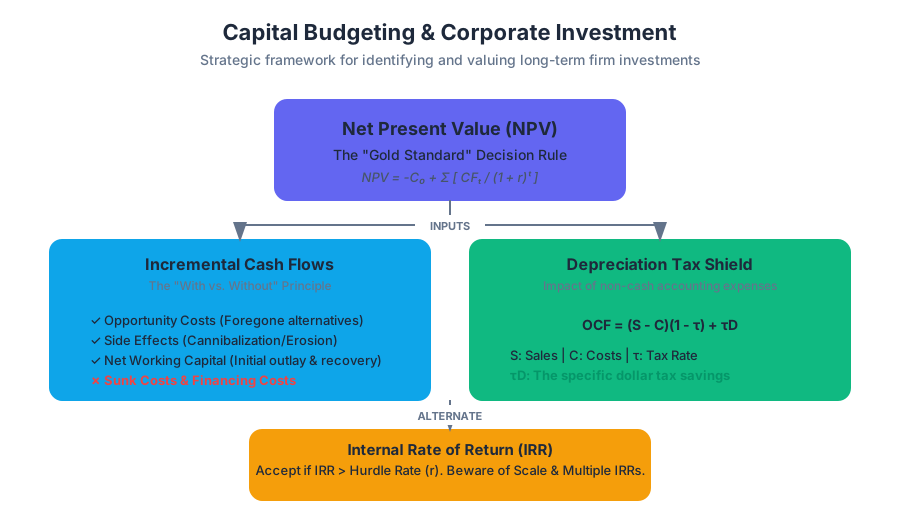
AI_SVGI_SVG## The Net Present Value (NPV) Framework
The Net Present Value (NPV) rule is the "gold standard" of capital budgeting. It states that a firm should accept all projects with a positive NPV and reject those with a negative NPV. If two projects are mutually exclusive, the firm should choose the one with the highest positive NPV.
Mathematical Definition
The NPV of a project is the sum of the present values of all its expected incremental cash flows, discounted at the appropriate risk-adjusted rate:
$$NPV = -C_0 + \sum_{t=1}^{T} \frac{CF_t}{(1 + r)^t}$$
Where:
- $C_0$ is the initial investment (outlay).
- $CF_t$ is the incremental after-tax cash flow at time $t$.
- $r$ is the discount rate (the opportunity cost of capital).
- $T$ is the project's life.
Why It Matters
NPV directly measures the expected increase in shareholder wealth. Unlike accounting metrics, NPV accounts for the Time Value of Money (TVM) and the specific risk profile of the project's cash flows. By discounting future dollars, we acknowledge that a dollar today is worth more than a dollar tomorrow, and a risky dollar is worth less than a certain one.
Incremental After-Tax Cash Flows
The most common error in capital budgeting is confusing accounting earnings with cash flows. For valuation purposes, only cash matters. Furthermore, we only care about incremental cash flows—the changes in the firm’s total cash flow that occur as a direct consequence of accepting the project.
The "With vs. Without" Principle
To identify incremental cash flows, ask: "What will the firm's total cash flows be with this project, minus what they would have been without it?"
| Feature | Include in NPV? | Reasoning |
|---|---|---|
| Sunk Costs | No | Costs already incurred (e.g., R&D, pilot studies) cannot be recovered and do not change regardless of the decision. |
| Opportunity Costs | Yes | If a project uses an existing asset (like land), the cash that asset could have generated elsewhere must be treated as a cost. |
| Side Effects | Yes | "Cannibalization" (new product reducing sales of an old one) or "Erosion" must be subtracted from the project's inflows. |
| Taxes | Yes | We only care about the cash available to distribute to investors; the government’s share is a real cash outflow. |
| Financing Costs | No | Interest and dividends are handled by the discount rate ($r$), not the cash flows. Including them in $CF_t$ would double-count the cost of capital. |
Net Working Capital (NWC)
Projects often require an initial investment in Net Working Capital (e.g., increasing inventory or accounts receivable). While these are not "expenses" in an accounting sense, they represent cash tied up in the business.
- Initial Outlay: An increase in NWC is a cash outflow.
- Project End: Usually, NWC is recovered at the end of the project's life, resulting in a final-year cash inflow.
The Depreciation Tax Shield
Depreciation is a non-cash accounting expense. You do not write a check to "Depreciation" every year. However, depreciation is tax-deductible. By reducing taxable income, depreciation reduces the actual cash paid in taxes. This effect is known as the Depreciation Tax Shield.
Derivation of After-Tax Cash Flow
Let $S$ be Sales, $C$ be Operating Costs, $D$ be Depreciation, and $\tau$ be the corporate tax rate.
- Accounting Profit (EBIT): $EBIT = S - C - D$
- Taxes Paid: $Taxes = (S - C - D) \times \tau$
- Net Income: $NI = (S - C - D) \times (1 - \tau)$
- Operating Cash Flow (OCF): $OCF = NI + D$ (Add back the non-cash expense)
By substituting (3) into (4), we get: $$OCF = (S - C - D)(1 - \tau) + D$$ $$OCF = (S - C)(1 - \tau) - D(1 - \tau) + D$$ $$OCF = (S - C)(1 - \tau) + \tau D$$
The Insight: The term $\tau D$ is the Depreciation Tax Shield. It represents the specific dollar amount saved in taxes due to the depreciation deduction.
Example: Calculating OCF
A project generates $100,000 in revenue and $40,000 in costs. Depreciation is $20,000. The tax rate is 21%.
- Method 1 (Bottom-Up): $NI = (100k - 40k - 20k) \times (1 - 0.21) = 31.6k$. $OCF = 31.6k + 20k = 51.6k$.
- Method 2 (Tax Shield): $OCF = (100k - 40k)(0.79) + (0.21 \times 20k) = 47.4k + 4.2k = 51.6k$.
Internal Rate of Return (IRR)
The Internal Rate of Return (IRR) is the discount rate that makes the NPV of a project equal to zero. It represents the project's expected percentage rate of return.
The Decision Rule
- Accept if $IRR > r$ (where $r$ is the hurdle rate/cost of capital).
- Reject if $IRR < r$.
Pitfalls of IRR
While intuitively appealing to managers, IRR has several mathematical flaws that make it secondary to NPV:
- Multiple IRRs: If a project has "non-conventional" cash flows (where the sign changes more than once, e.g., - + -), there may be multiple solutions for $IRR$. This is a result of Descartes' Rule of Signs for polynomials.
- The Scale Problem: IRR ignores the absolute dollar value. A 100% return on $1 is worse than a 10% return on $1,000,000, but IRR would rank the former higher.
- Reinvestment Assumption: IRR implicitly assumes that intermediate cash flows are reinvested at the IRR itself. NPV assumes they are reinvested at the more realistic cost of capital ($r$).
| Metric | Strengths | Weaknesses |
|---|---|---|
| NPV | Theoretically sound; accounts for scale; additive. | Harder to communicate to non-financial managers. |
| IRR | Expressed as a percentage (intuitive); easy to compare to interest rates. | Multiple solutions; scale neglect; reinvestment bias. |
AI_DEMOI_DEMO--
Profitability Index (PI)
The Profitability Index is the ratio of the present value of future cash flows to the initial investment.
$$PI = \frac{PV(\text{Future Cash Flows})}{\text{Initial Investment}} = \frac{NPV + |C_0|}{|C_0|}$$
Application: Capital Rationing
PI is particularly useful when a firm faces Capital Rationing—a limit on the total budget available for new investments. In this scenario, the goal is not just to find positive NPV projects, but to find the "biggest bang for the buck."
- Rule: Rank projects by PI and accept them in descending order until the budget is exhausted.
Project Beta and the Risk-Adjusted Discount Rate
A common mistake is using the firm's overall Weighted Average Cost of Capital (WACC) to discount all projects. However, the discount rate should reflect the risk of the project, not the risk of the firm.
If a software company (low risk) decides to invest in a gold mine (high risk), using the software WACC would lead to an overvaluation of the gold mine. We must find a Project Beta.
The "Pure Play" Method
To find the appropriate beta for a project:
- Identify "Pure Play" companies that operate solely in the project's industry.
- Unlever their equity betas to find the Asset Beta ($\beta_A$), removing the effect of their specific leverage.
- Relever the average Asset Beta using the firm's own target debt-to-equity ratio to find the project's equity beta.
Unlevering Formula (Hamada Equation): $$\beta_A = \frac{\beta_E}{1 + (1 - \tau)(D/E)}$$
Implementation in Python
The following code demonstrates a simple NPV and IRR calculation using standard financial logic.
import numpy as np
import numpy_financial as npf

def evaluate_project(cash_flows, discount_rate):
    """
    Calculates NPV, IRR, and PI for a given set of cash flows.
    cash_flows: list, where index 0 is the initial investment (negative)
    """
    npv = npf.npv(discount_rate, cash_flows)
    irr = npf.irr(cash_flows)

    # PI = PV of future flows / Initial Investment
    pv_future = npv - cash_flows[0]
    pi = pv_future / abs(cash_flows[0])

    return {
        "NPV": round(npv, 2),
        "IRR": f"{round(irr * 100, 2)}%",
        "PI": round(pi, 2)
    }

# Example: Project requiring $100k, returning $30k, $40k, $50k, $20k
project_cfs = [-100000, 30000, 40000, 50000, 20000]
r = 0.10 # 10% discount rate

results = evaluate_project(project_cfs, r)
print(f"Project Analysis: {results}")
# Output: Project Analysis: {'NPV': 13813.26, 'IRR': '16.54%', 'PI': 1.14}
Summary of Decision Rules
| Method | Decision Rule | Best Used When... |
|---|---|---|
| NPV | Accept if $> 0$ | Always. It is the most reliable metric. |
| IRR | Accept if $> r$ | Comparing projects of similar scale/timing. |
| PI | Accept if $> 1$ | Facing a constrained capital budget. |
| Payback | Accept if $< X$ years | Liquidity is the primary concern (ignores TVM). |
Common Pitfalls in Capital Budgeting
- Ignoring Inflation: If the discount rate is a nominal rate (which it usually is), the cash flow projections must also be nominal. Mixing real cash flows with nominal discount rates leads to significant undervaluation.
- Overestimating Terminal Value: Many projects assume a "perpetuity" value at the end. Small changes in the growth rate ($g$) or discount rate ($r$) in the Gordon Growth Model ($TV = \frac{CF_{T+1}}{r - g}$) can swing the NPV wildly.
- The "Pet Project" Bias: Managers may adjust cash flow estimates or discount rates to ensure their preferred project shows a positive NPV. This is why sensitivity analysis and scenario analysis are vital.
- Ignoring Real Options: NPV is a "now or never" calculation. In reality, managers have the option to expand, contract, or abandon projects based on new information. Traditional NPV often underestimates the value of projects with high flexibility.
Source Materials
Study Finance Theory I on Lykke
This course page is free to open: signed out, you can read its first two sections, and signing in, on any plan, opens the rest. The free Lykke Chrome extension syncs your own Canvas courses, so ChatGPT, Claude and Muse can answer from your classes and deadlines. It only reads Canvas.
Add the free extensionSign in to open every section