From the free course English Composition II: Rhetorical Methods–Based on Lykke
Thesis Statement Formulation
Key concepts: Debatable Claims · Working Thesis · Argumentative Scope
Crafting the central argument of an academic essay to provide direction and purpose.
Thesis Statement Formulation
In the architecture of academic writing, the Thesis Statement serves as the primary load-bearing structure. It is not merely a sentence at the end of an introduction; it is a high-density distillation of an entire argumentative trajectory. To formulate a thesis is to commit to a specific intellectual position, establishing the boundaries of inquiry and the "contract" between the writer and the reader.
Definition: The Thesis Statement A thesis statement is a concise, declarative sentence (or sentences) that encapsulates the central argument of an essay. It functions as a roadmap for the reader and a constraint for the writer, ensuring that every subsequent paragraph serves to validate, extend, or nuance the core claim.
The Anatomy of a Debatable Claim
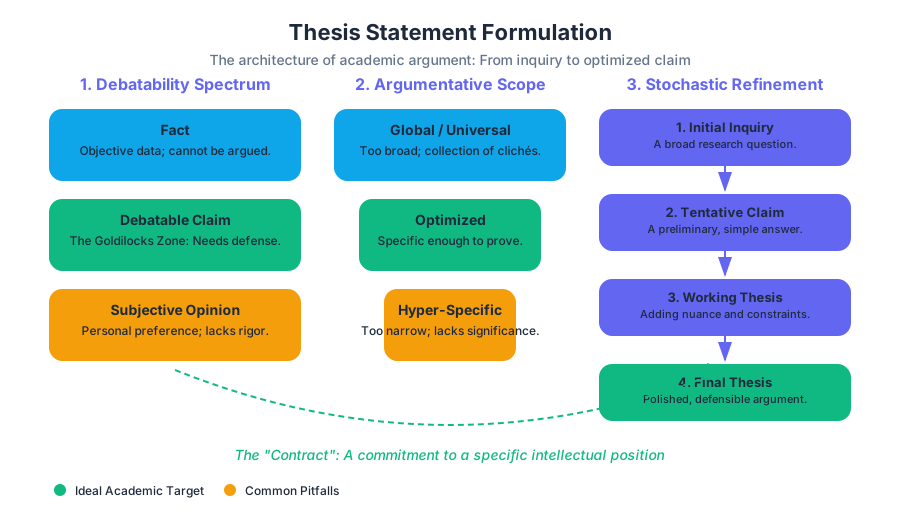
The most fundamental requirement of a thesis is that it must be debatable. In an academic context, a claim that is universally accepted as fact (e.g., "The Earth revolves around the Sun") or a matter of pure subjective preference (e.g., "Oranges taste better than apples") cannot serve as a thesis. A true thesis exists in the "Goldilocks Zone" of discourse: it must be supported by evidence, yet open to reasonable disagreement.
Distinguishing Claim Types
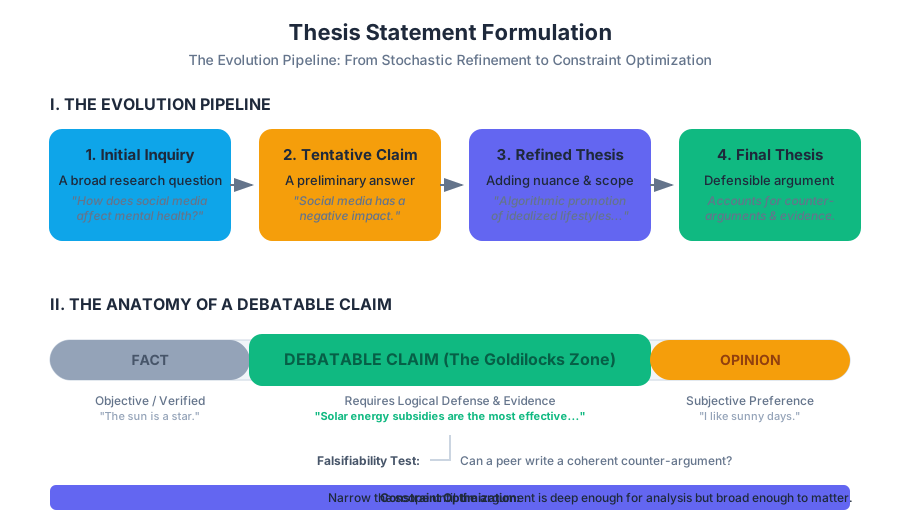
To understand the debatable claim, one must distinguish between three levels of assertion:
| Category | Definition | Example | Rhetorical Utility |
|---|---|---|---|
| Fact | A statement that can be verified through objective data or consensus. | "The Great Depression began in 1929." | Foundation for evidence; cannot be a thesis. |
| Opinion | A personal preference or belief not necessarily grounded in logic. | "The 1930s was the most boring decade." | Subjective; lacks the rigor for academic debate. |
| Debatable Claim | An interpretation of facts that requires logical defense. | "The Great Depression's length was primarily due to protectionist trade policies." | Ideal Thesis Material; invites counter-argument and analysis. |
The Falsifiability Test
A robust thesis must be falsifiable. If it is impossible to imagine a coherent counter-argument, the claim is likely a truism rather than a thesis. A professor evaluating a thesis often looks for the "Counter-Argument Potential": if a peer could write a 2,000-word essay arguing the exact opposite using the same set of facts, the thesis is sufficiently complex.
The Working Thesis: Stochastic Refinement
Rarely does a final thesis emerge fully formed in the first draft. Instead, writers employ a Working Thesis—a placeholder claim that evolves as the research process uncovers new data or reveals logical inconsistencies. This is an iterative process of stochastic refinement, where the writer moves from a broad area of interest to a specific, defensible position.
The Evolution Pipeline
- Initial Inquiry: A broad question (e.g., "How does social media affect mental health?").
- Tentative Claim: A preliminary answer (e.g., "Social media has a negative impact on teenagers' self-esteem.").
- Refined Working Thesis: Adding nuance and scope (e.g., "While social media provides community, the algorithmic promotion of idealized lifestyles contributes to increased rates of body dysmorphia among adolescent girls.").
- Final Thesis: A polished, structurally sound argument that accounts for counter-arguments.
Argumentative Scope: Constraint Optimization
The Scope of a thesis refers to the breadth of the argument. A common pitfall for novice writers is selecting a scope that is either too broad (impossible to cover in 10 pages) or too narrow (exhausted in two paragraphs). Effective scope management is an exercise in constraint optimization.
The Scope Funnel
A thesis should be narrow enough to allow for "deep-dive" analysis. If you are writing a 1,500-word paper, you cannot solve "World Hunger." You can, however, argue for the "efficacy of localized hydroponic systems in reducing food insecurity in sub-Saharan urban centers."
| Scope Level | Example | Problem |
|---|---|---|
| Global/Universal | "Education is the key to success in the modern world." | Too broad; becomes a collection of clichés. |
| Hyper-Specific | "The 2021 budget for the Springfield Elementary cafeteria was insufficient." | Too narrow; lacks broader academic significance. |
| Optimized | "The shift toward standardized testing in US public schools has inadvertently marginalized vocational training, leading to a skills gap in the labor market." | Perfect; specific enough to prove, broad enough to matter. |
Mathematical Representation of Scope
We can conceptualize the relationship between scope ($S$), evidence density ($E$), and word count ($W$) as a function of "Argumentative Depth" ($D$):
D = \frac{E}{S \cdot W}
Where:
- $S$ is the breadth of the claim (0 to 1).
- $W$ is the total word count.
- $E$ is the volume of supporting evidence.
- As $S$ (Scope) increases, $D$ (Depth) decreases unless the word count increases proportionally. To maintain high academic depth, one must minimize $S$.
Rhetorical Models for Thesis Construction
A thesis is not just a statement of "what" you believe, but "how" you intend to argue it. Different rhetorical models require different thesis structures.
The Toulmin Model
The Toulmin Model focuses on the "Warrant"—the underlying assumption that connects the evidence to the claim. A Toulmin-style thesis often includes a qualifier.
Formula: [Claim] + [Data] + [Warrant] + [Qualifier] Example: "Because [Data: student debt has reached $1.7 trillion], the federal government should [Claim: implement a tiered forgiveness program], assuming that [Warrant: economic mobility is currently stifled by debt], unless [Qualifier: inflation exceeds 5%]."
The Rogerian Model
The Rogerian Model is used for highly polarized topics where the goal is to find common ground. The thesis in a Rogerian essay often acknowledges the validity of the opposing view before introducing the writer's position.
| Component | Purpose |
|---|---|
| Introduction of Problem | Establish the issue as a shared problem. |
| Opposing View | State the "other side" fairly to build ethos. |
| Writer's Position | Introduce the claim as a synthesis or compromise. |
| Benefits to Both | Explain how the thesis solves the problem for everyone. |
Common Pitfalls in Thesis Formulation
Even experienced writers fall into traps that weaken the rhetorical velocity of their work.
- The "Announcement" Thesis: Avoid saying "In this paper, I will discuss..." This is meta-discourse. A strong thesis performs the argument rather than announcing it.
- The "Kitchen Sink" Thesis: Trying to include every single point of the essay in the thesis sentence. This leads to "cluttered" syntax. Use the Three-Pronged approach only for shorter, introductory essays; for advanced work, focus on the overarching logic.
- The "Vague Modifier": Using words like "good," "bad," "interesting," or "important." These are empty signifiers. Replace them with precise evaluative terms like "economically disruptive," "psychologically damaging," or "historically unprecedented."
Comparison: Weak vs. Strong Thesis
| Weak Thesis | Why it Fails | Strong Thesis |
|---|---|---|
| "Technology is changing how we learn." | Not debatable; too broad. | "The integration of Generative AI in primary education threatens to atrophy critical thinking skills by prioritizing output over cognitive process." |
| "I think the death penalty is wrong." | Subjective opinion; uses first-person "I". | "The application of the death penalty remains ethically untenable due to the statistical inevitability of executing innocent defendants." |
| "Shakespeare's Hamlet is a play about a prince who can't make up his mind." | Plot summary; not an argument. | "Hamlet’s indecision is not a character flaw but a calculated rhetorical strategy used to expose the corruption of the Danish court." |
Advanced Refinement: The "So What?" Test
Once a thesis is drafted, it must pass the "So What?" Test. This is the ultimate check for academic relevance. If a reader finishes your thesis and asks, "So what? Why does this matter?", the thesis has failed to establish its exigency (the urgency or importance of the argument).
To pass this test, the thesis should ideally hint at the implications of the argument.
Example Refinement: Initial: "Electric vehicles are becoming more popular." (Fails "So What?") Refined: "While the popularity of electric vehicles is rising, the environmental benefits will remain negligible unless the underlying power grid is transitioned away from coal and natural gas." (Passes "So What?" by highlighting a critical dependency).
Source Materials
Study English Composition II: Rhetorical Methods–Based on Lykke
This course page is free to open: signed out, you can read its first two sections, and signing in, on any plan, opens the rest. The free Lykke Chrome extension syncs your own Canvas courses, so ChatGPT, Claude and Muse can answer from your classes and deadlines. It only reads Canvas.
Add the free extensionSign in to open every sectionAll sections of English Composition II: Rhetorical Methods–Based · Browse more course pages