From the free course English Composition II: Rhetorical Methods–Based on Lykke
Source Integration: Quoting and Paraphrasing
Key concepts: Quoting · Paraphrasing · Summarizing · Signal Phrases
Methods for incorporating external evidence into an essay while maintaining the author's original voice.
Source Integration: Quoting and Paraphrasing
In the ecosystem of academic and technical discourse, Source Integration is the procedural framework for embedding external evidence into an original argument. Rather than merely "dropping" information into a text, integration functions as a semantic bridge, connecting the author’s unique thesis with the established consensus or data of the field. This process is governed by the metaphor of the Burkean Parlor: the writer enters a room where a complex conversation is already in progress, listens to the participants, and eventually contributes their own voice by synthesizing what has been said.
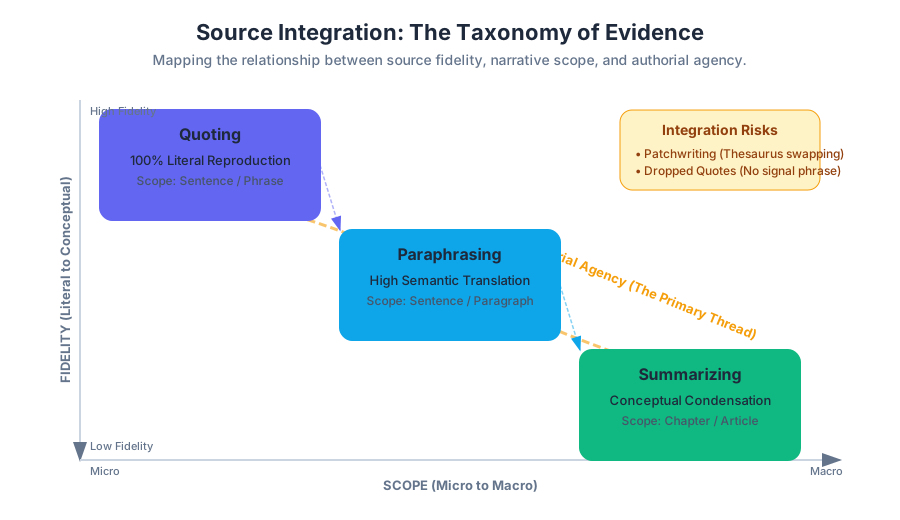
Effective integration is not a clerical task; it is a rhetorical strategy. It requires the writer to maintain authorial agency—ensuring their voice remains the "primary thread" while using external sources as "supporting fibers." Failure to integrate properly results in patchwriting or "dropped quotes," which disrupt the cognitive flow for the reader and undermine the writer's ethos.
The Taxonomy of Source Integration
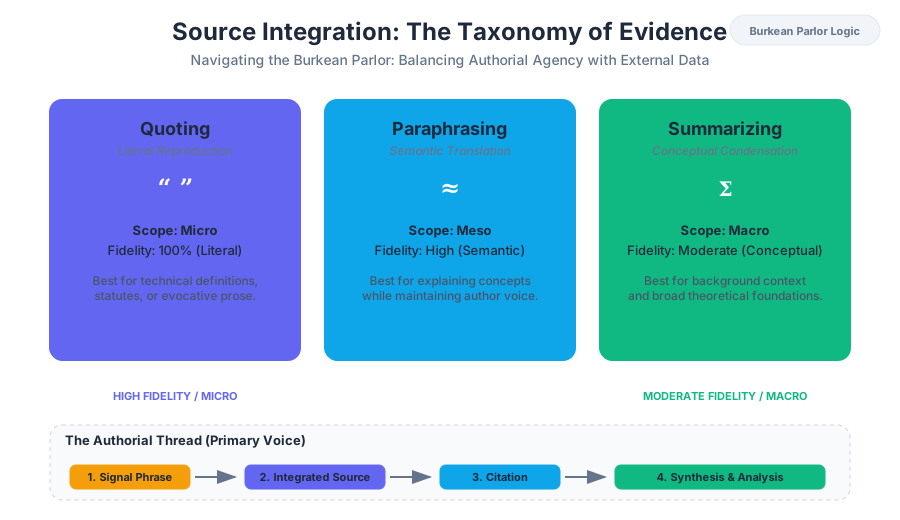
The method of integration chosen depends on the fidelity required and the granularity of the data being referenced. There are three primary modalities: Quoting, Paraphrasing, and Summarizing.
| Method | Definition | Scope | Fidelity to Original | Primary Use Case |
|---|---|---|---|---|
| Quoting | Exact transcription of source text within " " marks. |
Micro (Sentence/Phrase) | 100% (Literal) | Analyzing specific language, technical definitions, or "un-paraphrasable" prose. |
| Paraphrasing | Restating a specific passage in entirely new language. | Meso (Sentence/Paragraph) | High (Semantic) | Explaining a complex idea while maintaining the writer's own voice/style. |
| Summarizing | Condensing a large body of work into a brief overview. | Macro (Chapter/Book/Article) | Moderate (Conceptual) | Providing background context or broad theoretical foundations. |
1. Quoting: High-Fidelity Reproduction
Quoting is the literal reproduction of a source's language. In technical and academic writing, quoting is used sparingly. It is reserved for instances where the original phrasing is so precise, evocative, or authoritative that any change would result in a loss of meaning or impact.
Why It Matters
Quoting serves as "hard evidence." In a legal or technical audit, the exact wording of a statute or a specification is the only acceptable data point. Rhetorically, it allows the writer to "borrow" the ethos of an expert.
Mechanics and Implementation
To maintain the integrity of the quote while fitting it into a new sentence structure, writers use two primary tools:
- Ellipses (
...): Used to omit unnecessary parts of a quote. - Brackets (
[]): Used to insert clarifying information or adjust grammar (e.g., changing a tense to match the host sentence).
Common Pitfalls
- Dropped Quotes: Inserting a quote without a signal phrase or explanation.
- Over-Quoting: Allowing the source's voice to drown out the author's argument.
- Misrepresentation: Using ellipses to change the original intent of the author.
2. Paraphrasing: Semantic Translation
Paraphrasing is the act of translating a source's specific idea into the writer's own "voice." It is often more difficult than quoting because it requires a deep cognitive processing of the material. A successful paraphrase changes both the lexis (vocabulary) and the syntax (sentence structure).
The Mechanics of Paraphrasing
A common mistake is "thesaurus swapping," where a writer simply replaces words with synonyms. This is technically patchwriting and is often considered a form of academic dishonesty. To paraphrase correctly, one should:
- Read the passage until the core concept is understood.
- Set the source aside.
- Write the idea from memory.
- Compare the new version against the original to ensure no "accidental" phrasing remains.
Mathematical Representation of Paraphrasing
We can view paraphrasing as a function $f(x)$ that maps the semantic content $S$ of a source text $T_{src}$ to a new text $T_{dest}$ while minimizing the lexical overlap $L$.
\text{Minimize } \text{Overlap}(T_{src}, T_{dest}) = \frac{|T_{src} \cap T_{dest}|}{|T_{src} \cup T_{dest}|}
\text{Subject to } \text{SemanticSimilarity}(S(T_{src}), S(T_{dest})) \approx 1
Variations: The "Summary-Paraphrase" Hybrid
Often, writers will paraphrase a specific finding while summarizing the methodology. This allows for a high-density information transfer without the bulk of direct quotes.
3. Summarizing: Global Abstraction
Summarizing involves distilling the "essence" of a source. While a paraphrase is usually roughly the same length as the original, a summary is significantly shorter.
Why It Matters
Summarization is essential for establishing the "State of the Art" in research. If a writer is citing twenty different studies on climate change, they cannot paraphrase each one; they must summarize the collective findings to provide a macro-level view.
4. Signal Phrases: The Rhetorical Bridge
A Signal Phrase is a clause that introduces a quote or paraphrase. It serves as a "handshake" between the writer's prose and the source's data. Signal phrases provide two critical pieces of metadata:
- Identity: Who is speaking? (e.g., "According to Dr. Aris...")
- Stance: How are they speaking? (e.g., "Aris refutes the claim..." vs. "Aris concedes that...")
Rhetorical Verbs
The choice of verb in a signal phrase dictates the "temperature" of the argument.
| Verb Category | Examples | Connotation |
|---|---|---|
| Neutral | States, writes, says, notes, observes | Objective reporting of facts. |
| Argumentative | Claims, contends, argues, insists | Suggests the point is debatable. |
| Analytical | Demonstrates, illustrates, clarifies | Suggests the source is providing proof. |
| Oppositional | Denies, refutes, contradicts, rejects | Used when setting up a counter-argument. |
| Agreement | Concurs, admits, grants, concedes | Used when acknowledging a valid point from the "other side." |
5. The "Quote Sandwich": A Structural Framework
To ensure seamless integration, writers use the Quote Sandwich (also known as the ICE method: Introduce, Cite, Explain).
- The Top Bread (Introduction): A signal phrase that provides context. Never start a sentence with a quotation mark.
- The Filling (The Source): The quote, paraphrase, or summary itself, followed by an in-text citation.
- The Bottom Bread (Analysis): A sentence explaining why this source matters to your specific argument. Never end a paragraph with a quote.
Key Insight: The "Bottom Bread" is the most important part of the sandwich. It is where the writer's original thought synthesizes the evidence. If you remove the analysis, you are merely "curating" sources rather than "writing" an essay.
6. Technical Standards: MLA vs. APA
Integration is governed by style guides that dictate the formatting of citations. While the logic of integration remains the same, the "syntax" changes.
Comparison of Citation Syntax
| Feature | MLA (Modern Language Assoc.) | APA (American Psychological Assoc.) |
|---|---|---|
| Primary Field | Humanities / Literature | Social Sciences / STEM |
| In-Text Focus | Author and Page Number | Author and Year |
| Signal Phrase | "Smith argues..." | "Smith (2023) argues..." |
| Block Quote Limit | More than 4 lines of prose | 40 words or more |
| Philosophy | Focuses on the text as a static object. | Focuses on the currency of the research. |
Block Quotes
When a quote exceeds a certain length (see table above), it must be formatted as a Block Quote.
- Start on a new line.
- Indent the entire quote 0.5 inches.
- Remove quotation marks.
- Place the period before the parenthetical citation (the only exception to the standard rule).
7. Common Pitfalls and Debugging
Integration errors are often the result of "rushed" synthesis. Below are common "bugs" in the integration process and their fixes.
| Error | Description | Fix |
|---|---|---|
| The "Hit-and-Run" Quote | A quote appears suddenly without introduction. | Add a signal phrase (e.g., "As the study indicates..."). |
| The "Quote Pile-Up" | Multiple quotes in a row without intervening analysis. | Separate quotes with at least one sentence of your own commentary. |
| The "Muffled Voice" | The writer's voice disappears; the essay reads like a list of facts. | Use more paraphrasing and stronger "Bottom Bread" analysis. |
| Floating Citations | A citation at the end of a paragraph that refers to multiple sentences. | Place citations immediately after the idea they support. |
Summary of the Integration Pipeline
- Identify the Need: Do I need a specific word (Quote), a specific idea (Paraphrase), or a general context (Summary)?
- Select the Source: Choose the most authoritative evidence available.
- Construct the Lead-in: Use a signal phrase to establish the source's ethos.
- Insert and Format: Apply the correct syntax (MLA/APA) and punctuation.
- Analyze: Explicitly connect the source back to your thesis statement.
By mastering these techniques, a writer moves from being a "consumer" of information to a "synthesizer" of knowledge, capable of navigating complex academic and professional conversations with precision and authority.
Source Materials
Study English Composition II: Rhetorical Methods–Based on Lykke
This course page is free to open: signed out, you can read its first two sections, and signing in, on any plan, opens the rest. The free Lykke Chrome extension syncs your own Canvas courses, so ChatGPT, Claude and Muse can answer from your classes and deadlines. It only reads Canvas.
Add the free extensionSign in to open every sectionAll sections of English Composition II: Rhetorical Methods–Based · Browse more course pages