English Composition II: Rhetorical Methods–Based
Institution: MIT
19 study materials · 5 sections
English Composition II: Rhetorical Methods–Based is an advanced writing course designed to refine students' critical reading and academic research skills. The curriculum focuses on sophisticated rhetorical frameworks, including the Toulmin and Rogerian models, to analyze and construct persuasive arguments. Students will master the formal research process, from formulating inquiry-based questions to the precise integration and citation of external sources using MLA and APA standards.
Course Sections
Rhetorical Analysis: Toulmin and Rogerian Models
Key concepts: Toulmin Model · Rogerian Model · Critical Reading · Rhetorical Appeals
An exploration of advanced rhetorical frameworks used to analyze and build persuasive arguments.
Rhetorical Analysis: Toulmin and Rogerian Models
Rhetorical analysis is the formal "reverse engineering" of human persuasion. It is the systematic study of how writers and speakers use language to influence an audience, move them to action, or achieve a specific consensus. In the context of advanced composition and critical discourse, rhetorical analysis moves beyond identifying simple literary devices to evaluating the structural integrity and psychological efficacy of an argument.
At its core, rhetorical analysis asks not just what is being said, but how it is being said, to whom, and for what purpose. To navigate this complexity, scholars rely on two primary architectural frameworks: the Toulmin Model, which prioritizes logical rigor and structural completeness, and the Rogerian Model, which prioritizes empathy, common ground, and conflict resolution.
The Foundations: Rhetorical Appeals and Critical Reading
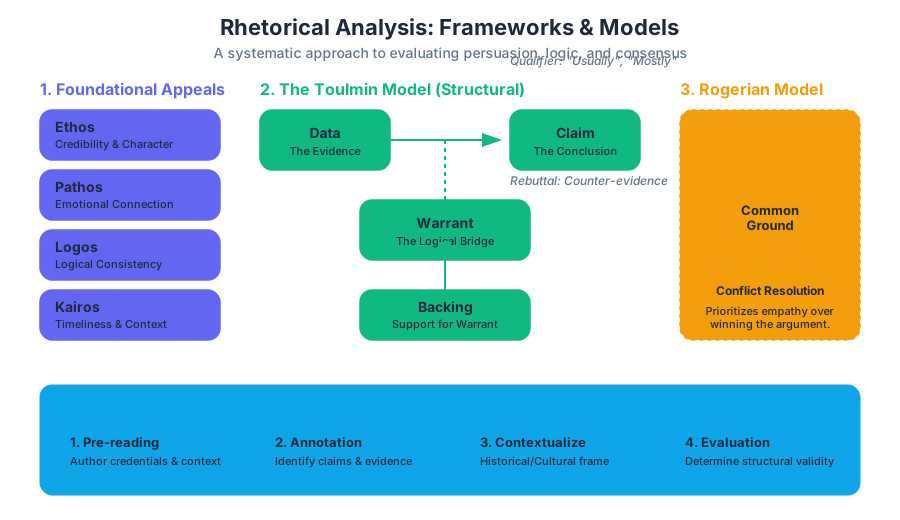
Before deploying specific models like Toulmin or Rogerian, an analyst must master the foundational Rhetorical Appeals. These are the primary "modes of persuasion" identified by Aristotle, serving as the raw materials from which all arguments are built.
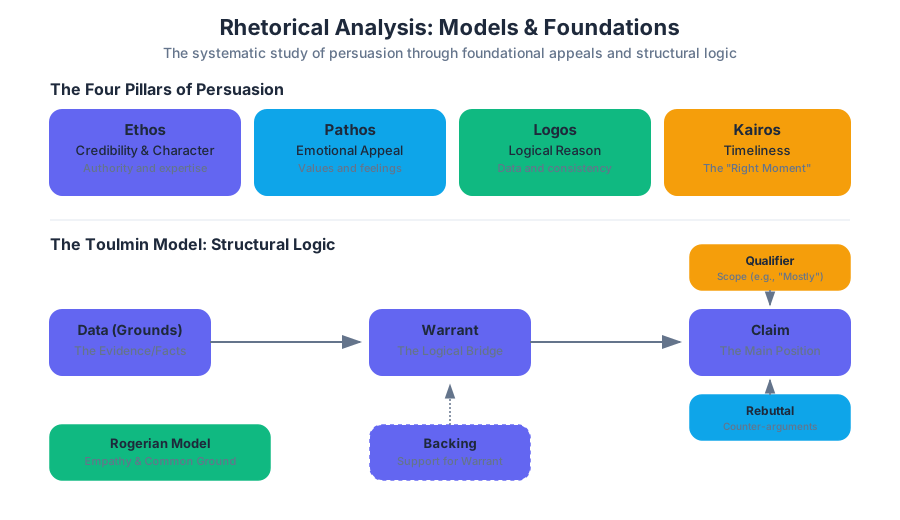
The Four Pillars of Persuasion
| Appeal | Greek Term | Primary Focus | Mechanism of Action |
|---|---|---|---|
| Ethos | Ethics / Character | Credibility of the speaker | Establishing authority, expertise, and moral standing. |
| Pathos | Emotion / Suffering | Audience's feelings | Leveraging empathy, fear, anger, or joy to bypass logical resistance. |
| Logos | Logic / Reason | The internal consistency of the message | Using data, statistics, syllogisms, and inductive reasoning. |
| Kairos | Timeliness / Opportunity | The "Right Moment" | Identifying the specific cultural or temporal window where an argument is most effective. |
Critical Reading: The Analytical Pipeline
Critical Reading is the active, skeptical, and systematic process of evaluating a text. It is the prerequisite for any rhetorical analysis. Unlike passive reading, which seeks to absorb information, critical reading seeks to interrogate the author's intent and the text's structural validity.
Definition: Critical Reading The process of analyzing a text to understand its purpose, audience, and the effectiveness of its rhetorical strategies. It involves identifying the thesis, evaluating evidence, and detecting underlying biases or logical fallacies.
The critical reading pipeline generally follows these stages:
- Pre-reading: Assessing the author’s credentials and the publication context.
- Annotation: Identifying the core claim and the supporting evidence in real-time.
- Contextualization: Placing the text within its historical and cultural framework.
- Evaluation: Determining if the evidence provided actually supports the claim made.
# A Pythonic representation of a Rhetorical Analysis Pipeline
class RhetoricalAnalyzer:
    def __init__(self, text, author_metadata):
        self.text = text
        self.metadata = author_metadata
        self.appeals = {"ethos": 0, "pathos": 0, "logos": 0}
        self.validity_score = 0.0

    def extract_claims(self):
        """Identifies primary and secondary assertions in the text."""
        # Logic to parse sentences for modal verbs and assertive structures
        pass

    def evaluate_ethos(self):
        """Checks author credentials against a credibility database."""
        if self.metadata['peer_reviewed'] and self.metadata['h_index'] > 20:
            self.appeals['ethos'] += 0.8
        return self.appeals['ethos']

    def calculate_logical_consistency(self, data_points, warrants):
        """Simulates the Toulmin check for data-to-claim mapping."""
        for data in data_points:
            if data in warrants:
                self.validity_score += 1.0
        return self.validity_score

# Example usage:
analyzer = RhetoricalAnalyzer(text="Climate change requires immediate policy shifts...",
                              author_metadata={'h_index': 45, 'peer_reviewed': True})
print(f"Ethos Score: {analyzer.evaluate_ethos()}")
The Toulmin Model: Architectural Persuasion
Developed by British philosopher Stephen Toulmin in his 1958 book The Uses of Argument, the Toulmin Model is a practical method for breaking an argument down into its constituent parts. Toulmin argued that formal logic (syllogisms) was often too rigid for "real-world" arguments, which are frequently based on probability rather than absolute certainty.
The Six Components of Toulmin
The Toulmin Model consists of three mandatory components and three optional (but highly recommended) components that add nuance and strength.
| Component | Definition | Function |
|---|---|---|
| Claim | The main point or position. | The "destination" of the argument. |
| Data (Grounds) | The evidence or facts. | The "fuel" that powers the claim. |
| Warrant | The underlying assumption. | The "bridge" connecting Data to Claim. |
| Backing | Support for the warrant. | Provides authority to the bridge. |
| Counterclaim / Rebuttal | Acknowledgement of opposing views. | Pre-empts criticism to strengthen the core logic. |
| Qualifier | Limits to the claim (e.g., "mostly," "usually"). | Defines the scope of the argument's validity. |
The Mechanics of the Warrant
The Warrant is the most critical and often the most invisible part of an argument. It is the logical connection that allows the reader to move from the evidence to the conclusion. If the audience does not accept the warrant, the entire argument collapses, regardless of how much data is provided.
\text{Data: "The streets are wet."} \\
\text{Claim: "It rained recently."} \\
\text{Warrant: "Wet streets are typically caused by rain."} \\
\text{Backing: "Meteorological records show rain is the primary cause of surface moisture in this region."} \\
\text{Qualifier: "In most cases (unless a fire hydrant burst)."}
Common Pitfalls in Toulmin Analysis
- Confusing Data and Backing: Data supports the claim; Backing supports the warrant.
- Implicit Warrants: Writers often leave warrants unstated, assuming the audience shares their worldview. A critical analyst must "surface" these hidden assumptions.
- Over-generalization: Failing to use a Qualifier makes an argument fragile. If you say "All X are Y," a single counter-example destroys your claim.
The Rogerian Model: Empathetic Synthesis
The Rogerian Model, derived from the work of psychologist Carl Rogers, represents a radical departure from traditional "adversarial" argumentation. While Toulmin seeks to prove a point, Rogerian strategies seek to solve a conflict.
Why It Matters: The Backfire Effect
In highly polarized environments, presenting hard facts often causes people to dig into their existing beliefs—a phenomenon known as the "Backfire Effect." The Rogerian model bypasses this by reducing the "threat" to the audience's identity.
The Rogerian Workflow
The goal is to reach a Consensus or a "Win-Win" scenario. The structure is as follows:
- Introduction: State the problem as a shared challenge.
- Summary of Opposing Views: Describe the "other side" with such accuracy and neutrality that they would agree with your description. This builds massive Ethos.
- Statement of Contexts: Acknowledge the specific situations where the opposing view is valid.
- Statement of Your Position: Present your view clearly but without aggression.
- Statement of Contexts (Your View): Explain where your view is most applicable.
- Statement of Benefits: Show how the opposing side would benefit from adopting elements of your position.
Comparison: Toulmin vs. Rogerian
| Feature | Toulmin Model | Rogerian Model |
|---|---|---|
| Primary Goal | To prove a claim is logically sound. | To find common ground and reduce conflict. |
| View of Audience | A neutral judge to be convinced. | A person with valid concerns to be understood. |
| Tone | Objective, assertive, structured. | Empathetic, diplomatic, collaborative. |
| Best Use Case | Scientific papers, legal briefs, policy debates. | Sensitive social issues, marital counseling, negotiations. |
| Risk | Can alienate those who disagree. | Can be seen as "weak" or compromising on truth. |
# A Rogerian Negotiation State Machine
negotiation_context:
  topic: "Remote Work Policy"
  parties:
    - role: "Management"
      concerns: ["Productivity", "Company Culture", "Facility Costs"]
    - role: "Employees"
      concerns: ["Work-Life Balance", "Commute Time", "Autonomy"]

rogerian_strategy:
  step_1_shared_goal: "Ensuring company success while maintaining employee well-being."
  step_2_neutral_summary: "Management values the collaborative energy of an in-person office."
  step_3_validation: "In-person meetings are indeed superior for high-stakes brainstorming."
  step_4_propose_synthesis: "A hybrid model (3 days in, 2 days out)."
  step_5_mutual_benefit: "Reduced overhead for management; increased retention for employees."
Research Methodology and Source Integration
Rhetorical analysis is not performed in a vacuum; it requires a robust Research Methodology. This involves formulating a research question, gathering peer-reviewed sources, and integrating them into a coherent argument using citation standards like MLA or APA.
The Thesis Statement Formulation
A strong rhetorical thesis is not a statement of fact, but an evaluative assertion.
- Weak Thesis: "The author uses many emotional appeals."
- Strong Thesis: "By leveraging the audience's fear of economic instability (Pathos) and grounding his claims in Department of Labor statistics (Logos), the author successfully creates a sense of urgency that outweighs his lack of personal expertise (Ethos)."
Source Integration: Quoting and Paraphrasing
Effective integration ensures that the "Backing" for your "Warrants" is seamless.
- Quoting: Used when the specific language of the source is essential for the analysis.
- Paraphrasing: Used to summarize complex data points or long arguments in your own voice.
- The "Quote Sandwich":
- Introduction: Introduce the source and context.
- The Quote: The evidence itself.
- Analysis: Explain how this quote supports your specific claim.
Citation Standards
| Feature | MLA (Modern Language Assoc.) | APA (American Psychological Assoc.) |
|---|---|---|
| Primary Field | Humanities, Literature, Arts. | Social Sciences, Education, Psychology. |
| In-Text Focus | Author and Page Number (Smith 42). |
Author and Year (Smith, 2023). |
| End Reference | "Works Cited" | "References" |
| Emphasis | Focuses on who wrote it and where. | Focuses on when it was written (currency of data). |
-- A conceptual database schema for managing sources in a Rhetorical Project
CREATE TABLE Sources (
    source_id INT PRIMARY KEY,
    author_name VARCHAR(255),
    publication_year INT,
    title TEXT,
    rhetorical_function VARCHAR(50), -- e.g., 'Data', 'Backing', 'Counter-argument'
    citation_style VARCHAR(10),      -- 'MLA' or 'APA'
    credibility_rating DECIMAL(3,2)  -- 0.0 to 1.0 based on peer review status
);

INSERT INTO Sources (author_name, publication_year, title, rhetorical_function, citation_style, credibility_rating)
VALUES ('Toulmin, Stephen', 1958, 'The Uses of Argument', 'Theoretical Framework', 'MLA', 0.99);
Common Pitfalls in Rhetorical Analysis
- Summary vs. Analysis: The most common mistake is simply summarizing what the author said rather than analyzing how they said it. If your essay reads like a book report, you are missing the rhetorical layer.
- Appeal Misidentification: Labeling every mention of a fact as "Logos" or every mention of a feeling as "Pathos." Analysis requires looking at the intent. A fact used solely to scare someone is actually a Pathos-driven use of data.
- Ignoring the Audience: An argument that works for a group of nuclear physicists will likely fail for a group of middle-school students. You cannot analyze a text without defining its Target Audience.
- The "Checklist" Approach: Treating the Toulmin model as a checklist to be filled out rather than a dynamic system of relationships. The magic happens in the interaction between the Warrant and the Data.
Conclusion: The Synthesis of Logic and Empathy
Mastering the Toulmin and Rogerian models transforms a writer from a mere communicator into a strategic architect of discourse. The Toulmin model provides the structural integrity necessary for academic and professional rigor, ensuring that every claim is anchored in sound reasoning and verifiable data. Conversely, the Rogerian model provides the emotional intelligence required to navigate the complexities of human psychology, turning potential conflicts into opportunities for collaboration.
By integrating these models with a deep understanding of rhetorical appeals and rigorous research methodologies, analysts can deconstruct the most persuasive texts in the world—and, more importantly, construct their own.
Research Methodology and Proposals
Key concepts: Research Questions · Research Proposals · Primary vs. Secondary Sources · Inquiry-Based Writing
The foundational steps of the formal research process, focusing on inquiry and planning.
Research Methodology and Proposals
In the landscape of higher academia, research is not merely the act of "looking things up." It is a systematic process of inquiry designed to contribute new knowledge or re-evaluate existing paradigms within a specific field. This section explores the rigorous frameworks required to move from a vague interest to a structured, defensible research project. We will examine the mechanics of the Research Question, the structural requirements of the Research Proposal, the hierarchy of Primary and Secondary Sources, and the shift toward Inquiry-Based Writing.
The Architecture of Inquiry: From Topic to Question
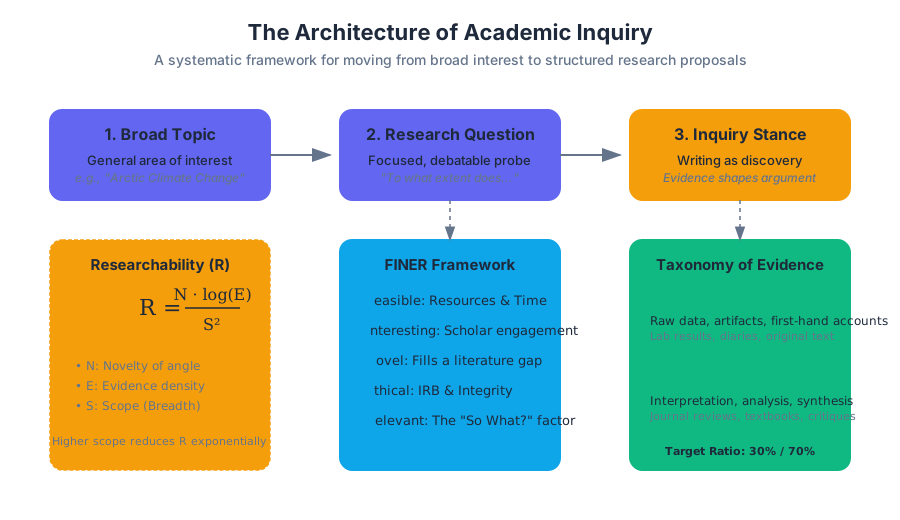
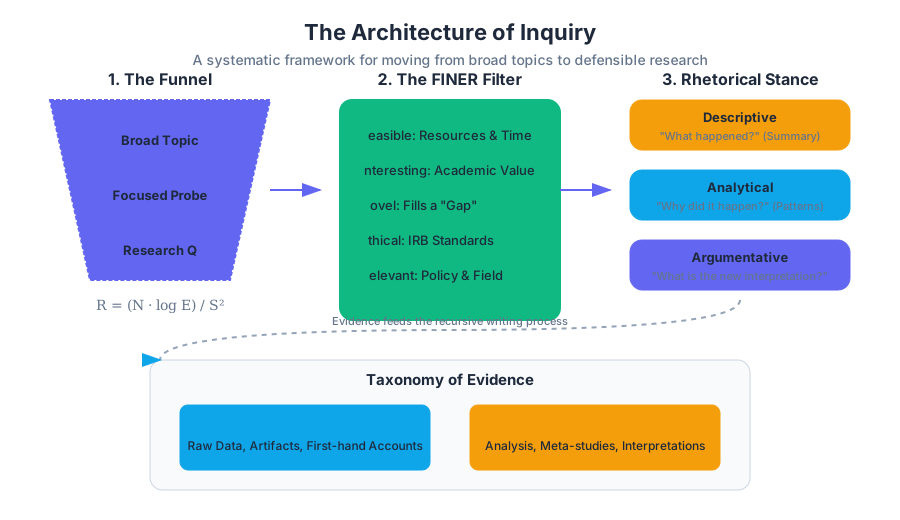
The most common failure in undergraduate and early-career research is the confusion between a topic and a research question. A topic is a broad area of interest (e.g., "Climate Change in the Arctic"); a research question is a focused, debatable, and researchable probe into that topic (e.g., "To what extent has the acceleration of permafrost melt in the Mackenzie River Basin affected the local indigenous food security between 2010 and 2020?").
The FINER Framework
To evaluate the viability of a research question, scholars often employ the FINER criteria. A question that fails any of these benchmarks likely requires refinement before a proposal can be drafted.
| Criterion | Description | Requirement |
|---|---|---|
| Feasible | Can the project be completed with available resources, time, and expertise? | Access to data, funding, and technical skills. |
| Interesting | Does the question capture the interest of the researcher and the academic community? | Avoids "reinventing the wheel." |
| Novel | Does it provide new insights or confirm/refute previous findings in a new context? | Addresses a "gap" in the literature. |
| Ethical | Does the study meet institutional review board (IRB) standards? | Protection of human subjects and data integrity. |
| Relevant | Does it matter to the field, to policy, or to future research? | Clear "So What?" factor. |
Mathematical Representation of Inquiry
We can conceptualize the "Researchability" ($R$) of a question as a function of its scope ($S$), the density of available evidence ($E$), and the novelty ($N$) of the proposed angle.
R = \frac{N \cdot \log(E)}{S^2}
In this heuristic model, as the Scope ($S$) increases (becoming too broad), the researchability drops exponentially. Conversely, a high degree of Novelty ($N$) and a robust (but not overwhelming) Evidence Base ($E$) maximize the potential for a successful project.
Inquiry-Based Writing
Inquiry-Based Writing is a rhetorical stance where the writer functions as an investigator rather than a judge. In traditional "thesis-first" writing, a student might decide on a conclusion and then cherry-pick evidence to support it. In inquiry-based writing, the conclusion is the result of the research process.
Definition: Inquiry-based writing is a recursive process where the act of writing helps the researcher discover what they think, allowing the evidence to shape the final argument rather than the other way around.
The Transition from Reporting to Arguing
A research paper is not a "book report." It must move beyond the descriptive (what happened) to the analytical (why it happened) and the argumentative (what should be done or how we should understand it).
| Level | Goal | Example Phrasing |
|---|---|---|
| Descriptive | Summarize known facts. | "The study shows that X leads to Y." |
| Analytical | Identify patterns and causes. | "The correlation between X and Y suggests a breakdown in Z." |
| Argumentative | Propose a new interpretation. | "While previous scholars argue X, the data indicates that Y is actually the primary driver." |
The Taxonomy of Evidence: Primary vs. Secondary Sources
A researcher’s methodology is defined by how they interact with evidence. The distinction between Primary and Secondary sources is not about the format (e.g., a book vs. a website) but about the source's relationship to the event or data.
Primary Sources
A primary source is an "artifact" or "first-hand account." It is the raw data of the research world.
- Science: Raw lab results, sensor data, field notes.
- History: Diaries, original treaties, photographs from the era.
- Literature: The novel or poem itself being analyzed.
Secondary Sources
A secondary source provides interpretation, analysis, or synthesis of primary data.
- Science: A meta-analysis or a review article in a journal.
- History: A textbook written in 2024 about the French Revolution.
- Literature: A peer-reviewed journal article discussing the themes of The Great Gatsby.
Data Management for Researchers
In modern research, managing these sources requires programmatic rigor. Below is a Python implementation of a simple Source Diversity Analyzer, which helps a researcher ensure they aren't over-relying on a single type of evidence.
import json
from collections import Counter

def analyze_source_composition(bibliography_file):
    """
    Analyzes the ratio of primary to secondary sources in a research project.
    Expects a JSON file with source metadata.
    """
    with open(bibliography_file, 'r') as f:
        sources = json.load(f)

    types = [s['type'] for s in sources]
    counts = Counter(types)
    total = len(sources)

    print(f"--- Research Source Analysis (n={total}) ---")
    for s_type, count in counts.items():
        percentage = (count / total) * 100
        print(f"{s_type.capitalize()}: {count} ({percentage:.2f}%)")

    # Heuristic: Ideal academic papers often aim for a 30/70 or 40/60 split
    # depending on the field.
    if counts.get('primary', 0) / total < 0.2:
        print("Warning: Low primary source density. Research may lack original data.")

# Example usage
# analyze_source_composition('project_sources.json')
The Research Proposal: The Blueprint of Scholarship
A Research Proposal is a formal document that "pitches" the project to a committee, supervisor, or funding body. It serves as a contract of intent. If the proposal is weak, the final paper will almost certainly be structurally unsound.
Core Components of a Proposal
- The Introduction/Abstract: A high-level overview of the problem.
- The Research Question: The specific, narrow inquiry.
- The Literature Review: A summary of what is already known and where the "gap" lies.
- Methodology: A detailed explanation of how the data will be collected and analyzed.
- Significance: The "So What?"—why this research matters to the world.
Methodological Frameworks
The methodology section is the heart of the proposal. It must justify the choice of tools.
| Framework | Focus | Best For... |
|---|---|---|
| Quantitative | Numerical data, statistical significance, large $N$. | Testing hypotheses, finding correlations. |
| Qualitative | Interviews, ethnography, textual analysis. | Understanding "how" or "why," exploring lived experiences. |
| Mixed-Methods | Integration of both Quant and Qual. | Complex social problems requiring both scale and depth. |
| Rhetorical Analysis | Examining how texts persuade or construct meaning. | Analyzing political speeches, advertisements, or literature. |
Schema Design for Research Tracking
To maintain the integrity of a proposal, researchers often use relational databases to track the relationship between their Research Questions (RQs) and their Sources.
-- Schema for a Research Management System
CREATE TABLE research_questions (
    id INTEGER PRIMARY KEY,
    question_text TEXT NOT NULL,
    priority_level INT DEFAULT 1
);

CREATE TABLE sources (
    id INTEGER PRIMARY KEY,
    title TEXT NOT NULL,
    author TEXT,
    source_type VARCHAR(20) CHECK (source_type IN ('primary', 'secondary')),
    publication_year INT
);

CREATE TABLE evidence_links (
    rq_id INTEGER,
    source_id INTEGER,
    key_finding TEXT,
    FOREIGN KEY (rq_id) REFERENCES research_questions(id),
    FOREIGN KEY (source_id) REFERENCES sources(id)
);
Advanced Methodology: Rogerian and Toulmin Integration
When drafting a proposal, especially in the humanities, one must account for counter-arguments. Two primary models are used to structure this inquiry:
- The Toulmin Model: Focuses on the Warrant—the underlying assumption that connects the data to the claim. It is highly logical and effective for "hard" arguments.
- The Rogerian Model: Focuses on finding Common Ground. It is best for highly polarized topics where the goal is to build a bridge between the researcher and the skeptical reader.
Project Configuration Example
A researcher might use a configuration file to define the parameters of their inquiry before they begin writing. This ensures all team members (or the writer themselves) stay within the bounds of the methodology.
project_metadata:
  title: "Algorithmic Bias in Mid-Sized Urban Hiring"
  researcher: "Dr. A. Smith"
  version: 1.2

methodology:
  type: "Mixed-Methods"
  primary_data:
    - "Semi-structured interviews with 15 HR managers"
    - "Anonymized hiring logs (2021-2023)"
  secondary_data:
    - "Peer-reviewed literature on ML ethics"
    - "Bureau of Labor Statistics reports"

constraints:
  time_limit: "6 months"
  ethical_clearance: "IRB-2024-09"
  max_word_count: 8000
Common Pitfalls in Research Design
Even with a strong proposal, several "traps" can derail the methodology:
- The "Kitchen Sink" Question: Trying to solve a massive problem (e.g., "How to fix education") instead of a specific one (e.g., "The impact of 1:1 tablet ratios on 3rd-grade reading scores in rural Ohio").
- Confirmation Bias: Searching only for sources that support your initial hunch. A true researcher looks for disconfirming evidence.
- Methodological Mismatch: Using a qualitative approach (interviews) to try and prove a broad statistical trend, or using a quantitative approach to understand deep emotional nuances.
- The "Quote Farm" Syndrome: Integrating sources by simply "dropping" them into the text without analysis. In inquiry-based writing, the researcher must mediate between the source and the reader.
Theorem of Source Integration: For every 1 inch of quoted material, there must be at least 2 inches of original analysis. The source provides the evidence; the researcher provides the meaning.
Conclusion
Research methodology is the "operating system" of academic inquiry. By carefully constructing a Research Question that meets the FINER criteria, distinguishing between Primary and Secondary evidence, and outlining a clear Methodology in a formal Proposal, writers move from being consumers of information to producers of knowledge. This systematic approach ensures that the final output is not just a collection of facts, but a rigorous contribution to a larger scholarly conversation.
Thesis Statement Formulation
Key concepts: Debatable Claims · Working Thesis · Argumentative Scope
Crafting the central argument of an academic essay to provide direction and purpose.
Thesis Statement Formulation
In the architecture of academic writing, the Thesis Statement serves as the primary load-bearing structure. It is not merely a sentence at the end of an introduction; it is a high-density distillation of an entire argumentative trajectory. To formulate a thesis is to commit to a specific intellectual position, establishing the boundaries of inquiry and the "contract" between the writer and the reader.
Definition: The Thesis Statement A thesis statement is a concise, declarative sentence (or sentences) that encapsulates the central argument of an essay. It functions as a roadmap for the reader and a constraint for the writer, ensuring that every subsequent paragraph serves to validate, extend, or nuance the core claim.
The Anatomy of a Debatable Claim
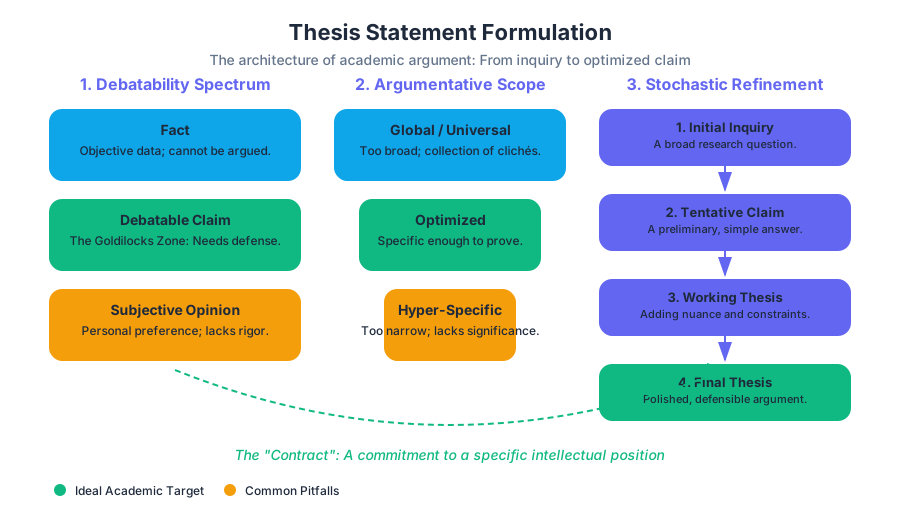
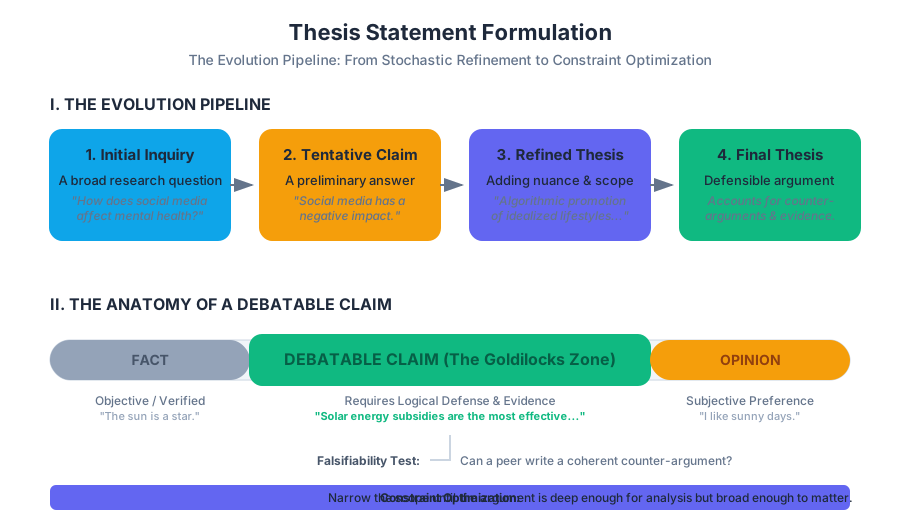
The most fundamental requirement of a thesis is that it must be debatable. In an academic context, a claim that is universally accepted as fact (e.g., "The Earth revolves around the Sun") or a matter of pure subjective preference (e.g., "Oranges taste better than apples") cannot serve as a thesis. A true thesis exists in the "Goldilocks Zone" of discourse: it must be supported by evidence, yet open to reasonable disagreement.
Distinguishing Claim Types
To understand the debatable claim, one must distinguish between three levels of assertion:
| Category | Definition | Example | Rhetorical Utility |
|---|---|---|---|
| Fact | A statement that can be verified through objective data or consensus. | "The Great Depression began in 1929." | Foundation for evidence; cannot be a thesis. |
| Opinion | A personal preference or belief not necessarily grounded in logic. | "The 1930s was the most boring decade." | Subjective; lacks the rigor for academic debate. |
| Debatable Claim | An interpretation of facts that requires logical defense. | "The Great Depression's length was primarily due to protectionist trade policies." | Ideal Thesis Material; invites counter-argument and analysis. |
The Falsifiability Test
A robust thesis must be falsifiable. If it is impossible to imagine a coherent counter-argument, the claim is likely a truism rather than a thesis. A professor evaluating a thesis often looks for the "Counter-Argument Potential": if a peer could write a 2,000-word essay arguing the exact opposite using the same set of facts, the thesis is sufficiently complex.
The Working Thesis: Stochastic Refinement
Rarely does a final thesis emerge fully formed in the first draft. Instead, writers employ a Working Thesis—a placeholder claim that evolves as the research process uncovers new data or reveals logical inconsistencies. This is an iterative process of stochastic refinement, where the writer moves from a broad area of interest to a specific, defensible position.
The Evolution Pipeline
- Initial Inquiry: A broad question (e.g., "How does social media affect mental health?").
- Tentative Claim: A preliminary answer (e.g., "Social media has a negative impact on teenagers' self-esteem.").
- Refined Working Thesis: Adding nuance and scope (e.g., "While social media provides community, the algorithmic promotion of idealized lifestyles contributes to increased rates of body dysmorphia among adolescent girls.").
- Final Thesis: A polished, structurally sound argument that accounts for counter-arguments.
Implementation: Analyzing Claim Indicators
In computational linguistics, we can identify potential thesis statements by looking for "stance markers" and "modal verbs" that indicate a claim rather than a fact.
import nltk
from nltk.tokenize import sent_tokenize

def analyze_thesis_potential(text):
    """
    Analyzes a sentence for 'claim indicators' that suggest a debatable position.
    """
    claim_indicators = [
        'should', 'must', 'because', 'although', 'however',
        'consequently', 'primary cause', 'essential', 'ineffective'
    ]

    sentences = sent_tokenize(text)
    results = []

    for sent in sentences:
        score = sum(1 for word in claim_indicators if word in sent.lower())
        # A higher score suggests a more complex, argumentative structure
        results.append({"sentence": sent, "argumentative_density": score})

    return sorted(results, key=lambda x: x['argumentative_density'], reverse=True)

# Example usage
essay_intro = "The internet was invented in the 20th century. It has changed the world. However, the centralization of web platforms should be regulated because it threatens democratic discourse."
print(analyze_thesis_potential(essay_intro))
Argumentative Scope: Constraint Optimization
The Scope of a thesis refers to the breadth of the argument. A common pitfall for novice writers is selecting a scope that is either too broad (impossible to cover in 10 pages) or too narrow (exhausted in two paragraphs). Effective scope management is an exercise in constraint optimization.
The Scope Funnel
A thesis should be narrow enough to allow for "deep-dive" analysis. If you are writing a 1,500-word paper, you cannot solve "World Hunger." You can, however, argue for the "efficacy of localized hydroponic systems in reducing food insecurity in sub-Saharan urban centers."
| Scope Level | Example | Problem |
|---|---|---|
| Global/Universal | "Education is the key to success in the modern world." | Too broad; becomes a collection of clichés. |
| Hyper-Specific | "The 2021 budget for the Springfield Elementary cafeteria was insufficient." | Too narrow; lacks broader academic significance. |
| Optimized | "The shift toward standardized testing in US public schools has inadvertently marginalized vocational training, leading to a skills gap in the labor market." | Perfect; specific enough to prove, broad enough to matter. |
Mathematical Representation of Scope
We can conceptualize the relationship between scope ($S$), evidence density ($E$), and word count ($W$) as a function of "Argumentative Depth" ($D$):
D = \frac{E}{S \cdot W}
Where:
- $S$ is the breadth of the claim (0 to 1).
- $W$ is the total word count.
- $E$ is the volume of supporting evidence.
- As $S$ (Scope) increases, $D$ (Depth) decreases unless the word count increases proportionally. To maintain high academic depth, one must minimize $S$.
Rhetorical Models for Thesis Construction
A thesis is not just a statement of "what" you believe, but "how" you intend to argue it. Different rhetorical models require different thesis structures.
The Toulmin Model
The Toulmin Model focuses on the "Warrant"—the underlying assumption that connects the evidence to the claim. A Toulmin-style thesis often includes a qualifier.
Formula: [Claim] + [Data] + [Warrant] + [Qualifier] Example: "Because [Data: student debt has reached $1.7 trillion], the federal government should [Claim: implement a tiered forgiveness program], assuming that [Warrant: economic mobility is currently stifled by debt], unless [Qualifier: inflation exceeds 5%]."
The Rogerian Model
The Rogerian Model is used for highly polarized topics where the goal is to find common ground. The thesis in a Rogerian essay often acknowledges the validity of the opposing view before introducing the writer's position.
| Component | Purpose |
|---|---|
| Introduction of Problem | Establish the issue as a shared problem. |
| Opposing View | State the "other side" fairly to build ethos. |
| Writer's Position | Introduce the claim as a synthesis or compromise. |
| Benefits to Both | Explain how the thesis solves the problem for everyone. |
Implementation: The Argument Graph
In complex research proposals, a thesis can be modeled as the "Root Node" of a directed acyclic graph (DAG). Every premise and piece of evidence is a child node that must eventually point back to the root.
-- Schema for an Argument Mapping Database
CREATE TABLE Thesis (
    thesis_id INT PRIMARY KEY,
    statement TEXT NOT NULL,
    scope_rating INT CHECK (scope_rating BETWEEN 1 AND 10)
);

CREATE TABLE Premises (
    premise_id INT PRIMARY KEY,
    thesis_id INT,
    content TEXT NOT NULL,
    evidence_type VARCHAR(50), -- 'Empirical', 'Anecdotal', 'Logical'
    FOREIGN KEY (thesis_id) REFERENCES Thesis(thesis_id)
);

-- Query to check if the thesis is supported by diverse evidence types
SELECT t.statement, COUNT(p.premise_id) as support_count
FROM Thesis t
JOIN Premises p ON t.thesis_id = p.thesis_id
WHERE p.evidence_type IN ('Empirical', 'Logical')
GROUP BY t.thesis_id
HAVING COUNT(p.premise_id) >= 3;
Common Pitfalls in Thesis Formulation
Even experienced writers fall into traps that weaken the rhetorical velocity of their work.
- The "Announcement" Thesis: Avoid saying "In this paper, I will discuss..." This is meta-discourse. A strong thesis performs the argument rather than announcing it.
- The "Kitchen Sink" Thesis: Trying to include every single point of the essay in the thesis sentence. This leads to "cluttered" syntax. Use the Three-Pronged approach only for shorter, introductory essays; for advanced work, focus on the overarching logic.
- The "Vague Modifier": Using words like "good," "bad," "interesting," or "important." These are empty signifiers. Replace them with precise evaluative terms like "economically disruptive," "psychologically damaging," or "historically unprecedented."
Comparison: Weak vs. Strong Thesis
| Weak Thesis | Why it Fails | Strong Thesis |
|---|---|---|
| "Technology is changing how we learn." | Not debatable; too broad. | "The integration of Generative AI in primary education threatens to atrophy critical thinking skills by prioritizing output over cognitive process." |
| "I think the death penalty is wrong." | Subjective opinion; uses first-person "I". | "The application of the death penalty remains ethically untenable due to the statistical inevitability of executing innocent defendants." |
| "Shakespeare's Hamlet is a play about a prince who can't make up his mind." | Plot summary; not an argument. | "Hamlet’s indecision is not a character flaw but a calculated rhetorical strategy used to expose the corruption of the Danish court." |
Advanced Refinement: The "So What?" Test
Once a thesis is drafted, it must pass the "So What?" Test. This is the ultimate check for academic relevance. If a reader finishes your thesis and asks, "So what? Why does this matter?", the thesis has failed to establish its exigency (the urgency or importance of the argument).
To pass this test, the thesis should ideally hint at the implications of the argument.
Example Refinement: Initial: "Electric vehicles are becoming more popular." (Fails "So What?") Refined: "While the popularity of electric vehicles is rising, the environmental benefits will remain negligible unless the underlying power grid is transitioned away from coal and natural gas." (Passes "So What?" by highlighting a critical dependency).
Source Integration: Quoting and Paraphrasing
Key concepts: Quoting · Paraphrasing · Summarizing · Signal Phrases
Methods for incorporating external evidence into an essay while maintaining the author's original voice.
Source Integration: Quoting and Paraphrasing
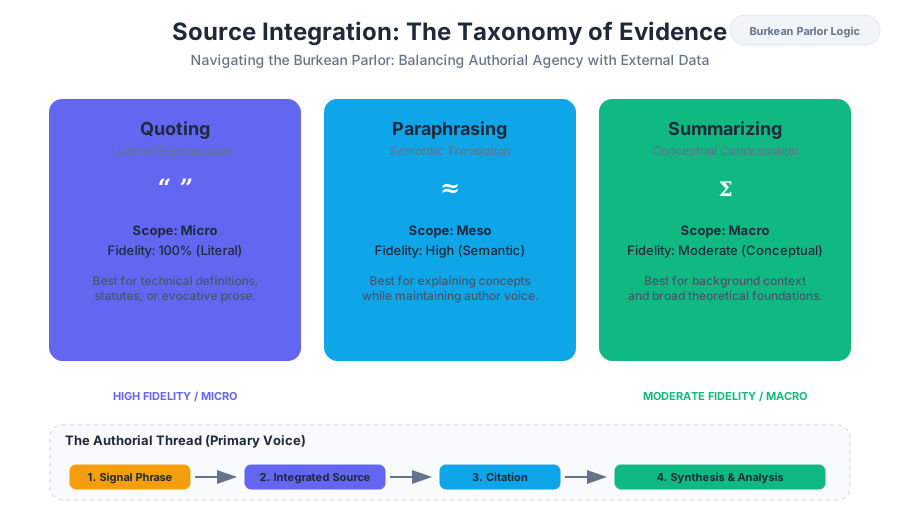
In the ecosystem of academic and technical discourse, Source Integration is the procedural framework for embedding external evidence into an original argument. Rather than merely "dropping" information into a text, integration functions as a semantic bridge, connecting the author’s unique thesis with the established consensus or data of the field. This process is governed by the metaphor of the Burkean Parlor: the writer enters a room where a complex conversation is already in progress, listens to the participants, and eventually contributes their own voice by synthesizing what has been said.
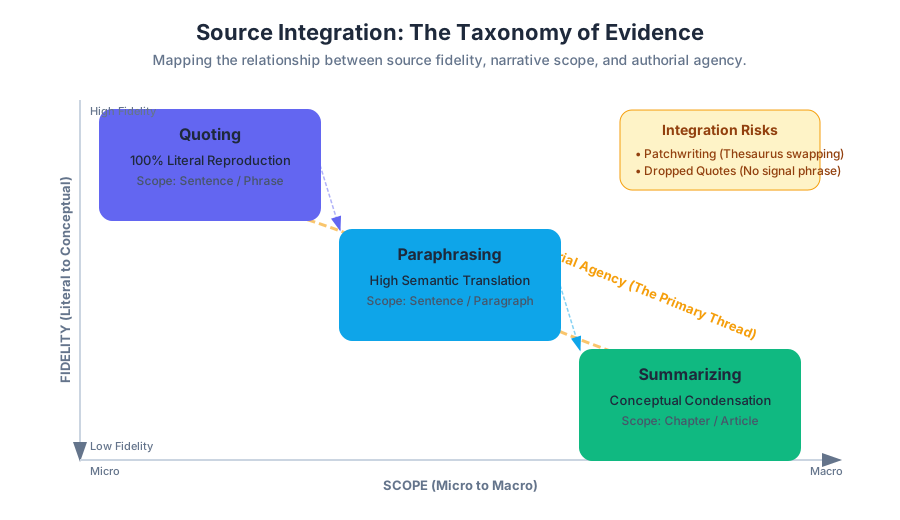
Effective integration is not a clerical task; it is a rhetorical strategy. It requires the writer to maintain authorial agency—ensuring their voice remains the "primary thread" while using external sources as "supporting fibers." Failure to integrate properly results in patchwriting or "dropped quotes," which disrupt the cognitive flow for the reader and undermine the writer's ethos.
The Taxonomy of Source Integration
The method of integration chosen depends on the fidelity required and the granularity of the data being referenced. There are three primary modalities: Quoting, Paraphrasing, and Summarizing.
| Method | Definition | Scope | Fidelity to Original | Primary Use Case |
|---|---|---|---|---|
| Quoting | Exact transcription of source text within " " marks. |
Micro (Sentence/Phrase) | 100% (Literal) | Analyzing specific language, technical definitions, or "un-paraphrasable" prose. |
| Paraphrasing | Restating a specific passage in entirely new language. | Meso (Sentence/Paragraph) | High (Semantic) | Explaining a complex idea while maintaining the writer's own voice/style. |
| Summarizing | Condensing a large body of work into a brief overview. | Macro (Chapter/Book/Article) | Moderate (Conceptual) | Providing background context or broad theoretical foundations. |
1. Quoting: High-Fidelity Reproduction
Quoting is the literal reproduction of a source's language. In technical and academic writing, quoting is used sparingly. It is reserved for instances where the original phrasing is so precise, evocative, or authoritative that any change would result in a loss of meaning or impact.
Why It Matters
Quoting serves as "hard evidence." In a legal or technical audit, the exact wording of a statute or a specification is the only acceptable data point. Rhetorically, it allows the writer to "borrow" the ethos of an expert.
Mechanics and Implementation
To maintain the integrity of the quote while fitting it into a new sentence structure, writers use two primary tools:
- Ellipses (
...): Used to omit unnecessary parts of a quote. - Brackets (
[]): Used to insert clarifying information or adjust grammar (e.g., changing a tense to match the host sentence).
Code Implementation: Citation Logic
The following Python script demonstrates a simplified logic for determining when a string requires quotation marks based on its similarity to a "source" database, simulating the logic of a plagiarism detection engine.
import difflib

def analyze_integration_type(source_text, student_text, threshold=0.9):
    """
    Determines if a text segment is a Quote, a Paraphrase, or potential Plagiarism.
    """
    sequence_matcher = difflib.SequenceMatcher(None, source_text, student_text)
    similarity_ratio = sequence_matcher.ratio()

    if similarity_ratio == 1.0:
        return "EXACT_QUOTE: Requires quotation marks and citation."
    elif similarity_ratio >= threshold:
        return "PATCHWRITING_RISK: Similarity too high. Needs more original phrasing."
    elif 0.3 <= similarity_ratio < threshold:
        return "PARAPHRASE: Ensure semantic meaning is preserved and cited."
    else:
        return "ORIGINAL_OR_SUMMARY: Low lexical overlap."

# Example Usage
source = "The integration of disparate data sources requires a robust ETL pipeline."
attempt = "The integration of disparate data sources requires a robust ETL pipeline."

print(f"Analysis: {analyze_integration_type(source, attempt)}")
Common Pitfalls
- Dropped Quotes: Inserting a quote without a signal phrase or explanation.
- Over-Quoting: Allowing the source's voice to drown out the author's argument.
- Misrepresentation: Using ellipses to change the original intent of the author.
2. Paraphrasing: Semantic Translation
Paraphrasing is the act of translating a source's specific idea into the writer's own "voice." It is often more difficult than quoting because it requires a deep cognitive processing of the material. A successful paraphrase changes both the lexis (vocabulary) and the syntax (sentence structure).
The Mechanics of Paraphrasing
A common mistake is "thesaurus swapping," where a writer simply replaces words with synonyms. This is technically patchwriting and is often considered a form of academic dishonesty. To paraphrase correctly, one should:
- Read the passage until the core concept is understood.
- Set the source aside.
- Write the idea from memory.
- Compare the new version against the original to ensure no "accidental" phrasing remains.
Mathematical Representation of Paraphrasing
We can view paraphrasing as a function $f(x)$ that maps the semantic content $S$ of a source text $T_{src}$ to a new text $T_{dest}$ while minimizing the lexical overlap $L$.
\text{Minimize } \text{Overlap}(T_{src}, T_{dest}) = \frac{|T_{src} \cap T_{dest}|}{|T_{src} \cup T_{dest}|}
\text{Subject to } \text{SemanticSimilarity}(S(T_{src}), S(T_{dest})) \approx 1
Variations: The "Summary-Paraphrase" Hybrid
Often, writers will paraphrase a specific finding while summarizing the methodology. This allows for a high-density information transfer without the bulk of direct quotes.
3. Summarizing: Global Abstraction
Summarizing involves distilling the "essence" of a source. While a paraphrase is usually roughly the same length as the original, a summary is significantly shorter.
Why It Matters
Summarization is essential for establishing the "State of the Art" in research. If a writer is citing twenty different studies on climate change, they cannot paraphrase each one; they must summarize the collective findings to provide a macro-level view.
Implementation: Automated Summarization
In modern workflows, Large Language Models (LLMs) are often used to generate initial summaries. Below is a representation of how a technical writer might use a CLI tool to summarize a local research PDF.
# Using a hypothetical CLI tool 'research-cli' to summarize a source
# --ratio 0.1 indicates a 10% compression rate

research-cli summarize ./papers/neural_networks_2023.pdf \
    --format "bullet-points" \
    --ratio 0.1 \
    --output ./notes/summary_nn.md

# Output:
# * Neural Networks show 15% efficiency gain in 2023.
# * Backpropagation remains the primary optimization bottleneck.
# * New 'Flash-Attention' layers reduce memory overhead by 40%.
4. Signal Phrases: The Rhetorical Bridge
A Signal Phrase is a clause that introduces a quote or paraphrase. It serves as a "handshake" between the writer's prose and the source's data. Signal phrases provide two critical pieces of metadata:
- Identity: Who is speaking? (e.g., "According to Dr. Aris...")
- Stance: How are they speaking? (e.g., "Aris refutes the claim..." vs. "Aris concedes that...")
Rhetorical Verbs
The choice of verb in a signal phrase dictates the "temperature" of the argument.
| Verb Category | Examples | Connotation |
|---|---|---|
| Neutral | States, writes, says, notes, observes | Objective reporting of facts. |
| Argumentative | Claims, contends, argues, insists | Suggests the point is debatable. |
| Analytical | Demonstrates, illustrates, clarifies | Suggests the source is providing proof. |
| Oppositional | Denies, refutes, contradicts, rejects | Used when setting up a counter-argument. |
| Agreement | Concurs, admits, grants, concedes | Used when acknowledging a valid point from the "other side." |
5. The "Quote Sandwich": A Structural Framework
To ensure seamless integration, writers use the Quote Sandwich (also known as the ICE method: Introduce, Cite, Explain).
- The Top Bread (Introduction): A signal phrase that provides context. Never start a sentence with a quotation mark.
- The Filling (The Source): The quote, paraphrase, or summary itself, followed by an in-text citation.
- The Bottom Bread (Analysis): A sentence explaining why this source matters to your specific argument. Never end a paragraph with a quote.
Key Insight: The "Bottom Bread" is the most important part of the sandwich. It is where the writer's original thought synthesizes the evidence. If you remove the analysis, you are merely "curating" sources rather than "writing" an essay.
6. Technical Standards: MLA vs. APA
Integration is governed by style guides that dictate the formatting of citations. While the logic of integration remains the same, the "syntax" changes.
Comparison of Citation Syntax
| Feature | MLA (Modern Language Assoc.) | APA (American Psychological Assoc.) |
|---|---|---|
| Primary Field | Humanities / Literature | Social Sciences / STEM |
| In-Text Focus | Author and Page Number | Author and Year |
| Signal Phrase | "Smith argues..." | "Smith (2023) argues..." |
| Block Quote Limit | More than 4 lines of prose | 40 words or more |
| Philosophy | Focuses on the text as a static object. | Focuses on the currency of the research. |
Block Quotes
When a quote exceeds a certain length (see table above), it must be formatted as a Block Quote.
- Start on a new line.
- Indent the entire quote 0.5 inches.
- Remove quotation marks.
- Place the period before the parenthetical citation (the only exception to the standard rule).
7. Common Pitfalls and Debugging
Integration errors are often the result of "rushed" synthesis. Below are common "bugs" in the integration process and their fixes.
| Error | Description | Fix |
|---|---|---|
| The "Hit-and-Run" Quote | A quote appears suddenly without introduction. | Add a signal phrase (e.g., "As the study indicates..."). |
| The "Quote Pile-Up" | Multiple quotes in a row without intervening analysis. | Separate quotes with at least one sentence of your own commentary. |
| The "Muffled Voice" | The writer's voice disappears; the essay reads like a list of facts. | Use more paraphrasing and stronger "Bottom Bread" analysis. |
| Floating Citations | A citation at the end of a paragraph that refers to multiple sentences. | Place citations immediately after the idea they support. |
Summary of the Integration Pipeline
- Identify the Need: Do I need a specific word (Quote), a specific idea (Paraphrase), or a general context (Summary)?
- Select the Source: Choose the most authoritative evidence available.
- Construct the Lead-in: Use a signal phrase to establish the source's ethos.
- Insert and Format: Apply the correct syntax (MLA/APA) and punctuation.
- Analyze: Explicitly connect the source back to your thesis statement.
By mastering these techniques, a writer moves from being a "consumer" of information to a "synthesizer" of knowledge, capable of navigating complex academic and professional conversations with precision and authority.
Citation Standards: MLA and APA
Key concepts: MLA Style · APA Style · In-text Citations · Works Cited/References · Academic Integrity
The technical requirements for documenting sources to ensure academic integrity.
Citation Standards: MLA and APA
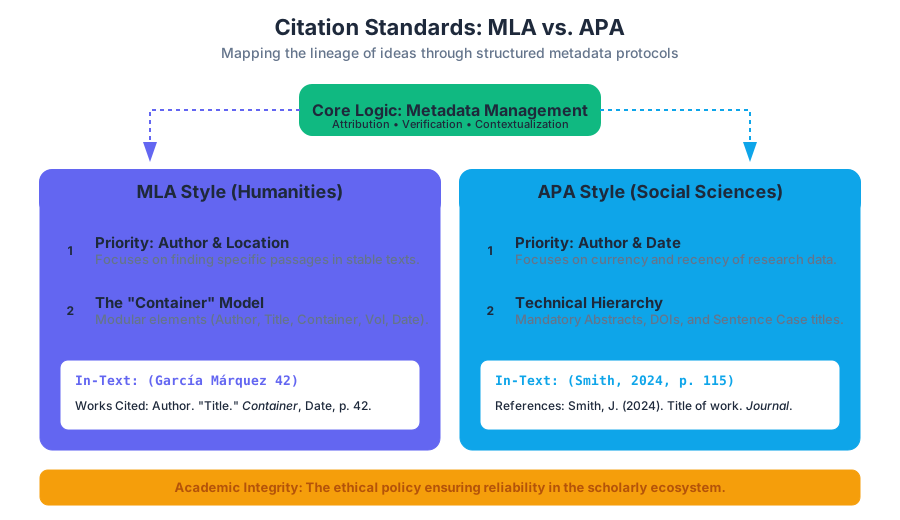
In the architecture of academic discourse, citation standards serve as the fundamental protocol for data provenance and intellectual integrity. Far from being mere stylistic preferences, these standards provide a structured framework for mapping the lineage of ideas, allowing researchers to trace the evolution of thought across disciplines. By adhering to standardized formats like those established by the Modern Language Association (MLA) and the American Psychological Association (APA), writers ensure that their work is interoperable with the broader body of scholarly literature.
The Philosophy of Documentation
At its core, academic documentation is a system of Metadata Management. Every citation acts as a pointer to a specific node in the global network of knowledge. This system serves three primary functions:
- Attribution: Giving credit to the original architects of an idea, thereby avoiding Plagiarism.
- Verification: Providing a "paper trail" that allows readers to audit the evidence and reproduce the author's reasoning.
- Contextualization: Situating the current work within a specific scholarly conversation, whether it be the interpretive traditions of the humanities or the empirical rigor of the social sciences.
Academic Integrity is the ethical policy of scholarly work, requiring that all contributors to a project's intellectual lifecycle are acknowledged. Its violation, whether intentional or through "patchwriting," compromises the reliability of the entire academic ecosystem.
MLA Style: The Humanities Protocol
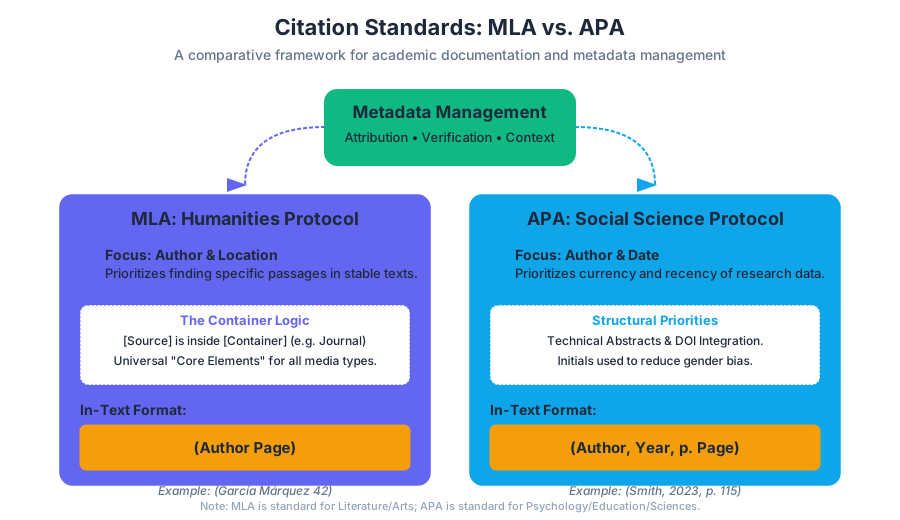
The MLA (Modern Language Association) style is the standard for literature, arts, and humanities. It is designed to prioritize the author and the location of the information within a source. Because humanities research often involves the close reading of stable texts (like novels, poems, or historical documents), the specific page number is the most critical coordinate for a reader to find the cited passage.
The Logic of the "Container"
Since the 8th edition, MLA has moved toward a modular "Container" system. Instead of having a unique rule for every possible media type (YouTube video vs. physical book), MLA uses a universal set of Core Elements.
| Element | Description | Requirement |
|---|---|---|
| Author | The primary creator(s) of the work. | Required if known. |
| Title of Source | The specific name of the work (e.g., "The Raven"). | Required. |
| Title of Container | The larger work the source is found in (e.g., The Complete Works of Poe). | Required for nested works. |
| Other Contributors | Editors, translators, or illustrators. | Optional/Contextual. |
| Version | Editions (e.g., 2nd ed.) or volumes. | If applicable. |
| Number | Issue numbers or volume numbers. | If applicable. |
| Publisher | The entity responsible for making the work available. | Required for most sources. |
| Publication Date | The date the work was released. | Required. |
| Location | Page numbers (p. or pp.), URLs, or DOIs. | Required for precision. |
MLA In-Text Citations
MLA utilizes an Author-Page system. The citation is placed as close as possible to the borrowed material, usually in parentheses before the terminal punctuation.
- Standard Format: (Author Page)
- Example: (García Márquez 42)
If the author's name is mentioned in a Signal Phrase (e.g., "García Márquez argues that..."), only the page number is required in the parentheses: (42).
APA Style: The Social Science Protocol
The APA (American Psychological Association) style is the dominant standard for the social sciences, education, and engineering. In these fields, the currency of research is paramount. A study on neurobiology from 1972 has different utility than one from 2024. Consequently, APA prioritizes the Author-Date relationship.
Structural Priorities
APA style emphasizes the hierarchy of information through specific heading levels and a highly structured "References" list. It also mandates the use of Technical Abstracts and, in many cases, a "Running Head" for professional manuscripts.
| Feature | APA Requirement | Rationale |
|---|---|---|
| Date Placement | Immediately after the author. | Highlights the age of the data. |
| Sentence Case | Titles of articles are not capitalized (except first word). | Focuses on the content over the "brand" of the title. |
| Author Initials | Uses initials instead of full first names. | Reduces gender bias and focuses on the surname. |
| DOI Integration | Digital Object Identifiers are mandatory for digital sources. | Ensures persistent linkability in digital databases. |
APA In-Text Citations
APA utilizes an Author-Date system. If a direct quote is used, a page number is also required, preceded by p. or pp..
- Standard Format: (Author, Year)
- Direct Quote: (Author, Year, p. Page)
- Example: (Smith, 2023, p. 115)
Technical Implementation: Citation as Code
From a computational perspective, a citation is a serialized string generated from a structured data object. Senior researchers often use reference management software (like Zotero or Mendeley) or markup languages like LaTeX to handle this programmatically.
1. Implementation Logic (Python)
The following script demonstrates how a citation engine might programmatically handle the logic of formatting a source based on the requested style.
class Source:
    def __init__(self, author_last, author_first, title, year, publisher, page=None):
        self.author_last = author_last
        self.author_first = author_first
        self.title = title
        self.year = year
        self.publisher = publisher
        self.page = page

    def to_mla(self):
        """Formats the source in MLA 9th Edition style."""
        page_str = f", p. {self.page}" if self.page else ""
        return f"{self.author_last}, {self.author_first}. \"{self.title}.\" {self.publisher}, {self.year}{page_str}."

    def to_apa(self):
        """Formats the source in APA 7th Edition style."""
        # Note: APA uses sentence case for titles in references
        sentence_title = self.title.capitalize()
        return f"{self.author_last}, {self.author_first[0]}. ({self.year}). {sentence_title}. {self.publisher}."

# Usage
paper_source = Source("Turing", "Alan", "Computing Machinery and Intelligence", 1950, "Mind", 433)

print(f"MLA: {paper_source.to_mla()}")
print(f"APA: {paper_source.to_apa()}")
2. Declarative Representation (BibTeX)
In technical fields, citations are often stored in a .bib file. This separates the data from the presentation, allowing the same source to be rendered in MLA, APA, or IEEE style simply by changing the stylesheet.
@article{turing1950,
  author  = {Turing, Alan M.},
  title   = {Computing Machinery and Intelligence},
  journal = {Mind},
  volume  = {LIX},
  number  = {236},
  pages   = {433--460},
  year    = {1950},
  doi     = {10.1093/mind/LIX.236.433}
}
3. CLI Transformation (Pandoc)
A senior researcher might use a command-line tool like pandoc to convert a Markdown draft into a perfectly formatted PDF, injecting citations from a library file using a specific CSL (Citation Style Language) file.
# Convert research_paper.md to PDF using APA 7th edition style
# --citeproc: processes the citations
# --bibliography: points to the source database
# --csl: defines the style (apa.csl)

pandoc research_paper.md \
    --citeproc \
    --bibliography=my_library.bib \
    --csl=apa-7th-edition.csl \
    -o final_submission.pdf
Comparative Analysis: In-Text Mechanics
The choice between MLA and APA often dictates the rhetorical flow of the paper. MLA papers tend to feel more "narrative," while APA papers feel more "analytical" and "data-centric."
Comparison of In-Text Patterns
| Scenario | MLA Format | APA Format |
|---|---|---|
| One Author | (Jones 15) | (Jones, 2021) |
| Two Authors | (Jones and Smith 15) | (Jones & Smith, 2021) |
| 3+ Authors | (Jones et al. 15) | (Jones et al., 2021) |
| No Author | (Title 15) | (Title, 2021) |
| Organization | (NASA 15) | (National Aeronautics and Space Administration [NASA], 2021) |
Source Integration: Quoting, Paraphrasing, and Summarizing
Effective citation is not just about the bibliography; it is about how the source is integrated into the writer's own prose. There are three primary methods for source integration:
- Direct Quoting: Using the exact words of the source. This is reserved for instances where the original phrasing is unique, authoritative, or subject to analysis.
- Paraphrasing: Re-stating a specific passage in one's own words. This requires an in-text citation because the idea still belongs to the original author.
- Summarizing: Providing a broad overview of a source's main points or a large section of text.
The "Sandwich" Method
A common pitfall is the "hit-and-run" quote—dropping a quote into a paragraph without explanation. Expert writers use the "Sandwich" method:
- Top Bread: Signal phrase or lead-in (introduces the author/context).
- The Meat: The quoted or paraphrased material.
- Bottom Bread: Analysis or connection (explains why the source matters to the thesis).
The Rule of Proportionality: In a high-level academic paper, your own analysis should significantly outweigh the cited material. If a paragraph is 80% quotes, the writer has failed to synthesize the information.
Common Pitfalls and Edge Cases
1. The "Et Al." Threshold
In MLA, et al. (Latin for "and others") is used for any source with three or more authors. In APA 7th Edition, et al. is also used for three or more authors, even on the first mention. This was a change from the 6th edition, which required listing up to five authors the first time.
2. Indirect Sources (Citing a source within a source)
Sometimes you find a great quote by "Author A" while reading "Author B."
- MLA: Use
qtd. in(quoted in). Example: (Author A qtd. in Author B 12). - APA: Use
as cited in. Example: (Author A, as cited in Author B, 2022).
3. Date of Access
For digital sources that are prone to change (like Wikis or live dashboards), both styles recommend including an "Access Date" to indicate which version of the data was viewed.
Annotated Bibliographies: The Meta-Layer
An Annotated Bibliography is an extension of the Works Cited or References list. Each citation is followed by an Annotation: a brief paragraph (usually 150–200 words) that performs three tasks:
- Summarize: What are the main arguments?
- Assess: Is the source reliable? What are its biases?
- Reflect: How does this source fit into your specific research project?
This tool is invaluable for the Research Proposal phase, as it forces the researcher to evaluate the utility of every source before committing to the writing process.
Conclusion
Mastering MLA and APA is less about memorizing punctuation and more about understanding the Information Architecture of your discipline. MLA facilitates the deep, textual conversations of the humanities, while APA supports the rapid, evidence-based iterations of the sciences. By treating citations as a rigorous metadata system, researchers protect their own credibility and contribute to a transparent, verifiable global knowledge base.
Source Materials
Study English Composition II: Rhetorical Methods–Based with AI — Free on Lykke
Sign up for free to generate personalized flashcards, quizzes, and study guides from this course. Chat with an AI tutor that knows the material.
Get Started FreeView this course wiki on Lykke · Browse all public course wikis