From the free course English Composition II: Rhetorical Methods–Based on Lykke
Research Methodology and Proposals
Key concepts: Research Questions · Research Proposals · Primary vs. Secondary Sources · Inquiry-Based Writing
The foundational steps of the formal research process, focusing on inquiry and planning.
Research Methodology and Proposals
In the landscape of higher academia, research is not merely the act of "looking things up." It is a systematic process of inquiry designed to contribute new knowledge or re-evaluate existing paradigms within a specific field. This section explores the rigorous frameworks required to move from a vague interest to a structured, defensible research project. We will examine the mechanics of the Research Question, the structural requirements of the Research Proposal, the hierarchy of Primary and Secondary Sources, and the shift toward Inquiry-Based Writing.
The Architecture of Inquiry: From Topic to Question
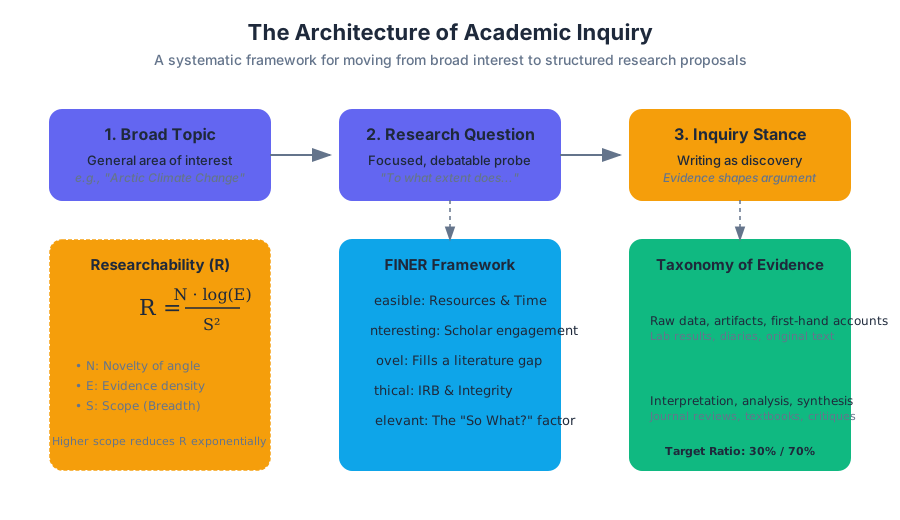
The most common failure in undergraduate and early-career research is the confusion between a topic and a research question. A topic is a broad area of interest (e.g., "Climate Change in the Arctic"); a research question is a focused, debatable, and researchable probe into that topic (e.g., "To what extent has the acceleration of permafrost melt in the Mackenzie River Basin affected the local indigenous food security between 2010 and 2020?").
The FINER Framework
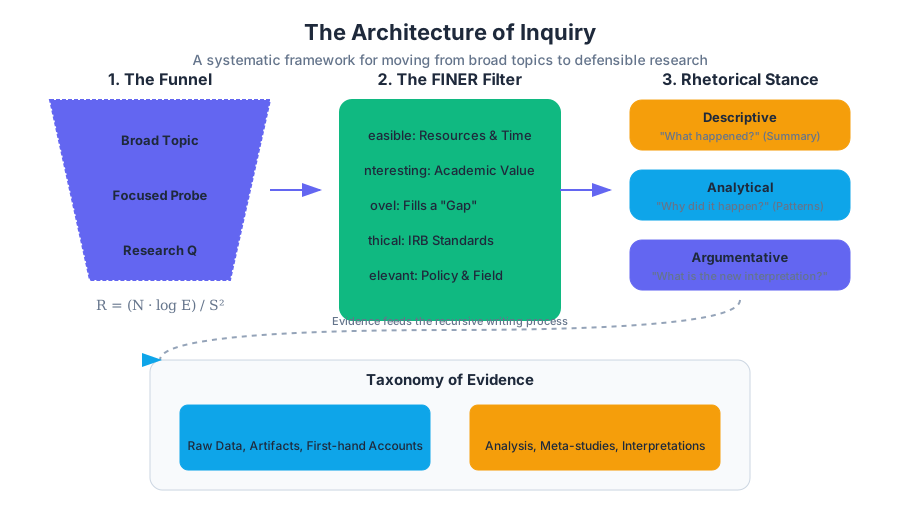
To evaluate the viability of a research question, scholars often employ the FINER criteria. A question that fails any of these benchmarks likely requires refinement before a proposal can be drafted.
| Criterion | Description | Requirement |
|---|---|---|
| Feasible | Can the project be completed with available resources, time, and expertise? | Access to data, funding, and technical skills. |
| Interesting | Does the question capture the interest of the researcher and the academic community? | Avoids "reinventing the wheel." |
| Novel | Does it provide new insights or confirm/refute previous findings in a new context? | Addresses a "gap" in the literature. |
| Ethical | Does the study meet institutional review board (IRB) standards? | Protection of human subjects and data integrity. |
| Relevant | Does it matter to the field, to policy, or to future research? | Clear "So What?" factor. |
Mathematical Representation of Inquiry
We can conceptualize the "Researchability" ($R$) of a question as a function of its scope ($S$), the density of available evidence ($E$), and the novelty ($N$) of the proposed angle.
R = \frac{N \cdot \log(E)}{S^2}
In this heuristic model, as the Scope ($S$) increases (becoming too broad), the researchability drops exponentially. Conversely, a high degree of Novelty ($N$) and a robust (but not overwhelming) Evidence Base ($E$) maximize the potential for a successful project.
Inquiry-Based Writing
Inquiry-Based Writing is a rhetorical stance where the writer functions as an investigator rather than a judge. In traditional "thesis-first" writing, a student might decide on a conclusion and then cherry-pick evidence to support it. In inquiry-based writing, the conclusion is the result of the research process.
Definition: Inquiry-based writing is a recursive process where the act of writing helps the researcher discover what they think, allowing the evidence to shape the final argument rather than the other way around.
The Transition from Reporting to Arguing
A research paper is not a "book report." It must move beyond the descriptive (what happened) to the analytical (why it happened) and the argumentative (what should be done or how we should understand it).
| Level | Goal | Example Phrasing |
|---|---|---|
| Descriptive | Summarize known facts. | "The study shows that X leads to Y." |
| Analytical | Identify patterns and causes. | "The correlation between X and Y suggests a breakdown in Z." |
| Argumentative | Propose a new interpretation. | "While previous scholars argue X, the data indicates that Y is actually the primary driver." |
The Taxonomy of Evidence: Primary vs. Secondary Sources
A researcher’s methodology is defined by how they interact with evidence. The distinction between Primary and Secondary sources is not about the format (e.g., a book vs. a website) but about the source's relationship to the event or data.
Primary Sources
A primary source is an "artifact" or "first-hand account." It is the raw data of the research world.
- Science: Raw lab results, sensor data, field notes.
- History: Diaries, original treaties, photographs from the era.
- Literature: The novel or poem itself being analyzed.
Secondary Sources
A secondary source provides interpretation, analysis, or synthesis of primary data.
- Science: A meta-analysis or a review article in a journal.
- History: A textbook written in 2024 about the French Revolution.
- Literature: A peer-reviewed journal article discussing the themes of The Great Gatsby.
Data Management for Researchers
In modern research, managing these sources requires programmatic rigor.
The Research Proposal: The Blueprint of Scholarship
A Research Proposal is a formal document that "pitches" the project to a committee, supervisor, or funding body. It serves as a contract of intent. If the proposal is weak, the final paper will almost certainly be structurally unsound.
Core Components of a Proposal
- The Introduction/Abstract: A high-level overview of the problem.
- The Research Question: The specific, narrow inquiry.
- The Literature Review: A summary of what is already known and where the "gap" lies.
- Methodology: A detailed explanation of how the data will be collected and analyzed.
- Significance: The "So What?"—why this research matters to the world.
Methodological Frameworks
The methodology section is the heart of the proposal. It must justify the choice of tools.
| Framework | Focus | Best For... |
|---|---|---|
| Quantitative | Numerical data, statistical significance, large $N$. | Testing hypotheses, finding correlations. |
| Qualitative | Interviews, ethnography, textual analysis. | Understanding "how" or "why," exploring lived experiences. |
| Mixed-Methods | Integration of both Quant and Qual. | Complex social problems requiring both scale and depth. |
| Rhetorical Analysis | Examining how texts persuade or construct meaning. | Analyzing political speeches, advertisements, or literature. |
Advanced Methodology: Rogerian and Toulmin Integration
When drafting a proposal, especially in the humanities, one must account for counter-arguments. Two primary models are used to structure this inquiry:
- The Toulmin Model: Focuses on the Warrant—the underlying assumption that connects the data to the claim. It is highly logical and effective for "hard" arguments.
- The Rogerian Model: Focuses on finding Common Ground. It is best for highly polarized topics where the goal is to build a bridge between the researcher and the skeptical reader.
Common Pitfalls in Research Design
Even with a strong proposal, several "traps" can derail the methodology:
- The "Kitchen Sink" Question: Trying to solve a massive problem (e.g., "How to fix education") instead of a specific one (e.g., "The impact of 1:1 tablet ratios on 3rd-grade reading scores in rural Ohio").
- Confirmation Bias: Searching only for sources that support your initial hunch. A true researcher looks for disconfirming evidence.
- Methodological Mismatch: Using a qualitative approach (interviews) to try and prove a broad statistical trend, or using a quantitative approach to understand deep emotional nuances.
- The "Quote Farm" Syndrome: Integrating sources by simply "dropping" them into the text without analysis. In inquiry-based writing, the researcher must mediate between the source and the reader.
Theorem of Source Integration: For every 1 inch of quoted material, there must be at least 2 inches of original analysis. The source provides the evidence; the researcher provides the meaning.
Conclusion
Research methodology is the "operating system" of academic inquiry. By carefully constructing a Research Question that meets the FINER criteria, distinguishing between Primary and Secondary evidence, and outlining a clear Methodology in a formal Proposal, writers move from being consumers of information to producers of knowledge. This systematic approach ensures that the final output is not just a collection of facts, but a rigorous contribution to a larger scholarly conversation.
Source Materials
Study English Composition II: Rhetorical Methods–Based on Lykke
This course page is free to open: signed out, you can read its first two sections, and signing in, on any plan, opens the rest. The free Lykke Chrome extension syncs your own Canvas courses, so ChatGPT, Claude and Muse can answer from your classes and deadlines. It only reads Canvas.
Add the free extensionSign in to open every sectionAll sections of English Composition II: Rhetorical Methods–Based · Browse more course pages