From the free course English Composition II: Rhetorical Methods–Based on Lykke
Citation Standards: MLA and APA
Key concepts: MLA Style · APA Style · In-text Citations · Works Cited/References · Academic Integrity
The technical requirements for documenting sources to ensure academic integrity.
Citation Standards: MLA and APA
In the architecture of academic discourse, citation standards serve as the fundamental protocol for data provenance and intellectual integrity. Far from being mere stylistic preferences, these standards provide a structured framework for mapping the lineage of ideas, allowing researchers to trace the evolution of thought across disciplines. By adhering to standardized formats like those established by the Modern Language Association (MLA) and the American Psychological Association (APA), writers ensure that their work is interoperable with the broader body of scholarly literature.
The Philosophy of Documentation
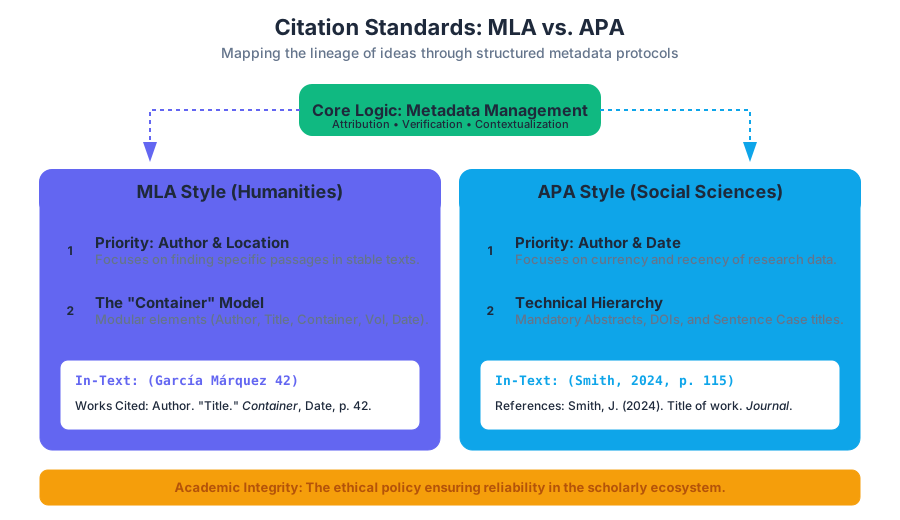
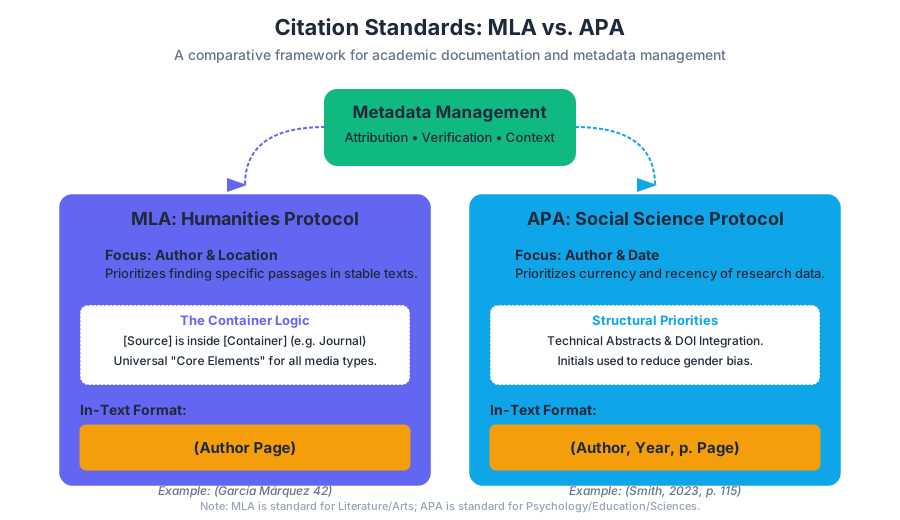
At its core, academic documentation is a system of Metadata Management. Every citation acts as a pointer to a specific node in the global network of knowledge. This system serves three primary functions:
- Attribution: Giving credit to the original architects of an idea, thereby avoiding Plagiarism.
- Verification: Providing a "paper trail" that allows readers to audit the evidence and reproduce the author's reasoning.
- Contextualization: Situating the current work within a specific scholarly conversation, whether it be the interpretive traditions of the humanities or the empirical rigor of the social sciences.
Academic Integrity is the ethical policy of scholarly work, requiring that all contributors to a project's intellectual lifecycle are acknowledged. Its violation, whether intentional or through "patchwriting," compromises the reliability of the entire academic ecosystem.
MLA Style: The Humanities Protocol
The MLA (Modern Language Association) style is the standard for literature, arts, and humanities. It is designed to prioritize the author and the location of the information within a source. Because humanities research often involves the close reading of stable texts (like novels, poems, or historical documents), the specific page number is the most critical coordinate for a reader to find the cited passage.
The Logic of the "Container"
Since the 8th edition, MLA has moved toward a modular "Container" system. Instead of having a unique rule for every possible media type (YouTube video vs. physical book), MLA uses a universal set of Core Elements.
| Element | Description | Requirement |
|---|---|---|
| Author | The primary creator(s) of the work. | Required if known. |
| Title of Source | The specific name of the work (e.g., "The Raven"). | Required. |
| Title of Container | The larger work the source is found in (e.g., The Complete Works of Poe). | Required for nested works. |
| Other Contributors | Editors, translators, or illustrators. | Optional/Contextual. |
| Version | Editions (e.g., 2nd ed.) or volumes. | If applicable. |
| Number | Issue numbers or volume numbers. | If applicable. |
| Publisher | The entity responsible for making the work available. | Required for most sources. |
| Publication Date | The date the work was released. | Required. |
| Location | Page numbers (p. or pp.), URLs, or DOIs. | Required for precision. |
MLA In-Text Citations
MLA utilizes an Author-Page system. The citation is placed as close as possible to the borrowed material, usually in parentheses before the terminal punctuation.
- Standard Format: (Author Page)
- Example: (García Márquez 42)
If the author's name is mentioned in a Signal Phrase (e.g., "García Márquez argues that..."), only the page number is required in the parentheses: (42).
APA Style: The Social Science Protocol
The APA (American Psychological Association) style is the dominant standard for the social sciences, education, and engineering. In these fields, the currency of research is paramount. A study on neurobiology from 1972 has different utility than one from 2024. Consequently, APA prioritizes the Author-Date relationship.
Structural Priorities
APA style emphasizes the hierarchy of information through specific heading levels and a highly structured "References" list. It also mandates the use of Technical Abstracts and, in many cases, a "Running Head" for professional manuscripts.
| Feature | APA Requirement | Rationale |
|---|---|---|
| Date Placement | Immediately after the author. | Highlights the age of the data. |
| Sentence Case | Titles of articles are not capitalized (except first word). | Focuses on the content over the "brand" of the title. |
| Author Initials | Uses initials instead of full first names. | Reduces gender bias and focuses on the surname. |
| DOI Integration | Digital Object Identifiers are mandatory for digital sources. | Ensures persistent linkability in digital databases. |
APA In-Text Citations
APA utilizes an Author-Date system. If a direct quote is used, a page number is also required, preceded by p. or pp..
- Standard Format: (Author, Year)
- Direct Quote: (Author, Year, p. Page)
- Example: (Smith, 2023, p. 115)
Citation as Code
From a computational perspective, a citation is a serialized string generated from a structured data object. Senior researchers often use reference management software (like Zotero or Mendeley) or markup languages like LaTeX to handle this programmatically.
2. Declarative Representation (BibTeX)
In technical fields, citations are often stored in a .bib file. This separates the data from the presentation, allowing the same source to be rendered in MLA, APA, or IEEE style simply by changing the stylesheet.
@article{turing1950,
  author  = {Turing, Alan M.},
  title   = {Computing Machinery and Intelligence},
  journal = {Mind},
  volume  = {LIX},
  number  = {236},
  pages   = {433--460},
  year    = {1950},
  doi     = {10.1093/mind/LIX.236.433}
}
Comparative Analysis: In-Text Mechanics
The choice between MLA and APA often dictates the rhetorical flow of the paper. MLA papers tend to feel more "narrative," while APA papers feel more "analytical" and "data-centric."
Comparison of In-Text Patterns
| Scenario | MLA Format | APA Format |
|---|---|---|
| One Author | (Jones 15) | (Jones, 2021) |
| Two Authors | (Jones and Smith 15) | (Jones & Smith, 2021) |
| 3+ Authors | (Jones et al. 15) | (Jones et al., 2021) |
| No Author | (Title 15) | (Title, 2021) |
| Organization | (NASA 15) | (National Aeronautics and Space Administration [NASA], 2021) |
Source Integration: Quoting, Paraphrasing, and Summarizing
Effective citation is not just about the bibliography; it is about how the source is integrated into the writer's own prose. There are three primary methods for source integration:
- Direct Quoting: Using the exact words of the source. This is reserved for instances where the original phrasing is unique, authoritative, or subject to analysis.
- Paraphrasing: Re-stating a specific passage in one's own words. This requires an in-text citation because the idea still belongs to the original author.
- Summarizing: Providing a broad overview of a source's main points or a large section of text.
The "Sandwich" Method
A common pitfall is the "hit-and-run" quote—dropping a quote into a paragraph without explanation. Expert writers use the "Sandwich" method:
- Top Bread: Signal phrase or lead-in (introduces the author/context).
- The Meat: The quoted or paraphrased material.
- Bottom Bread: Analysis or connection (explains why the source matters to the thesis).
The Rule of Proportionality: In a high-level academic paper, your own analysis should significantly outweigh the cited material. If a paragraph is 80% quotes, the writer has failed to synthesize the information.
Common Pitfalls and Edge Cases
1. The "Et Al." Threshold
In MLA, et al. (Latin for "and others") is used for any source with three or more authors. In APA 7th Edition, et al. is also used for three or more authors, even on the first mention. This was a change from the 6th edition, which required listing up to five authors the first time.
2. Indirect Sources (Citing a source within a source)
Sometimes you find a great quote by "Author A" while reading "Author B."
- MLA: Use
qtd. in(quoted in). Example: (Author A qtd. in Author B 12). - APA: Use
as cited in. Example: (Author A, as cited in Author B, 2022).
3. Date of Access
For digital sources that are prone to change (like Wikis or live dashboards), both styles recommend including an "Access Date" to indicate which version of the data was viewed.
Annotated Bibliographies: The Meta-Layer
An Annotated Bibliography is an extension of the Works Cited or References list. Each citation is followed by an Annotation: a brief paragraph (usually 150–200 words) that performs three tasks:
- Summarize: What are the main arguments?
- Assess: Is the source reliable? What are its biases?
- Reflect: How does this source fit into your specific research project?
This tool is invaluable for the Research Proposal phase, as it forces the researcher to evaluate the utility of every source before committing to the writing process.
Conclusion
Mastering MLA and APA is less about memorizing punctuation and more about understanding the Information Architecture of your discipline. MLA facilitates the deep, textual conversations of the humanities, while APA supports the rapid, evidence-based iterations of the sciences. By treating citations as a rigorous metadata system, researchers protect their own credibility and contribute to a transparent, verifiable global knowledge base.
Source Materials
Study English Composition II: Rhetorical Methods–Based on Lykke
This course page is free to open: signed out, you can read its first two sections, and signing in, on any plan, opens the rest. The free Lykke Chrome extension syncs your own Canvas courses, so ChatGPT, Claude and Muse can answer from your classes and deadlines. It only reads Canvas.
Add the free extensionSign in to open every sectionAll sections of English Composition II: Rhetorical Methods–Based · Browse more course pages