From the free course English Composition I on Lykke
Foundations of Rhetoric and Composition
Key concepts: Rhetorical Situation · Academic Reading Strategies · Thesis Statements · Logical Fallacies · Rhetorical Modes (Ethos, Logos, Pathos)
Covers the essential elements of the writing process, including rhetorical analysis, reading strategies, and the construction of logical arguments.
Foundations of Rhetoric and Composition
Overview
In the landscape of higher education and professional innovation, the ability to synthesize complex information and construct persuasive arguments is not merely a "soft skill"—it is the foundational operating system upon which all specialized knowledge is built. As noted in the Hart Research Associates report, It Takes More Than a Major, 93% of employers prioritize a candidate’s ability to think critically, communicate clearly, and solve complex problems over their specific undergraduate major.
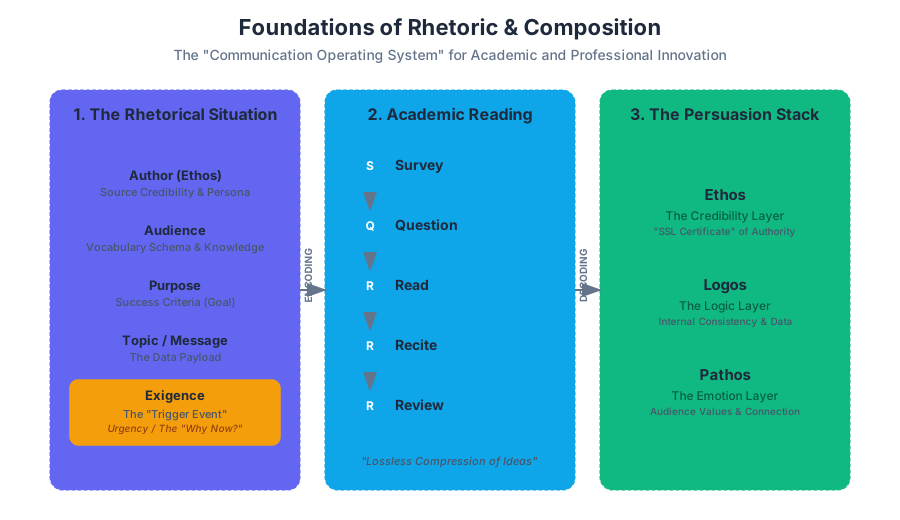
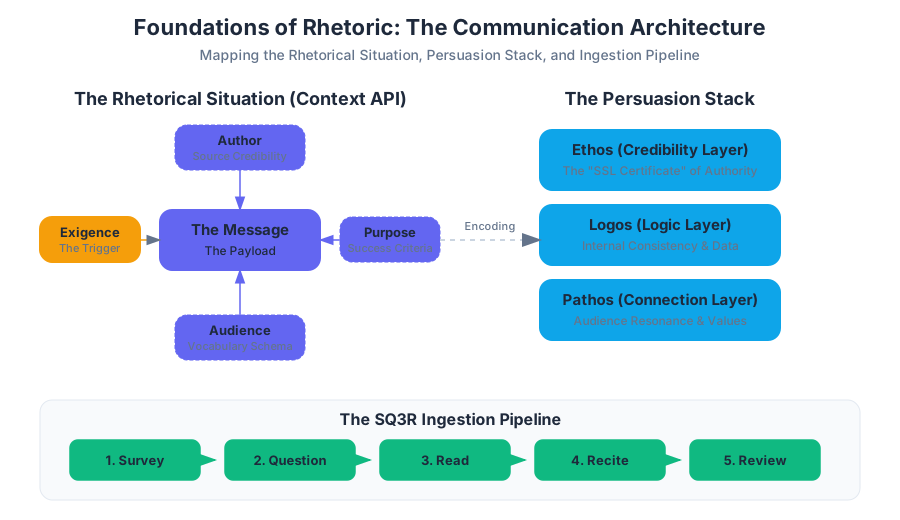
This section explores the Foundations of Rhetoric and Composition, treating language as a precision tool. We will deconstruct the Rhetorical Situation, establish high-throughput Academic Reading Strategies, and analyze the "Persuasion Stack" (Ethos, Logos, Pathos) to understand how information is encoded, transmitted, and decoded in academic and professional environments.
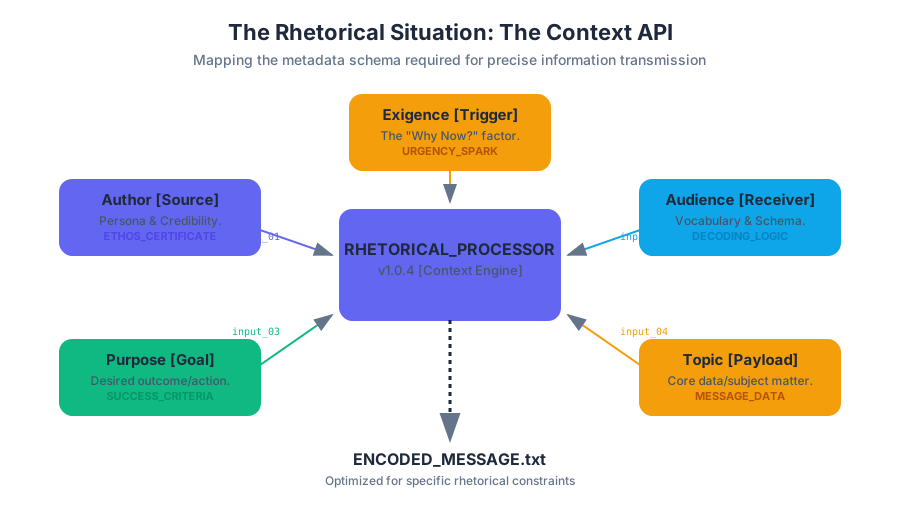
The Rhetorical Situation: The Context API
The Rhetorical Situation is the set of circumstances under which a writer creates a text. It is the "metadata" that determines the appropriate "encoding" for a message. Without understanding the rhetorical situation, a writer risks "protocol mismatch"—delivering a message that the audience cannot or will not process.
Components of the Rhetorical Situation
The rhetorical situation is often visualized as a triangle or a web of interconnected variables:
| Variable | Definition | Technical Implication |
|---|---|---|
| Author/Writer | The persona or identity of the person creating the content. | Determines the "Source Credibility" (Ethos) and the perspective of the data. |
| Audience | The specific group of people the text is intended for. | Defines the "Vocabulary Schema" and the level of prerequisite knowledge required. |
| Purpose | The goal of the communication (to inform, persuade, entertain). | Sets the "Success Criteria" for the document. |
| Topic/Message | The core subject matter or data being transmitted. | The "Payload" of the communication. |
| Context/Exigence | The specific event or situation that prompted the writing. | The "Trigger Event" or environmental conditions (e.g., a policy change, a discovery). |
Definition: Exigence Exigence is an imperfection marked by urgency; it is a defect, an obstacle, something waiting to be done, a thing which is other than it should be. In rhetoric, it is the "spark" that demands a response.
Academic Reading Strategies: The Ingestion Pipeline
Academic reading is not a passive consumption of text; it is an active process of "decryption" and "reverse-engineering." To engage with complex texts, students must move from Surface Reading (understanding what is said) to Critical Reading (understanding how and why it is said).
The SQ3R Method
The SQ3R method is a high-efficiency framework for information extraction:
- Survey: Scan the headings, abstracts, and conclusions to map the document's architecture.
- Question: Convert headings into questions to prime the brain for data retrieval.
- Read: Consume the text with the intent of answering the generated questions.
- Recite: Summarize the key points in your own words to ensure "lossless" compression of the ideas.
- Review: Revisit the text to reinforce memory and check for missed nuances.
Comparison of Reading Modes
| Feature | Passive Reading | Active/Critical Reading |
|---|---|---|
| Goal | Completion of the text. | Extraction of meaning and evaluation of logic. |
| Activity | Linear scanning. | Annotating, questioning, and cross-referencing. |
| Outcome | Temporary recall of facts. | Integration of concepts into long-term mental models. |
| Feedback Loop | None. | Writing summaries and identifying gaps in logic. |
The Persuasion Stack: Ethos, Logos, and Pathos
Aristotle identified three primary modes of persuasion, which we can view as the "layers" of an argument's effectiveness.
1. Ethos (The Credibility Layer)
Ethos establishes the writer's authority and character. In academic writing, this is achieved through proper citation, professional tone, and demonstrating expertise. It is the "SSL Certificate" of the argument—it tells the reader that the source is trusted.
2. Logos (The Logic Layer)
Logos is the internal consistency and logical validity of the argument. It relies on data, evidence, and "Syllogistic Reasoning."
3. Pathos (The Emotional Layer)
Pathos appeals to the audience's values and emotions. While often minimized in technical fields, it is essential for "Exigence"—making the audience care about the problem.
Formalizing Logos: The Syllogism
Logos often follows the structure of a formal syllogism. If the premises are true and the structure is valid, the conclusion is "hard-coded" to be true.
\begin{aligned}
&\text{Major Premise: } \forall x (P(x) \rightarrow Q(x)) \\
&\text{Minor Premise: } P(a) \\
&\hline \\
&\text{Conclusion: } Q(a)
\end{aligned}
Example:
- Major Premise: All peer-reviewed studies undergo rigorous validation.
- Minor Premise: This paper is a peer-reviewed study.
- Conclusion: This paper has undergone rigorous validation.
Thesis Statements: The Argument’s Entry Point
A Thesis Statement is the "Main Function" of an essay. It is a concise, one-to-two sentence summary of the writer's central claim and the "roadmap" for the supporting evidence. A weak thesis leads to "spaghetti code" writing—disorganized and difficult to follow.
Anatomy of a Strong Thesis
A robust thesis must be Arguable, Specific, and Manageable.
| Component | Purpose | Example (Weak) | Example (Strong) |
|---|---|---|---|
| Topic | The subject. | Climate change is bad. | While climate change is a global threat... |
| Claim | The stance. | We should stop it. | ...local governments must prioritize urban reforestation... |
| Reasoning | The "Because." | Because it's hot. | ...to mitigate the "heat island effect" and improve public health. |
Key Insight: The "So What?" Test If a reader can respond to your thesis with "So what?" or "That’s obvious," your thesis is likely a summary, not an argument. A strong thesis requires a counter-argument to exist.
Logical Fallacies: Debugging the Argument
Logical Fallacies are "runtime errors" in reasoning. They may appear persuasive on the surface but fail upon execution because they violate the rules of logic. Identifying these is critical for both writing and peer review.
Common Fallacies in Academic Discourse
| Fallacy | Description | Technical Analogy |
|---|---|---|
| Ad Hominem | Attacking the person instead of the argument. | Attacking the hardware because the software has a bug. |
| Slippery Slope | Claiming a small step will inevitably lead to a chain of disasters. | Claiming a single if statement will lead to a sentient AI takeover. |
| Straw Man | Misrepresenting an opponent's argument to make it easier to attack. | Mocking a "Hello World" script to prove a language is useless for enterprise. |
| False Dilemma | Presenting only two options when more exist. | "Either we use Python or we fail," ignoring C++, Java, or Rust. |
| Hasty Generalization | Drawing a conclusion from a sample size that is too small. | Benchmarking a function once and claiming it's the fastest in the world. |
Academic Integrity and Synthesis
As outlined in the Academic Literacy Workshops handbook, Academic Integrity is the ethical foundation of the university. It involves more than just avoiding plagiarism; it is about the "Provenance" of ideas.
Synthesis vs. Summary
- Summary: A low-fidelity reproduction of a single source's main points.
- Synthesis: A high-fidelity integration of multiple sources to create a new, unified argument.
The Referencing Protocol
Referencing serves as "Dependency Management." It allows the reader to "trace the source code" of your ideas back to their original authors.
Prewriting and the Iterative Process
Writing is not a linear path from start to finish; it is an iterative development cycle.
- Brainstorming/Clustering: Mapping out the "Object Model" of your argument.
- Outlining: Defining the "Skeleton" or the control flow of the essay.
- Drafting: The "Implementation Phase."
- Revision: Refactoring the logic and structure.
- Editing/Proofreading: Final "Linting" for syntax and grammar errors.
Prewriting Strategy: The "Meaty" Paragraph Structure
Every body paragraph should function as a "Module" with a specific interface:
- Topic Sentence: The API definition (what this paragraph does).
- Evidence: The data input.
- Analysis: The processing logic (how the data supports the topic sentence).
- Transition: The "Return" statement (linking to the next module).
Conclusion: The Innovation Imperative
The study of rhetoric and composition is not merely a hurdle for first-year students; it is the mastery of the tools required for Innovation. As the Hart Research report emphasizes, the modern workplace values "cross-cutting skills" that allow individuals to apply knowledge across different contexts. By mastering the rhetorical situation, logical structures, and critical reading, writers become architects of information, capable of navigating and shaping the complex discourse of the 21st century.
Source Materials
- English Composition 1 PDF
- Hurst, Ellen, Ed.Academic Literacy Workshops: A Handbook for Students and Instructors. U of Capetown. 2011.
- Hart Research Associates.It Takes More Than a Major: Employer Priorities for College Learning and Student Success. 10 Apr 2013.
- English Composition I
- English Composition I
- English Composition I
- English Composition I
- English Composition I
Study English Composition I on Lykke
This course page is free to open: signed out, you can read its first two sections, and signing in, on any plan, opens the rest. The free Lykke Chrome extension syncs your own Canvas courses, so ChatGPT, Claude and Muse can answer from your classes and deadlines. It only reads Canvas.
Add the free extensionSign in to open every sectionAll sections of English Composition I · Browse more course pages