English Composition I
Institution: MIT
22 study materials · 3 sections
English Composition I provides a comprehensive introduction to the foundational skills of academic writing, critical reading, and logical argumentation. The course guides students through the rhetorical situation, teaching them how to adapt their writing for different audiences and purposes using strategies like ethos, logos, and pathos. Additionally, it explores the real-world application of these skills, highlighting why employers value cross-cutting competencies like critical thinking and ethical communication in the modern workforce.
Course Sections
Foundations of Rhetoric and Composition
Key concepts: Rhetorical Situation · Academic Reading Strategies · Thesis Statements · Logical Fallacies · Rhetorical Modes (Ethos, Logos, Pathos)
Covers the essential elements of the writing process, including rhetorical analysis, reading strategies, and the construction of logical arguments.
Foundations of Rhetoric and Composition
Overview
In the landscape of higher education and professional innovation, the ability to synthesize complex information and construct persuasive arguments is not merely a "soft skill"—it is the foundational operating system upon which all specialized knowledge is built. As noted in the Hart Research Associates report, It Takes More Than a Major, 93% of employers prioritize a candidate’s ability to think critically, communicate clearly, and solve complex problems over their specific undergraduate major.
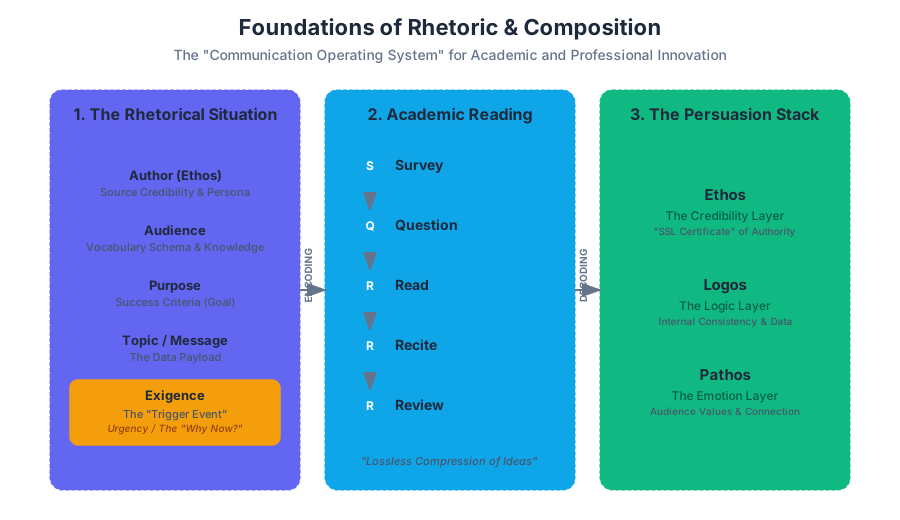
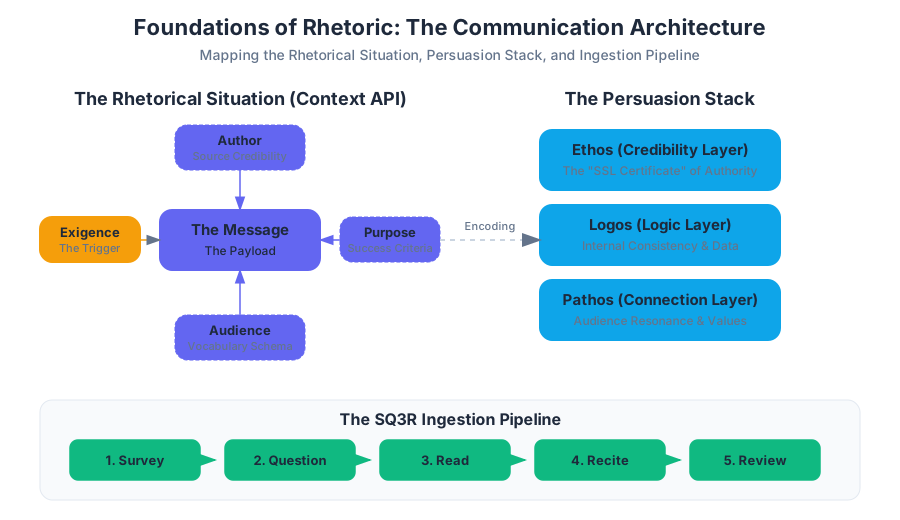
This section explores the Foundations of Rhetoric and Composition, treating language as a precision tool. We will deconstruct the Rhetorical Situation, establish high-throughput Academic Reading Strategies, and analyze the "Persuasion Stack" (Ethos, Logos, Pathos) to understand how information is encoded, transmitted, and decoded in academic and professional environments.
The Rhetorical Situation: The Context API
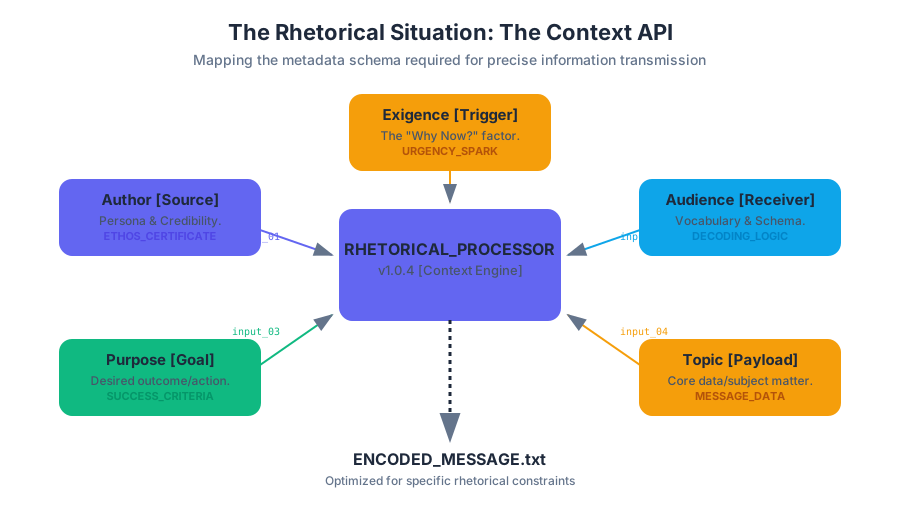
The Rhetorical Situation is the set of circumstances under which a writer creates a text. It is the "metadata" that determines the appropriate "encoding" for a message. Without understanding the rhetorical situation, a writer risks "protocol mismatch"—delivering a message that the audience cannot or will not process.
Components of the Rhetorical Situation
The rhetorical situation is often visualized as a triangle or a web of interconnected variables:
| Variable | Definition | Technical Implication |
|---|---|---|
| Author/Writer | The persona or identity of the person creating the content. | Determines the "Source Credibility" (Ethos) and the perspective of the data. |
| Audience | The specific group of people the text is intended for. | Defines the "Vocabulary Schema" and the level of prerequisite knowledge required. |
| Purpose | The goal of the communication (to inform, persuade, entertain). | Sets the "Success Criteria" for the document. |
| Topic/Message | The core subject matter or data being transmitted. | The "Payload" of the communication. |
| Context/Exigence | The specific event or situation that prompted the writing. | The "Trigger Event" or environmental conditions (e.g., a policy change, a discovery). |
Definition: Exigence Exigence is an imperfection marked by urgency; it is a defect, an obstacle, something waiting to be done, a thing which is other than it should be. In rhetoric, it is the "spark" that demands a response.
Implementation: Analyzing the Situation
Before a single word is written, a rhetorical analysis must occur. This is analogous to a requirements gathering phase in software engineering.
class RhetoricalProfile:
    """
    Analyzes the requirements for a specific writing task.
    """
    def __init__(self, audience_type, purpose, exigence):
        self.audience_type = audience_type  # e.g., 'Expert', 'Layperson', 'Stakeholder'
        self.purpose = purpose              # e.g., 'Persuade', 'Document', 'Critique'
        self.exigence = exigence            # The 'why now?' factor

    def determine_tone(self):
        if self.audience_type == 'Expert':
            return "Formal, Jargon-dense, Evidence-heavy"
        elif self.audience_type == 'Stakeholder':
            return "Action-oriented, Concise, Result-focused"
        else:
            return "Accessible, Explanatory, Narrative"

    def validate_strategy(self, current_draft_mode):
        # High-level logic to ensure the mode matches the purpose
        strategies = {
            'Persuade': ['Logos', 'Ethos', 'Pathos'],
            'Document': ['Logos'],
            'Critique': ['Logos', 'Ethos']
        }
        return current_draft_mode in strategies.get(self.purpose, [])

# Example instantiation for a Research Paper
paper_reqs = RhetoricalProfile(audience_type='Expert', purpose='Persuade', exigence='New Data')
print(f"Target Tone: {paper_reqs.determine_tone()}")
Academic Reading Strategies: The Ingestion Pipeline
Academic reading is not a passive consumption of text; it is an active process of "decryption" and "reverse-engineering." To engage with complex texts, students must move from Surface Reading (understanding what is said) to Critical Reading (understanding how and why it is said).
The SQ3R Method
The SQ3R method is a high-efficiency framework for information extraction:
- Survey: Scan the headings, abstracts, and conclusions to map the document's architecture.
- Question: Convert headings into questions to prime the brain for data retrieval.
- Read: Consume the text with the intent of answering the generated questions.
- Recite: Summarize the key points in your own words to ensure "lossless" compression of the ideas.
- Review: Revisit the text to reinforce memory and check for missed nuances.
Comparison of Reading Modes
| Feature | Passive Reading | Active/Critical Reading |
|---|---|---|
| Goal | Completion of the text. | Extraction of meaning and evaluation of logic. |
| Activity | Linear scanning. | Annotating, questioning, and cross-referencing. |
| Outcome | Temporary recall of facts. | Integration of concepts into long-term mental models. |
| Feedback Loop | None. | Writing summaries and identifying gaps in logic. |
The Persuasion Stack: Ethos, Logos, and Pathos
Aristotle identified three primary modes of persuasion, which we can view as the "layers" of an argument's effectiveness.
1. Ethos (The Credibility Layer)
Ethos establishes the writer's authority and character. In academic writing, this is achieved through proper citation, professional tone, and demonstrating expertise. It is the "SSL Certificate" of the argument—it tells the reader that the source is trusted.
2. Logos (The Logic Layer)
Logos is the internal consistency and logical validity of the argument. It relies on data, evidence, and "Syllogistic Reasoning."
3. Pathos (The Emotional Layer)
Pathos appeals to the audience's values and emotions. While often minimized in technical fields, it is essential for "Exigence"—making the audience care about the problem.
Formalizing Logos: The Syllogism
Logos often follows the structure of a formal syllogism. If the premises are true and the structure is valid, the conclusion is "hard-coded" to be true.
\begin{aligned}
&\text{Major Premise: } \forall x (P(x) \rightarrow Q(x)) \\
&\text{Minor Premise: } P(a) \\
&\hline \\
&\text{Conclusion: } Q(a)
\end{aligned}
Example:
- Major Premise: All peer-reviewed studies undergo rigorous validation.
- Minor Premise: This paper is a peer-reviewed study.
- Conclusion: This paper has undergone rigorous validation.
Thesis Statements: The Argument’s Entry Point
A Thesis Statement is the "Main Function" of an essay. It is a concise, one-to-two sentence summary of the writer's central claim and the "roadmap" for the supporting evidence. A weak thesis leads to "spaghetti code" writing—disorganized and difficult to follow.
Anatomy of a Strong Thesis
A robust thesis must be Arguable, Specific, and Manageable.
| Component | Purpose | Example (Weak) | Example (Strong) |
|---|---|---|---|
| Topic | The subject. | Climate change is bad. | While climate change is a global threat... |
| Claim | The stance. | We should stop it. | ...local governments must prioritize urban reforestation... |
| Reasoning | The "Because." | Because it's hot. | ...to mitigate the "heat island effect" and improve public health. |
Key Insight: The "So What?" Test If a reader can respond to your thesis with "So what?" or "That’s obvious," your thesis is likely a summary, not an argument. A strong thesis requires a counter-argument to exist.
Logical Fallacies: Debugging the Argument
Logical Fallacies are "runtime errors" in reasoning. They may appear persuasive on the surface but fail upon execution because they violate the rules of logic. Identifying these is critical for both writing and peer review.
Common Fallacies in Academic Discourse
| Fallacy | Description | Technical Analogy |
|---|---|---|
| Ad Hominem | Attacking the person instead of the argument. | Attacking the hardware because the software has a bug. |
| Slippery Slope | Claiming a small step will inevitably lead to a chain of disasters. | Claiming a single if statement will lead to a sentient AI takeover. |
| Straw Man | Misrepresenting an opponent's argument to make it easier to attack. | Mocking a "Hello World" script to prove a language is useless for enterprise. |
| False Dilemma | Presenting only two options when more exist. | "Either we use Python or we fail," ignoring C++, Java, or Rust. |
| Hasty Generalization | Drawing a conclusion from a sample size that is too small. | Benchmarking a function once and claiming it's the fastest in the world. |
Academic Integrity and Synthesis
As outlined in the Academic Literacy Workshops handbook, Academic Integrity is the ethical foundation of the university. It involves more than just avoiding plagiarism; it is about the "Provenance" of ideas.
Synthesis vs. Summary
- Summary: A low-fidelity reproduction of a single source's main points.
- Synthesis: A high-fidelity integration of multiple sources to create a new, unified argument.
The Referencing Protocol
Referencing serves as "Dependency Management." It allows the reader to "trace the source code" of your ideas back to their original authors.
# A conceptual CLI for checking citation integrity
$ cite-check --input essay_draft.md --style APA

[CHECKING] Scanning for external claims...
[FOUND] "Innovation is a top priority for 93% of employers."
[VALIDATING] Cross-referencing with 'Hart Research 2013'...
[SUCCESS] Citation found: (Hart Research Associates, 2013).
[WARNING] Claim on page 4: "Rhetoric is dead." -> NO SOURCE FOUND.
[ACTION] Please provide a citation or rephrase as a subjective claim.
Prewriting and the Iterative Process
Writing is not a linear path from start to finish; it is an iterative development cycle.
- Brainstorming/Clustering: Mapping out the "Object Model" of your argument.
- Outlining: Defining the "Skeleton" or the control flow of the essay.
- Drafting: The "Implementation Phase."
- Revision: Refactoring the logic and structure.
- Editing/Proofreading: Final "Linting" for syntax and grammar errors.
Prewriting Strategy: The "Meaty" Paragraph Structure
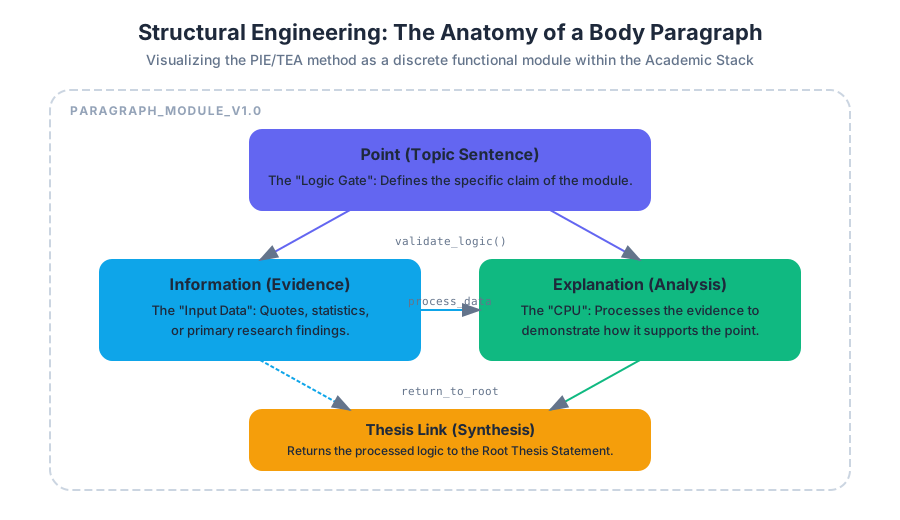
Every body paragraph should function as a "Module" with a specific interface:
- Topic Sentence: The API definition (what this paragraph does).
- Evidence: The data input.
- Analysis: The processing logic (how the data supports the topic sentence).
- Transition: The "Return" statement (linking to the next module).
Conclusion: The Innovation Imperative
The study of rhetoric and composition is not merely a hurdle for first-year students; it is the mastery of the tools required for Innovation. As the Hart Research report emphasizes, the modern workplace values "cross-cutting skills" that allow individuals to apply knowledge across different contexts. By mastering the rhetorical situation, logical structures, and critical reading, writers become architects of information, capable of navigating and shaping the complex discourse of the 21st century.
Employer Priorities and Cross-Cutting Skills
Key concepts: Innovation as a workplace priority · Cross-cutting skills vs. undergraduate major · Liberal education and broad knowledge · Applied and collaborative learning · Entry-level readiness vs. advancement potential
Explores the connection between a liberal education and career success, emphasizing the skills employers value most in the modern economy.
Employer Priorities and Cross-Cutting Skills
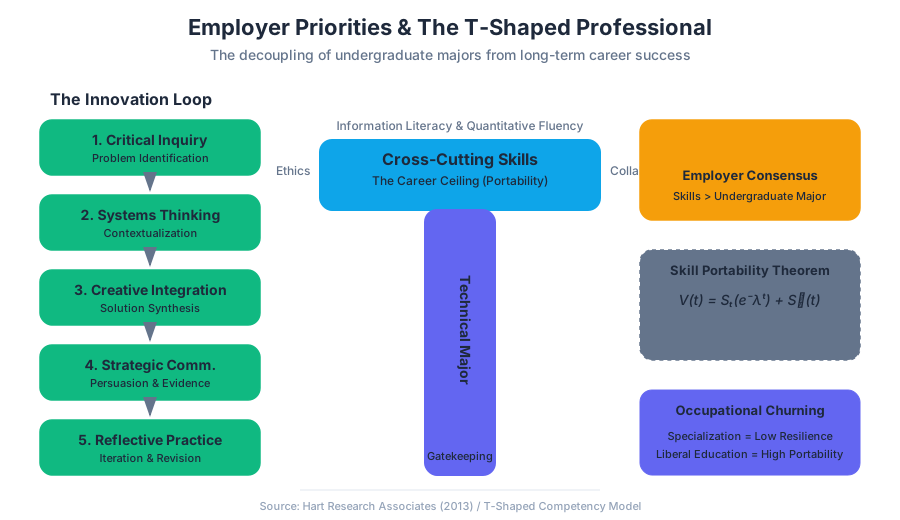
In the contemporary labor market, the traditional correlation between a specific undergraduate major and a long-term career path has undergone a fundamental decoupling. While technical proficiency remains a prerequisite for entry-level "gatekeeping," longitudinal career success is increasingly governed by cross-cutting skills—a suite of high-level cognitive and interpersonal competencies that transcend disciplinary boundaries. This shift reflects a broader economic transition toward an innovation-driven workplace, where the ability to synthesize disparate information, communicate complex ideas, and adapt to rapid systemic change is valued more highly than the mastery of a static body of specialized knowledge.
The Innovation Imperative: Workplace Priorities in Flux
Innovation is no longer the exclusive domain of Research and Development (R&D) departments; it has become a baseline expectation across all organizational tiers. Employers prioritize innovation because it serves as the primary mechanism for maintaining a competitive edge in a globalized economy.
Definition: Innovation-Centricity The organizational requirement for employees at all levels to contribute to the improvement of processes, the identification of new market opportunities, and the creative resolution of non-routine problems.
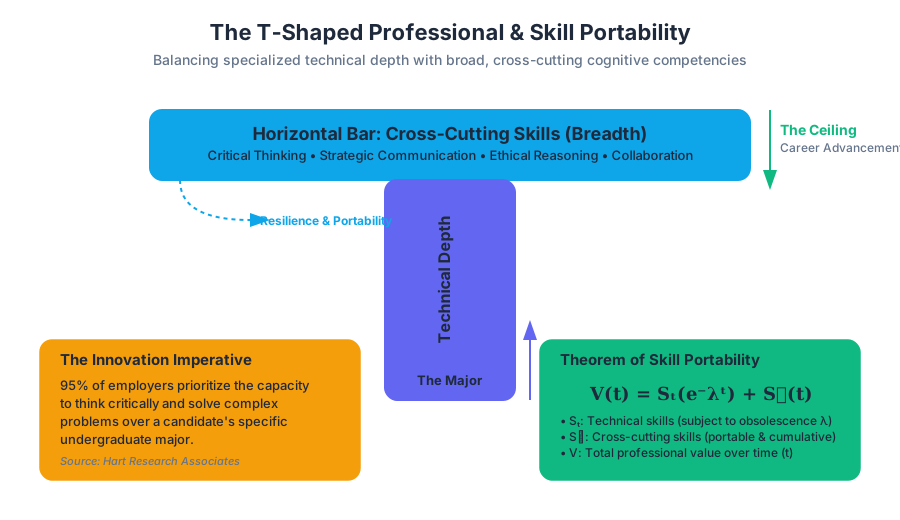
According to the Hart Research Associates (2013) findings, nearly 95% of employers agree that "a candidate’s demonstrated capacity to think critically, communicate clearly, and solve complex problems is more important than their undergraduate major." This suggests that the "what" of education (the subject matter) is increasingly secondary to the "how" (the cognitive processes developed during study).
The Mechanics of Workplace Innovation
Innovation functions as a recursive loop of identification, analysis, and execution. The skills required for this loop map directly onto the rhetorical strategies taught in advanced composition and liberal arts curricula.
| Phase | Required Cognitive Skill | Academic Parallel |
|---|---|---|
| Problem Identification | Critical Inquiry | Research & Questioning |
| Contextualization | Systems Thinking | Rhetorical Situation Analysis |
| Solution Synthesis | Creative Integration | Thesis Development |
| Persuasion | Strategic Communication | Argumentation & Evidence |
| Iteration | Reflective Practice | Revision & Peer Review |
Cross-Cutting Skills vs. The Undergraduate Major
The debate between "vocational" training (specific majors) and "liberal" education (broad skills) is often framed as a zero-sum game. However, modern employer data suggests a hierarchical relationship: technical skills provide the baseline for employment, but cross-cutting skills provide the ceiling for advancement.
Defining Cross-Cutting Skills
Cross-cutting skills (often colloquially termed "soft skills," though "essential skills" is more accurate) are the cognitive frameworks that allow an individual to apply knowledge across different contexts. These include:
- Ethical Decision-Making: The ability to navigate complex moral landscapes and anticipate the long-term consequences of organizational actions.
- Intercultural Competency: Proficiency in collaborating across diverse demographic and global boundaries.
- Information Literacy: The capacity to filter, verify, and synthesize high volumes of data into actionable intelligence.
- Quantitative Fluency: The ability to interpret and communicate data-driven insights.
The "Major" Fallacy
The misconception that a major equals a career path ignores the high rate of "occupational churning." Data indicates that most graduates will change industries multiple times. A specialized major in a declining field offers low resilience, whereas cross-cutting skills offer portability.
Liberal Education and the "T-Shaped" Professional
The concept of a Liberal Education—not to be confused with "liberal" in a political sense—is an approach to learning that empowers individuals with broad knowledge and transferable skills. It aims to develop a sense of social responsibility as well as strong intellectual and practical skills.
The T-Shaped Competency Model
The "T-Shaped" professional is a metaphor used in recruitment to describe the ideal employee:
- The Vertical Bar: Represents deep, specialized knowledge in one specific field (the "Major").
- The Horizontal Bar: Represents the ability to collaborate across disciplines and apply broad knowledge (the "Liberal Education").
Theorem of Skill Portability Let $S_t$ be technical skills and $S_c$ be cross-cutting skills. The total professional value $V$ over time $t$ is expressed as: $V(t) = S_t(e^{-\lambda t}) + S_c(t)$ Where $\lambda$ represents the rate of technical obsolescence. As $t$ increases, the value of cross-cutting skills $S_c$ becomes the dominant factor in career longevity.
Implementation: Analyzing Skill Density
To understand how these skills manifest in the real world, we can look at how an automated HR screening system might parse a candidate's profile for cross-cutting competencies versus technical keywords.
import spacy

# A simplified NLP model to detect "Cross-Cutting" vs "Technical" skills
nlp = spacy.load("en_core_web_sm")

def analyze_skill_density(resume_text):
    categories = {
        "cross_cutting": ["critical thinking", "communication", "ethics", "collaboration", "synthesis"],
        "technical": ["python", "accounting", "cad", "sql", "clinical"]
    }

    doc = nlp(resume_text.lower())
    scores = {"cross_cutting": 0, "technical": 0}

    for token in doc:
        for category, keywords in categories.items():
            if token.text in keywords:
                scores[category] += 1

    # Calculate density
    total = sum(scores.values())
    return {k: (v / total if total > 0 else 0) for k, v in scores.items()}

# Example Usage
resume = "Expert in Python and SQL with strong communication and critical thinking skills."
print(analyze_skill_density(resume))
Applied and Collaborative Learning
Employers express a strong preference for applied learning—educational experiences where students apply their knowledge to real-world problems. This bridges the gap between theoretical "academic literacy" and professional "workplace literacy."
High-Impact Practices (HIPs)
Research by the AAC&U identifies several practices that significantly increase a student's readiness for the workforce:
- Collaborative Projects: Simulating the team-based environments of modern offices.
- Undergraduate Research: Developing the "inquiry and analysis" skills required for innovation.
- Service Learning: Applying classroom concepts to community challenges, fostering ethical reasoning.
- Internships: Providing a "sandbox" for the application of cross-cutting skills.
The Collaborative Matrix
In a professional setting, collaboration is not merely "working together" but the integration of diverse cognitive styles.
| Collaboration Type | Goal | Academic Equivalent |
|---|---|---|
| Synchronous | Rapid problem-solving / Brainstorming | Peer Review Sessions |
| Asynchronous | Complex document production | Group Research Papers |
| Interdisciplinary | Multi-perspective synthesis | Cross-departmental electives |
Entry-Level Readiness vs. Advancement Potential
One of the most striking findings in the Hart Research report is the Readiness Gap. Employers generally feel that recent graduates are adequately prepared for entry-level positions (the "how-to" of a job) but lack the skills necessary for long-term advancement (the "why" and "what next").
The Advancement Paradox
The skills that get you hired are rarely the skills that get you promoted.
- Entry-Level Requirements: Punctuality, basic technical proficiency, following instructions, specific software knowledge.
- Advancement Requirements: Strategic vision, conflict resolution, complex synthesis, ability to lead diverse teams, ethical leadership.
Quantifying the Gap
Employers rate graduates on a scale of 1-10 for various competencies. The "Gap" is the difference between the importance of the skill and the perceived proficiency of the graduate.
| Competency | Importance (1-10) | Graduate Proficiency (1-10) | The "Readiness Gap" |
|---|---|---|---|
| Critical Thinking | 9.2 | 4.8 | 4.4 |
| Written Communication | 9.0 | 4.5 | 4.5 |
| Complex Problem Solving | 9.1 | 4.6 | 4.5 |
| Technical Skills (Major) | 7.2 | 6.8 | 0.4 |
Key Insight: The gap is smallest in technical skills and largest in the very cross-cutting skills that define "liberal education." This suggests that students are over-investing in their major at the expense of the skills that facilitate career growth.
E-Portfolios and Employer Partnerships
To address the readiness gap, there is a growing movement toward E-portfolios and deeper partnerships between higher education and industry. An E-portfolio is more than a digital resume; it is a curated collection of artifacts that demonstrate mastery of cross-cutting skills through evidence.
The Logic of Evidence-Based Hiring
Instead of claiming "I am a good communicator," a graduate provides a link to a white paper they authored, a video of a presentation they delivered, or a reflective essay on a collaborative project. This aligns with the "Academic Integrity" and "Referencing" concepts from academic literacy—providing proof for claims.
Digital Badge Metadata (JSON-LD Example)
In a modern ecosystem, these skills are often verified via digital badges. Below is a conceptual representation of the metadata for a "Critical Thinking" badge.
{
  "@context": "https://w3id.org/openbadges/v2",
  "type": "Assertion",
  "id": "https://university.edu/assertions/crit-think-123",
  "recipient": {
    "type": "email",
    "hashed": true,
    "identity": "sha256$8e3f..."
  },
  "badge": {
    "name": "Advanced Critical Inquiry",
    "description": "Demonstrated ability to analyze complex arguments and synthesize multi-modal evidence.",
    "criteria": "https://university.edu/criteria/critical-thinking",
    "issuer": {
      "name": "Office of Liberal Education",
      "url": "https://university.edu"
    }
  },
  "evidence": "https://student-portfolio.com/projects/environmental-impact-analysis"
}
Common Pitfalls in Career Preparation
- The "Major-as-Identity" Trap: Students often define themselves solely by their major (e.g., "I am a coder"), which leads to cognitive rigidity. When the industry shifts, they lack the "broad knowledge" to pivot.
- Underestimating Writing: Many students in STEM or business view English Composition as a "check-box" requirement. However, the ability to write a persuasive proposal is often the difference between a project being funded or ignored.
- Ignoring the "Rhetorical Situation" of the Job Market: Applying for jobs requires the same rhetorical awareness as writing an essay: understanding the audience (the recruiter), the purpose (solving the company's problem), and the tone (professionalism).
Mathematical Derivation of Career Resilience
We can model career resilience ($R$) as a function of the breadth of knowledge ($B$) and the depth of specialization ($D$).
$$R = \int_{0}^{T} (B \cdot D(t)) dt$$
Where:
- $B$ is the constant provided by a liberal education.
- $D(t)$ is the specialization which decays as technology evolves: $D(t) = D_0 e^{-kt}$.
If $B$ is low (narrow vocational focus), $R$ drops precipitously as $D(t)$ decays. If $B$ is high, the individual can "re-specialize" (reset $D_0$) more efficiently, maintaining high resilience over the duration of a 40-year career ($T$).
Summary of Employer Priorities
The modern employer is looking for a "whole person"—someone who possesses the technical "literacy" to perform immediate tasks but the "academic literacy" (analysis, synthesis, argument) to drive the organization forward. The skills developed in general education and composition courses are not "distractions" from the major; they are the foundational infrastructure upon which a successful career is built.
Academic Literacy and Essay Structure
Key concepts: Academic Argument · Essay Structure · Academic Integrity · Plagiarism · Referencing
Focuses on the structural mechanics of essay writing and the ethical requirements of academic integrity.
Academic Literacy and Essay Structure
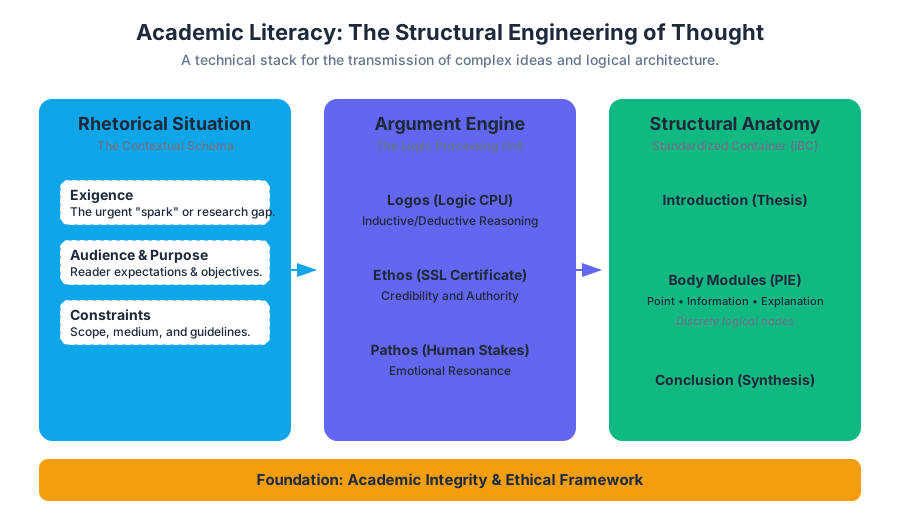
Academic literacy is not merely the ability to read and write within a university setting; it is the mastery of a specific discursive protocol. It functions as a technical stack for the transmission of complex ideas, requiring an understanding of the Rhetorical Situation, the structural engineering of the Academic Argument, and the rigorous ethical framework of Academic Integrity. To be academically literate is to move from being a passive consumer of information to an active contributor in a global, multi-generational conversation.
The Rhetorical Situation: The Context of Composition
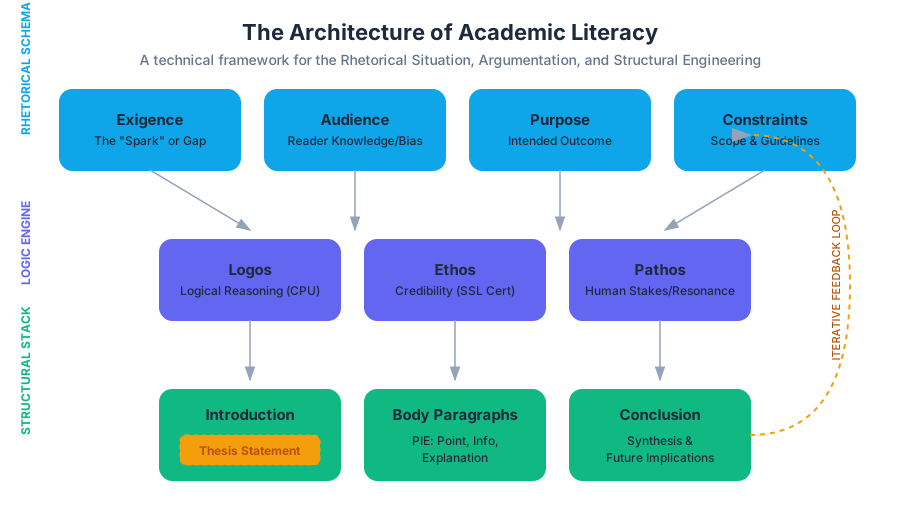
Before a single word is written, a scholar must analyze the Rhetorical Situation. This framework, derived from classical rhetoric, dictates the "schema" of the communication. It is defined by the intersection of the author, the audience, the topic, and the purpose.
Definition: The Rhetorical Situation is the set of circumstances—context, audience, purpose, and exigence—that shape how a text is created and how it should be interpreted.
Components of the Rhetorical Framework
| Component | Technical Definition | Function in Academic Writing |
|---|---|---|
| Exigence | The "spark" or urgent need that prompts the writing. | Identifies the gap in current research or the problem to be solved. |
| Audience | The specific group of readers with their own biases and knowledge levels. | Determines the level of technical jargon and the "burden of proof" required. |
| Purpose | The intended outcome (to persuade, inform, analyze, or critique). | Governs the tone and the selection of evidence. |
| Constraints | The limitations of the medium, word count, or institutional guidelines. | Defines the scope and the structural boundaries of the essay. |
The Academic Argument: Logical Architecture
An Academic Argument is not a "dispute" in the colloquial sense; it is a logically sequenced presentation of evidence designed to support a specific Thesis Statement. In the "DeepWiki" view, an argument is a directed acyclic graph (DAG) where the thesis is the root node, and every subsequent claim and piece of evidence must provide a path back to that root.
The Three Pillars of Persuasion (Rhetorical Modes)
Scholars utilize three primary modes of appeal, originally codified by Aristotle, to build a robust argument:
- Logos (Logical Appeal): The use of inductive and deductive reasoning. This is the "CPU" of the argument, processing data into conclusions.
- Ethos (Ethical Appeal): The establishment of the writer’s credibility and authority. This is the "SSL Certificate" of the paper—it proves the source is trusted.
- Pathos (Pathetic Appeal): The strategic use of emotional resonance. While minimized in "hard" sciences, it is vital in humanities to demonstrate the human stakes of an issue.
Logical Fallacies: System Vulnerabilities
Just as code can have bugs, arguments can have Logical Fallacies. These are errors in reasoning that invalidate the "logic gate" of an argument.
| Fallacy | Description | Example in Academic Context |
|---|---|---|
| Ad Hominem | Attacking the person rather than the argument. | "Researcher X's data is wrong because they have a history of controversial views." |
| Straw Man | Misrepresenting an opponent's position to make it easier to attack. | "Proponents of climate change want to destroy the global economy overnight." |
| Non Sequitur | The conclusion does not follow from the premises. | "The study was conducted in London; therefore, the results apply to all humans." |
| Hasty Generalization | Drawing a conclusion from an insufficient sample size. | "Two students failed the test; the entire curriculum is flawed." |
Structural Engineering: The Anatomy of an Essay
The Essay Structure is the standardized container for academic thought. While variations exist across disciplines, the "IBC" (Introduction, Body, Conclusion) model remains the industry standard for ensuring clarity and logical flow.
The Introduction and the Thesis Statement
The Introduction serves as the "header file" for the essay. It provides the necessary context and culminates in the Thesis Statement.
The Thesis Statement: A concise, arguable claim that serves as the central "pointer" for the entire document. It must be specific, evidence-based, and capable of being contested.
The Body: Paragraph-Level Logic
Each body paragraph should function as a discrete module within the larger system. A common heuristic for this is the PIE or TEA method:
- Point (Topic Sentence): The claim the paragraph is making.
- Information (Evidence): Data, quotes, or findings.
- Explanation (Analysis): Connecting the evidence back to the thesis.
The Conclusion: Synthesis and Future State
The Conclusion is not merely a summary. It is a synthesis that demonstrates how the individual "modules" (paragraphs) have proven the "root claim" (thesis). It often includes a "Look Ahead" or "Implications" section, suggesting where the research protocol should go next.
# A conceptual logic-checker for an Academic Argument structure
class ArgumentNode:
    def __init__(self, claim, evidence_score=0.0, is_thesis=False):
        self.claim = claim
        self.evidence_score = evidence_score
        self.is_thesis = is_thesis
        self.supporting_nodes = []

    def add_support(self, node):
        self.supporting_nodes.append(node)

    def validate_integrity(self):
        """
        Recursively checks if the thesis is supported by nodes
        with sufficient evidence scores.
        """
        if not self.supporting_nodes:
            return self.evidence_score > 0.5

        support_valid = all(node.validate_integrity() for node in self.supporting_nodes)
        return support_valid and (self.evidence_score > 0.3 or self.is_thesis)

# Example Usage:
thesis = ArgumentNode("Renewable energy mandates reduce long-term costs.", is_thesis=True)
p1 = ArgumentNode("Solar efficiency has increased by 200%", evidence_score=0.9)
p2 = ArgumentNode("Fossil fuel subsidies are hidden costs", evidence_score=0.8)

thesis.add_support(p1)
thesis.add_support(p2)

print(f"Argument Integrity Verified: {thesis.validate_integrity()}")
Academic Integrity: The Ethical Protocol
Academic Integrity is the moral code of the scholarly community. It is based on the principle that knowledge production is a collaborative effort requiring radical honesty regarding the provenance of ideas.
Plagiarism: The Critical Failure
Plagiarism is the unauthorized use or "theft" of intellectual property. It is treated as a "fatal error" in academic environments, often resulting in expulsion or loss of professional standing.
- Direct Plagiarism: Word-for-word transcription without quotation marks or citation.
- Mosaic Plagiarism: Patching together bits of different sources without original thought.
- Self-Plagiarism: Re-submitting one's own previous work for a new credit without disclosure.
- Accidental Plagiarism: Neglecting to cite a source due to poor note-taking or ignorance of the rules.
Referencing and Citation Systems
Referencing is the technical implementation of academic integrity. It provides a "stack trace" for the reader to follow the writer’s research process.
| Style | Primary Discipline | Key Characteristic |
|---|---|---|
| APA (7th Ed.) | Social Sciences / Education | Emphasizes the date of research (Author-Date). |
| MLA (9th Ed.) | Humanities / Literature | Emphasizes the location in the text (Author-Page). |
| Chicago | History / Business | Uses footnotes or endnotes for a clean page layout. |
| IEEE | Engineering / Tech | Uses numerical citations in brackets [1]. |
\text{Citation Density} (CD) = \frac{\sum \text{Unique Sources}}{\text{Total Word Count}} \times 100
Note: A high CD often indicates a literature review, while a moderate CD suggests an original synthesis.
The Professional Imperative: Why It Matters Beyond University
The Hart Research Associates report, It Takes More Than a Major, highlights a critical disconnect: while students focus on their specific major, 93% of employers prioritize "a demonstrated capacity to think critically, communicate clearly, and solve complex problems"—the exact core competencies of academic literacy.
Cross-Cutting Skills vs. Field-Specific Knowledge
Employers value Cross-cutting skills (the ability to synthesize information and argue a point) over rote memorization of field-specific facts. Academic literacy provides the "operating system" that allows a professional to learn any new "software" (job-specific skill).
# Example: Using Pandoc to convert a Markdown essay to a
# professionally formatted PDF with a bibliography.
# This represents the technical "build" process of academic writing.

pandoc essay_draft.md \
    --from=markdown \
    --to=latex \
    --citeproc \
    --bibliography=references.bib \
    --csl=apa.csl \
    -o final_submission.pdf
Common Pitfalls in Academic Writing
- The "Data Dump": Providing evidence without analysis. Evidence does not speak for itself; it must be interpreted through the lens of the thesis.
- Weak Thesis Statements: Making a statement of fact rather than a claim. "The sun is hot" is not a thesis; "Solar thermal energy is the most viable path to carbon neutrality in sub-Saharan Africa" is.
- Tone Inconsistency: Shifting between formal academic register and informal "blog-style" writing.
- Over-reliance on Direct Quotes: A "Frankenstein" essay made of other people's words lacks the author's original synthesis. Aim for a ratio of 80% original analysis to 20% direct/indirect evidence.
Summary of the Writing Pipeline
- Pre-writing: Brainstorming, clustering, and analyzing the Rhetorical Situation.
- Drafting: Constructing the "Minimum Viable Product" (MVP) of the essay.
- Revision: Refactoring the logic, strengthening the "connective tissue" between paragraphs.
- Editing/Proofreading: Debugging the syntax, grammar, and citation formatting.
Source Materials
- English Composition 1 PDF
- Hurst, Ellen, Ed.Academic Literacy Workshops: A Handbook for Students and Instructors. U of Capetown. 2011.
- Hart Research Associates.It Takes More Than a Major: Employer Priorities for College Learning and Student Success. 10 Apr 2013.
- English Composition I
- English Composition I
- English Composition I
- English Composition I
- English Composition I
- Hart Research Associates.Raising the Bar: Employers’ Views on College Learning in the Wake of the Economic Downturn. 20 Jan 2010, p. 9.
Study English Composition I with AI — Free on Lykke
Sign up for free to generate personalized flashcards, quizzes, and study guides from this course. Chat with an AI tutor that knows the material.
Get Started FreeView this course wiki on Lykke · Browse all public course wikis