From the free course English Composition I on Lykke
Academic Literacy and Essay Structure
Key concepts: Academic Argument · Essay Structure · Academic Integrity · Plagiarism · Referencing
Focuses on the structural mechanics of essay writing and the ethical requirements of academic integrity.
Academic Literacy and Essay Structure
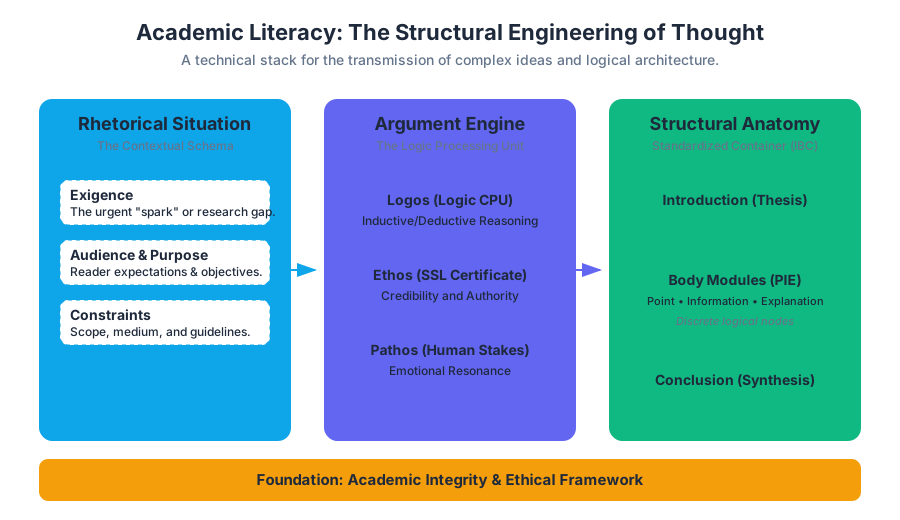
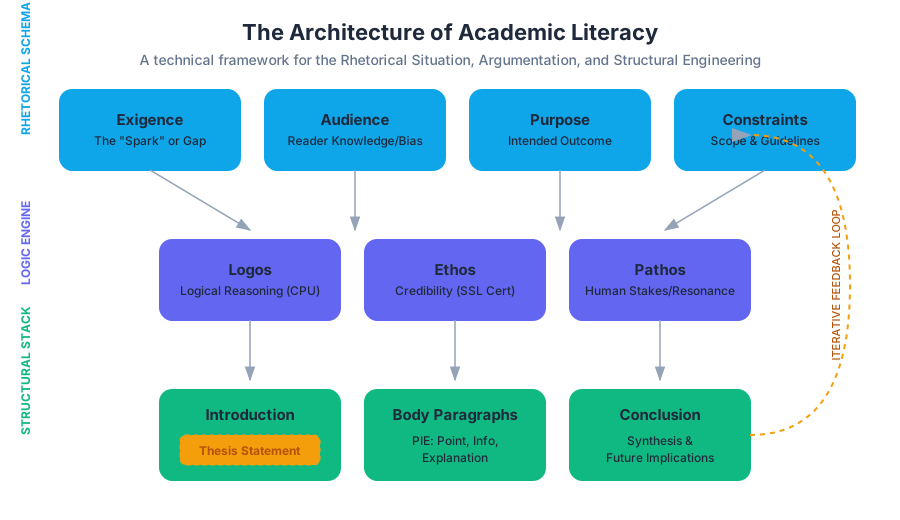
Academic literacy is not merely the ability to read and write within a university setting; it is the mastery of a specific discursive protocol. It functions as a technical stack for the transmission of complex ideas, requiring an understanding of the Rhetorical Situation, the structural engineering of the Academic Argument, and the rigorous ethical framework of Academic Integrity. To be academically literate is to move from being a passive consumer of information to an active contributor in a global, multi-generational conversation.
The Rhetorical Situation: The Context of Composition
Before a single word is written, a scholar must analyze the Rhetorical Situation. This framework, derived from classical rhetoric, dictates the "schema" of the communication. It is defined by the intersection of the author, the audience, the topic, and the purpose.
Definition: The Rhetorical Situation is the set of circumstances—context, audience, purpose, and exigence—that shape how a text is created and how it should be interpreted.
Components of the Rhetorical Framework
| Component | Technical Definition | Function in Academic Writing |
|---|---|---|
| Exigence | The "spark" or urgent need that prompts the writing. | Identifies the gap in current research or the problem to be solved. |
| Audience | The specific group of readers with their own biases and knowledge levels. | Determines the level of technical jargon and the "burden of proof" required. |
| Purpose | The intended outcome (to persuade, inform, analyze, or critique). | Governs the tone and the selection of evidence. |
| Constraints | The limitations of the medium, word count, or institutional guidelines. | Defines the scope and the structural boundaries of the essay. |
The Academic Argument: Logical Architecture
An Academic Argument is not a "dispute" in the colloquial sense; it is a logically sequenced presentation of evidence designed to support a specific Thesis Statement. In the "DeepWiki" view, an argument is a directed acyclic graph (DAG) where the thesis is the root node, and every subsequent claim and piece of evidence must provide a path back to that root.
The Three Pillars of Persuasion (Rhetorical Modes)
Scholars utilize three primary modes of appeal, originally codified by Aristotle, to build a robust argument:
- Logos (Logical Appeal): The use of inductive and deductive reasoning. This is the "CPU" of the argument, processing data into conclusions.
- Ethos (Ethical Appeal): The establishment of the writer’s credibility and authority. This is the "SSL Certificate" of the paper—it proves the source is trusted.
- Pathos (Pathetic Appeal): The strategic use of emotional resonance. While minimized in "hard" sciences, it is vital in humanities to demonstrate the human stakes of an issue.
Logical Fallacies: System Vulnerabilities
Just as code can have bugs, arguments can have Logical Fallacies. These are errors in reasoning that invalidate the "logic gate" of an argument.
| Fallacy | Description | Example in Academic Context |
|---|---|---|
| Ad Hominem | Attacking the person rather than the argument. | "Researcher X's data is wrong because they have a history of controversial views." |
| Straw Man | Misrepresenting an opponent's position to make it easier to attack. | "Proponents of climate change want to destroy the global economy overnight." |
| Non Sequitur | The conclusion does not follow from the premises. | "The study was conducted in London; therefore, the results apply to all humans." |
| Hasty Generalization | Drawing a conclusion from an insufficient sample size. | "Two students failed the test; the entire curriculum is flawed." |
Structural Engineering: The Anatomy of an Essay
The Essay Structure is the standardized container for academic thought. While variations exist across disciplines, the "IBC" (Introduction, Body, Conclusion) model remains the industry standard for ensuring clarity and logical flow.
The Introduction and the Thesis Statement
The Introduction serves as the "header file" for the essay. It provides the necessary context and culminates in the Thesis Statement.
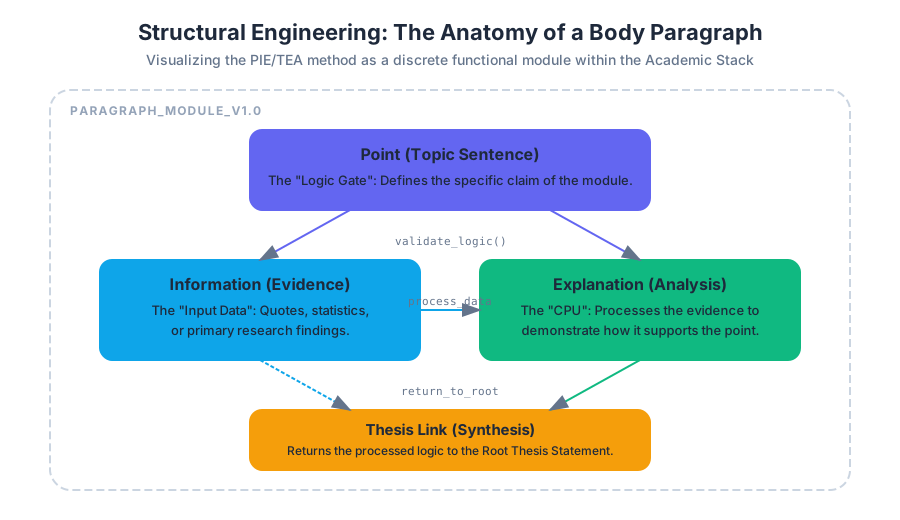
The Thesis Statement: A concise, arguable claim that serves as the central "pointer" for the entire document. It must be specific, evidence-based, and capable of being contested.
The Body: Paragraph-Level Logic
Each body paragraph should function as a discrete module within the larger system. A common heuristic for this is the PIE or TEA method:
- Point (Topic Sentence): The claim the paragraph is making.
- Information (Evidence): Data, quotes, or findings.
- Explanation (Analysis): Connecting the evidence back to the thesis.
The Conclusion: Synthesis and Future State
The Conclusion is not merely a summary. It is a synthesis that demonstrates how the individual "modules" (paragraphs) have proven the "root claim" (thesis). It often includes a "Look Ahead" or "Implications" section, suggesting where the research protocol should go next.
Academic Integrity: The Ethical Protocol
Academic Integrity is the moral code of the scholarly community. It is based on the principle that knowledge production is a collaborative effort requiring radical honesty regarding the provenance of ideas.
Plagiarism: The Critical Failure
Plagiarism is the unauthorized use or "theft" of intellectual property. It is treated as a "fatal error" in academic environments, often resulting in expulsion or loss of professional standing.
- Direct Plagiarism: Word-for-word transcription without quotation marks or citation.
- Mosaic Plagiarism: Patching together bits of different sources without original thought.
- Self-Plagiarism: Re-submitting one's own previous work for a new credit without disclosure.
- Accidental Plagiarism: Neglecting to cite a source due to poor note-taking or ignorance of the rules.
Referencing and Citation Systems
Referencing is the technical implementation of academic integrity. It provides a "stack trace" for the reader to follow the writer’s research process.
| Style | Primary Discipline | Key Characteristic |
|---|---|---|
| APA (7th Ed.) | Social Sciences / Education | Emphasizes the date of research (Author-Date). |
| MLA (9th Ed.) | Humanities / Literature | Emphasizes the location in the text (Author-Page). |
| Chicago | History / Business | Uses footnotes or endnotes for a clean page layout. |
| IEEE | Engineering / Tech | Uses numerical citations in brackets [1]. |
\text{Citation Density} (CD) = \frac{\sum \text{Unique Sources}}{\text{Total Word Count}} \times 100
Note: A high CD often indicates a literature review, while a moderate CD suggests an original synthesis.
The Professional Imperative: Why It Matters Beyond University
The Hart Research Associates report, It Takes More Than a Major, highlights a critical disconnect: while students focus on their specific major, 93% of employers prioritize "a demonstrated capacity to think critically, communicate clearly, and solve complex problems"—the exact core competencies of academic literacy.
Cross-Cutting Skills vs. Field-Specific Knowledge
Employers value Cross-cutting skills (the ability to synthesize information and argue a point) over rote memorization of field-specific facts. Academic literacy provides the "operating system" that allows a professional to learn any new "software" (job-specific skill).
Common Pitfalls in Academic Writing
- The "Data Dump": Providing evidence without analysis. Evidence does not speak for itself; it must be interpreted through the lens of the thesis.
- Weak Thesis Statements: Making a statement of fact rather than a claim. "The sun is hot" is not a thesis; "Solar thermal energy is the most viable path to carbon neutrality in sub-Saharan Africa" is.
- Tone Inconsistency: Shifting between formal academic register and informal "blog-style" writing.
- Over-reliance on Direct Quotes: A "Frankenstein" essay made of other people's words lacks the author's original synthesis. Aim for a ratio of 80% original analysis to 20% direct/indirect evidence.
Summary of the Writing Pipeline
- Pre-writing: Brainstorming, clustering, and analyzing the Rhetorical Situation.
- Drafting: Constructing the "Minimum Viable Product" (MVP) of the essay.
- Revision: Refactoring the logic, strengthening the "connective tissue" between paragraphs.
- Editing/Proofreading: Debugging the syntax, grammar, and citation formatting.
Source Materials
- Hurst, Ellen, Ed.Academic Literacy Workshops: A Handbook for Students and Instructors. U of Capetown. 2011.
- English Composition 1 PDF
- Hart Research Associates.It Takes More Than a Major: Employer Priorities for College Learning and Student Success. 10 Apr 2013.
- English Composition I
- English Composition I
- English Composition I
- English Composition I
- English Composition I
Study English Composition I on Lykke
This course page is free to open: signed out, you can read its first two sections, and signing in, on any plan, opens the rest. The free Lykke Chrome extension syncs your own Canvas courses, so ChatGPT, Claude and Muse can answer from your classes and deadlines. It only reads Canvas.
Add the free extensionSign in to open every sectionAll sections of English Composition I · Browse more course pages