From the free course Chemistry 2e on Lykke
Thermodynamics and Electrochemistry
Key concepts: Entropy · Gibbs Free Energy · Redox Reactions · Galvanic Cells
Advanced topics covering the spontaneity of reactions through entropy and Gibbs free energy, and the conversion between chemical and electrical energy.
Thermodynamics and Electrochemistry
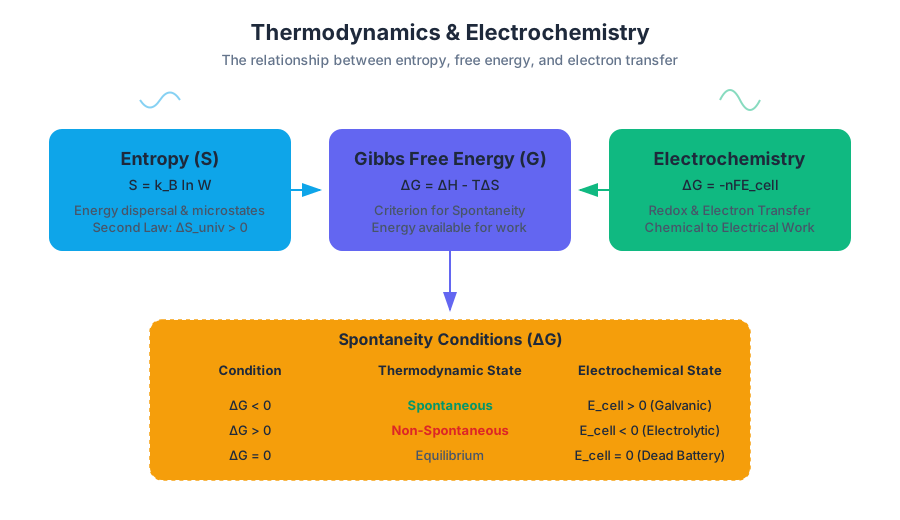
The study of chemical change is governed by two fundamental questions: "Can it happen?" and "How much energy can we extract if it does?" While kinetics describes the rate of a reaction, Thermodynamics provides the ultimate roadmap for spontaneity and equilibrium. When these thermodynamic principles are applied to the movement of electrons, we enter the domain of Electrochemistry—the bridge between chemical bonding and electrical work.
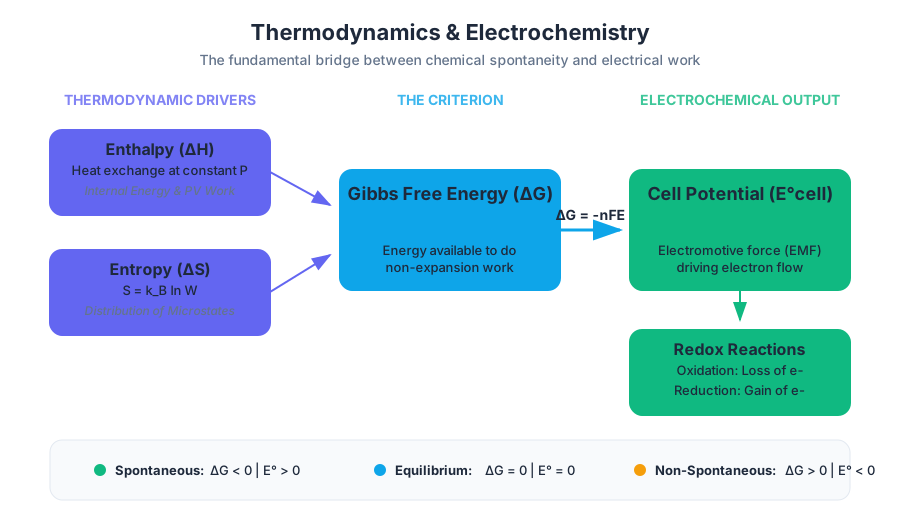
This article explores the rigorous framework connecting entropy, free energy, and the electrochemical potential, providing the technical foundation required to understand everything from cellular respiration to the next generation of solid-state batteries.
Entropy and the Second Law
At the heart of all spontaneous processes lies Entropy ($S$), a state function that quantifies the distribution of energy within a system. Unlike energy, which is conserved, entropy is cumulative.
The Second Law of Thermodynamics: In any spontaneous process, the total entropy of the universe ($S_{universe} = S_{system} + S_{surroundings}$) must increase.
Microstates and Statistical Mechanics
From a statistical perspective, entropy is defined by the Boltzmann Equation: $$S = k_B \ln W$$ where $k_B$ is the Boltzmann constant ($1.38 \times 10^{-23} J/K$) and $W$ is the number of microstates—the specific microscopic configurations (position and momentum of particles) that correspond to a particular macroscopic state.
Factors Influencing Entropy
Entropy is not merely "disorder"; it is a measure of energy dispersal. Several factors predictably increase the number of available microstates:
- Phase Changes: Transitioning from solid to liquid to gas significantly increases positional entropy.
- Temperature: Higher kinetic energy allows particles to access more vibrational and rotational energy levels.
- Molecular Complexity: Larger molecules have more internal degrees of freedom (bonds that can vibrate or rotate).
- Dissolution: Mixing solutes into solvents generally increases the volume available to each particle.
| State Change | Entropy Trend ($\Delta S$) | Physical Justification |
|---|---|---|
| $S \rightarrow L \rightarrow G$ | Positive (+) | Massive increase in translational microstates. |
| $N_2(g) + 3H_2(g) \rightarrow 2NH_3(g)$ | Negative (-) | Reduction in the total moles of gas particles. |
| Dissolving $NaCl(s)$ in $H_2O$ | Positive (+) | Lattice breakdown increases ion mobility. |
| Heating $Cu(s)$ from 298K to 500K | Positive (+) | Increased population of higher energy vibrational states. |
Gibbs Free Energy ($G$): The Criterion for Spontaneity
While the Second Law focuses on the universe, chemists require a metric focused solely on the system. This is provided by the Gibbs Free Energy ($G$), defined as the energy available to do "useful" (non-expansion) work at constant temperature and pressure.
The Gibbs-Helmholtz Equation
The relationship between enthalpy ($H$), entropy ($S$), and temperature ($T$) is expressed as: $$\Delta G = \Delta H - T\Delta S$$
This equation acts as a balance between the drive toward minimum energy (enthalpy) and maximum dispersal (entropy).
Spontaneity Conditions
The sign of $\Delta G$ determines the direction of chemical change:
- $\Delta G < 0$: Spontaneous (Exergonic)
- $\Delta G > 0$: Non-spontaneous (Endergonic)
- $\Delta G = 0$: Equilibrium
| $\Delta H$ | $\Delta S$ | Spontaneity Condition | Example |
|---|---|---|---|
| Negative (-) | Positive (+) | Spontaneous at all temperatures | $2O_3(g) \rightarrow 3O_2(g)$ |
| Positive (+) | Negative (-) | Non-spontaneous at all temperatures | $3O_2(g) \rightarrow 2O_3(g)$ |
| Negative (-) | Negative (-) | Spontaneous at LOW temperatures | Freezing of water |
| Positive (+) | Positive (+) | Spontaneous at HIGH temperatures | Vaporization of water |
Redox Reactions and Electron Transfer
Redox (Reduction-Oxidation) reactions involve the transfer of electrons between chemical species. This transfer is the fundamental "current" exploited in electrochemistry.
- Oxidation: The loss of electrons (increase in oxidation state).
- Reduction: The gain of electrons (decrease in oxidation state).
The Reducing Agent is the species that is oxidized (it gives up electrons to reduce another). The Oxidizing Agent is the species that is reduced (it takes electrons to oxidize another).
Balancing Redox via the Half-Reaction Method
In complex aqueous environments, balancing redox reactions requires more than simple inspection. The half-reaction method separates the process into oxidation and reduction components.
ALGORITHM: Half-Reaction Method (Acidic Solution)
------------------------------------------------
1. Identify and write the two unbalanced half-reactions.
2. Balance all elements EXCEPT Oxygen and Hydrogen.
3. Balance Oxygen by adding H2O to the deficient side.
4. Balance Hydrogen by adding H+ ions to the deficient side.
5. Balance Charge by adding Electrons (e-) to the more positive side.
6. Equalize Electrons between the two half-reactions by multiplying by integers.
7. Add the half-reactions and cancel common species (e-, H2O, H+).
8. (If Basic): Add OH- to both sides to neutralize H+, forming H2O.
Electrochemical Cells: Galvanic vs. Electrolytic
An electrochemical cell is a device that interfaces a chemical system with an external circuit. There are two primary types:
- Galvanic (Voltaic) Cells: Utilize a spontaneous chemical reaction ($\Delta G < 0$) to generate an electric current. Examples include alkaline batteries and fuel cells.
- Electrolytic Cells: Use an external power source to drive a non-spontaneous reaction ($\Delta G > 0$). Examples include electroplating and the charging of a battery.
Anatomy of a Galvanic Cell
A standard cell consists of two electrodes submerged in electrolyte solutions, connected by an external wire and a salt bridge.
- Anode: The electrode where oxidation occurs. It is the negative terminal in a galvanic cell.
- Cathode: The electrode where reduction occurs. It is the positive terminal in a galvanic cell.
- Salt Bridge: A tube filled with an inert electrolyte (like $KNO_3$) that allows ions to migrate, maintaining electrical neutrality without mixing the bulk solutions.
Cell Notation
To avoid drawing complex diagrams, chemists use a shorthand notation: $$Zn(s) | Zn^{2+}(aq, 1M) || Cu^{2+}(aq, 1M) | Cu(s)$$
- The single bar
|represents a phase boundary. - The double bar
||represents the salt bridge. - The anode is always written on the left.
| Feature | Galvanic Cell | Electrolytic Cell |
|---|---|---|
| Spontaneity | Spontaneous ($\Delta G < 0$) | Non-spontaneous ($\Delta G > 0$) |
| Energy Conversion | Chemical $\rightarrow$ Electrical | Electrical $\rightarrow$ Chemical |
| Anode Charge | Negative (-) | Positive (+) |
| Cathode Charge | Positive (+) | Negative (-) |
| Common Use | Powering devices (Batteries) | Metal refining, Electroplating |
Standard Reduction Potentials ($E^\circ$)
The driving force behind the movement of electrons is the Cell Potential ($E_{cell}$), also known as electromotive force (EMF). It is measured in Volts ($1 V = 1 J/C$).
The potential of an individual half-cell cannot be measured in isolation. Instead, all potentials are measured relative to the Standard Hydrogen Electrode (SHE), which is assigned a potential of exactly $0.00 V$.
Calculating $E^\circ_{cell}$
The standard cell potential is the difference between the reduction potential of the cathode and the anode: $$E^\circ_{cell} = E^\circ_{cathode} - E^\circ_{anode}$$
Note: Both values used in this equation are standard reduction potentials. Do not flip the sign of the anode potential before subtracting.
Mathematical Derivation: Connecting $\Delta G$ and $E$
The bridge between thermodynamics and electrochemistry is the relationship between free energy and electrical work ($W_{elec} = -nFE$):
\Delta G = -nFE_{cell}
\Delta G^\circ = -nFE^\circ_{cell}
Where:
- $n$ = moles of electrons transferred.
- $F$ = Faraday's constant ($\approx 96,485 C/mol e^-$).
- $E$ = Cell potential.
From this, we can also link $E^\circ$ to the equilibrium constant ($K$): $$\Delta G^\circ = -RT \ln K \implies -nFE^\circ = -RT \ln K \implies E^\circ = \frac{RT}{nF} \ln K$$
The Nernst Equation: Non-Standard Conditions
In the real world, concentrations are rarely exactly $1.0 M$ and pressures are rarely $1.0 atm$. The Nernst Equation allows us to calculate the cell potential under any conditions.
$$E = E^\circ - \frac{RT}{nF} \ln Q$$
At $25^\circ C$ ($298 K$), using base-10 logarithms, the equation simplifies to: $$E = E^\circ - \frac{0.0592 V}{n} \log Q$$ Where $Q$ is the reaction quotient.
Advanced Applications and Pitfalls
Concentration Cells
A concentration cell is a unique galvanic cell where both compartments contain the same electrodes and electrolytes, but at different concentrations. The drive to reach equilibrium (equalize concentrations) creates a potential.
- Mechanism: Oxidation occurs in the more dilute compartment; reduction occurs in the more concentrated compartment.
- $E^\circ$: Always $0.00 V$ (since electrodes are identical).
- $E$: Calculated via Nernst; usually small but significant in biological systems (e.g., nerve impulse conduction via $Na^+/K^+$ gradients).
Corrosion: The Unwanted Galvanic Cell
Corrosion is the spontaneous oxidation of metals by environmental agents.
- The Iron Example: For iron to rust, it requires both oxygen and water. The iron acts as the anode, while a different spot on the metal surface (or a droplet of water) acts as the cathode.
- Prevention (Cathodic Protection): By attaching a "sacrificial anode" (a more active metal like Zinc or Magnesium), the iron is forced to become the cathode and is protected from oxidation.
Common Pitfalls
- Stoichiometry and $E^\circ$: Unlike $\Delta G$ or $\Delta H$, you never multiply $E^\circ$ by the coefficients in a balanced equation. Potential is an intensive property (voltage doesn't change with the amount of material, though the total energy capacity does).
- Sign Confusion: In the Nernst equation, if $Q > 1$ (more products than reactants), the potential $E$ will be less than $E^\circ$. If $Q < 1$, $E$ will be greater than $E^\circ$.
- The Salt Bridge: Forgetting the salt bridge is a common conceptual error. Without it, charge builds up instantly, and the current stops flowing.
Summary of Battery Chemistries
To conclude, let us look at how these principles manifest in modern energy storage technologies.
| Battery Type | Anode (-) | Cathode (+) | $E_{cell}$ (Approx) | Characteristics |
|---|---|---|---|---|
| Lead-Acid | $Pb$ | $PbO_2$ | $2.1 V$ | Heavy, reliable, high surge current. |
| Alkaline | $Zn$ | $MnO_2$ | $1.5 V$ | Disposable, high energy density. |
| Lithium-Ion | $LiC_6$ | $LiCoO_2$ | $3.7 V$ | Lightweight, rechargeable, high voltage. |
| Hydrogen Fuel Cell | $H_2$ | $O_2$ | $1.2 V$ | Continuous fuel supply, zero emissions ($H_2O$). |
By mastering the interplay between the chaotic drive of entropy and the structured flow of electrons, we gain the ability to predict the stability of materials and design the systems that power our civilization.
Source Materials
Study Chemistry 2e on Lykke
This course page is free to open: signed out, you can read its first two sections, and signing in, on any plan, opens the rest. The free Lykke Chrome extension syncs your own Canvas courses, so ChatGPT, Claude and Muse can answer from your classes and deadlines. It only reads Canvas.
Add the free extensionSign in to open every section