From the free course Chemistry 2e on Lykke
States of Matter and Thermochemistry
Key concepts: Ideal Gas Law · Intermolecular Forces · Enthalpy · Calorimetry
An analysis of the physical states of matter (gases, liquids, solids) and the energy changes that accompany physical and chemical processes.
States of Matter and Thermochemistry
The study of matter is fundamentally a study of energy and interaction. While introductory chemistry often treats substances as static entities, a deep-dive into the States of Matter and Thermochemistry reveals a dynamic landscape where microscopic forces and macroscopic energy transfers dictate the behavior of everything from the air in a combustion engine to the folding of proteins in a cell. This section bridges the gap between the Kinetic Molecular Theory of gases and the thermodynamic laws that govern heat flow and phase transitions.
The Gaseous State and the Ideal Gas Law
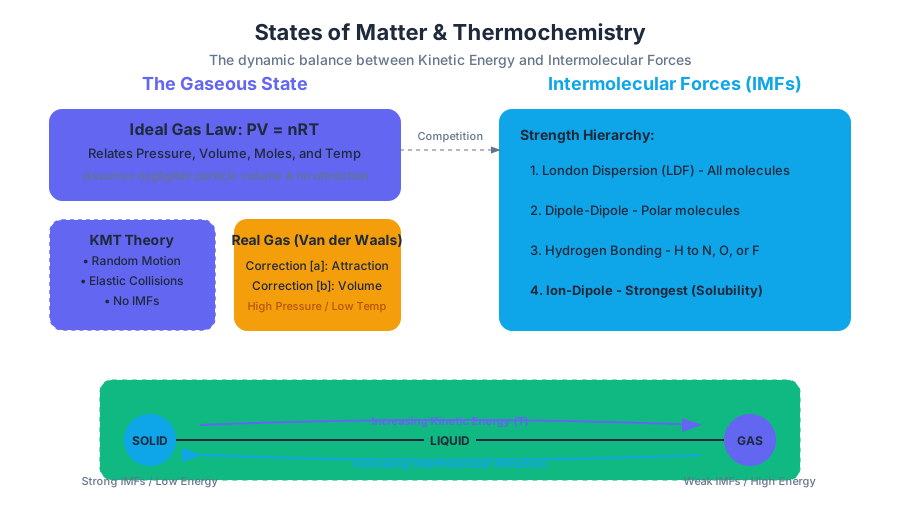
Gases represent the most chaotic state of matter, where kinetic energy significantly outweighs the attractive forces between particles. To model this behavior, we use the Ideal Gas Law, a cornerstone of classical thermodynamics that relates the physical properties of a gas sample.
What it is
The Ideal Gas Law is an equation of state defined as:
PV = nRTWherePis absolute pressure,Vis volume,nis the number of moles,Ris the universal gas constant (8.314 J/mol·K or 0.08206 L·atm/mol·K), andTis the absolute temperature in Kelvin.
How it Works: Kinetic Molecular Theory (KMT)
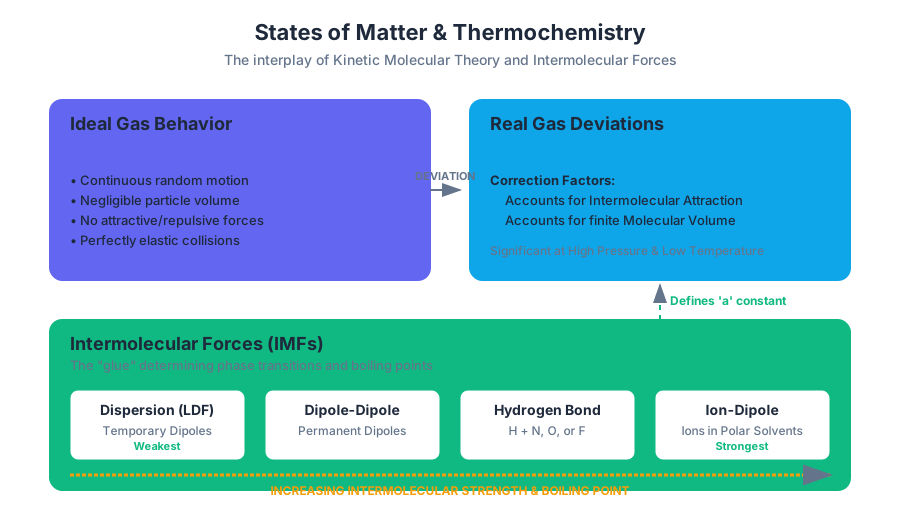
The validity of the Ideal Gas Law rests on the Kinetic Molecular Theory, which posits four primary assumptions:
- Gas particles are in continuous, random motion.
- The volume of the particles themselves is negligible compared to the container volume.
- Particles exert no attractive or repulsive forces on each other.
- Collisions are perfectly elastic (no net loss of kinetic energy).
Real Gas Deviations
In reality, no gas is truly "ideal." At high pressures, the volume of the molecules becomes significant. At low temperatures, Intermolecular Forces (IMFs) cause particles to "stick" together, reducing the pressure exerted on container walls. To account for this, engineers use the Van der Waals Equation:
[P + a(n/V)²][V - nb] = nRTHere,aaccounts for attractive forces andbaccounts for the finite volume of the gas molecules.
| Law Name | Constant Variables | Relationship | Mathematical Form |
|---|---|---|---|
| Boyle’s Law | n, T |
Pressure is inversely proportional to Volume | P1V1 = P2V2 |
| Charles’s Law | n, P |
Volume is directly proportional to Temperature | V1/T1 = V2/T2 |
| Avogadro’s Law | P, T |
Volume is directly proportional to Moles | V1/n1 = V2/n2 |
| Gay-Lussac’s Law | n, V |
Pressure is directly proportional to Temperature | P1/T1 = P2/T2 |
Intermolecular Forces (IMFs)
While gases are defined by the absence of interaction, liquids and solids are defined by them. Intermolecular Forces are the non-covalent attractive forces that hold molecules together. They are the "glue" of the physical world.
The Hierarchy of Forces
IMFs vary in strength based on molecular polarity and electron cloud polarizability.
- London Dispersion Forces (LDF): Present in all molecules. Caused by temporary fluctuations in electron density creating "instantaneous dipoles." Strength increases with molar mass (polarizability).
- Dipole-Dipole Interactions: Occur between polar molecules with permanent dipoles.
- Hydrogen Bonding: A specific, ultra-strong dipole-dipole interaction occurring when H is bonded to N, O, or F.
- Ion-Dipole Forces: The strongest IMF, occurring between an ion and a polar molecule (critical for solubility in water).
| Force Type | Relative Strength | Requirement | Example |
|---|---|---|---|
| Dispersion | Weakest | All molecules | CH4, He, I2 |
| Dipole-Dipole | Moderate | Permanent Dipole | HCl, CH3Cl |
| Hydrogen Bond | Strong | H-F, H-O, or H-N |
H2O, NH3, DNA base pairs |
| Ion-Dipole | Strongest | Ion + Polar solvent | NaCl in H2O |
Why IMFs Matter: Phase Transitions
The boiling point and melting point of a substance are direct proxies for the strength of its IMFs. To transition from liquid to gas, a molecule must gain enough kinetic energy to overcome the "stickiness" of its neighbors.
The Vapor Pressure Paradox: As IMFs increase, vapor pressure decreases. This is because fewer molecules have the energy required to escape the liquid phase into the gas phase at a given temperature.
Mathematical Derivation: The Lennard-Jones Potential
In computational chemistry, the interaction between two non-bonded atoms is often modeled using the Lennard-Jones 6-12 Potential, which describes the balance between attractive dispersion forces and Pauli repulsion.
V_{LJ}(r) = 4\epsilon \left[ \left( \frac{\sigma}{r} \right)^{12} - \left( \frac{\sigma}{r} \right)^{6} \right]
r: Distance between particles.ε: Depth of the potential well (strength of attraction).σ: Distance at which the potential is zero (particle size).- The
r^-12term represents short-range repulsion (Pauli exclusion). - The
r^-6term represents long-range attraction (Van der Waals/Dispersion).
Thermochemistry and Enthalpy
Thermochemistry is the study of heat absorbed or released during chemical reactions and physical changes. It is a subset of thermodynamics, focusing specifically on the First Law of Thermodynamics: Energy cannot be created or destroyed, only transformed.
Enthalpy (ΔH)
In most laboratory settings, reactions occur at constant pressure. Under these conditions, the heat flow (q) is equal to the change in Enthalpy (ΔH).
Enthalpy (H): A state function defined as
H = U + PV. The change in enthalpy (ΔH) represents the heat exchanged by the system at constant pressure.
- Exothermic (ΔH < 0): The system releases heat to the surroundings (e.g., combustion).
- Endothermic (ΔH > 0): The system absorbs heat from the surroundings (e.g., photosynthesis, ice melting).
Standard Enthalpy of Formation (ΔH°f)
To standardize measurements, we use the Standard Enthalpy of Formation, which is the change in enthalpy when 1 mole of a substance is formed from its pure elements in their most stable form at 1 atm and 25°C.
Hess’s Law
Since enthalpy is a state function (independent of the path taken), we can calculate the ΔH of a complex reaction by summing the ΔH values of its individual steps.
\Delta H_{reaction} = \sum n\Delta H_f^\circ(\text{products}) - \sum m\Delta H_f^\circ(\text{reactants})
Calorimetry: Measuring the Heat of Reaction
Calorimetry is the experimental backbone of thermochemistry. It involves measuring the temperature change of a known mass of substance (usually water) to determine the heat exchanged by a process.
Specific Heat Capacity (c)
The amount of heat required to raise the temperature of 1 gram of a substance by 1 degree Celsius.
q = m * c * ΔTWhereqis heat (Joules),mis mass (g),cis specific heat (J/g·°C), andΔTis the change in temperature.
Types of Calorimeters
- Constant-Pressure Calorimetry (Coffee-Cup): Used for reactions in solution. Since the pressure is constant (atmospheric),
q_soln = ΔH. - Constant-Volume Calorimetry (Bomb): Used for combustion reactions. The rigid "bomb" prevents volume change, meaning no
PΔVwork is done. Here, the measured heatq_vequals the change in internal energy (ΔU), not enthalpy.
| Feature | Coffee-Cup Calorimeter | Bomb Calorimeter |
|---|---|---|
| Constant Parameter | Pressure (P) |
Volume (V) |
| Measured Heat | Enthalpy (ΔH) |
Internal Energy (ΔU) |
| Typical Use Case | Acid-Base Neutralization | Fuel Combustion |
| Complexity | Low (Styrofoam cup) | High (Steel pressure vessel) |
Common Pitfalls in Calorimetry Calculations
- Sign Conventions: Remember that
q_system = -q_surroundings. If the water (surroundings) gets hotter, the reaction (system) is exothermic (negativeΔH). - Heat Capacity of the Calorimeter: In high-precision work, the calorimeter itself absorbs heat. This is accounted for using the "Calorimeter Constant" (
C_cal).q_total = (m_water * c_water * ΔT) + (C_cal * ΔT)
- State of Matter: The enthalpy of formation for
H2O(l)is different fromH2O(g). Always check the phase in your thermochemical equations.
Worked Example: Hess's Law Calculation
Calculate the ΔH for the reaction: C(graphite) + 2H2(g) → CH4(g)
Given:
C(graphite) + O2(g) → CO2(g)(ΔH = -393.5 kJ)H2(g) + 1/2 O2(g) → H2O(l)(ΔH = -285.8 kJ)CH4(g) + 2O2(g) → CO2(g) + 2H2O(l)(ΔH = -890.3 kJ)
Step 1: Keep Eq 1 as is (provides 1C).
Step 2: Multiply Eq 2 by 2 (provides 2H2). ΔH = 2 * (-285.8) = -571.6 kJ.
Step 3: Reverse Eq 3 (puts CH4 on the product side). ΔH = +890.3 kJ.
Sum: -393.5 + (-571.6) + 890.3 = -74.8 kJ/mol.
Summary of State Transitions
The interplay between kinetic energy (temperature) and IMFs determines the phase of matter.
| Transition | Name | Energy Change | IMF Effect |
|---|---|---|---|
| Solid → Liquid | Melting/Fusion | Endothermic | Overcoming rigid lattice |
| Liquid → Gas | Vaporization | Endothermic | Breaking all IMFs |
| Gas → Liquid | Condensation | Exothermic | Re-establishing IMFs |
| Liquid → Solid | Freezing | Exothermic | Forming rigid lattice |
| Solid → Gas | Sublimation | Endothermic | Direct bypass of liquid |
Source Materials
Study Chemistry 2e on Lykke
This course page is free to open: signed out, you can read its first two sections, and signing in, on any plan, opens the rest. The free Lykke Chrome extension syncs your own Canvas courses, so ChatGPT, Claude and Muse can answer from your classes and deadlines. It only reads Canvas.
Add the free extensionSign in to open every section