From the free course Chemistry 2e on Lykke
Chemical Kinetics and Equilibrium
Key concepts: Reaction Rates · Activation Energy · Le Chatelier's Principle · Acid-Base Equilibria
Study of the rates of chemical reactions and the state of dynamic equilibrium where forward and reverse reactions occur at the same rate.
Chemical Kinetics and Equilibrium
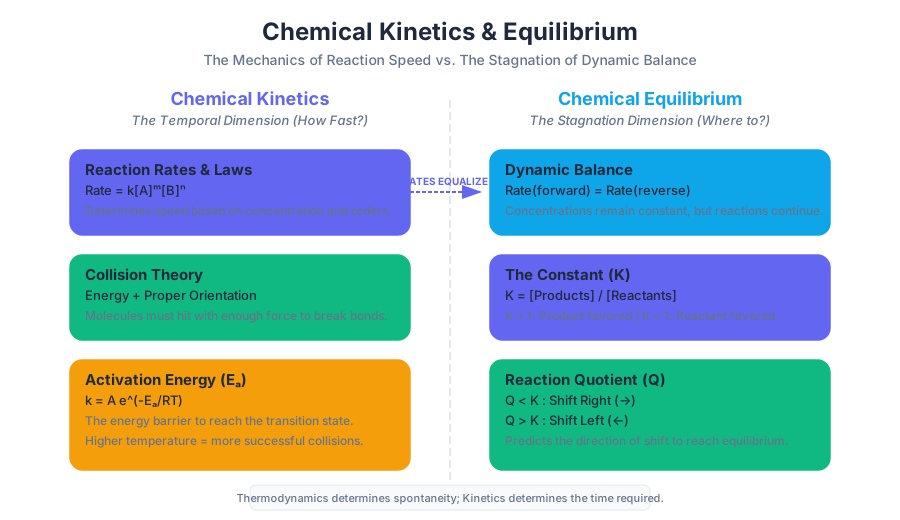
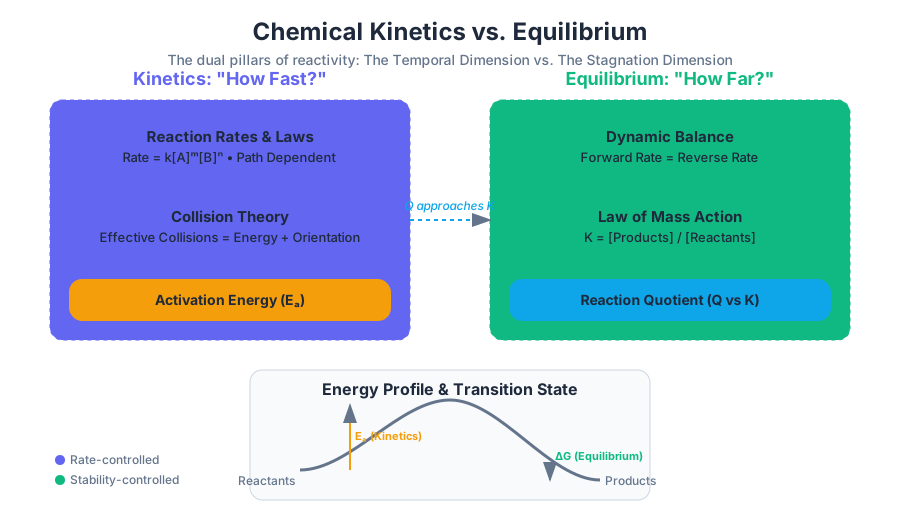
Chemical kinetics and equilibrium represent the two fundamental pillars of chemical reactivity: the temporal dimension (how fast a reaction occurs) and the stagnation dimension (where a reaction eventually settles). While thermodynamics tells us whether a reaction is spontaneous, it remains silent on the time required to reach the finish line. A diamond is thermodynamically unstable relative to graphite, yet the kinetics of that transition are so slow that the process is effectively non-existent on human timescales. This article explores the mechanics of reaction rates, the energy barriers of molecular collisions, and the delicate balance of reversible systems.
Chemical Kinetics: The Mechanics of Speed
Chemical Kinetics is the study of reaction rates and the molecular pathways (mechanisms) by which reactants transform into products. Understanding kinetics is not merely academic; it is the difference between an industrial process that takes hours and one that takes seconds, or a medication that releases its active ingredient over twelve hours versus one that peaks in minutes.
Reaction Rates and Rate Laws
The reaction rate is defined as the change in concentration of a reactant or product per unit of time. For a general reaction $aA + bB \rightarrow cC + dD$, the rate is expressed as:
$$Rate = -\frac{1}{a}\frac{\Delta[A]}{\Delta t} = \frac{1}{c}\frac{\Delta[C]}{\Delta t}$$
However, the rate is rarely constant. It typically depends on the concentrations of the reactants, a relationship defined by the Differential Rate Law:
$$Rate = k[A]^m[B]^n$$
Where:
- $k$ is the rate constant, a temperature-dependent proportionality constant.
- $m$ and $n$ are the reaction orders, determined experimentally and not necessarily equal to the stoichiometric coefficients.
Integrated Rate Laws
To predict the concentration of a substance at a specific time, we use Integrated Rate Laws. These equations vary based on the overall order of the reaction.
| Reaction Order | Rate Law | Integrated Rate Law | Units of $k$ | Half-life ($t_{1/2}$) |
|---|---|---|---|---|
| Zero | $Rate = k$ | $[A]_t = -kt + [A]_0$ | $M \cdot s^{-1}$ | $[A]_0 / 2k$ |
| First | $Rate = k[A]$ | $\ln[A]_t = -kt + \ln[A]_0$ | $s^{-1}$ | $0.693 / k$ |
| Second | $Rate = k[A]^2$ | $1/[A]_t = kt + 1/[A]_0$ | $M^{-1} \cdot s^{-1}$ | $1 / (k[A]_0)$ |
Collision Theory and Activation Energy
For a reaction to occur, molecules must collide. However, collision alone is insufficient. According to Collision Theory, two criteria must be met:
- Sufficient Energy: The collision must possess enough kinetic energy to overcome the Activation Energy ($E_a$), the minimum energy required to break existing bonds and form the transition state (or activated complex).
- Correct Orientation: The molecules must hit each other in a geometry that allows new bonds to form.
The relationship between temperature, activation energy, and the rate constant is quantified by the Arrhenius Equation:
$$k = A e^{-E_a / RT}$$
Where $A$ is the frequency factor (representing collision frequency and orientation probability), $R$ is the ideal gas constant, and $T$ is the absolute temperature.
Chemical Equilibrium: The Dynamic Balance
When a reaction occurs in a closed system, it eventually reaches a state where the concentrations of reactants and products no longer change. This is Chemical Equilibrium. It is important to realize that equilibrium is dynamic, not static; the forward and reverse reactions continue to occur, but at exactly the same rate.
The Equilibrium Constant ($K$)
The Law of Mass Action states that for a reversible reaction at equilibrium, the ratio of product concentrations to reactant concentrations (each raised to the power of their coefficients) is constant at a given temperature.
$$K_c = \frac{[C]^c[D]^d}{[A]^a[B]^b}$$
The Equilibrium Principle: The value of $K$ indicates the extent of a reaction. A large $K$ ($> 10^3$) implies the reaction goes nearly to completion, while a small $K$ ($< 10^{-3}$) implies the reaction hardly proceeds at all.
Reaction Quotient ($Q$) vs. Equilibrium Constant ($K$)
To determine if a system is at equilibrium or which direction it must shift to reach it, we calculate the Reaction Quotient ($Q$) using current (non-equilibrium) concentrations.
| Condition | Meaning | Direction of Shift |
|---|---|---|
| $Q < K$ | Too much reactant, not enough product | Shift Right (towards products) |
| $Q > K$ | Too much product, not enough reactant | Shift Left (towards reactants) |
| $Q = K$ | System is at chemical equilibrium | No net change |
Mathematical Derivation: $K_p$ vs $K_c$
For gaseous reactions, equilibrium can be expressed in terms of partial pressures ($K_p$). The relationship between $K_p$ and $K_c$ is derived from the Ideal Gas Law ($PV = nRT$).
\begin{aligned}
P_i &= \frac{n_i}{V}RT = [M]_i RT \\
K_p &= \frac{(P_C)^c (P_D)^d}{(P_A)^a (P_B)^b} \\
K_p &= \frac{([C]RT)^c ([D]RT)^d}{([A]RT)^a ([B]RT)^b} \\
K_p &= \frac{[C]^c [D]^d}{[A]^a [B]^b} (RT)^{(c+d)-(a+b)} \\
K_p &= K_c (RT)^{\Delta n}
\end{aligned}
Where $\Delta n$ is the change in moles of gas (moles of gaseous products - moles of gaseous reactants).
Le Chatelier’s Principle: Responding to Stress
If a system at equilibrium is subjected to a change in concentration, pressure, or temperature, the system will shift its equilibrium position to counteract the effect of the disturbance.
Stressors and Responses
- Concentration: Adding a reactant shifts the equilibrium toward the products. Removing a product does the same (a common tactic in industrial synthesis).
- Pressure/Volume: For reactions involving gases, decreasing the volume (increasing pressure) shifts the equilibrium toward the side with fewer moles of gas.
- Temperature: This is the only stressor that actually changes the value of $K$.
- In an Exothermic reaction (heat is a product), increasing temperature shifts the equilibrium toward reactants ($K$ decreases).
- In an Endothermic reaction (heat is a reactant), increasing temperature shifts the equilibrium toward products ($K$ increases).
| Disturbance | Shift Direction (Exothermic) | Shift Direction (Endothermic) | Change in $K$ |
|---|---|---|---|
| Increase Temp | Left | Right | Yes |
| Decrease Temp | Right | Left | Yes |
| Increase Pressure | Toward fewer gas moles | Toward fewer gas moles | No |
| Add Catalyst | No shift | No shift | No |
Acid-Base Equilibria: A Specialized Framework
One of the most critical applications of equilibrium is in the behavior of acids and bases in aqueous solutions. This is governed by the transfer of protons ($H^+$).
The Brønsted-Lowry Theory
An acid is a proton donor, and a base is a proton acceptor. Every acid has a conjugate base, and every base has a conjugate acid.
HA(aq) + H_2O(l) \rightleftharpoons H_3O^+(aq) + A^-(aq)
The Autoionization of Water
Even pure water exists in equilibrium with its ions:
H_2O(l) + H_2O(l) \rightleftharpoons H_3O^+(aq) + OH^-(aq)
The equilibrium constant for this process is $K_w = [H_3O^+][OH^-] = 1.0 \times 10^{-14}$ at 25°C. This constant forms the basis of the pH scale: $$pH = -\log[H_3O^+]$$
Weak Acids and Bases
Unlike strong acids which dissociate completely, weak acids reach an equilibrium defined by the acid dissociation constant ($K_a$): $$K_a = \frac{[H_3O^+][A^-]}{[HA]}$$ The smaller the $K_a$, the weaker the acid. A similar constant, $K_b$, exists for weak bases.
Buffers and the Henderson-Hasselbalch Equation
A buffer is a solution that resists changes in pH when small amounts of acid or base are added. It consists of a weak acid and its conjugate base. The pH of a buffer is calculated using the Henderson-Hasselbalch Equation:
$$pH = pK_a + \log\left(\frac{[Base]}{[Acid]}\right)$$
Common Pitfalls and Misconceptions
- Confusing Rate with Equilibrium: A reaction can have a very large $K$ (highly favorable) but a very small $k$ (extremely slow). Do not assume that because a reaction is "spontaneous," it will happen quickly.
- The Role of Catalysts: A catalyst increases the rate of reaction by providing an alternative pathway with a lower activation energy. It does not change the equilibrium constant or the position of equilibrium. It simply helps the system reach equilibrium faster.
- Pure Solids and Liquids: In the equilibrium expression, the activities of pure solids and pure liquids are defined as 1. Therefore, they do not appear in the $K_c$ or $K_p$ expressions. Adding more of a solid reactant will not shift the equilibrium position.
- Temperature and $K$: Many students forget that $K$ is constant only if temperature is constant. If a problem involves a temperature change, you must find the new $K$ (often using the Van 't Hoff equation).
Summary of Key Parameters
| Parameter | Symbol | Definition | Influence |
|---|---|---|---|
| Rate Constant | $k$ | Speed of elementary step | Temperature, $E_a$, Catalyst |
| Activation Energy | $E_a$ | Energy barrier to react | Molecular structure, Catalyst |
| Equilibrium Constant | $K$ | Ratio of products/reactants | Temperature, $\Delta G^\circ$ |
| Reaction Quotient | $Q$ | Current state of system | Instantaneous concentrations |
| Acid Dissociation | $K_a$ | Strength of weak acid | Molecular structure, Solvent |
Source Materials
Study Chemistry 2e on Lykke
This course page is free to open: signed out, you can read its first two sections, and signing in, on any plan, opens the rest. The free Lykke Chrome extension syncs your own Canvas courses, so ChatGPT, Claude and Muse can answer from your classes and deadlines. It only reads Canvas.
Add the free extensionSign in to open every section