From the free course Chemistry 2e on Lykke
Foundations of Chemistry: Matter and Measurement
Key concepts: Stoichiometry · Atomic Theory · Chemical Formulas · Dimensional Analysis
Introduction to the fundamental building blocks of chemistry, including atomic theory, stoichiometry, and the quantitative measurement of matter.
Foundations of Chemistry: Matter and Measurement
Overview
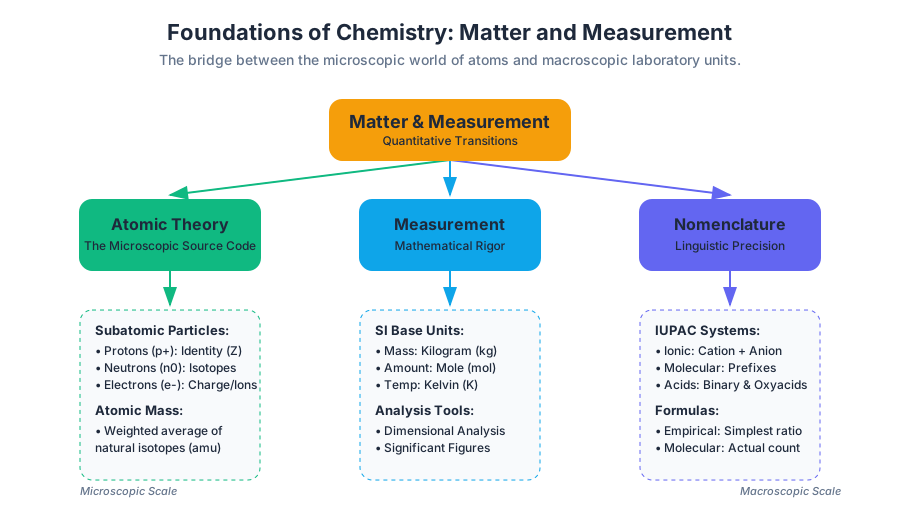
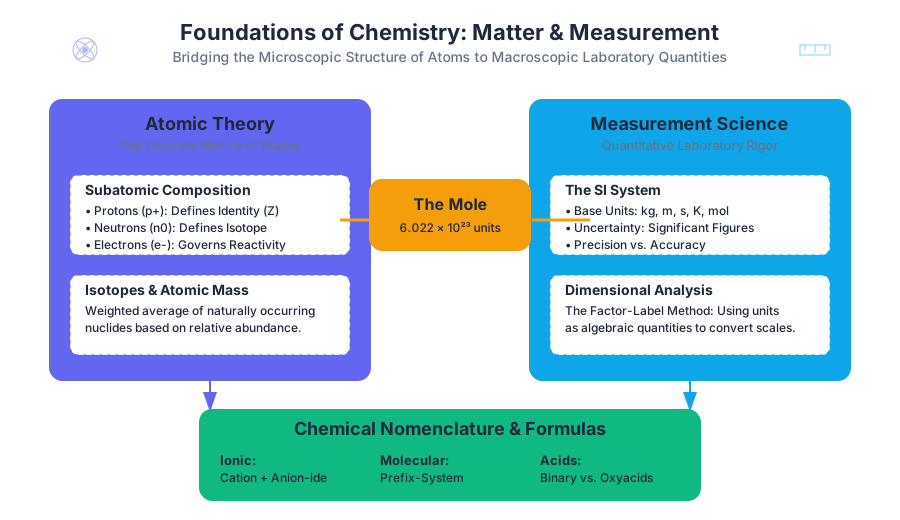
Chemistry is often defined as the study of matter and the changes it undergoes. However, at a more rigorous level, it is the science of quantitative transitions. To understand these transitions, one must master the bridge between the microscopic world of atoms and the macroscopic world of laboratory measurements. This section establishes the fundamental framework of chemistry, integrating the structural logic of Atomic Theory, the linguistic precision of Chemical Nomenclature, and the mathematical rigor of Stoichiometry and Dimensional Analysis.
Atomic Theory: The Discrete Nature of Matter
Modern chemistry rests upon the realization that matter is not continuous, but composed of discrete units called atoms. This concept, first formalized by John Dalton in the early 19th century, provides the "source code" for understanding chemical behavior.
The Evolution of the Atom
While Dalton envisioned atoms as indivisible spheres, modern physics reveals a complex internal structure. The behavior of an element is dictated by its subatomic composition—specifically the arrangement of protons, neutrons, and electrons.
The Law of Definite Proportions: A fundamental chemical principle stating that a given chemical compound always contains its component elements in a fixed ratio (by mass) and does not depend on its source and method of preparation.
| Particle | Symbol | Charge (e) | Mass (amu) | Location |
|---|---|---|---|---|
| Proton | $p^+$ | +1 | 1.00727 | Nucleus |
| Neutron | $n^0$ | 0 | 1.00866 | Nucleus |
| Electron | $e^-$ | -1 | 0.00055 | Extranuclear |
Isotopes and Atomic Mass
The identity of an element is defined solely by its Atomic Number ($Z$), the number of protons. However, atoms of the same element can have different numbers of neutrons, known as Isotopes. The Atomic Mass reported on the periodic table is a weighted average of all naturally occurring isotopes.
Common Pitfalls in Atomic Theory
- Confusing Mass Number with Atomic Mass: The mass number ($A$) is an integer (protons + neutrons) for a specific isotope, whereas atomic mass is a decimal average.
- Charge Misconceptions: Ions are formed by the gain or loss of electrons, never protons. Changing the proton count changes the element itself.
Measurement and Dimensional Analysis
In chemistry, a number without a unit is meaningless. Dimensional Analysis (or the Factor-Label Method) is the primary tool for navigating the scales of the universe, from picometers to kilometers.
The SI System and Uncertainty
Chemistry utilizes the International System of Units (SI). Because every measurement involves an instrument, every measurement carries Uncertainty. This is expressed through Significant Figures.
| Quantity | Base Unit | Symbol | Common Derived Units |
|---|---|---|---|
| Length | Meter | m | cm, nm, Å |
| Mass | Kilogram | kg | g, mg, μg |
| Time | Second | s | ms, ns |
| Temperature | Kelvin | K | Celsius (°C) |
| Amount | Mole | mol | mmol |
| Volume | Cubic Meter | $m^3$ | Liter (L), mL |
Precision vs. Accuracy
- Accuracy: How close a measurement is to the true or accepted value.
- Precision: How close a series of measurements are to one another (reproducibility).
How Dimensional Analysis Works
Dimensional analysis treats units as algebraic quantities that can be cancelled out. This prevents "conversion drift" and ensures that the final answer is physically logical.
Chemical Formulas and Nomenclature
A Chemical Formula represents the elemental composition of a substance. Understanding these formulas is the prerequisite for stoichiometry.
Molecular vs. Empirical Formulas
- Empirical Formula: The simplest whole-number ratio of atoms in a compound (e.g., $CH_2O$ for glucose).
- Molecular Formula: The actual number of atoms of each element in a molecule (e.g., $C_6H_{12}O_6$ for glucose).
Nomenclature Systems
Naming follows strict IUPAC (International Union of Pure and Applied Chemistry) conventions.
| Compound Type | Naming Rule | Example |
|---|---|---|
| Ionic (Type I) | Cation + Anion-ide | $NaCl$ (Sodium Chloride) |
| Ionic (Type II) | Cation (Roman Numeral) + Anion | $FeCl_3$ (Iron(III) Chloride) |
| Molecular | Prefix-Element + Prefix-Element-ide | $N_2O_4$ (Dinitrogen Tetroxide) |
| Acids (Binary) | Hydro-root-ic Acid | $HCl$ (Hydrochloric Acid) |
| Oxyacids | Root-ic/ous Acid | $H_2SO_4$ (Sulfuric Acid) |
The Mole and Stoichiometry: The Quantitative Core
Stoichiometry is the calculation of relative quantities of reactants and products in chemical reactions. It is the "accounting" of chemistry.
The Mole Concept
The Mole ($mol$) is the SI unit for amount of substance. It is defined as exactly $6.02214076 \times 10^{23}$ (Avogadro's Number) elementary entities. This number is chosen so that the mass of one mole of a substance in grams is numerically equal to the mass of one atom/molecule in atomic mass units (amu).
Reaction Balancing and Molar Ratios
A balanced chemical equation obeys the Law of Conservation of Mass. The coefficients in a balanced equation represent the Molar Ratio between substances.
\text{The General Stoichiometric Equation:} \\
aA + bB \rightarrow cC + dD \\
\text{Where } a, b, c, d \text{ are stoichiometric coefficients.}
Limiting Reactants and Percent Yield
In real-world scenarios, reactants are rarely present in exact stoichiometric proportions. The Limiting Reactant is the reagent that is entirely consumed first, limiting the amount of product formed.
Theoretical Yield: The maximum amount of product that can be produced from a given amount of limiting reactant. Actual Yield: The amount of product actually obtained from a reaction. Percent Yield: $(\text{Actual Yield} / \text{Theoretical Yield}) \times 100%$.
Concrete Example: Combustion of Propane
Calculate the mass of $CO_2$ produced when 44.1 g of $C_3H_8$ is burned in excess $O_2$.
- Balanced Equation: $C_3H_8 + 5O_2 \rightarrow 3CO_2 + 4H_2O$
- Molar Mass of $C_3H_8$: $\approx 44.1 , g/mol$
- Moles of $C_3H_8$: $44.1 , g / 44.1 , g/mol = 1.00 , mol$
- Molar Ratio: $1 , mol , C_3H_8 : 3 , mol , CO_2$
- Moles of $CO_2$: $1.00 , mol \times 3 = 3.00 , mol$
- Mass of $CO_2$: $3.00 , mol \times 44.01 , g/mol = 132.03 , g$
Advanced Stoichiometry: Solution and Gas Phase
Stoichiometry is not limited to solids. In liquid phases, we use Molarity ($M$); in gas phases, we use the Ideal Gas Law.
Molarity and Dilution
Molarity is defined as moles of solute per liter of solution ($mol/L$).
| Parameter | Definition | Formula |
|---|---|---|
| Molarity (M) | Concentration | $M = \frac{n}{V}$ |
| Dilution | Reducing concentration | $M_1V_1 = M_2V_2$ |
| Mass Percent | Mass ratio | $\frac{\text{mass solute}}{\text{total mass}} \times 100$ |
Variations and Extensions
1. Non-Stoichiometric Compounds
In solid-state chemistry, some compounds (Berthollides) do not have fixed integer ratios (e.g., $Fe_{0.95}O$). These challenge the traditional Daltonian view but are critical in materials science and superconductivity.
2. Green Chemistry Metrics
Modern stoichiometry extends beyond yield to include Atom Economy: $$\text{Atom Economy} = \frac{\text{Mass of Desired Product}}{\text{Total Mass of Reactants}} \times 100$$ High yield does not always mean a "green" process if the byproduct mass is excessive.
Common Pitfalls and Troubleshooting
The "Gram-to-Gram" Trap
Mistake: Attempting to use mass ratios directly from the balanced equation (e.g., assuming 2g of A reacts with 1g of B because the ratio is 2:1). Solution: Always convert to moles first. The balanced equation speaks the language of counts (moles), not weights (grams).
Significant Figure Propagation
Mistake: Rounding at every intermediate step of a multi-step calculation. Solution: Keep all digits in your calculator and only round to the correct number of significant figures at the very end.
Limiting Reactant Identification
Mistake: Assuming the reactant with the smallest mass is the limiting reactant. Solution: The limiting reactant is the one that produces the least amount of product. You must perform the molar conversion for both reactants to compare them fairly.
Source Materials
Study Chemistry 2e on Lykke
This course page is free to open: signed out, you can read its first two sections, and signing in, on any plan, opens the rest. The free Lykke Chrome extension syncs your own Canvas courses, so ChatGPT, Claude and Muse can answer from your classes and deadlines. It only reads Canvas.
Add the free extensionSign in to open every section