From the free course Calculus I: Single Variable Calculus on Lykke
Part 1: Differentiation
Key concepts: Differentiation · Rates of Change · Tangent Lines · Derivatives
Explores the mathematical notation, physical meaning, and geometric interpretation of derivatives.
Part 1: Differentiation
Differentiation is the cornerstone of modern mathematical analysis, providing the formal framework to quantify change. While algebra allows us to solve for static unknowns, calculus—specifically differentiation—allows us to capture the "dynamic" state of the world. As Professor Gigliola Staffilani (MIT) emphasizes in her approach to 18.01, the transition from average rates of change to instantaneous rates of change is not merely a computational step, but a conceptual leap that bridges the gap between discrete observations and continuous reality.
The Fundamental Definition: The Derivative as a Limit
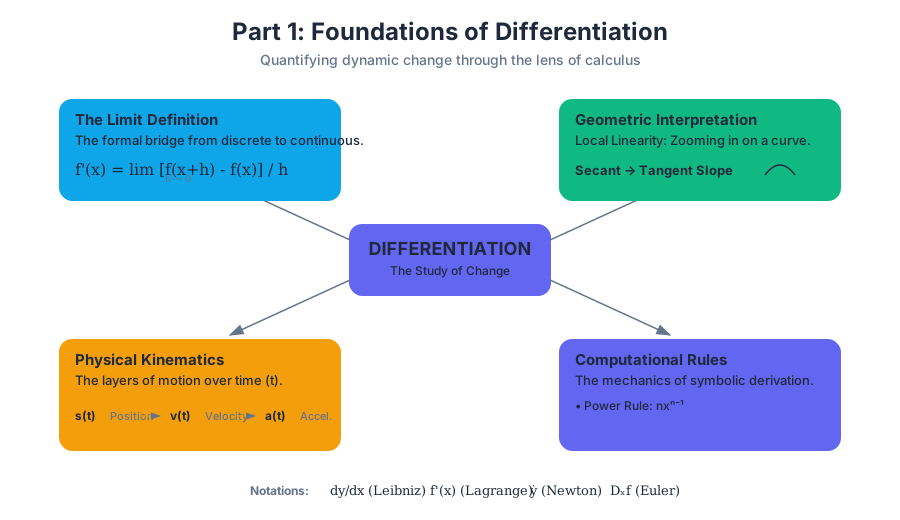
At its core, the derivative of a function measures how the output value changes in response to an infinitesimal change in the input value. We move from the Average Rate of Change (the slope of a secant line connecting two points) to the Instantaneous Rate of Change (the slope of the tangent line at a single point).
The Difference Quotient
To find the slope at a specific point $x$, we consider a second point slightly further away at $x + h$. The slope between these two points is: $$\frac{f(x + h) - f(x)}{h}$$
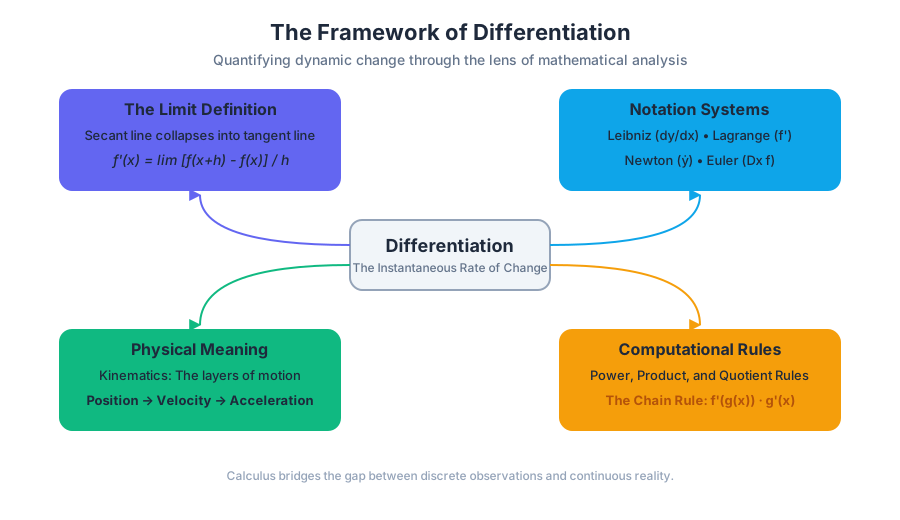
As $h$ approaches zero, this secant line "collapses" into the tangent line. This leads to the formal definition of the derivative, denoted as $f'(x)$ or $\frac{dy}{dx}$:
Definition: The Derivative The derivative of a function $f$ at a point $x$ is defined as: $$f'(x) = \lim_{h \to 0} \frac{f(x + h) - f(x)}{h}$$ provided this limit exists. If the limit exists, the function is said to be differentiable at $x$.
Notation Systems
Differentiation has been refined over centuries, resulting in several notation systems used across different disciplines.
| Notation Name | Symbol | Primary Use Case |
|---|---|---|
| Leibniz's Notation | $\frac{dy}{dx}$ | Calculus, Physics, Differential Equations (emphasizes ratios) |
| Lagrange's Notation | $f'(x)$ | Pure Mathematics, Functional Analysis (emphasizes the function) |
| Newton's Notation | $\dot{y}$ | Physics, Classical Mechanics (specifically for time derivatives) |
| Euler's Notation | $D_x f$ | Linear Algebra, Operator Theory (treats differentiation as an operator) |
Geometric Interpretation: The Tangent Line
The most intuitive way to visualize differentiation is through geometry. If you zoom in infinitely on a smooth curve, the curve eventually looks like a straight line. This "local linearity" is the essence of the derivative.
- The Secant Line: Connects two points $(x, f(x))$ and $(x+h, f(x+h))$. It represents the average speed over an interval.
- The Tangent Line: Touches the curve at exactly one point, representing the direction the curve is heading at that exact moment.
- The Slope: The value of the derivative $f'(a)$ is exactly the slope of the tangent line to the graph of $f$ at $x = a$.
The equation of the tangent line at $x = a$ is given by the point-slope form: $$y - f(a) = f'(a)(x - a)$$
Physical Meaning: Kinematics and Beyond
In physics, differentiation translates position into motion. If $s(t)$ represents the position of an object at time $t$, its derivatives reveal the fundamental layers of kinematics.
| Derivative Order | Physical Concept | Definition |
|---|---|---|
| $s(t)$ | Position | Where the object is located in space. |
| $s'(t) = v(t)$ | Velocity | The rate of change of position (speed + direction). |
| $s''(t) = a(t)$ | Acceleration | The rate of change of velocity. |
| $s'''(t) = j(t)$ | Jerk | The rate of change of acceleration (felt as a "jolt"). |
Worked Example: Falling Objects
Consider an object dropped from a height. Its position is $s(t) = -4.9t^2 + 20$.
- Velocity: $v(t) = s'(t) = -9.8t$. At $t=2$ seconds, the velocity is $-19.6$ m/s (downward).
- Acceleration: $a(t) = v'(t) = -9.8$. This is the constant acceleration due to gravity.
Computational Mechanics: The Rules of the Game
While the limit definition is the theoretical foundation, we use derived rules for efficient computation. These rules allow us to differentiate complex functions by breaking them into smaller, manageable parts.
Fundamental Rules Summary
| Rule Name | Mathematical Form | Description |
|---|---|---|
| Power Rule | $\frac{d}{dx}[x^n] = nx^{n-1}$ | Used for polynomials and radical functions. |
| Product Rule | $(uv)' = u'v + uv'$ | Used when two functions are multiplied. |
| Quotient Rule | $(\frac{u}{v})' = \frac{u'v - uv'}{v^2}$ | Used for ratios of functions. |
| Chain Rule | $\frac{d}{dx}[f(g(x))] = f'(g(x)) \cdot g'(x)$ | Used for nested (composite) functions. |
Implementing Numerical Differentiation
In engineering and data science, we often don't have a symbolic formula, only discrete data points. We use numerical methods like the Central Difference Method to approximate the derivative.
The Chain Rule: The Engine of Deep Learning
The Chain Rule is arguably the most important rule in applied mathematics. It describes how to differentiate a function of a function. If $y$ depends on $u$, and $u$ depends on $x$, then $y$ depends on $x$ through the intermediate variable $u$.
$$\frac{dy}{dx} = \frac{dy}{du} \cdot \frac{du}{dx}$$
This principle is the basis for Backpropagation in neural networks. A neural network is essentially a massive composition of functions; to update weights, we calculate how the final error changes with respect to a weight deep inside the network by "chaining" derivatives backward.
\begin{aligned}
&\text{Let } y = f(g(x)) \\
&\text{Step 1: Identify outer function } f(u) \text{ and inner function } g(x). \\
&\text{Step 2: Differentiate outer: } f'(u). \\
&\text{Step 3: Differentiate inner: } g'(x). \\
&\text{Step 4: Multiply: } f'(g(x)) \cdot g'(x). \\
\\
&\text{Example: } y = \sin(x^2) \\
&u = x^2 \implies \frac{du}{dx} = 2x \\
&y = \sin(u) \implies \frac{dy}{du} = \cos(u) \\
&\frac{dy}{dx} = \cos(x^2) \cdot 2x
\end{aligned}
Automatic Differentiation in Modern Systems
In modern software engineering, we rarely write out derivatives by hand. We use Automatic Differentiation (Autograd). This is distinct from numerical differentiation (which is prone to rounding errors) and symbolic differentiation (which can lead to "expression swell").
Autograd works by tracking the "computational graph" of an operation and applying the chain rule at each node.
Pedagogical Philosophy: Bridging the Gap
Professor Staffilani’s teaching philosophy for MIT's 18.01 emphasizes that calculus should not be an "intimidating black box." She advocates for:
- Visual Intuition: Using applets to show the secant line turning into the tangent line.
- Physical Props: Using balloons or food items to demonstrate rates of change in volume and surface area.
- Addressing Bias: Recognizing that the "abstraction gap" often discourages students from underrepresented backgrounds. By grounding differentiation in real-world examples (like the spread of a virus or the optimization of a structural beam), the subject becomes more accessible and equitable.
Common Pitfalls and Misconceptions
- The "h=0" Fallacy: Students often try to plug $h=0$ into the difference quotient immediately. Differentiation is about the limit as $h$ approaches zero, not the value at zero (which would result in $0/0$, an indeterminate form).
- Differentiability vs. Continuity: Every differentiable function is continuous, but not every continuous function is differentiable. A classic example is $f(x) = |x|$ at $x=0$. The "sharp corner" means there is no unique tangent line, so the derivative does not exist there.
- Floating Point Precision: In computational differentiation, choosing an $h$ that is too small can lead to subtractive cancellation errors in standard 64-bit floats.
Higher-Order Derivatives and Curve Sketching
The first derivative $f'(x)$ tells us if a function is increasing or decreasing. The second derivative $f''(x)$ tells us about the concavity—how the rate of change itself is changing.
- $f'(x) > 0$: Function is increasing.
- $f'(x) < 0$: Function is decreasing.
- $f''(x) > 0$: Concave Up (holds water, like a cup).
- $f''(x) < 0$: Concave Down (sheds water, like a cap).
- $f''(x) = 0$: Potential Inflection Point (where the curve changes concavity).
This hierarchy of derivatives allows engineers to optimize systems—finding the "sweet spot" where a cost function is at its absolute minimum.
- Derivative: The instantaneous rate of change of a function.
- Limit Definition: The formal mathematical foundation of the derivative using $h \to 0$.
- Tangent Line: A straight line that best approximates a curve at a specific point.
- Chain Rule: The formula for the derivative of a composite function: $f'(g(x))g'(x)$.
- Differentiability: The property of a function having a defined derivative at a point.
- Concavity: The "bending" direction of a curve, determined by the second derivative.
- Leibniz Notation: The $\frac{dy}{dx}$ notation emphasizing the ratio of differentials.
- Power Rule: The rule stating that $\frac{d}{dx}x^n = nx^{n-1}$.
- Conceptual: Why does the derivative of a constant function (e.g., $f(x) = 5$) always equal zero?
- Answer: A constant function does not change; its rate of change is zero, and its graph is a horizontal line with slope 0.
- Geometric: If a function has a vertical tangent line at $x=c$, is the function differentiable at $c$?
- Answer: No. A vertical line has an undefined slope (infinite), so the limit definition of the derivative fails to converge to a real number.
- Application: You are designing a cooling system where the temperature $T(t)$ drops over time. If $T'(t)$ is negative and $T''(t)$ is positive, what is happening to the cooling rate?
- Answer: The temperature is decreasing ($T' < 0$), but it is decreasing at a slower and slower rate ($T'' > 0$), suggesting the temperature is stabilizing.
- Computational: Use the power rule and chain rule to find the derivative of $f(x) = (3x^2 + 1)^4$.
- Answer: $f'(x) = 4(3x^2 + 1)^3 \cdot (6x) = 24x(3x^2 + 1)^3$.
- Edge Case: Is the function $f(x) = x^{1/3}$ differentiable at $x=0$?
- Answer: No. The derivative $f'(x) = \frac{1}{3}x^{-2/3}$ involves division by zero at $x=0$, corresponding to a vertical tangent.
Key Objectives
- Master the limit definition to understand the "why" behind the "how."
- Memorize the fundamental rules (Power, Product, Quotient, Chain) for rapid calculation.
- Connect the derivative to the slope of the tangent line and physical velocity.
- Understand the importance of the Chain Rule in modern computational contexts like AI.
- Recognize the conditions for differentiability (smoothness and continuity).
Practice Problems
- Derive the derivative of $f(x) = x^2$ using the limit definition.
- Find the equation of the tangent line to $y = e^x$ at $x = 0$.
- A particle moves according to $s(t) = t^3 - 6t^2 + 9t$. Find the times when the particle is at rest ($v=0$).
- Differentiate $y = \ln(\cos(x))$ using the chain rule.
Source Materials
Study Calculus I: Single Variable Calculus on Lykke
This course page is free to open: signed out, you can read its first two sections, and signing in, on any plan, opens the rest. The free Lykke Chrome extension syncs your own Canvas courses, so ChatGPT, Claude and Muse can answer from your classes and deadlines. It only reads Canvas.
Add the free extensionSign in to open every sectionAll sections of Calculus I: Single Variable Calculus · Browse more course pages