From the free course Art Appreciation on Lykke
The Language of Art: Formal Analysis
Key concepts: Visual Elements · Principles of Design · Composition · Formal Analysis
An introduction to the visual elements and principles of design that form the foundation of all artworks.
The Language of Art: Formal Analysis
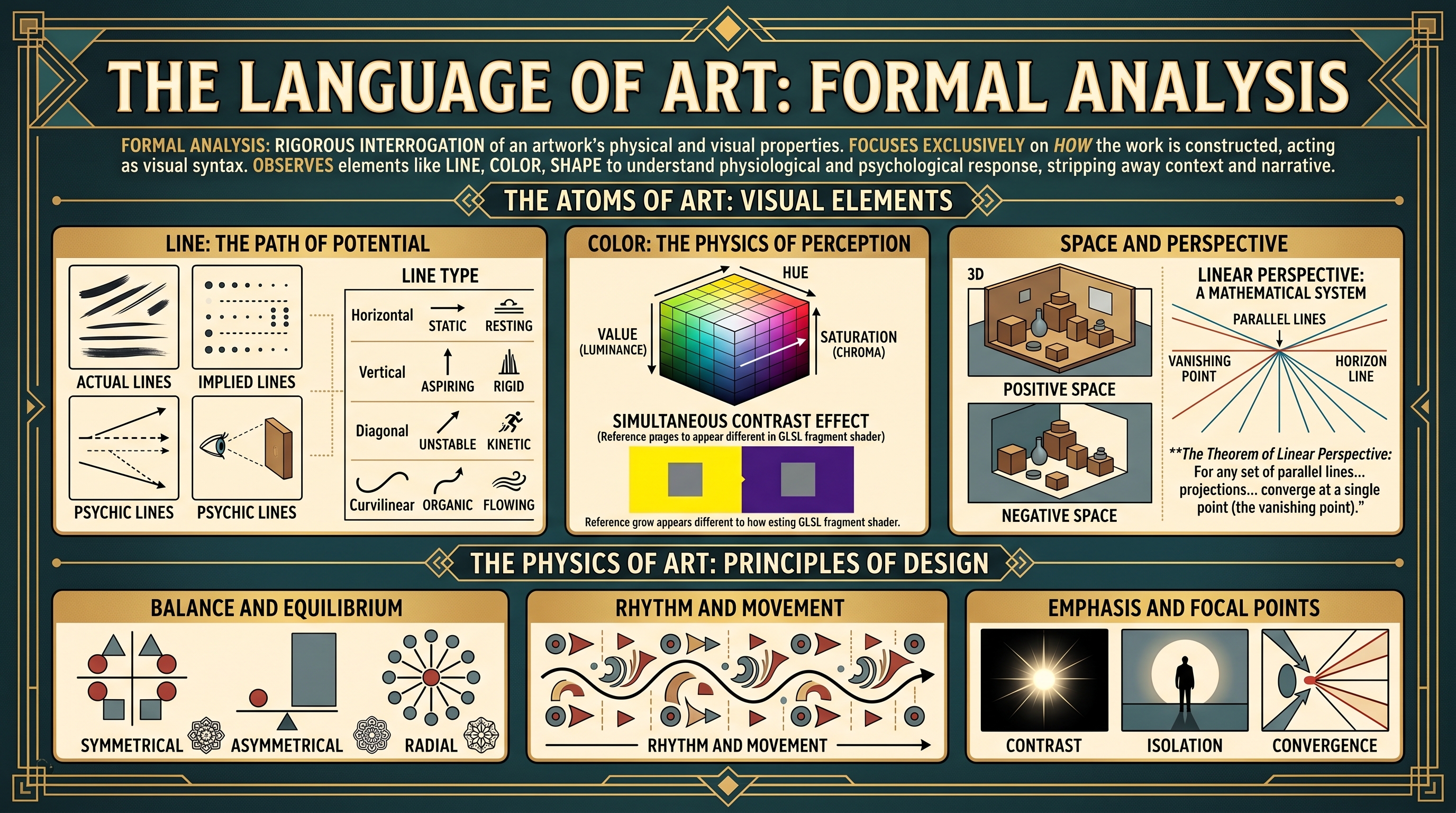
Formal analysis is the rigorous interrogation of an artwork’s physical and visual properties. It is the foundational methodology of art history, acting as a "syntax" for the visual language. While iconography deals with what is depicted and context deals with why it was made, formal analysis focuses exclusively on how the work is constructed. By stripping away the narrative and historical baggage, we can observe how the arrangement of lines, colors, and shapes dictates the viewer's physiological and psychological response.
The Atoms of Art: Visual Elements
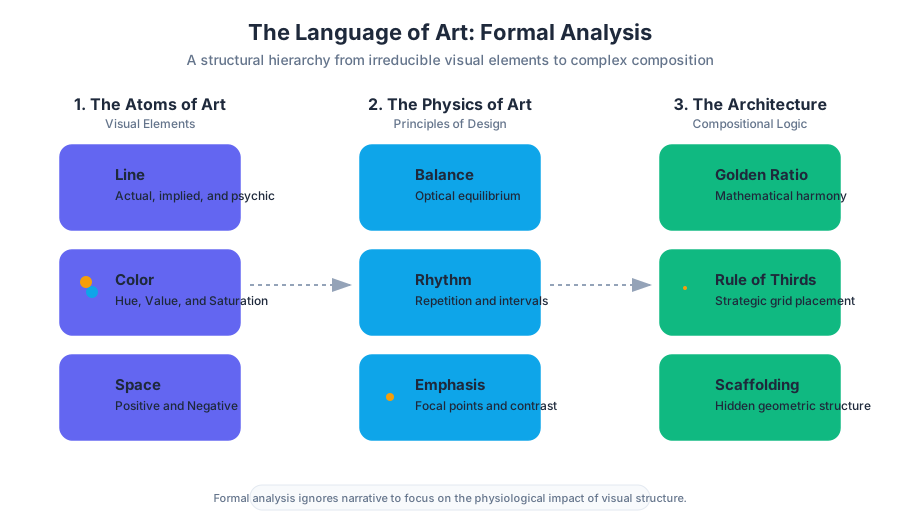
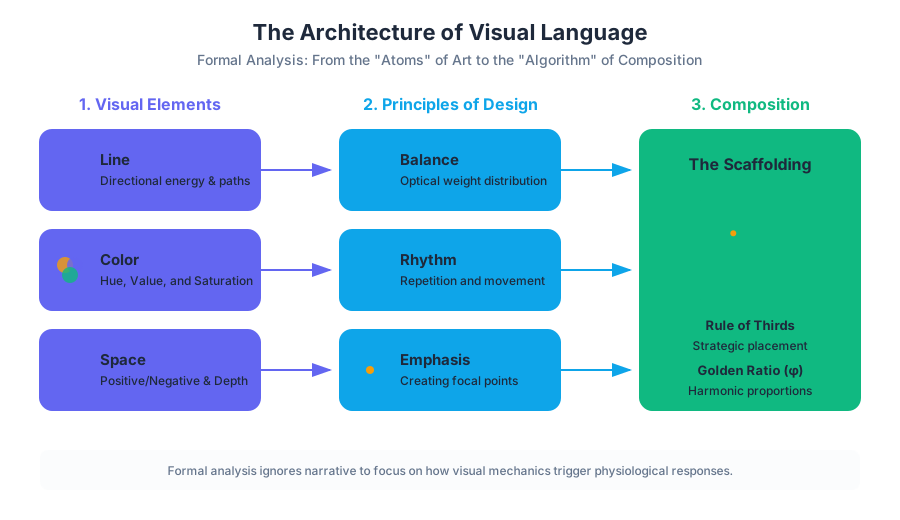
The visual elements are the irreducible components of any composition. In the same way a programmer uses primitive data types (integers, booleans, strings) to build complex software, an artist uses these elements to build a visual experience.
Line: The Path of Potential
A Line is technically the track made by a point moving through space. However, in formal analysis, we distinguish between actual lines (physical marks), implied lines (suggested by the alignment of shapes or the "gaze" of a figure), and psychic lines (the invisible connection between two points of interest).
| Line Type | Directional Energy | Psychological Association |
|---|---|---|
| Horizontal | Static, resting | Stability, calm, the horizon, death |
| Vertical | Aspiring, rigid | Strength, growth, authority, divinity |
| Diagonal | Unstable, kinetic | Movement, tension, drama, transition |
| Curvilinear | Organic, flowing | Softness, sensuality, nature |
Color: The Physics of Perception
Color is the most emotive element, defined by three distinct dimensions:
- Hue: The specific wavelength of light (Red, Blue, Green).
- Value (Luminance): The relative lightness or darkness, regardless of hue.
- Saturation (Chroma): The purity or intensity of the color.
In a technical sense, color interaction is governed by the Simultaneous Contrast effect, where the appearance of a color changes based on its neighbors.
Space and Perspective
Space in art is either positive (the area occupied by objects) or negative (the area around them). To represent 3D space on a 2D plane, artists use Linear Perspective, a mathematical system based on the convergence of parallel lines at a vanishing point.
The Theorem of Linear Perspective: For any set of parallel lines in three-dimensional space that are not parallel to the picture plane, their projections onto the picture plane will converge at a single point (the vanishing point).
The Physics of Art: Principles of Design
If the visual elements are the "atoms," the principles of design are the "laws of physics" that govern how those atoms interact. These principles determine the structural integrity and communicative power of the work.
Balance and Equilibrium
Balance is the distribution of visual weight. It is not necessarily about literal weight but about "optical heaviness." A small, bright red dot can balance a large, dull gray rectangle due to its high saturation and visual "pull."
| Type of Balance | Description | Effect |
|---|---|---|
| Symmetrical | Mirror-image or near-mirror equivalence. | Formality, permanence, stillness. |
| Asymmetrical | Uneven weights that achieve equilibrium through placement. | Dynamic, modern, lifelike. |
| Radial | Elements radiate from a central point. | Focus, spiritual significance (e.g., Mandalas). |
Rhythm and Movement
Rhythm is the repetition or alternation of elements, often with defined intervals between them. It creates a sense of movement, leading the eye through the composition in a specific sequence.
Emphasis and Focal Points
Emphasis is the "entry point" of the artwork. Artists create focal points through Contrast (a sudden change in value or color), Isolation (placing an object alone), or Convergence (using lines to point toward a specific area).
The Architecture of the Frame: Composition
Composition is the deliberate arrangement of elements within the frame. It is the "algorithm" of the image. A successful composition manages the viewer's cognitive load, ensuring the eye doesn't get "stuck" or "lost."
The Golden Ratio and the Rule of Thirds
The Golden Ratio ($\phi \approx 1.618$) is often found in nature and has been used since antiquity to create aesthetically pleasing proportions. A common simplification for artists is the Rule of Thirds, which divides the frame into a 3x3 grid.
\text{The Golden Ratio derivation:}
\phi = \frac{a+b}{a} = \frac{a}{b} \implies \phi^2 - \phi - 1 = 0
\phi = \frac{1 + \sqrt{5}}{2} \approx 1.61803398875...
In practice, placing the subject at the intersections of these grid lines (the "power points") creates more tension and interest than centering the subject.
Geometric Scaffolding
Many Master paintings are built upon "hidden" geometric structures. For example, the Pyramidal Composition (common in High Renaissance art) uses a triangular arrangement of figures to create a sense of stability and hierarchy, drawing the eye upward toward the apex.
The Methodology: Performing a Formal Analysis
To perform a formal analysis, one must move through a structured pipeline. This prevents the analyst from jumping to conclusions about the "meaning" before fully seeing the "form."
Step 1: Inventory (Description)
List every physical attribute. What is the medium? What is the scale? What are the dominant colors? Example: "The work is a large-scale oil on canvas, dominated by vertical brushstrokes and a restricted palette of ochre and Prussian blue."
Step 2: Structural Analysis
How are the elements organized? Look for the "skeleton." Example: "The artist utilizes a strong diagonal axis running from the bottom-left to the top-right, creating a sense of impending collapse."
Step 3: Synthesis (The "So What?")
Connect the formal choices to the emotional or conceptual effect. Example: "The high-key values and lack of deep shadows create a flattened space, which reinforces the subject's feeling of claustrophobia."
| Analysis Phase | Objective | Key Questions |
|---|---|---|
| Observation | Data collection | What shapes do I see? Where is the light source? |
| Relationship | Pattern recognition | How does the red circle interact with the blue line? |
| Function | Impact assessment | How does the scale of the work affect my physical presence? |
| Conclusion | Formal Thesis | How do these formal choices support the overall mood? |
Common Pitfalls in Formal Analysis
- The Narrative Trap: Focusing on the story (e.g., "This is a painting of a man crying") rather than the form ("The downward-sloping lines and cool blue palette evoke sadness").
- Subjective Projection: Assuming your personal reaction is a universal formal property. (e.g., "The color yellow is happy." In some contexts, yellow can represent decay or sickness).
- Ignoring Scale: Analyzing a digital thumbnail of a 20-foot mural. Scale is a formal element; the physical relationship between the viewer's body and the work is crucial.
- Contextual Over-reliance: Using the artist's biography to explain a visual choice that should be explained through the visual evidence itself.
Advanced Concept: The "Gaze" as a Formal Element
In modern analysis, the Gaze is treated as a directional vector. Where the figures in a painting look creates a network of "implied lines" that dictate the viewer's path. If three figures look at a central point, that point becomes the focal point regardless of its color or size. This is a form of Vectorial Composition.
Source Materials
Study Art Appreciation on Lykke
This course page is free to open: signed out, you can read its first two sections, and signing in, on any plan, opens the rest. The free Lykke Chrome extension syncs your own Canvas courses, so ChatGPT, Claude and Muse can answer from your classes and deadlines. It only reads Canvas.
Add the free extensionSign in to open every section