From the free course Art Appreciation on Lykke
Interpretation and the Role of the Viewer
Key concepts: Subjective vs. Objective · Art Criticism · Aesthetics · Visual Literacy
Synthesizing formal and contextual analysis to form a personal and critical interpretation of art.
Interpretation and the Role of the Viewer
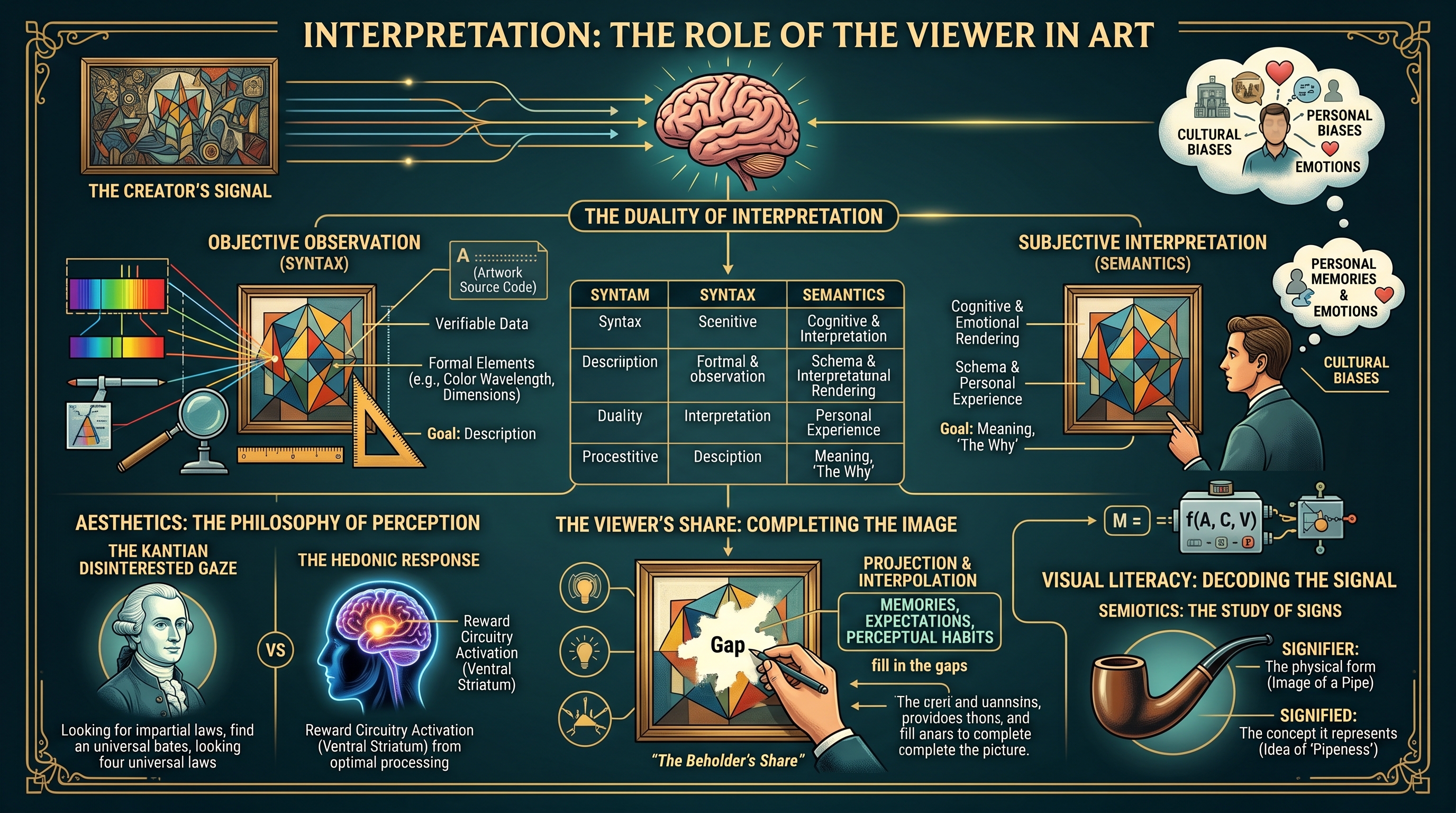
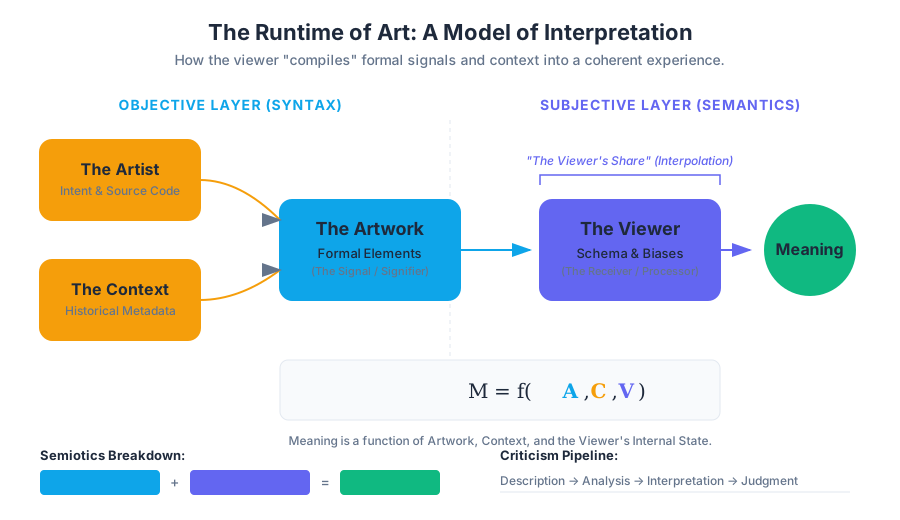
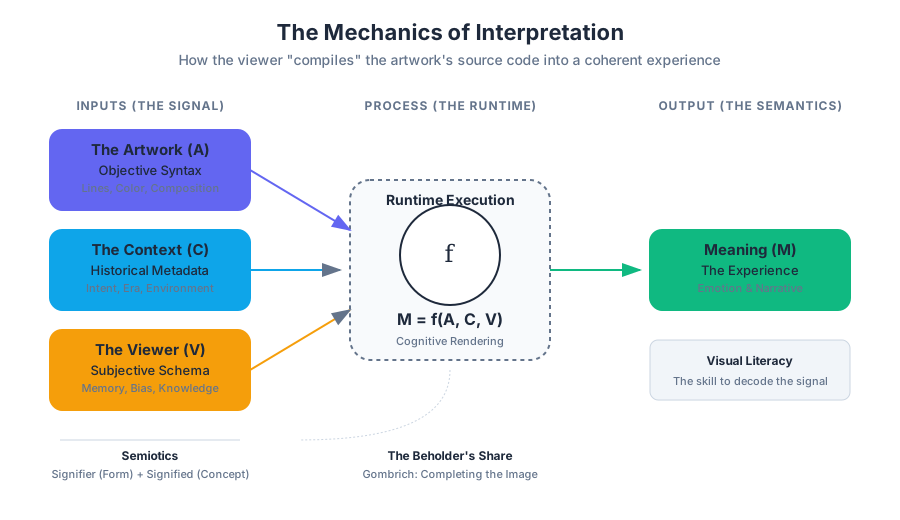
Interpretation is the "runtime execution" of an artwork. While formal analysis provides the source code (the lines, colors, and composition) and art history provides the documentation (the context and intent), it is the viewer who compiles these elements into a coherent experience. In this framework, an artwork is not a static object but a dynamic process—a transaction between the creator’s signal and the viewer’s receiver.
The Duality of Interpretation: Subjective vs. Objective
The fundamental tension in art appreciation lies between Objective Observation and Subjective Interpretation. Objective observation deals with the "verifiable" data of the work: the wavelength of the light (color), the physical dimensions, and the chemical composition of the pigments. Subjective interpretation, however, involves the cognitive and emotional "rendering" that occurs within the viewer’s mind.
The Objective Layer (Syntax)
The objective layer is the structural foundation. It consists of the Formal Elements that can be measured or agreed upon by any observer regardless of their cultural background. In information theory terms, this is the signal.
The Subjective Layer (Semantics)
The subjective layer is where meaning is constructed. It is influenced by the viewer’s schema—the mental structures of pre-conceived ideas, cultural biases, and personal memories. This is the interpretation of the signal.
| Feature | Objective Observation | Subjective Interpretation |
|---|---|---|
| Focus | Physical attributes, formal elements. | Meaning, emotional resonance, narrative. |
| Goal | Description and inventory. | Understanding and "The Why." |
| Verification | Can be proven via measurement or consensus. | Validated through argument and personal experience. |
| Stability | High (the painting doesn't change). | Low (meaning shifts over time and between viewers). |
| Example | "The painting uses high-saturation red." | "The red evokes a sense of urgent violence." |
Aesthetics: The Philosophy of Perception
Aesthetics is the branch of philosophy that investigates the nature of beauty, art, and taste. It seeks to define the criteria by which we judge something as "successful" or "valuable." Historically, aesthetics has oscillated between the search for universal laws of beauty (the Golden Ratio, symmetry) and the recognition of beauty as a social construct.
The Kantian "Disinterested" Gaze
Immanuel Kant argued that for a judgment to be truly aesthetic, it must be disinterested. This means the viewer must set aside their personal desires, needs, or the practical utility of the object to appreciate it "for its own sake."
The Hedonic Response
In contrast, modern neuroaesthetics looks at the Hedonic Response—the physiological pleasure derived from viewing art. This involves the activation of the brain's reward circuitry (the ventral striatum) when encountering patterns that the brain finds "optimal" for processing.
The Viewer’s Share: Completing the Image
The concept of The Viewer's Share, popularized by art historian Ernst Gombrich, posits that an artwork is fundamentally incomplete without the viewer's participation. The artist provides a "schema" or a set of cues, and the viewer uses their "beholder's share" to fill in the gaps.
Definition: The Viewer's Share The psychological process where the observer utilizes their own memories, expectations, and perceptual habits to project a complete meaning onto the partial or ambiguous cues provided by the artist.
The "Gap" in Representation
No artwork is a perfect 1:1 recreation of reality. Whether it is a brushstroke that suggests a leaf or a pixel that suggests a curve, the viewer’s brain performs Interpolation.
Mathematical Representation of Interpretation
We can model the interpretive process as a function where the resulting Meaning ($M$) is a product of the Artwork ($A$), the Context ($C$), and the Viewer ($V$).
M = f(A, C, V)
Where:
- $A$ = The formal properties (the "source code").
- $C$ = The historical and environmental metadata.
- $V$ = The viewer's internal state (priors, biases, and knowledge).
Visual Literacy: Decoding the Signal
Visual Literacy is the ability to read, write, and create visual images. It is a competency that allows a viewer to move beyond "looking" (passive reception) to "seeing" (active decoding). Just as textual literacy requires an understanding of grammar and syntax, visual literacy requires an understanding of Semiotics.
Semiotics: The Study of Signs
In semiotics, every element in an artwork can be viewed as a Sign, consisting of two parts:
- Signifier: The physical form (the actual image of a pipe).
- Signified: The concept it represents (the idea of "pipeness" or "tobacco use").
| Component | Definition | Example in Art |
|---|---|---|
| Denotation | The literal, primary meaning. | A painting of a red rose. |
| Connotation | The socio-cultural or emotional association. | The rose signifies love, passion, or fragility. |
| Icon | A sign that resembles its signified. | A portrait that looks like the sitter. |
| Symbol | A sign with an arbitrary, learned connection. | A dove representing peace. |
| Index | A sign that shows evidence of an action. | A visible, aggressive brushstroke (index of the artist's movement). |
Art Criticism: The Analytical Framework
Art Criticism is the systematic evaluation of an artwork. It is not merely "having an opinion"; it is the application of a rigorous framework to justify an interpretation. Professional critics use several distinct lenses to "debug" the meaning of a work.
The Four-Step Criticism Pipeline
- Description: What is physically there? (Inventory of elements).
- Analysis: How are the elements organized? (Principles of design).
- Interpretation: What is the work saying? (Meaning and intent).
- Judgment: Is the work successful? (Evaluation based on criteria).
Critical Frameworks (Lenses)
Different "compilers" produce different "outputs" for the same artwork.
| Framework | Primary Focus | Key Question |
|---|---|---|
| Formalism | The visual structure and "plastic" qualities. | How do the lines and colors create balance? |
| Contextualism | The historical, social, and political environment. | How does this reflect the French Revolution? |
| Psychoanalytic | The subconscious of the artist or viewer. | What repressed desires are manifested here? |
| Feminist | Gender roles and power dynamics. | How is the "male gaze" operating in this work? |
| Iconography | The specific meaning of symbols and motifs. | Why is the subject holding a pomegranate? |
Advanced Perspectives: The Problem of "Intentional Fallacy"
A common mistake in interpretation is the Intentional Fallacy—the belief that the artist's stated intention is the only or final meaning of the work.
The Death of the Author
Literary critic Roland Barthes argued for "The Death of the Author," suggesting that once a work is released, the author's control over its meaning ceases. The meaning is recreated every time a new viewer engages with it.
The Affective Fallacy
Similarly, the Affective Fallacy is the mistake of judging a work solely based on the emotional effect it has on the viewer. While emotions are valid, a rigorous interpretation must also account for the work's internal logic and external context.
Worked Example: Interpreting "The Treachery of Images" (Magritte)
Let's apply the visual literacy and criticism framework to René Magritte’s Ceci n'est pas une pipe (This is not a pipe).
- Description: A realistic painting of a briar pipe with the text "Ceci n'est pas une pipe" written in cursive underneath.
- Analysis: The image is centered and rendered in a deadpan, illustrative style, reminiscent of an advertisement or a dictionary entry.
- Interpretation:
- Level 1 (Literal): It is literally not a pipe; it is a representation of a pipe (oil on canvas).
- Level 2 (Semiotics): Magritte is highlighting the gap between the Signifier (the image/word) and the Referent (the actual physical object).
- Level 3 (Philosophical): The work challenges the viewer's trust in visual representation and language.
- Judgment: The work is highly successful as a piece of conceptual art because it forces the viewer to confront the mechanics of their own perception.
Common Pitfalls in Interpretation
- Over-Interpretation (Apophenia): Finding patterns or meanings where none exist (e.g., seeing a complex political conspiracy in a random splatter of paint).
- Literalism: Failing to move past the denotative layer (e.g., "It's just a picture of a bowl of fruit").
- Anachronism: Applying modern values or knowledge to a historical work in a way that distorts its original context (e.g., criticizing a 15th-century painting for lacking 21st-century digital color theory).
- Projection: Using the artwork as a mirror for one's own personal issues without acknowledging the artist's signal.
The Evolution of Interpretation in the Digital Age
In the era of AI and algorithmic curation, the role of the viewer is shifting. We are no longer just interpreting static objects; we are interpreting Generative Systems.
Metadata and the Semantic Web
Modern interpretation often involves interacting with an artwork's "Digital Twin"—the metadata that surrounds it online.
The Feedback Loop
The viewer’s interpretation now feeds back into the system. Every "like," "share," or "comment" on a digital artwork acts as a data point that influences how the next viewer will perceive that work, creating a collective, real-time interpretive layer.
Source Materials
Study Art Appreciation on Lykke
This course page is free to open: signed out, you can read its first two sections, and signing in, on any plan, opens the rest. The free Lykke Chrome extension syncs your own Canvas courses, so ChatGPT, Claude and Muse can answer from your classes and deadlines. It only reads Canvas.
Add the free extensionSign in to open every section