From the free course Art Appreciation on Lykke
Art in Context: History and Culture
Key concepts: Contextualism · Patronage · Iconography · Art Movements
Examining how historical events, religious beliefs, and social structures shape the creation and reception of art.
Art in Context: History and Culture
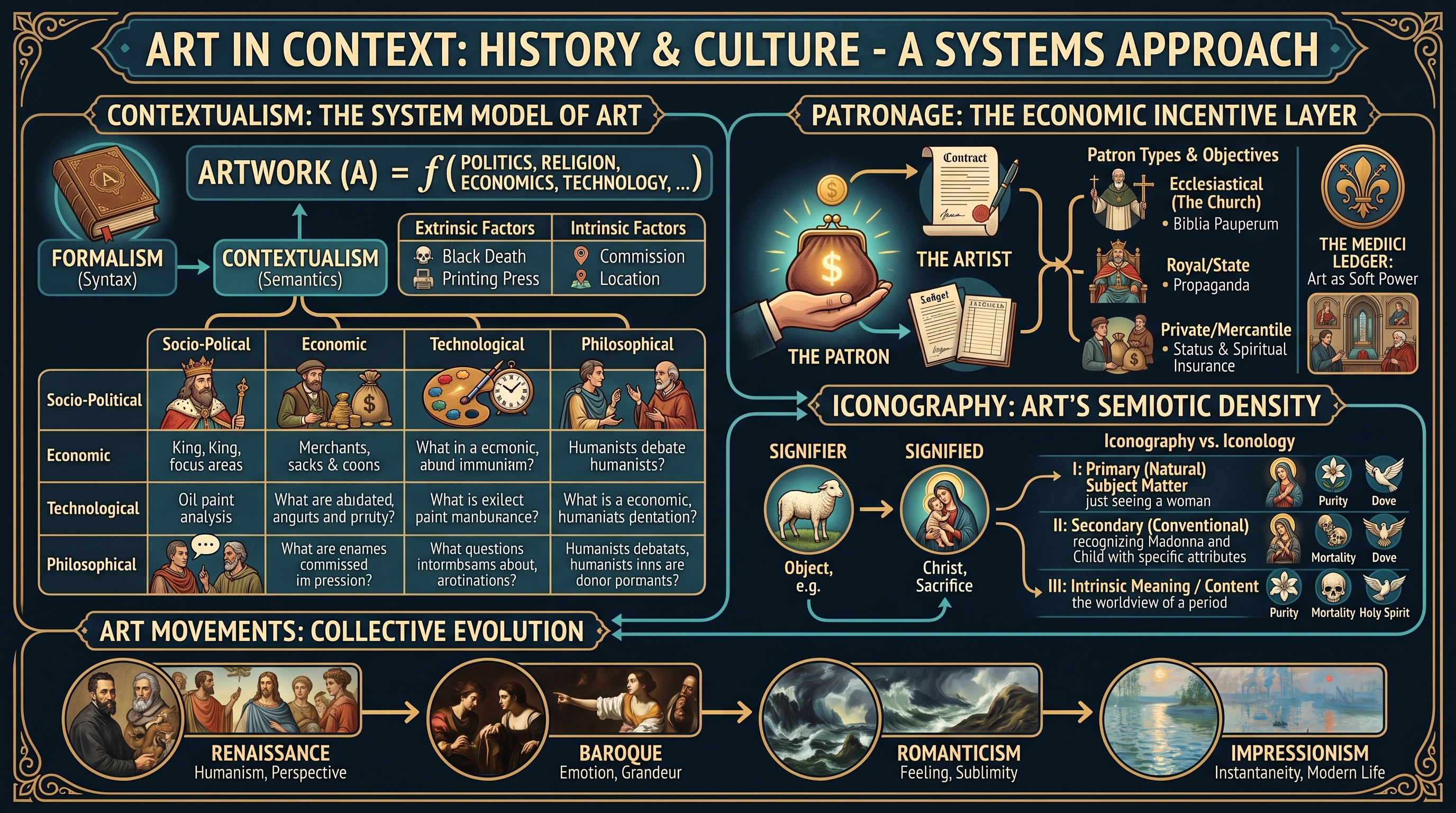
Art is rarely the product of a solitary genius working in a vacuum; it is a high-dimensional output of a specific socio-historical system. To analyze a work of art through the lens of Contextualism is to treat the object not merely as an aesthetic arrangement of form and color, but as a primary source document that encodes the political, religious, and economic state of its era.
In this deep dive, we will move beyond the surface-level appreciation of beauty to examine the underlying "operating systems" of art history: the power dynamics of Patronage, the semiotic density of Iconography, and the evolutionary pressures that drive Art Movements.
Contextualism: The System Model of Art
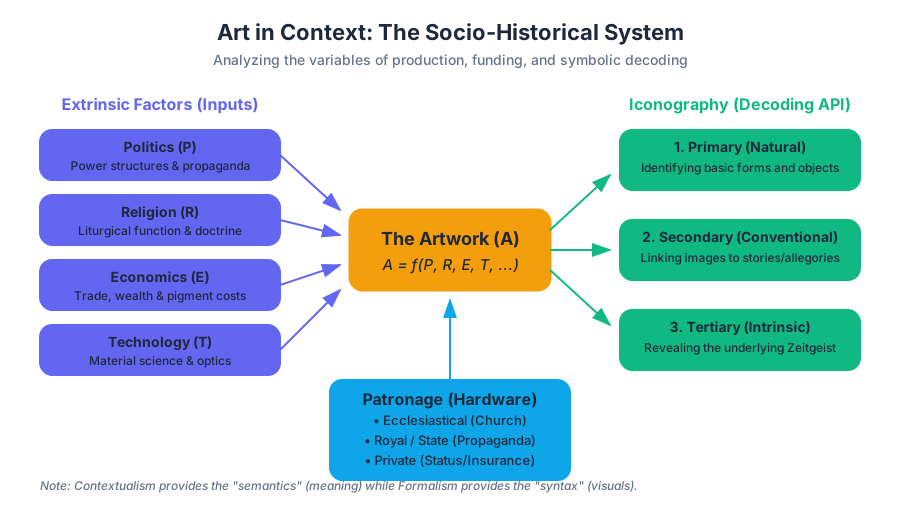
Contextualism is the methodological framework that asserts a work of art cannot be fully understood without reference to the environment of its creation. While Formalism (the study of line, shape, and color) provides the "syntax" of art, Contextualism provides the "semantics."
What it is
In a contextualist analysis, the artwork is the dependent variable ($Y$) in a function where the independent variables ($X_n$) are the prevailing cultural forces.
Definition: The Contextualist Function Let $A$ be the Artwork. $A$ is a function of $P$ (Politics), $R$ (Religion), $E$ (Economics), and $T$ (Technology), such that: $A = f(P, R, E, T, ...)$ To understand $A$, one must derive the values of the input variables at time $t$.
Why it matters
Without context, the viewer is prone to "anachronistic projection"—imposing modern values onto historical objects. For example, viewing a medieval altarpiece as a "self-expression" of the artist ignores the fact that the concept of the "individual artist" did not exist in the modern sense; the work was a functional liturgical tool designed to facilitate prayer.
How it works: Extrinsic vs. Intrinsic Factors
Contextual analysis typically bifurcates into two investigative streams:
- Extrinsic Factors: External pressures such as the Black Death, the invention of the printing press, or the rise of the merchant class.
- Intrinsic Factors: The specific circumstances of the commission, the artist's training, and the physical location where the work was intended to be displayed.
| Analysis Type | Focus Area | Key Question |
|---|---|---|
| Socio-Political | Power structures, wars, laws | How does this work reinforce or subvert the ruling class? |
| Economic | Trade routes, wealth distribution | What was the cost of the pigments (e.g., Ultramarine) used? |
| Technological | Material science, optics | Did the invention of the oil medium allow for this level of detail? |
| Philosophical | Intellectual trends, zeitgeist | Does the work reflect Humanism, Scholasticism, or Nihilism? |
Patronage: The Economic Incentive Layer
If art is the "software," Patronage is the "hardware" and the "funding." Historically, the person or institution paying for the work had a decisive influence on its content, scale, and medium.
The Mechanics of the Commission
In the pre-modern era, art was rarely "made and then sold." Instead, it was commissioned via legal contracts. These contracts specified the quality of materials (e.g., the amount of gold leaf), the deadline, and often the specific figures to be included.
Patron Types and Their Objectives
- Ecclesiastical (The Church): Art as Biblia Pauperum (Bible of the Poor) to teach doctrine and inspire awe.
- Royal/State: Art as propaganda to solidify the "Divine Right of Kings" or national identity.
- Private/Mercantile: Art as a status symbol or "spiritual insurance" (e.g., donor portraits in chapels).
Worked Example: The Medici Ledger
The Medici family of Florence functioned as the "venture capitalists" of the Renaissance. Their patronage was not merely philanthropic; it was a strategic deployment of "soft power" to mask their usurious banking practices through the support of religious art.
Iconography: The Encoding Protocol
Iconography is the study of the subject matter and symbolic meaning in the visual arts. It is the "API" that allows a viewer to decode the visual signals into specific narratives.
Panofsky’s Three Levels of Analysis
Erwin Panofsky, the father of modern iconography, proposed a tripartite system for interpreting images:
- Primary (Natural) Subject Matter: Identifying basic forms (e.g., "a man sitting at a table with 12 others").
- Secondary (Conventional) Subject Matter: Identifying the story or allegory (e.g., "This is the Last Supper"). This requires knowledge of literary sources (The Bible, Ovid, etc.).
- Tertiary (Intrinsic) Meaning / Iconology: Determining the underlying "attitude" of a nation, period, or class (e.g., "This specific depiction of the Last Supper reflects the Counter-Reformation's emphasis on the Eucharist").
Common Symbolic Mappings
In Western art, symbols often have fixed meanings that acted as a visual shorthand for a largely illiterate population.
| Symbol | Iconographic Meaning | Contextual Origin |
|---|---|---|
| Dog | Fidelity / Loyalty | Latin fides (faith); common in marriage portraits (e.g., Arnolfini). |
| Skull | Memento Mori | "Remember you must die"; common in Dutch Still Life. |
| Lily | Purity / Virginity | Associated with the Annunciation of Mary. |
| Scales | Justice / Judgment | Derived from Egyptian and Roman legal imagery. |
| Open Book | Knowledge / Revelation | Often held by Apostles or personifications of Philosophy. |
Decoding Complexity: The Polysemic Nature of Symbols
Symbols are not static; their meaning shifts based on context. A "lion" might represent Christ (The Lion of Judah) in one painting, and the sin of Pride in another.
Art Movements: The Evolutionary Trajectory
An Art Movement is a collective trend in style, philosophy, or goal followed by a group of artists during a specific period. Movements are often reactions to the ones that preceded them—a dialectic of "action and reaction."
The Dialectic Pipeline
- Thesis (The Status Quo): A dominant style (e.g., the rigid rules of the French Academy).
- Antithesis (The Rebellion): A new movement that rejects those rules (e.g., Impressionism's focus on light and spontaneity).
- Synthesis: The eventual absorption of the rebellion into the mainstream, which then becomes the new Thesis.
Major Movements: A Technical Comparison
| Movement | Approximate Era | Core Philosophy | Technical Innovation |
|---|---|---|---|
| Renaissance | 1400–1550 | Humanism, Rationalism | Linear Perspective, Chiaroscuro |
| Baroque | 1600–1750 | Drama, Grandeur | Tenebrism (extreme light/dark) |
| Neoclassicism | 1750–1850 | Order, Logic, Virtue | Clean lines, invisible brushwork |
| Romanticism | 1790–1850 | Emotion, Nature, Sublime | Expressive color, textured surfaces |
| Modernism | 1860–1970 | Abstraction, Self-reflexivity | Flattening of the picture plane |
Case Study: The Shift from Neoclassicism to Romanticism
The transition from the 18th to the 19th century provides a perfect example of contextual pressure. Neoclassicism (think Jacques-Louis David) was the art of the Enlightenment and the French Revolution—it emphasized stoicism, duty, and clear, logical composition.
However, as the Industrial Revolution began to alienate workers and the Napoleonic Wars shattered the dream of a rational Europe, Romanticism emerged. Artists like Géricault and Delacroix turned inward, focusing on the "Sublime"—the overwhelming, terrifying power of nature and the irrationality of the human psyche.
Common Pitfalls in Contextual Analysis
Even seasoned historians fall into specific traps when analyzing art in context:
- The "Intentional Fallacy": Assuming the artist’s stated intention is the only meaning of the work. Context often reveals subconscious or systemic meanings the artist wasn't aware of (e.g., colonialist undertones in 19th-century landscapes).
- Over-determinism: Attributing every brushstroke to a historical event. Sometimes, an artist chooses a color simply because they ran out of another, or because they liked the way it looked.
- Monolithic Context: Treating "The Middle Ages" or "The Renaissance" as a single, unchanging block of time. Context is granular; the context of 1420 Florence is vastly different from 1490 Florence.
Practical Application: A Metadata Standard
In the professional world of museum curation, context is preserved using standardized schemas like CDWA (Categories for the Description of Works of Art).
Summary
Understanding art in context is the process of reverse-engineering the cultural conditions that made a specific visual output possible. By analyzing the Patronage (who funded it), the Iconography (how it was encoded), and the Movement (where it fits in the stylistic timeline), we transform art from a decorative object into a high-fidelity record of human history.
Source Materials
Study Art Appreciation on Lykke
This course page is free to open: signed out, you can read its first two sections, and signing in, on any plan, opens the rest. The free Lykke Chrome extension syncs your own Canvas courses, so ChatGPT, Claude and Muse can answer from your classes and deadlines. It only reads Canvas.
Add the free extensionSign in to open every section