Art Appreciation
Institution: MIT
1 study materials · 4 sections
Art Appreciation is an introductory course designed to equip students with the tools to analyze, interpret, and value visual art across diverse cultures and historical periods. The course explores the fundamental elements of design, the various media used by artists, and the social contexts that influence creative production. By developing a critical eye, learners will move beyond simple observation to a deeper understanding of the power and purpose of visual expression.
Course Sections
The Language of Art: Formal Analysis
Key concepts: Visual Elements · Principles of Design · Composition · Formal Analysis
An introduction to the visual elements and principles of design that form the foundation of all artworks.
The Language of Art: Formal Analysis
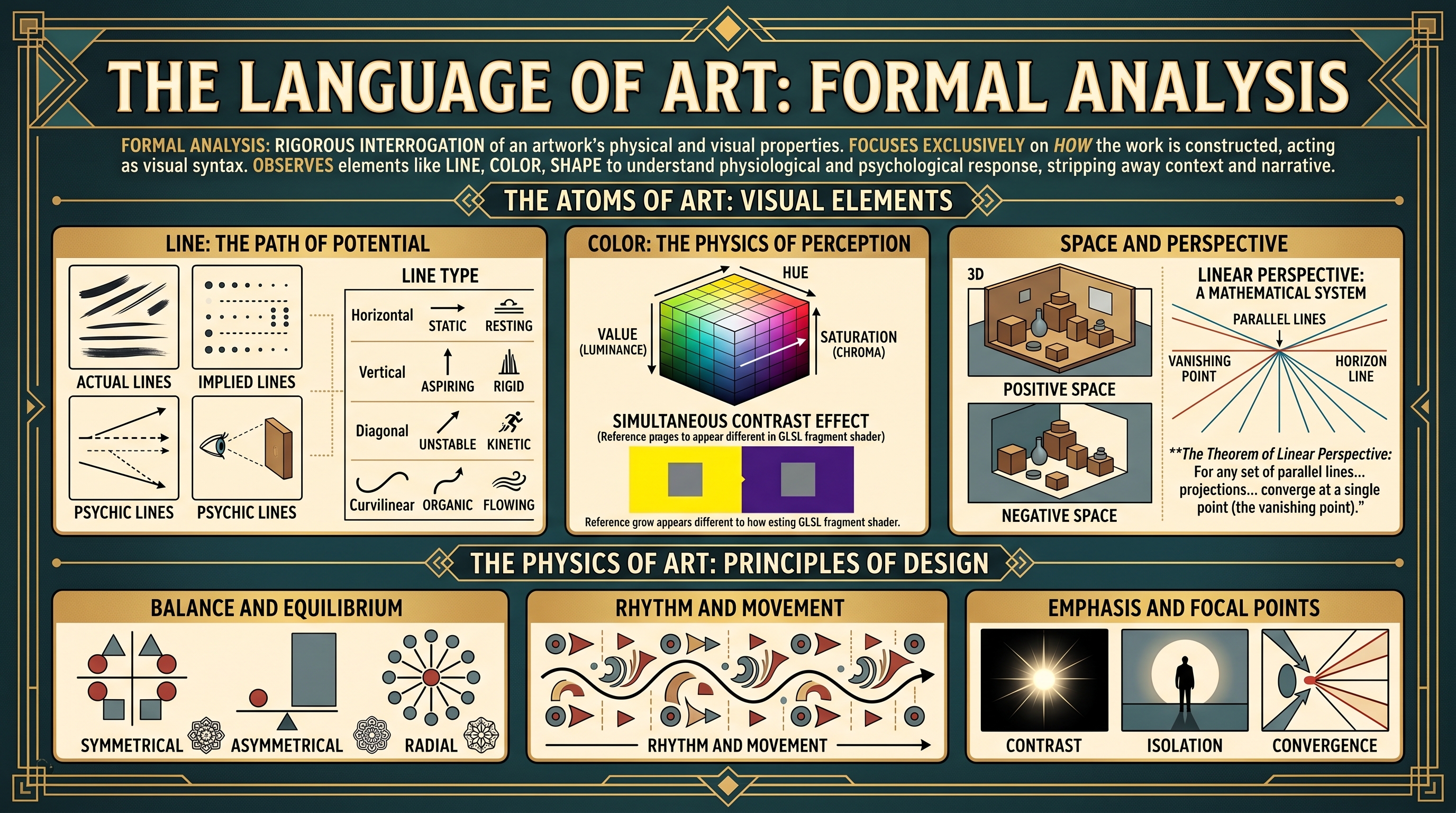
Formal analysis is the rigorous interrogation of an artwork’s physical and visual properties. It is the foundational methodology of art history, acting as a "syntax" for the visual language. While iconography deals with what is depicted and context deals with why it was made, formal analysis focuses exclusively on how the work is constructed. By stripping away the narrative and historical baggage, we can observe how the arrangement of lines, colors, and shapes dictates the viewer's physiological and psychological response.
The Atoms of Art: Visual Elements
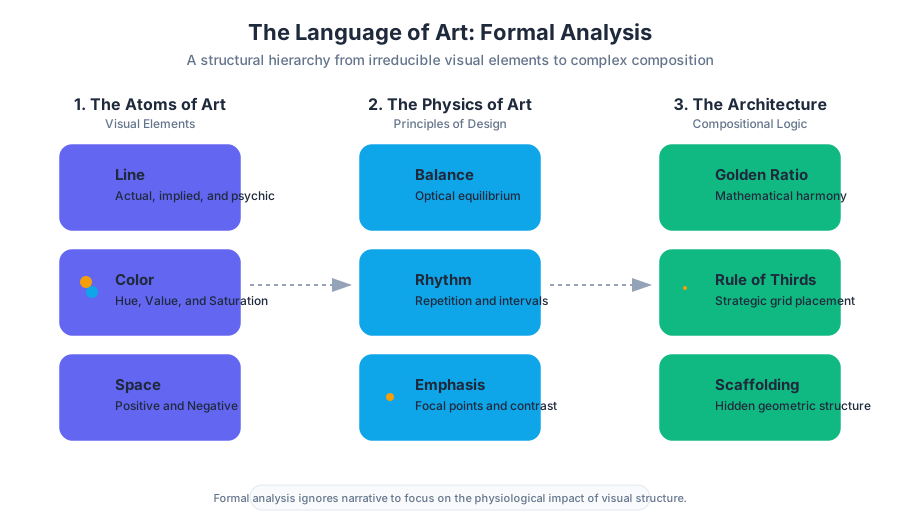
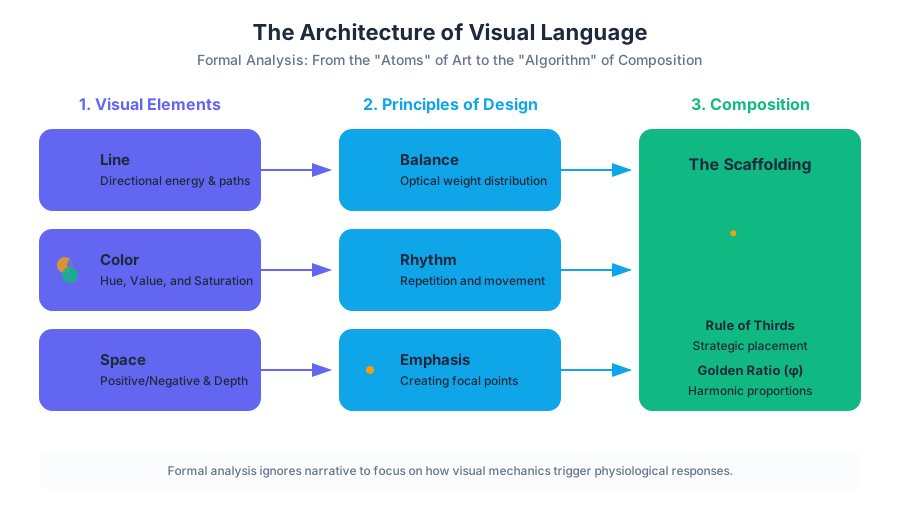
The visual elements are the irreducible components of any composition. In the same way a programmer uses primitive data types (integers, booleans, strings) to build complex software, an artist uses these elements to build a visual experience.
Line: The Path of Potential
A Line is technically the track made by a point moving through space. However, in formal analysis, we distinguish between actual lines (physical marks), implied lines (suggested by the alignment of shapes or the "gaze" of a figure), and psychic lines (the invisible connection between two points of interest).
| Line Type | Directional Energy | Psychological Association |
|---|---|---|
| Horizontal | Static, resting | Stability, calm, the horizon, death |
| Vertical | Aspiring, rigid | Strength, growth, authority, divinity |
| Diagonal | Unstable, kinetic | Movement, tension, drama, transition |
| Curvilinear | Organic, flowing | Softness, sensuality, nature |
Color: The Physics of Perception
Color is the most emotive element, defined by three distinct dimensions:
- Hue: The specific wavelength of light (Red, Blue, Green).
- Value (Luminance): The relative lightness or darkness, regardless of hue.
- Saturation (Chroma): The purity or intensity of the color.
In a technical sense, color interaction is governed by the Simultaneous Contrast effect, where the appearance of a color changes based on its neighbors.
// A GLSL fragment shader demonstrating "Simultaneous Contrast"
// This simulates how a neutral gray square looks different against
// a bright yellow vs. a deep purple background.

precision medium precision;
uniform float u_time;
varying vec2 v_texCoord;

void main() {
    vec2 uv = v_texCoord;
    vec3 bgColor = vec3(0.9, 0.8, 0.1); // Bright Yellow
    if (uv.x > 0.5) {
        bgColor = vec3(0.2, 0.1, 0.4); // Deep Purple
    }

    // The central "Gray" square
    float squareSize = 0.2;
    bool inSquare = abs(uv.x - 0.25) < squareSize/2.0 || abs(uv.x - 0.75) < squareSize/2.0;
    inSquare = inSquare && abs(uv.y - 0.5) < squareSize/2.0;

    vec3 color = inSquare ? vec3(0.5) : bgColor;
    gl_FragColor = vec4(color, 1.0);
}
Space and Perspective
Space in art is either positive (the area occupied by objects) or negative (the area around them). To represent 3D space on a 2D plane, artists use Linear Perspective, a mathematical system based on the convergence of parallel lines at a vanishing point.
The Theorem of Linear Perspective: For any set of parallel lines in three-dimensional space that are not parallel to the picture plane, their projections onto the picture plane will converge at a single point (the vanishing point).
The Physics of Art: Principles of Design
If the visual elements are the "atoms," the principles of design are the "laws of physics" that govern how those atoms interact. These principles determine the structural integrity and communicative power of the work.
Balance and Equilibrium
Balance is the distribution of visual weight. It is not necessarily about literal weight but about "optical heaviness." A small, bright red dot can balance a large, dull gray rectangle due to its high saturation and visual "pull."
| Type of Balance | Description | Effect |
|---|---|---|
| Symmetrical | Mirror-image or near-mirror equivalence. | Formality, permanence, stillness. |
| Asymmetrical | Uneven weights that achieve equilibrium through placement. | Dynamic, modern, lifelike. |
| Radial | Elements radiate from a central point. | Focus, spiritual significance (e.g., Mandalas). |
Rhythm and Movement
Rhythm is the repetition or alternation of elements, often with defined intervals between them. It creates a sense of movement, leading the eye through the composition in a specific sequence.
Emphasis and Focal Points
Emphasis is the "entry point" of the artwork. Artists create focal points through Contrast (a sudden change in value or color), Isolation (placing an object alone), or Convergence (using lines to point toward a specific area).
The Architecture of the Frame: Composition
Composition is the deliberate arrangement of elements within the frame. It is the "algorithm" of the image. A successful composition manages the viewer's cognitive load, ensuring the eye doesn't get "stuck" or "lost."
The Golden Ratio and the Rule of Thirds
The Golden Ratio ($\phi \approx 1.618$) is often found in nature and has been used since antiquity to create aesthetically pleasing proportions. A common simplification for artists is the Rule of Thirds, which divides the frame into a 3x3 grid.
\text{The Golden Ratio derivation:}
\phi = \frac{a+b}{a} = \frac{a}{b} \implies \phi^2 - \phi - 1 = 0
\phi = \frac{1 + \sqrt{5}}{2} \approx 1.61803398875...
In practice, placing the subject at the intersections of these grid lines (the "power points") creates more tension and interest than centering the subject.
Geometric Scaffolding
Many Master paintings are built upon "hidden" geometric structures. For example, the Pyramidal Composition (common in High Renaissance art) uses a triangular arrangement of figures to create a sense of stability and hierarchy, drawing the eye upward toward the apex.
<!-- A structural diagram of a Pyramidal Composition -->
<svg width="400" height="300" viewBox="0 0 400 300" xmlns="http://www.w3.org/2000/svg">
  <!-- The Frame -->
  <rect x="10" y="10" width="380" height="280" fill="none" stroke="#333" stroke-width="2"/>

  <!-- The Pyramidal Scaffold -->
  <path d="M 200 50 L 350 250 L 50 250 Z" fill="rgba(100, 150, 255, 0.2)" stroke="blue" stroke-dasharray="5,5" />

  <!-- Focal Point (The Apex) -->
  <circle cx="200" cy="50" r="10" fill="red" />
  <text x="215" y="55" font-family="Arial" font-size="12">Focal Point (Apex)</text>

  <!-- Base of Stability -->
  <line x1="50" y1="260" x2="350" y2="260" stroke="black" stroke-width="3" />
  <text x="150" y="280" font-family="Arial" font-size="12">Base of Stability</text>
</svg>
The Methodology: Performing a Formal Analysis
To perform a formal analysis, one must move through a structured pipeline. This prevents the analyst from jumping to conclusions about the "meaning" before fully seeing the "form."
Step 1: Inventory (Description)
List every physical attribute. What is the medium? What is the scale? What are the dominant colors? Example: "The work is a large-scale oil on canvas, dominated by vertical brushstrokes and a restricted palette of ochre and Prussian blue."
Step 2: Structural Analysis
How are the elements organized? Look for the "skeleton." Example: "The artist utilizes a strong diagonal axis running from the bottom-left to the top-right, creating a sense of impending collapse."
Step 3: Synthesis (The "So What?")
Connect the formal choices to the emotional or conceptual effect. Example: "The high-key values and lack of deep shadows create a flattened space, which reinforces the subject's feeling of claustrophobia."
| Analysis Phase | Objective | Key Questions |
|---|---|---|
| Observation | Data collection | What shapes do I see? Where is the light source? |
| Relationship | Pattern recognition | How does the red circle interact with the blue line? |
| Function | Impact assessment | How does the scale of the work affect my physical presence? |
| Conclusion | Formal Thesis | How do these formal choices support the overall mood? |
Common Pitfalls in Formal Analysis
- The Narrative Trap: Focusing on the story (e.g., "This is a painting of a man crying") rather than the form ("The downward-sloping lines and cool blue palette evoke sadness").
- Subjective Projection: Assuming your personal reaction is a universal formal property. (e.g., "The color yellow is happy." In some contexts, yellow can represent decay or sickness).
- Ignoring Scale: Analyzing a digital thumbnail of a 20-foot mural. Scale is a formal element; the physical relationship between the viewer's body and the work is crucial.
- Contextual Over-reliance: Using the artist's biography to explain a visual choice that should be explained through the visual evidence itself.
Advanced Concept: The "Gaze" as a Formal Element
In modern analysis, the Gaze is treated as a directional vector. Where the figures in a painting look creates a network of "implied lines" that dictate the viewer's path. If three figures look at a central point, that point becomes the focal point regardless of its color or size. This is a form of Vectorial Composition.
# A conceptual CLI tool for "Formal Analysis" of an image
# Usage: analyze_art --file masterpiece.jpg --mode formal

$ analyze_art --file las_meninas.jpg --detect-lines
> Found: 12 strong vertical axes (pillars/doorframes)
> Found: 4 implied lines (gazes of the Infanta and attendants)
> Dominant Geometry: Centered X-composition with deep recession.

$ analyze_art --file las_meninas.jpg --color-palette
> Top 3 Hues: #3A2F28 (Dark Umber), #E5D3B3 (Cream), #8B2323 (Madder Red)
> Contrast Ratio: High (Value range 0.1 to 0.95)
Media and Artistic Processes
Key concepts: Medium · Pigment · Additive vs. Subtractive Sculpture · Ephemeral Art
Exploration of the materials and techniques used by artists to create two-dimensional and three-dimensional works.
Media and Artistic Processes
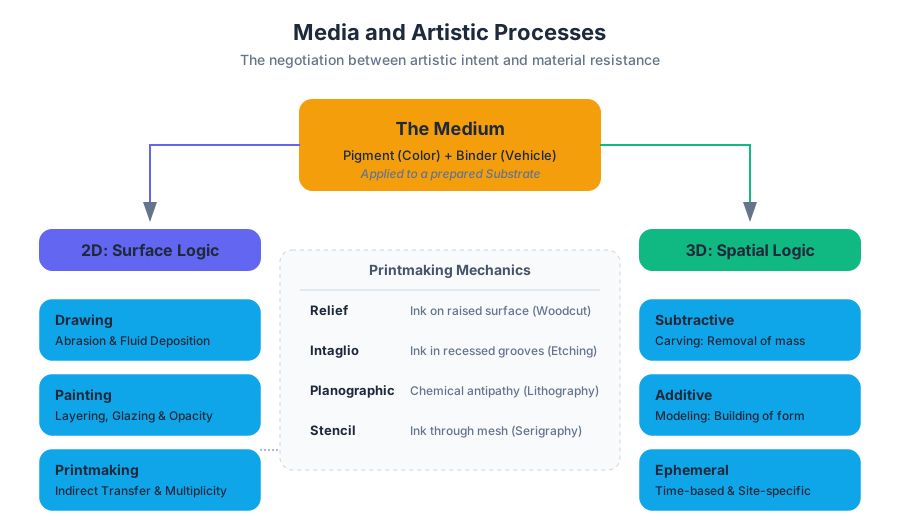
The ontological status of an artwork is inextricably linked to its physical substrate. In the study of art history and theory, the medium is not merely a neutral carrier of meaning but a fundamental constraint that dictates the formal possibilities, longevity, and sensory impact of the work. To understand an artistic process is to understand the negotiation between an artist’s intent and the resistance of the material world.
From the chemical stability of mineral pigments to the structural load-bearing capacity of marble, the "how" of art is as significant as the "what." This article explores the technical frameworks of artistic production, categorizing media by their physical properties and the procedural logic—whether additive, subtractive, or ephemeral—that governs their creation.
The Physics and Chemistry of Medium
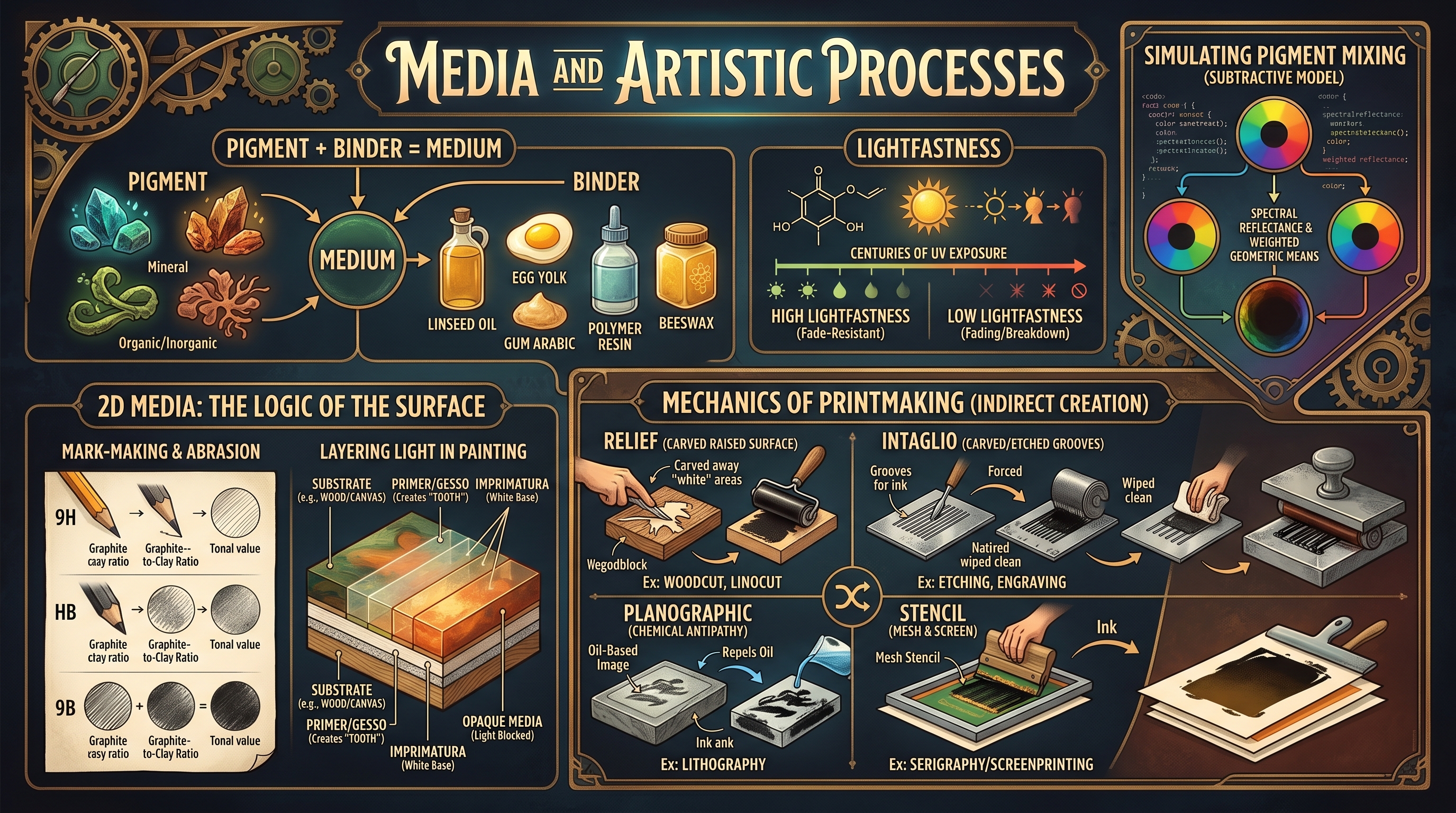
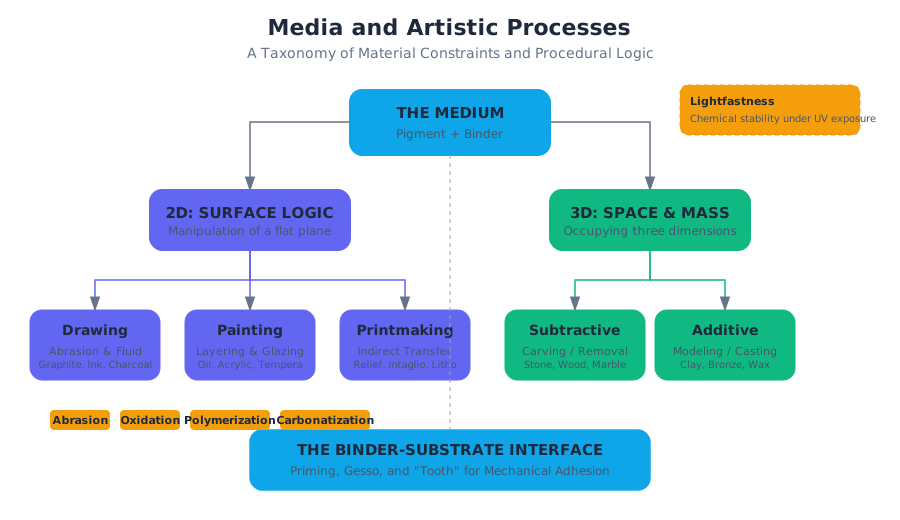
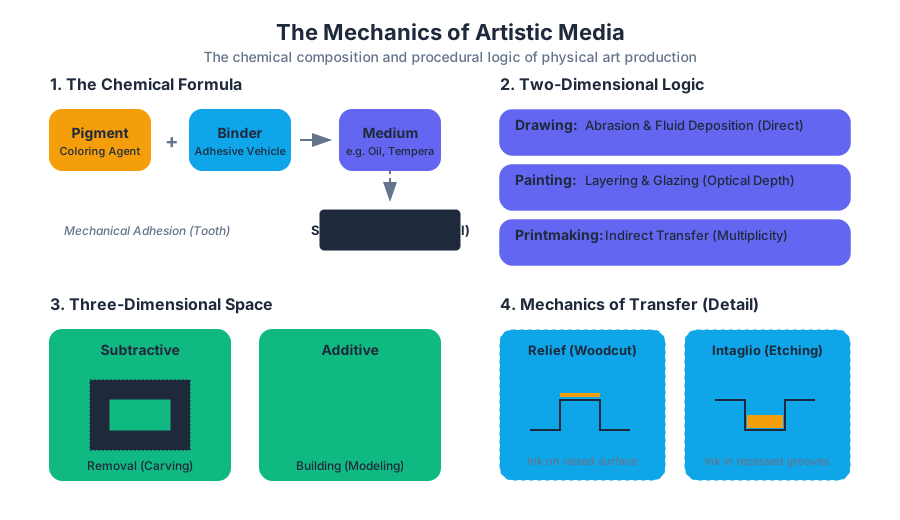
At its most basic level, a medium is the combination of a pigment (the coloring agent) and a binder (the substance that holds the pigment together and attaches it to a surface). The choice of binder determines the medium's name and its behavior: oil painting uses linseed or poppy oil, tempera uses egg yolk, and watercolor uses gum arabic.
Pigment: The Source of Color
Pigments are finely ground particles that do not dissolve but remain suspended in the binder. Historically, pigments were derived from organic sources (plants, insects) or inorganic minerals (lapis lazuli, ochre, lead).
Definition: Lightfastness The chemical stability of a pigment under exposure to light. High lightfastness ensures that the molecular structure of the pigment does not break down (fade) over centuries of UV exposure.
The Binder-Substrate Interface
The substrate (the surface being painted on, such as canvas, wood, or plaster) must be prepared to accept the binder. This often involves priming or gessoing, creating a "tooth" that allows the medium to adhere mechanically or chemically.
| Medium | Binder | Substrate | Drying Mechanism | Optical Property |
|---|---|---|---|---|
| Fresco | Lime Plaster | Wall/Stone | Carbonatization | Matte, Integrated |
| Tempera | Egg Yolk | Wood Panel | Evaporation/Polymerization | Opaque, Fast-drying |
| Oil | Linseed Oil | Canvas/Wood | Oxidation | Translucent, Glossy |
| Acrylic | Polymer Resin | Various | Evaporation | Plasticity, Vibrant |
| Encaustic | Beeswax | Wood | Cooling/Solidification | Textural, Luminous |
Two-Dimensional Media: The Logic of the Surface
Two-dimensional processes are defined by the manipulation of a flat plane. These are generally categorized into drawing, painting, and printmaking.
Drawing and the Mark-Making Economy
Drawing is often the most direct translation of thought to form. It relies on abrasion (graphite or charcoal leaving particles on paper) or fluid deposition (ink). The "hardness" of a drawing tool (e.g., a 9H vs. 9B graphite pencil) determines the ratio of clay to graphite, affecting the friction and the resulting value (darkness).
Painting: The Layering of Light
In painting, the artist manages opacity and translucency. Oil painting, in particular, revolutionized art through the use of glazes—thin, transparent layers of paint that allow light to pass through and reflect off the white primer (the imprimatura), creating a "glow" that opaque media like tempera cannot achieve.
Printmaking: The Mechanics of Transfer
Printmaking is a process of indirect creation. The artist works on a matrix (plate, block, or screen), which is then used to transfer the image to a final substrate. This allows for the multiplicity of the artwork.
- Relief: The artist carves away the "white" areas. The remaining raised surface receives the ink (e.g., Woodcut, Linocut).
- Intaglio: The artist carves or etches the "black" lines into a metal plate. Ink is forced into the grooves, and the surface is wiped clean (e.g., Etching, Engraving).
- Planographic: The process relies on the chemical antipathy of oil and water (e.g., Lithography).
- Stencil: Ink is pushed through a mesh (e.g., Serigraphy/Screenprinting).
# Example: Simulating Pigment Mixing (Subtractive Color Model)
# This script calculates the resulting RGB value when mixing two pigments
# based on their spectral reflectance properties.

import numpy as np

def mix_pigments(pigment_a, pigment_b, ratio=0.5):
    """
    Simulates the mixing of two pigments using a simplified
    Kubelka-Munk theory approach for subtractive mixing.
    """
    # Normalize ratios
    ratio_a = ratio
    ratio_b = 1.0 - ratio

    # Subtractive mixing in CMYK space is more accurate for pigments
    # but here we use a simplified weighted geometric mean of RGB
    # to simulate the absorption of light.
    mixed_rgb = np.power(pigment_a, ratio_a) * np.power(pigment_b, ratio_b)

    return np.clip(mixed_rgb, 0, 255).astype(int)

# Define Pigments (RGB)
ultramarine_blue = np.array([18, 10, 143])
cadmium_yellow = np.array([255, 246, 0])

# Mix 50/50
green_mix = mix_pigments(ultramarine_blue, cadmium_yellow, 0.5)
print(f"Resulting Mix RGB: {green_mix}")
Three-Dimensional Media: Space and Mass
Sculpture is the art of occupying three-dimensional space. The primary distinction in sculptural process is between subtractive and additive methodologies.
Subtractive Sculpture: The Logic of Removal
Subtractive sculpture (carving) starts with a solid mass—usually stone or wood—and removes material until the form is revealed. This process is inherently "lossy"; once material is removed, it cannot be replaced. This requires the artist to have a complete mental model of the finished work before the first strike.
- Material Constraints: Stone has tensile strength issues. A marble statue cannot have thin, outstretched limbs without support (often disguised as tree stumps or drapery) because the weight of the stone would cause it to snap.
- Tools: Points, tooth chisels, and rasps are used in sequence to move from rough volume to refined surface.
Additive Sculpture: The Logic of Accumulation
Additive sculpture (modeling) involves building up form from nothing, usually using a pliable material like clay or wax. This is "lossless" or reversible; the artist can add, remove, and reshape indefinitely.
- Armatures: Because clay is soft, large additive sculptures require an internal "skeleton" made of wire or wood to prevent collapse under their own weight.
- Casting: To make an additive work permanent, it is often cast in metal (usually bronze) using the lost-wax process (cire perdue).
| Feature | Subtractive (Carving) | Additive (Modeling) |
|---|---|---|
| Primary Material | Marble, Granite, Wood | Clay, Wax, Plaster |
| Error Tolerance | Low (Irreversible) | High (Reversible) |
| Structural Logic | Monolithic / Compression | Armature-supported / Tension |
| Directionality | Outside-In | Inside-Out |
| Finality | The original block | Often a mold for casting |
The Lost-Wax Casting Pipeline
- Original Model: Created in clay or wax.
- Mold Making: A negative mold is taken from the original.
- Wax Positive: A hollow wax version is produced from the mold.
- Invesment: The wax is encased in a heat-resistant material (ceramic shell).
- Burnout: The shell is heated; the wax melts out (leaving a void).
- Pouring: Molten bronze is poured into the void.
- Chasing: The bronze is cleaned, and the "seams" are filed down.
; Example: Subtractive Manufacturing (CNC Carving)
; G-code for a roughing pass on a 3D sculptural relief
G21 ; Set units to millimeters
G90 ; Absolute positioning
M03 S12000 ; Start spindle at 12000 RPM

; Move to start position
G00 X0 Y0 Z5.0

; Begin Spiral Roughing Cut
G01 Z-2.0 F500 ; Plunge to 2mm depth
G02 X10.0 Y10.0 I5.0 J0 F1200 ; Clockwise arc movement
G02 X0.0 Y0.0 I-5.0 J0
G01 Z-4.0 ; Increase depth
; ... (Iterative removal of material)
M05 ; Stop spindle
G00 Z50 ; Retract for tool change
Ephemeral Art: The Dimension of Time
Not all art is intended to last. Ephemeral art deliberately incorporates its own destruction or disappearance as part of the work's meaning. This challenges the traditional museum model of "preservation."
Types of Ephemerality
- Environmental/Land Art: Works like Andy Goldsworthy’s ice sculptures or Robert Smithson’s Spiral Jetty are subject to the entropy of nature (tides, melting, erosion).
- Performance Art: The "medium" is the human body and the "substrate" is time. Once the performance ends, the work exists only in documentation (video, photography) or memory.
- Installation Art: Often site-specific and temporary, these works are dismantled after an exhibition, existing only for a specific duration.
The Role of Documentation
In ephemeral art, the documentation (the photograph of the melting ice) often becomes the commodity that is sold or archived, creating a tension between the original experience and its historical record.
Key Insight: The Medium is the Message Coined by Marshall McLuhan, this concept suggests that the characteristics of the medium (e.g., the flickering light of video vs. the static weight of stone) exert more influence on the viewer's psyche than the actual content of the image.
Modern and New Media
The 20th and 21st centuries introduced media that are non-physical or purely digital.
- Photography and Film: The medium is light captured on a chemically sensitive surface or a digital sensor. It introduced the concept of the "mechanical eye."
- Digital Art: The medium is code and pixels. It is infinitely reproducible without loss of quality, breaking the "aura" of the unique original.
- Bio-Art: Using living organisms (bacteria, DNA, tissue) as the medium, raising ethical questions about the manipulation of life as an aesthetic pursuit.
{
  "artwork_metadata": {
    "title": "Digital Ephemera #4",
    "artist": "A. Random",
    "medium": "Generative Adversarial Network (GAN)",
    "format": "MP4 / H.264",
    "bitrate": "15Mbps",
    "dimensions": {
      "width": 3840,
      "height": 2160,
      "unit": "pixels"
    },
    "provenance": {
      "blockchain": "Ethereum",
      "token_standard": "ERC-721",
      "contract_address": "0x71C7656EC7ab88b098defB751B7401B5f6d8976F"
    },
    "preservation_strategy": "IPFS Decentralized Storage"
  }
}
Common Pitfalls in Understanding Media
- Confusing "Style" with "Medium": An artist can paint in a "realistic style" using either oil or digital tools. The style is the visual language; the medium is the physical dialect.
- Underestimating the Binder: Many people focus on the pigment (the color) and ignore the binder. However, the binder dictates whether a painting will crack, yellow, or remain flexible over time.
- The "Subtractive is Harder" Myth: While carving is irreversible, additive processes like bronze casting are technically much more complex, involving metallurgy, mold chemistry, and multi-stage engineering.
- Assuming Digital is "Easy": Digital media removes physical resistance but introduces "infinite choice" and "versioning fatigue," which are their own forms of creative resistance.
| Concept | Misconception | Reality |
|---|---|---|
| Fresco | It's just painting on a wall. | It's a chemical bond between pigment and wet lime; it becomes part of the wall. |
| Etching | The artist carves the metal. | The artist scratches a wax coating; acid "carves" the metal. |
| Watercolor | It's for beginners. | It is one of the most difficult media because it is transparent and cannot be "painted over" to fix errors. |
| Bronze | It's a solid hunk of metal. | Most large bronzes are hollow to save weight and prevent cooling-related cracking. |
Conclusion: The Materiality of Meaning
The choice of medium is a philosophical statement. A sculptor choosing to work in ephemeral ice rather than permanent granite is making a statement about the transience of life. A painter choosing oil over acrylic is opting for a historical lineage of depth and slow labor. By understanding the technical processes—the chemistry of pigments, the physics of sculpture, and the mechanics of the print—we gain a deeper appreciation for the "physical intelligence" required to transform raw matter into art.
- Medium: The material(s) from which an artwork is made.
- Pigment: The coloring component of a medium, usually in powder form.
- Binder: The substance that holds pigment particles together and attaches them to the substrate.
- Subtractive: A sculptural process involving the removal of material (e.g., carving).
- Additive: A sculptural process involving the building up of material (e.g., modeling).
- Lost-Wax Casting: A multi-step process for creating hollow metal sculptures from a wax original.
- Intaglio: A printmaking technique where the image is incised into a surface (the opposite of relief).
- Encaustic: A painting medium using heated beeswax as the binder.
- Lightfastness: The ability of a pigment to resist fading when exposed to light.
- Ephemeral Art: Art intended to last only for a short time.
-
Why does a marble statue often feature a "tree stump" or extra drapery near the legs?
- A) To hide mistakes in the stone.
- B) To provide structural support against the stone's low tensile strength.
- C) Because the artist liked nature.
- D) To make the carving process faster. (Correct: B)
-
Which medium relies on the chemical process of carbonatization?
- A) Oil Painting
- B) Encaustic
- C) Buon Fresco
- D) Lithography (Correct: C)
-
In printmaking, what is the primary difference between Relief and Intaglio?
- A) Relief uses metal; Intaglio uses wood.
- B) Relief prints the raised surface; Intaglio prints the recessed grooves.
- C) Relief is additive; Intaglio is subtractive.
- D) There is no difference. (Correct: B)
-
What is the "binder" in tempera paint?
- A) Linseed Oil
- B) Gum Arabic
- C) Egg Yolk
- D) Polymer Resin (Correct: C)
-
Which of these is an example of an ephemeral medium?
- A) Bronze Casting
- B) Performance Art
- C) Oil on Canvas
- D) Marble Carving (Correct: B)
Key Objectives for Mastery:
- Differentiate between binders: Be able to identify the binder for oil, fresco, tempera, and watercolor and explain how each affects the drying time and appearance.
- Process Mapping: Sketch the steps of the lost-wax casting process and the difference between relief and intaglio printmaking.
- Material Logic: Explain why certain materials (like stone) dictate specific shapes in sculpture compared to additive materials (like clay).
- Conceptual Application: Discuss how the choice of an ephemeral medium changes the viewer's perception of an artwork's value and meaning.
- Technical Vocabulary: Use terms like substrate, tensile strength, matrix, and glaze correctly in the context of artistic analysis.
Art in Context: History and Culture
Key concepts: Contextualism · Patronage · Iconography · Art Movements
Examining how historical events, religious beliefs, and social structures shape the creation and reception of art.
Art in Context: History and Culture
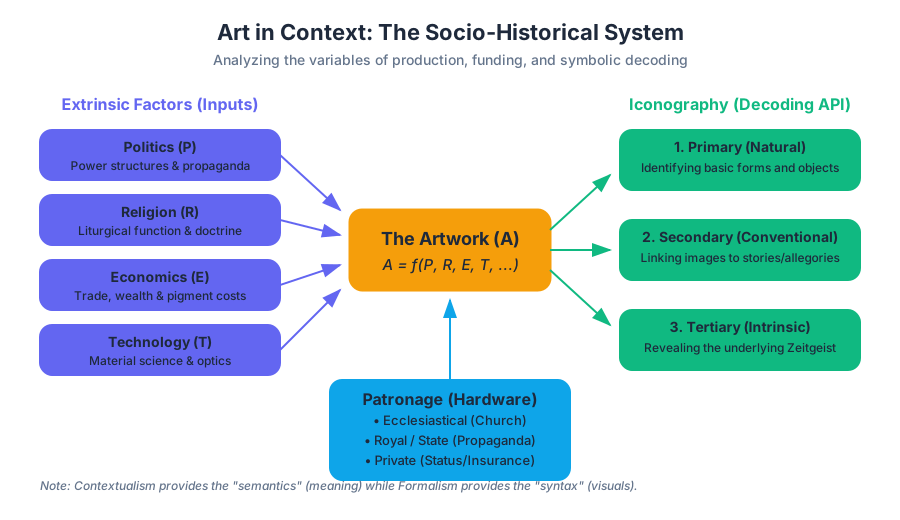
Art is rarely the product of a solitary genius working in a vacuum; it is a high-dimensional output of a specific socio-historical system. To analyze a work of art through the lens of Contextualism is to treat the object not merely as an aesthetic arrangement of form and color, but as a primary source document that encodes the political, religious, and economic state of its era.
In this deep dive, we will move beyond the surface-level appreciation of beauty to examine the underlying "operating systems" of art history: the power dynamics of Patronage, the semiotic density of Iconography, and the evolutionary pressures that drive Art Movements.
Contextualism: The System Model of Art
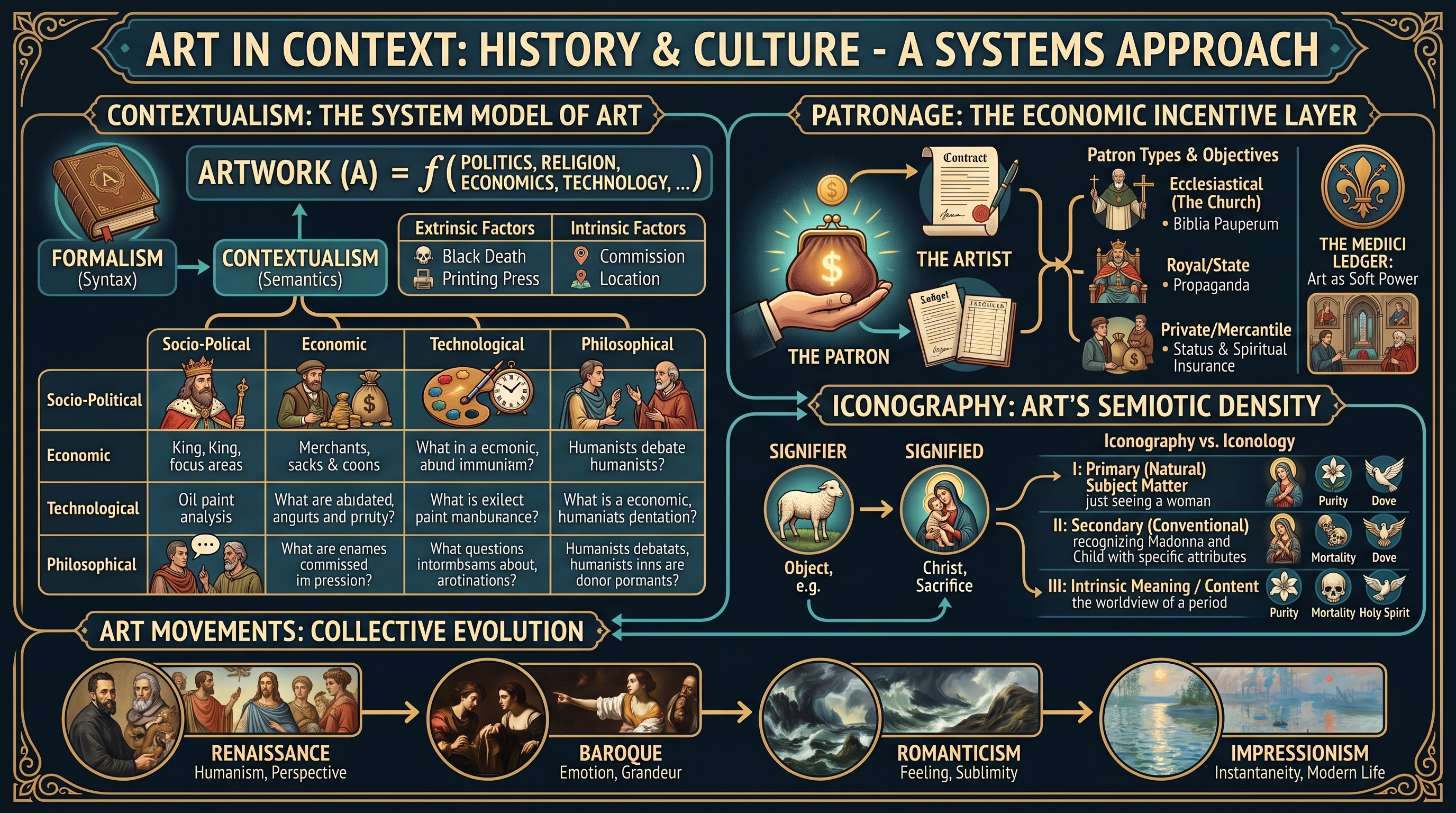
Contextualism is the methodological framework that asserts a work of art cannot be fully understood without reference to the environment of its creation. While Formalism (the study of line, shape, and color) provides the "syntax" of art, Contextualism provides the "semantics."
What it is
In a contextualist analysis, the artwork is the dependent variable ($Y$) in a function where the independent variables ($X_n$) are the prevailing cultural forces.
Definition: The Contextualist Function Let $A$ be the Artwork. $A$ is a function of $P$ (Politics), $R$ (Religion), $E$ (Economics), and $T$ (Technology), such that: $A = f(P, R, E, T, ...)$ To understand $A$, one must derive the values of the input variables at time $t$.
Why it matters
Without context, the viewer is prone to "anachronistic projection"—imposing modern values onto historical objects. For example, viewing a medieval altarpiece as a "self-expression" of the artist ignores the fact that the concept of the "individual artist" did not exist in the modern sense; the work was a functional liturgical tool designed to facilitate prayer.
How it works: Extrinsic vs. Intrinsic Factors
Contextual analysis typically bifurcates into two investigative streams:
- Extrinsic Factors: External pressures such as the Black Death, the invention of the printing press, or the rise of the merchant class.
- Intrinsic Factors: The specific circumstances of the commission, the artist's training, and the physical location where the work was intended to be displayed.
| Analysis Type | Focus Area | Key Question |
|---|---|---|
| Socio-Political | Power structures, wars, laws | How does this work reinforce or subvert the ruling class? |
| Economic | Trade routes, wealth distribution | What was the cost of the pigments (e.g., Ultramarine) used? |
| Technological | Material science, optics | Did the invention of the oil medium allow for this level of detail? |
| Philosophical | Intellectual trends, zeitgeist | Does the work reflect Humanism, Scholasticism, or Nihilism? |
Patronage: The Economic Incentive Layer
If art is the "software," Patronage is the "hardware" and the "funding." Historically, the person or institution paying for the work had a decisive influence on its content, scale, and medium.
The Mechanics of the Commission
In the pre-modern era, art was rarely "made and then sold." Instead, it was commissioned via legal contracts. These contracts specified the quality of materials (e.g., the amount of gold leaf), the deadline, and often the specific figures to be included.
Patron Types and Their Objectives
- Ecclesiastical (The Church): Art as Biblia Pauperum (Bible of the Poor) to teach doctrine and inspire awe.
- Royal/State: Art as propaganda to solidify the "Divine Right of Kings" or national identity.
- Private/Mercantile: Art as a status symbol or "spiritual insurance" (e.g., donor portraits in chapels).
Worked Example: The Medici Ledger
The Medici family of Florence functioned as the "venture capitalists" of the Renaissance. Their patronage was not merely philanthropic; it was a strategic deployment of "soft power" to mask their usurious banking practices through the support of religious art.
/*
 * A low-level representation of a Renaissance Commission Contract
 * simulating the constraints placed on an artist by a patron.
 */

#include <stdio.h>

typedef struct {
    char* patron_name;
    char* artist_name;
    double florins_paid;
    int lapis_lazuli_grams; // Expensive pigment requirement
    int gold_leaf_sheets;
    char* subject_matter;
    int includes_donor_portrait; // Boolean: 1 if patron is in the painting
} Commission;

void validate_contract(Commission c) {
    printf("Contract for: %s\n", c.subject_matter);
    if (c.lapis_lazuli_grams < 50) {
        printf("Warning: Insufficient pigment quality for high-status work.\n");
    }
    if (c.includes_donor_portrait) {
        printf("Requirement: Artist %s must place %s in the foreground.\n",
                c.artist_name, c.patron_name);
    }
}

int main() {
    Commission medici_request = {
        "Cosimo de' Medici",
        "Fra Angelico",
        500.0,
        100,
        20,
        "The Adoration of the Magi",
        1
    };

    validate_contract(medici_request);
    return 0;
}
Iconography: The Encoding Protocol
Iconography is the study of the subject matter and symbolic meaning in the visual arts. It is the "API" that allows a viewer to decode the visual signals into specific narratives.
Panofsky’s Three Levels of Analysis
Erwin Panofsky, the father of modern iconography, proposed a tripartite system for interpreting images:
- Primary (Natural) Subject Matter: Identifying basic forms (e.g., "a man sitting at a table with 12 others").
- Secondary (Conventional) Subject Matter: Identifying the story or allegory (e.g., "This is the Last Supper"). This requires knowledge of literary sources (The Bible, Ovid, etc.).
- Tertiary (Intrinsic) Meaning / Iconology: Determining the underlying "attitude" of a nation, period, or class (e.g., "This specific depiction of the Last Supper reflects the Counter-Reformation's emphasis on the Eucharist").
Common Symbolic Mappings
In Western art, symbols often have fixed meanings that acted as a visual shorthand for a largely illiterate population.
| Symbol | Iconographic Meaning | Contextual Origin |
|---|---|---|
| Dog | Fidelity / Loyalty | Latin fides (faith); common in marriage portraits (e.g., Arnolfini). |
| Skull | Memento Mori | "Remember you must die"; common in Dutch Still Life. |
| Lily | Purity / Virginity | Associated with the Annunciation of Mary. |
| Scales | Justice / Judgment | Derived from Egyptian and Roman legal imagery. |
| Open Book | Knowledge / Revelation | Often held by Apostles or personifications of Philosophy. |
Decoding Complexity: The Polysemic Nature of Symbols
Symbols are not static; their meaning shifts based on context. A "lion" might represent Christ (The Lion of Judah) in one painting, and the sin of Pride in another.
-- A relational database schema representing Iconographic Mapping
-- Shows how symbols (Attributes) link to Entities across different Eras.

CREATE TABLE Symbols (
    symbol_id INT PRIMARY KEY,
    name VARCHAR(50),
    base_meaning VARCHAR(255)
);

CREATE TABLE Cultural_Context (
    context_id INT PRIMARY KEY,
    era VARCHAR(50),
    region VARCHAR(50),
    dominant_religion VARCHAR(50)
);

CREATE TABLE Interpretations (
    interpretation_id INT PRIMARY KEY,
    symbol_id INT REFERENCES Symbols(symbol_id),
    context_id INT REFERENCES Cultural_Context(context_id),
    specific_meaning VARCHAR(255),
    source_text VARCHAR(255) -- e.g., "The Golden Legend"
);

-- Example Query: What does a 'Snake' mean in a Medieval vs. Modern context?
SELECT era, specific_meaning
FROM Interpretations
JOIN Cultural_Context ON Interpretations.context_id = Cultural_Context.context_id
WHERE symbol_id = (SELECT symbol_id FROM Symbols WHERE name = 'Snake');
Art Movements: The Evolutionary Trajectory
An Art Movement is a collective trend in style, philosophy, or goal followed by a group of artists during a specific period. Movements are often reactions to the ones that preceded them—a dialectic of "action and reaction."
The Dialectic Pipeline
- Thesis (The Status Quo): A dominant style (e.g., the rigid rules of the French Academy).
- Antithesis (The Rebellion): A new movement that rejects those rules (e.g., Impressionism's focus on light and spontaneity).
- Synthesis: The eventual absorption of the rebellion into the mainstream, which then becomes the new Thesis.
Major Movements: A Technical Comparison
| Movement | Approximate Era | Core Philosophy | Technical Innovation |
|---|---|---|---|
| Renaissance | 1400–1550 | Humanism, Rationalism | Linear Perspective, Chiaroscuro |
| Baroque | 1600–1750 | Drama, Grandeur | Tenebrism (extreme light/dark) |
| Neoclassicism | 1750–1850 | Order, Logic, Virtue | Clean lines, invisible brushwork |
| Romanticism | 1790–1850 | Emotion, Nature, Sublime | Expressive color, textured surfaces |
| Modernism | 1860–1970 | Abstraction, Self-reflexivity | Flattening of the picture plane |
Case Study: The Shift from Neoclassicism to Romanticism
The transition from the 18th to the 19th century provides a perfect example of contextual pressure. Neoclassicism (think Jacques-Louis David) was the art of the Enlightenment and the French Revolution—it emphasized stoicism, duty, and clear, logical composition.
However, as the Industrial Revolution began to alienate workers and the Napoleonic Wars shattered the dream of a rational Europe, Romanticism emerged. Artists like Géricault and Delacroix turned inward, focusing on the "Sublime"—the overwhelming, terrifying power of nature and the irrationality of the human psyche.
Common Pitfalls in Contextual Analysis
Even seasoned historians fall into specific traps when analyzing art in context:
- The "Intentional Fallacy": Assuming the artist’s stated intention is the only meaning of the work. Context often reveals subconscious or systemic meanings the artist wasn't aware of (e.g., colonialist undertones in 19th-century landscapes).
- Over-determinism: Attributing every brushstroke to a historical event. Sometimes, an artist chooses a color simply because they ran out of another, or because they liked the way it looked.
- Monolithic Context: Treating "The Middle Ages" or "The Renaissance" as a single, unchanging block of time. Context is granular; the context of 1420 Florence is vastly different from 1490 Florence.
Practical Application: A Metadata Standard
In the professional world of museum curation, context is preserved using standardized schemas like CDWA (Categories for the Description of Works of Art).
# Example of a CDWA-compliant metadata record for a contextual archive
object_id: "1992.1.1"
title: "The Death of Marat"
creator: "Jacques-Louis David"
date: "1793"
culture: "French"
contextual_metadata:
  political_event: "French Revolution"
  subject_biography: "Jean-Paul Marat, Jacobin leader"
  patronage: "The National Convention"
  intended_location: "Meeting hall of the Deputies"
  symbolism:
    - element: "Writing quill"
      meaning: "The power of the pen/propaganda"
    - element: "Wound"
      meaning: "Secular martyrdom (Christ-like pose)"
technical_data:
  medium: "Oil on canvas"
  dimensions: "165 x 128 cm"
Summary
Understanding art in context is the process of reverse-engineering the cultural conditions that made a specific visual output possible. By analyzing the Patronage (who funded it), the Iconography (how it was encoded), and the Movement (where it fits in the stylistic timeline), we transform art from a decorative object into a high-fidelity record of human history.
Interpretation and the Role of the Viewer
Key concepts: Subjective vs. Objective · Art Criticism · Aesthetics · Visual Literacy
Synthesizing formal and contextual analysis to form a personal and critical interpretation of art.
Interpretation and the Role of the Viewer
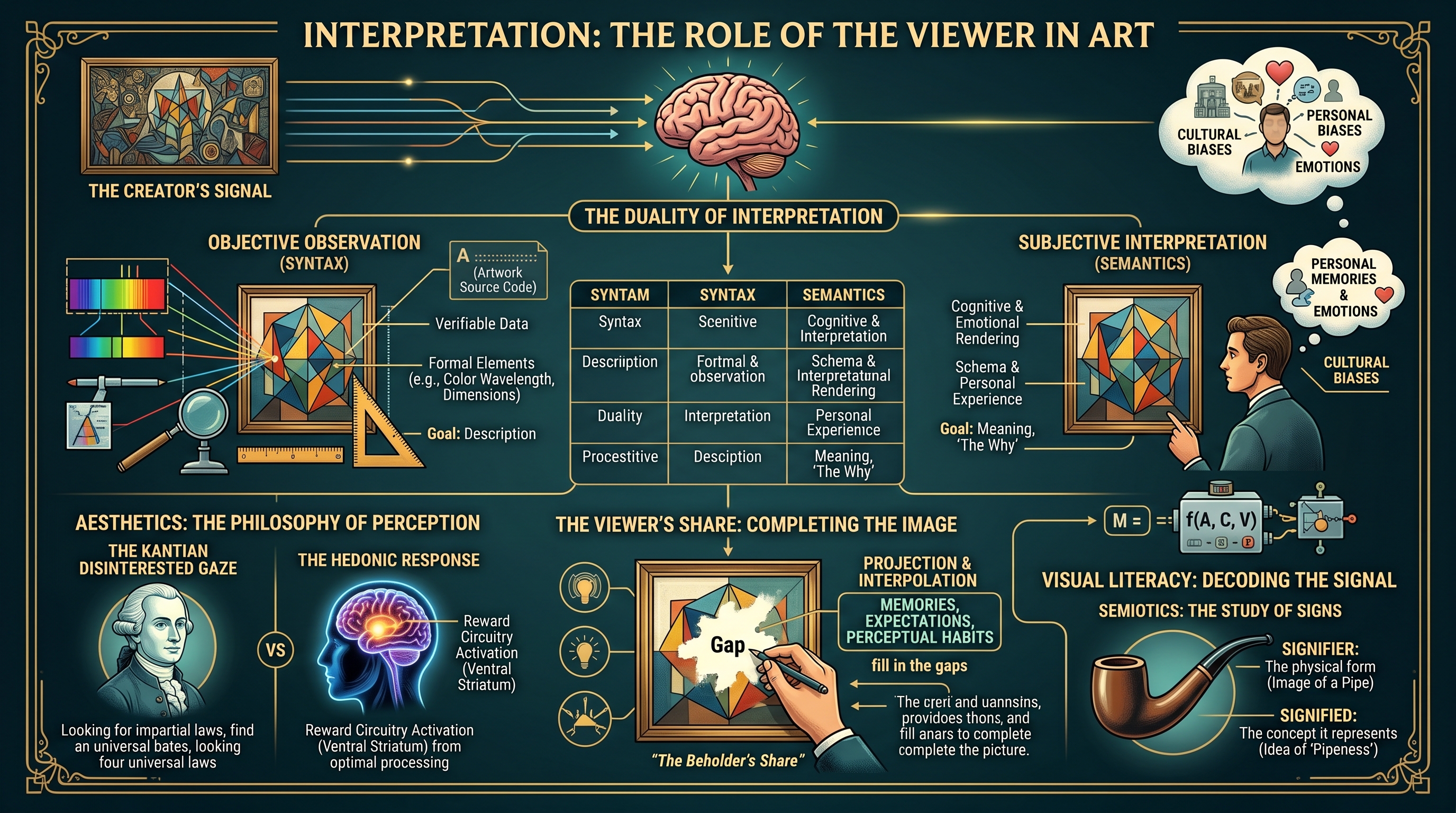
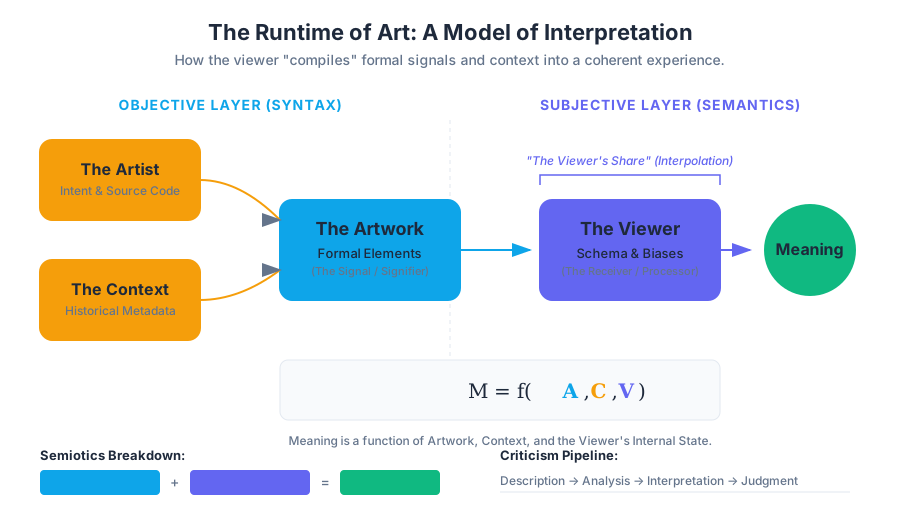
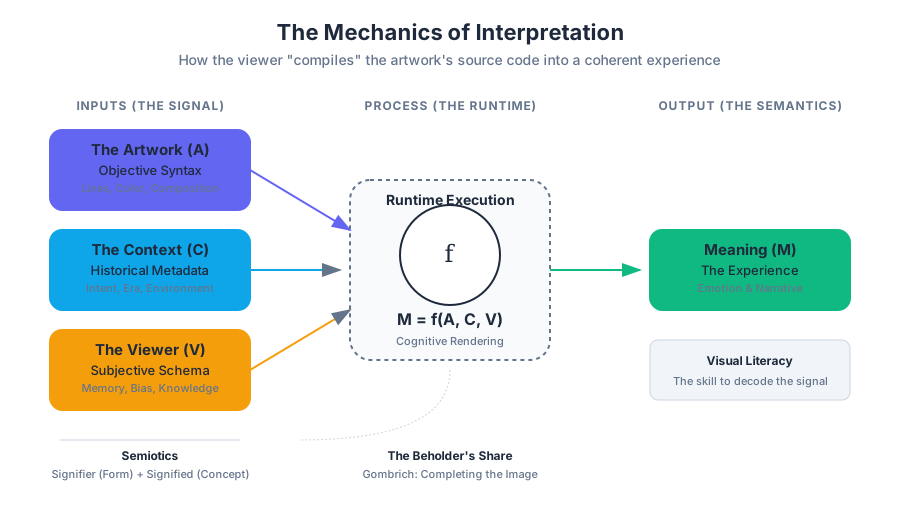
Interpretation is the "runtime execution" of an artwork. While formal analysis provides the source code (the lines, colors, and composition) and art history provides the documentation (the context and intent), it is the viewer who compiles these elements into a coherent experience. In this framework, an artwork is not a static object but a dynamic process—a transaction between the creator’s signal and the viewer’s receiver.
The Duality of Interpretation: Subjective vs. Objective
The fundamental tension in art appreciation lies between Objective Observation and Subjective Interpretation. Objective observation deals with the "verifiable" data of the work: the wavelength of the light (color), the physical dimensions, and the chemical composition of the pigments. Subjective interpretation, however, involves the cognitive and emotional "rendering" that occurs within the viewer’s mind.
The Objective Layer (Syntax)
The objective layer is the structural foundation. It consists of the Formal Elements that can be measured or agreed upon by any observer regardless of their cultural background. In information theory terms, this is the signal.
The Subjective Layer (Semantics)
The subjective layer is where meaning is constructed. It is influenced by the viewer’s schema—the mental structures of pre-conceived ideas, cultural biases, and personal memories. This is the interpretation of the signal.
| Feature | Objective Observation | Subjective Interpretation |
|---|---|---|
| Focus | Physical attributes, formal elements. | Meaning, emotional resonance, narrative. |
| Goal | Description and inventory. | Understanding and "The Why." |
| Verification | Can be proven via measurement or consensus. | Validated through argument and personal experience. |
| Stability | High (the painting doesn't change). | Low (meaning shifts over time and between viewers). |
| Example | "The painting uses high-saturation red." | "The red evokes a sense of urgent violence." |
Aesthetics: The Philosophy of Perception
Aesthetics is the branch of philosophy that investigates the nature of beauty, art, and taste. It seeks to define the criteria by which we judge something as "successful" or "valuable." Historically, aesthetics has oscillated between the search for universal laws of beauty (the Golden Ratio, symmetry) and the recognition of beauty as a social construct.
The Kantian "Disinterested" Gaze
Immanuel Kant argued that for a judgment to be truly aesthetic, it must be disinterested. This means the viewer must set aside their personal desires, needs, or the practical utility of the object to appreciate it "for its own sake."
The Hedonic Response
In contrast, modern neuroaesthetics looks at the Hedonic Response—the physiological pleasure derived from viewing art. This involves the activation of the brain's reward circuitry (the ventral striatum) when encountering patterns that the brain finds "optimal" for processing.
The Viewer’s Share: Completing the Image
The concept of The Viewer's Share, popularized by art historian Ernst Gombrich, posits that an artwork is fundamentally incomplete without the viewer's participation. The artist provides a "schema" or a set of cues, and the viewer uses their "beholder's share" to fill in the gaps.
Definition: The Viewer's Share The psychological process where the observer utilizes their own memories, expectations, and perceptual habits to project a complete meaning onto the partial or ambiguous cues provided by the artist.
The "Gap" in Representation
No artwork is a perfect 1:1 recreation of reality. Whether it is a brushstroke that suggests a leaf or a pixel that suggests a curve, the viewer’s brain performs Interpolation.
Mathematical Representation of Interpretation
We can model the interpretive process as a function where the resulting Meaning ($M$) is a product of the Artwork ($A$), the Context ($C$), and the Viewer ($V$).
M = f(A, C, V)
Where:
- $A$ = The formal properties (the "source code").
- $C$ = The historical and environmental metadata.
- $V$ = The viewer's internal state (priors, biases, and knowledge).
Visual Literacy: Decoding the Signal
Visual Literacy is the ability to read, write, and create visual images. It is a competency that allows a viewer to move beyond "looking" (passive reception) to "seeing" (active decoding). Just as textual literacy requires an understanding of grammar and syntax, visual literacy requires an understanding of Semiotics.
Semiotics: The Study of Signs
In semiotics, every element in an artwork can be viewed as a Sign, consisting of two parts:
- Signifier: The physical form (the actual image of a pipe).
- Signified: The concept it represents (the idea of "pipeness" or "tobacco use").
| Component | Definition | Example in Art |
|---|---|---|
| Denotation | The literal, primary meaning. | A painting of a red rose. |
| Connotation | The socio-cultural or emotional association. | The rose signifies love, passion, or fragility. |
| Icon | A sign that resembles its signified. | A portrait that looks like the sitter. |
| Symbol | A sign with an arbitrary, learned connection. | A dove representing peace. |
| Index | A sign that shows evidence of an action. | A visible, aggressive brushstroke (index of the artist's movement). |
Art Criticism: The Analytical Framework
Art Criticism is the systematic evaluation of an artwork. It is not merely "having an opinion"; it is the application of a rigorous framework to justify an interpretation. Professional critics use several distinct lenses to "debug" the meaning of a work.
The Four-Step Criticism Pipeline
- Description: What is physically there? (Inventory of elements).
- Analysis: How are the elements organized? (Principles of design).
- Interpretation: What is the work saying? (Meaning and intent).
- Judgment: Is the work successful? (Evaluation based on criteria).
Critical Frameworks (Lenses)
Different "compilers" produce different "outputs" for the same artwork.
| Framework | Primary Focus | Key Question |
|---|---|---|
| Formalism | The visual structure and "plastic" qualities. | How do the lines and colors create balance? |
| Contextualism | The historical, social, and political environment. | How does this reflect the French Revolution? |
| Psychoanalytic | The subconscious of the artist or viewer. | What repressed desires are manifested here? |
| Feminist | Gender roles and power dynamics. | How is the "male gaze" operating in this work? |
| Iconography | The specific meaning of symbols and motifs. | Why is the subject holding a pomegranate? |
Implementation: The Interpretation Engine
To understand how a viewer "processes" an image, we can look at a simplified computational model. This Python example simulates a "Criticism Engine" that evaluates an image based on different weighted frameworks.
class Artwork:
    def __init__(self, title, elements, context_tags):
        self.title = title
        self.elements = elements  # e.g., {"color": "red", "line": "jagged"}
        self.context_tags = context_tags  # e.g., ["war", "1914", "expressionism"]

class Viewer:
    def __init__(self, bias_weights):
        # bias_weights: dict e.g., {"formalism": 0.8, "history": 0.2}
        self.bias_weights = bias_weights

    def interpret(self, artwork):
        interpretation_log = []

        # Formalist Layer
        if "formalism" in self.bias_weights:
            score = self._analyze_formalism(artwork.elements)
            interpretation_log.append(f"Formalist Analysis: {score}")

        # Contextual Layer
        if "history" in self.bias_weights:
            score = self._analyze_context(artwork.context_tags)
            interpretation_log.append(f"Contextual Analysis: {score}")

        return " | ".join(interpretation_log)

    def _analyze_formalism(self, elements):
        if elements.get("color") == "red" and elements.get("line") == "jagged":
            return "High Tension/Aggression"
        return "Neutral Balance"

    def _analyze_context(self, tags):
        if "war" in tags:
            return "Social Trauma/Protest"
        return "General Narrative"

# Usage
guernica = Artwork("Guernica", {"color": "monochrome", "line": "sharp"}, ["war", "fascism"])
modernist_viewer = Viewer({"formalism": 0.9, "history": 0.1})
historian_viewer = Viewer({"formalism": 0.1, "history": 0.9})

print(f"Modernist: {modernist_viewer.interpret(guernica)}")
print(f"Historian: {historian_viewer.interpret(guernica)}")
Advanced Perspectives: The Problem of "Intentional Fallacy"
A common mistake in interpretation is the Intentional Fallacy—the belief that the artist's stated intention is the only or final meaning of the work.
The Death of the Author
Literary critic Roland Barthes argued for "The Death of the Author," suggesting that once a work is released, the author's control over its meaning ceases. The meaning is recreated every time a new viewer engages with it.
The Affective Fallacy
Similarly, the Affective Fallacy is the mistake of judging a work solely based on the emotional effect it has on the viewer. While emotions are valid, a rigorous interpretation must also account for the work's internal logic and external context.
Worked Example: Interpreting "The Treachery of Images" (Magritte)
Let's apply the visual literacy and criticism framework to René Magritte’s Ceci n'est pas une pipe (This is not a pipe).
- Description: A realistic painting of a briar pipe with the text "Ceci n'est pas une pipe" written in cursive underneath.
- Analysis: The image is centered and rendered in a deadpan, illustrative style, reminiscent of an advertisement or a dictionary entry.
- Interpretation:
- Level 1 (Literal): It is literally not a pipe; it is a representation of a pipe (oil on canvas).
- Level 2 (Semiotics): Magritte is highlighting the gap between the Signifier (the image/word) and the Referent (the actual physical object).
- Level 3 (Philosophical): The work challenges the viewer's trust in visual representation and language.
- Judgment: The work is highly successful as a piece of conceptual art because it forces the viewer to confront the mechanics of their own perception.
Formal Logic Representation of Magritte's Paradox
% Definitions
is_representation(image_of_pipe).
is_physical_object(actual_pipe).
label(image_of_pipe, "pipe").

% The Paradox
% A representation is NOT the object it represents.
not_identical(X, Y) :- is_representation(X), is_physical_object(Y).

% Query
% ?- not_identical(image_of_pipe, actual_pipe).
% Output: True.
Common Pitfalls in Interpretation
- Over-Interpretation (Apophenia): Finding patterns or meanings where none exist (e.g., seeing a complex political conspiracy in a random splatter of paint).
- Literalism: Failing to move past the denotative layer (e.g., "It's just a picture of a bowl of fruit").
- Anachronism: Applying modern values or knowledge to a historical work in a way that distorts its original context (e.g., criticizing a 15th-century painting for lacking 21st-century digital color theory).
- Projection: Using the artwork as a mirror for one's own personal issues without acknowledging the artist's signal.
The Evolution of Interpretation in the Digital Age
In the era of AI and algorithmic curation, the role of the viewer is shifting. We are no longer just interpreting static objects; we are interpreting Generative Systems.
Metadata and the Semantic Web
Modern interpretation often involves interacting with an artwork's "Digital Twin"—the metadata that surrounds it online.
{
  "@context": "http://schema.org",
  "@type": "VisualArtwork",
  "name": "Starry Night",
  "creator": {
    "@type": "Person",
    "name": "Vincent van Gogh"
  },
  "interpretationLayer": {
    "movement": "Post-Impressionism",
    "emotionalTone": "Turbulent",
    "symbolism": ["Cypress tree as mourning", "Stars as the infinite"]
  }
}
The Feedback Loop
The viewer’s interpretation now feeds back into the system. Every "like," "share," or "comment" on a digital artwork acts as a data point that influences how the next viewer will perceive that work, creating a collective, real-time interpretive layer.
Source Materials
Study Art Appreciation with AI — Free on Lykke
Sign up for free to generate personalized flashcards, quizzes, and study guides from this course. Chat with an AI tutor that knows the material.
Get Started FreeView this course wiki on Lykke · Browse all public course wikis