From the free course AP/College Calculus BC on Lykke
Infinite Sequences and Series
Key concepts: Convergence Tests · Taylor/Maclaurin Series · Power Series · Lagrange Error Bound
Determining convergence and representing functions as power series.
Infinite Sequences and Series
The study of infinite sequences and series represents one of the most profound leaps in mathematical thought. It is the transition from the finite—things we can count and add by hand—to the infinite, where intuition often fails and rigorous logic must take over. In the context of calculus, series allow us to represent transcendental functions (like $e^x$, $\sin(x)$, and $\ln(x)$) as "infinite polynomials." This transformation is not merely a theoretical curiosity; it is the engine that powers modern computing, signal processing, and physics.
Foundations: Sequences vs. Series
Before we can sum an infinite number of terms, we must understand the individual terms themselves. A sequence ${a_n}$ is an ordered list of numbers defined by a function whose domain is the set of positive integers. A series $\sum a_n$ is the sum of the terms of a sequence.
The most critical question we ask of any infinite series is: Does it converge?
Definition: Convergence A series $\sum_{n=1}^{\infty} a_n$ converges to a sum $S$ if the sequence of its partial sums ${S_k}$, where $S_k = \sum_{n=1}^{k} a_n$, approaches a finite limit $S$ as $k \to \infty$. If the limit of partial sums does not exist or is infinite, the series diverges.
The Divergence Test (nth Term Test)
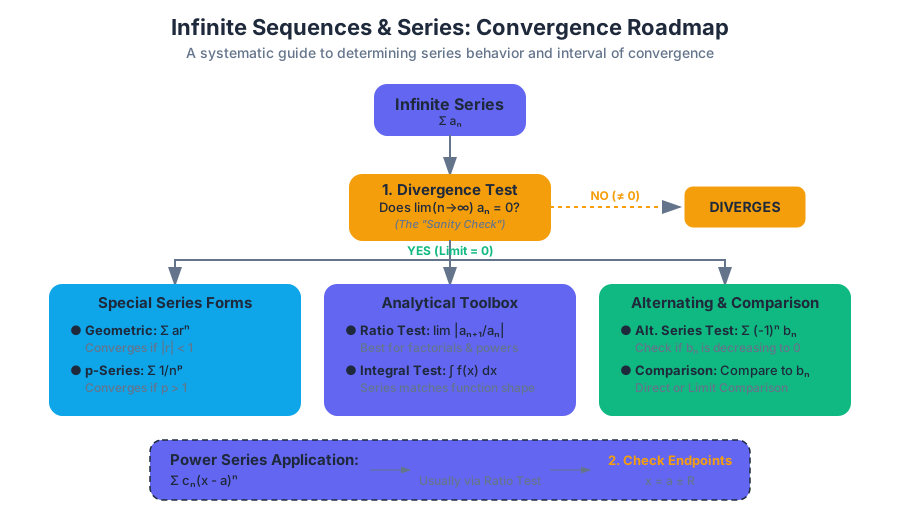
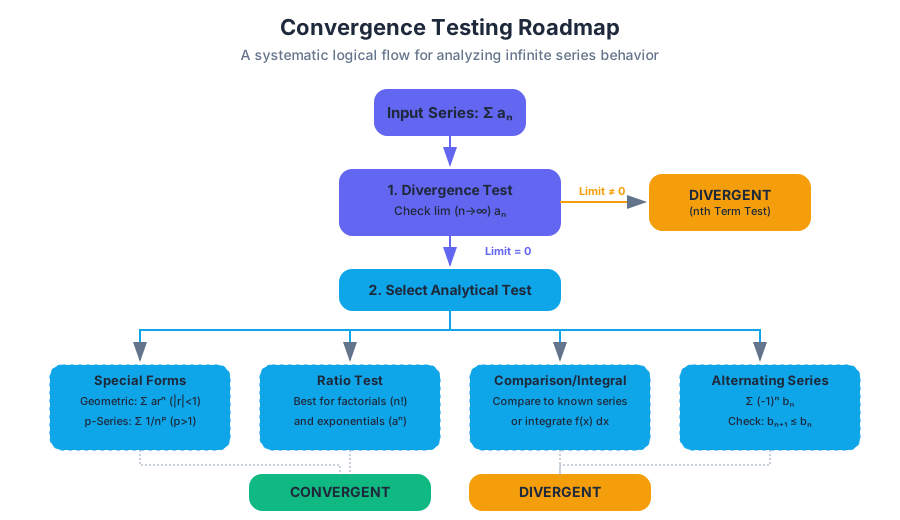
The first "sanity check" for any series is the Divergence Test. If the individual terms $a_n$ do not approach zero as $n$ goes to infinity, the sum cannot possibly settle at a finite value.
- If $\lim_{n \to \infty} a_n \neq 0$, then $\sum a_n$ diverges.
- If $\lim_{n \to \infty} a_n = 0$, the test is inconclusive. (Recall the Harmonic Series $\sum \frac{1}{n}$, which diverges even though its terms go to zero).
Convergence Tests: The Analytical Toolbox
Determining convergence is rarely as simple as looking at the limit of the nth term. We require a suite of tests, each suited to different "shapes" of functions.
Summary of Convergence Tests
| Test Name | Series Form | Condition for Convergence | Condition for Divergence |
|---|---|---|---|
| Geometric Series | $\sum ar^n$ | $\vert r\vert < 1$ | $\vert r\vert \geq 1$ |
| p-Series | $\sum \frac{1}{n^p}$ | $p > 1$ | $p \leq 1$ |
| Integral Test | $\sum f(n)$ | $\int_{1}^{\infty} f(x) dx$ converges | $\int_{1}^{\infty} f(x) dx$ diverges |
| Ratio Test | $\sum a_n$ | $\lim_{n \to \infty} \vert \frac{a_{n+1}}{a_n}\vert < 1$ | $\lim_{n \to \infty} \vert \frac{a_{n+1}}{a_n}\vert > 1$ |
| Comparison Test | $\sum a_n$ | $a_n \leq b_n$ and $\sum b_n$ converges | $a_n \geq b_n$ and $\sum b_n$ diverges |
| Alt. Series Test | $\sum (-1)^n b_n$ | $b_{n+1} \leq b_n$ AND $\lim_{n \to \infty} b_n = 0$ | If limit $\neq 0$, diverges by nth term |
The Ratio Test: The Powerhouse of Power Series
The Ratio Test is perhaps the most vital tool for the calculus student. It measures the "growth rate" of the series terms. If the ratio of a term to its predecessor is less than 1 in the limit, the series behaves like a decaying geometric series and converges.
Absolute vs. Conditional Convergence
A series $\sum a_n$ is absolutely convergent if the series of absolute values $\sum |a_n|$ converges. If $\sum a_n$ converges but $\sum |a_n|$ diverges (like the alternating harmonic series $\sum \frac{(-1)^n}{n}$), the series is conditionally convergent. This distinction is crucial because absolutely convergent series can be rearranged in any order without changing the sum—a property not shared by conditionally convergent series.
Power Series and the Interval of Convergence
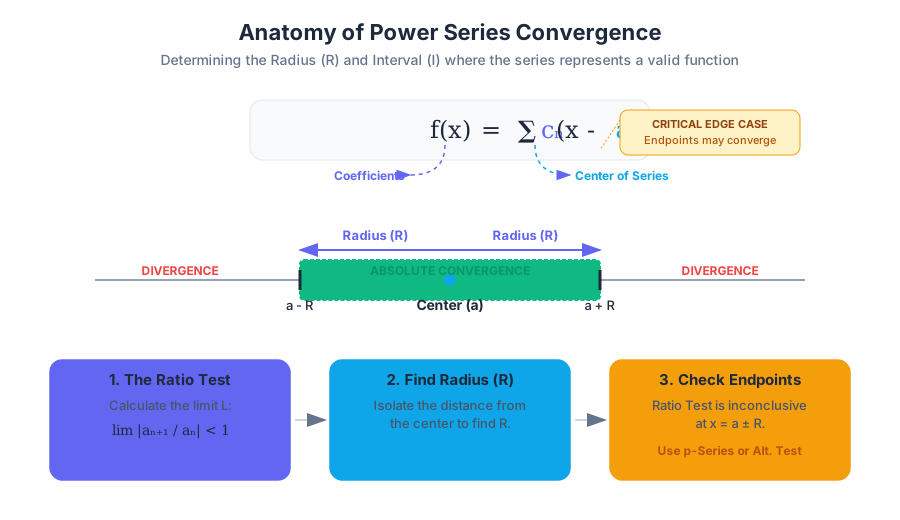
A Power Series is a series of the form: $$\sum_{n=0}^{\infty} c_n (x - a)^n = c_0 + c_1(x-a) + c_2(x-a)^2 + \dots$$ where $a$ is the center and $c_n$ are coefficients. Unlike constant series, a power series may converge for some values of $x$ and diverge for others.
Radius ($R$) and Interval ($I$) of Convergence
Every power series has a Radius of Convergence $R$.
- If $R=0$, the series converges only at $x=a$.
- If $R=\infty$, the series converges for all real $x$.
- If $0 < R < \infty$, the series converges if $|x-a| < R$ and diverges if $|x-a| > R$.
Crucial Step: To find the Interval of Convergence, you must use the Ratio Test to find $R$, then manually check the endpoints ($x = a-R$ and $x = a+R$) using other convergence tests, as the Ratio Test is inconclusive when the limit equals 1.
| Scenario | Convergence Behavior |
|---|---|
| Inside the Radius | Absolute Convergence |
| Outside the Radius | Divergence |
| At the Endpoints | Varies (Can be Absolute, Conditional, or Divergent) |
Taylor and Maclaurin Series
If we assume a function $f(x)$ can be represented as a power series, we can derive the coefficients by repeatedly differentiating the series and evaluating it at the center.
The Derivation
Suppose $f(x) = \sum_{n=0}^{\infty} c_n (x-a)^n$.
- $f(a) = c_0$
- $f'(x) = c_1 + 2c_2(x-a) + 3c_3(x-a)^2 \dots \implies f'(a) = c_1$
- $f''(x) = 2c_2 + 6c_3(x-a) \dots \implies f''(a) = 2c_2 \implies c_2 = \frac{f''(a)}{2!}$
- Generalizing this, we find the Taylor Coefficient: $c_n = \frac{f^{(n)}(a)}{n!}$
% Mathematical Derivation of the Taylor Series Formula
f(x) = \sum_{n=0}^{\infty} \frac{f^{(n)}(a)}{n!} (x-a)^n

\text{When the center } a = 0, \text{ the series is called a Maclaurin Series:}
f(x) = f(0) + f'(0)x + \frac{f''(0)}{2!}x^2 + \frac{f'''(0)}{3!}x^3 + \dots
Common Maclaurin Series to Memorize
These series are the building blocks for more complex approximations.
| Function | Maclaurin Series | Interval of Convergence |
|---|---|---|
| $\frac{1}{1-x}$ | $\sum_{n=0}^{\infty} x^n = 1 + x + x^2 + \dots$ | $(-1, 1)$ |
| $e^x$ | $\sum_{n=0}^{\infty} \frac{x^n}{n!} = 1 + x + \frac{x^2}{2!} + \dots$ | $(-\infty, \infty)$ |
| $\sin(x)$ | $\sum_{n=0}^{\infty} \frac{(-1)^n x^{2n+1}}{(2n+1)!} = x - \frac{x^3}{3!} + \frac{x^5}{5!} \dots$ | $(-\infty, \infty)$ |
| $\cos(x)$ | $\sum_{n=0}^{\infty} \frac{(-1)^n x^{2n}}{(2n)!} = 1 - \frac{x^2}{2!} + \frac{x^4}{4!} \dots$ | $(-\infty, \infty)$ |
| $\ln(1+x)$ | $\sum_{n=1}^{\infty} \frac{(-1)^{n-1} x^n}{n} = x - \frac{x^2}{2} + \frac{x^3}{3} \dots$ | $(-1, 1]$ |
Error Analysis: How Wrong Are We?
In practice, we cannot sum an infinite number of terms. We use a Taylor Polynomial of degree $n$, denoted $P_n(x)$, to approximate the function. The difference between the actual function and the polynomial is the remainder (or error): $R_n(x) = f(x) - P_n(x)$.
1. Alternating Series Error Bound
If a series satisfies the Alternating Series Test, the error in using the $n$-th partial sum is less than or equal to the magnitude of the first unused term. $$|R_n| \leq |a_{n+1}|$$
2. Lagrange Error Bound
For non-alternating series (or a more general bound), we use the Lagrange Error Bound. It states that for a Taylor polynomial of degree $n$ centered at $a$: $$|R_n(x)| \leq \frac{M}{(n+1)!} |x-a|^{n+1}$$ where $M$ is the maximum value of the $(n+1)$-th derivative $|f^{(n+1)}(z)|$ for all $z$ between $x$ and $a$.
Worked Example: Approximating $\sin(0.1)$
Suppose we use the 3rd-degree Maclaurin polynomial for $\sin(x)$ to estimate $\sin(0.1)$. $P_3(x) = x - \frac{x^3}{3!}$ $P_3(0.1) = 0.1 - \frac{(0.1)^3}{6} = 0.1 - 0.0001666... = 0.0998333...$
To find the Lagrange Error Bound ($n=3$): We need the 4th derivative of $\sin(x)$, which is $\sin(x)$. The maximum value of $|\sin(z)|$ on the interval $[0, 0.1]$ is $\sin(0.1)$, but for simplicity, we often use the global maximum $M=1$. $|R_3(0.1)| \leq \frac{1}{(3+1)!} |0.1 - 0|^{4} = \frac{0.0001}{24} \approx 0.00000416$
This tells us our approximation $0.0998333$ is accurate to at least 5 decimal places.
Common Pitfalls and Misconceptions
- Confusing Sequences and Series: A sequence can converge to zero while its series diverges (e.g., the harmonic series). Always check if you are being asked about the list of numbers or the sum.
- Forgetting the Center: When using the Taylor formula, ensure all derivatives are evaluated at the center $a$, not at $x$.
- Endpoint Neglect: The Ratio Test only gives the open interval. You must test the endpoints separately to determine if the interval is $(, )$, $[, )$, $(, ]$, or $[, ]$.
- The "M" in Lagrange: Students often struggle to find $M$. Remember, $M$ is an upper bound. If you can't find the exact maximum of the $(n+1)$-th derivative, any value that is definitely larger than the maximum (like 1 for sine/cosine) will technically work, though it will give a looser bound.
Summary Table: Error Bounds Comparison
| Feature | Alternating Series Bound | Lagrange Error Bound |
|---|---|---|
| Applicability | Only alternating series with decreasing terms | Any function with $n+1$ derivatives |
| Ease of Use | Very Easy (just look at next term) | Moderate (requires $(n+1)$-th derivative) |
| Precision | Usually tighter for alternating series | General-purpose |
| Formula | $\vert a_{n+1}\vert $ | $\frac{max\vert f^{(n+1)}(z)\vert }{(n+1)!}\vert x-a\vert ^{n+1}$ |
Author Note: This article serves as a deep-dive into the mechanics of infinite series. For further exploration, one might look into Fourier Series, which use trigonometric functions instead of polynomials to represent periodic signals, or Complex Analysis, where the radius of convergence is visualized as a literal disk in the complex plane.
Source Materials
Study AP/College Calculus BC on Lykke
This course page is free to open: signed out, you can read its first two sections, and signing in, on any plan, opens the rest. The free Lykke Chrome extension syncs your own Canvas courses, so ChatGPT, Claude and Muse can answer from your classes and deadlines. It only reads Canvas.
Add the free extensionSign in to open every sectionAll sections of AP/College Calculus BC · Browse more course pages