From the free course AP/College Calculus BC on Lykke
Differentiation: Fundamentals
Key concepts: Power Rule · Product Rule · Quotient Rule · Transcendental Functions
Introduction to the derivative as a limit and basic differentiation rules.
Differentiation: Fundamentals
Overview
Differentiation is the mathematical study of change. While algebra allows us to calculate the average rate of change over a discrete interval, calculus provides the machinery to determine the instantaneous rate of change at a single point. Geometrically, this corresponds to finding the slope of the tangent line to a curve. In the context of physics, if a function represents position over time, its derivative represents velocity; the derivative of velocity, in turn, represents acceleration.
This section moves beyond the intuitive "slope" concept into the rigorous formalisms required for engineering, physics, and advanced data science. We will transition from the computationally expensive Limit Definition to the optimized Differentiation Rules that form the backbone of modern computational mathematics.
The Formal Definition of the Derivative
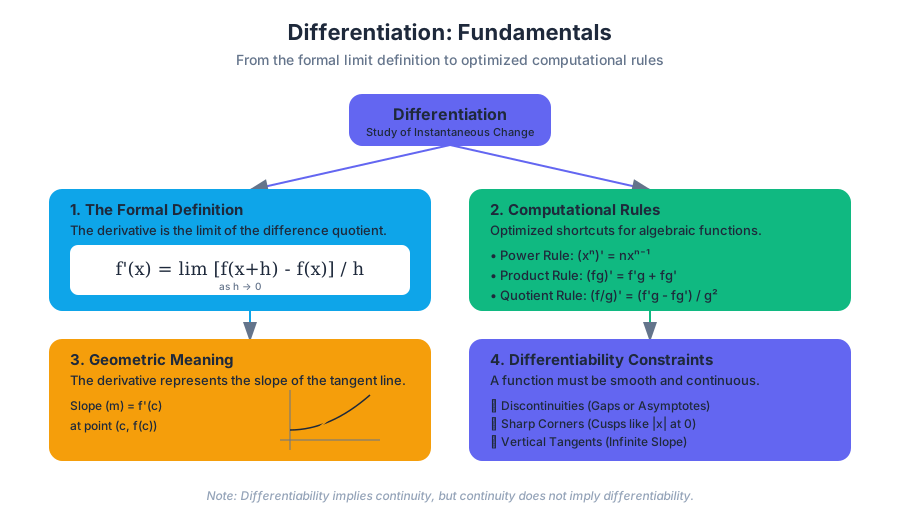
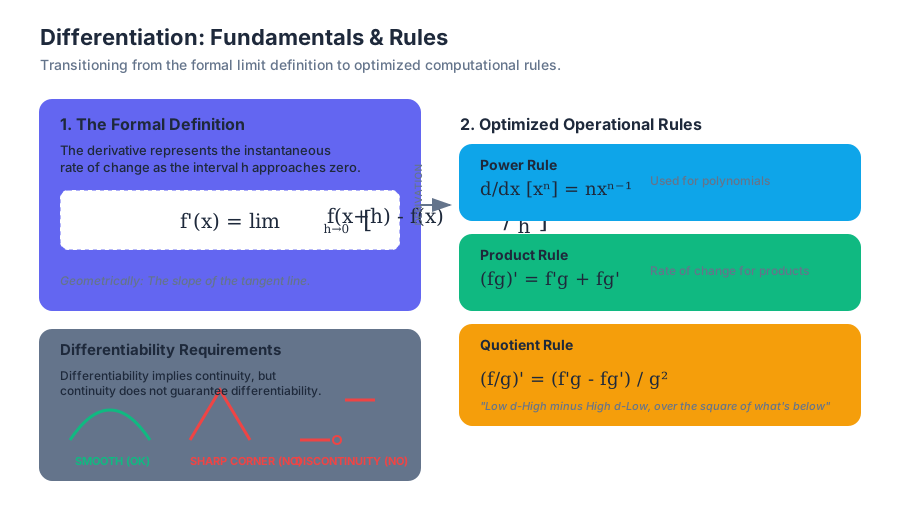
The derivative of a function $f(x)$ at a point $x$, denoted as $f'(x)$ or $\frac{dy}{dx}$, is defined as the limit of the difference quotient as the interval $h$ approaches zero.
Definition: The Derivative For a function $f(x)$, the derivative $f'(x)$ is defined as: $$f'(x) = \lim_{h \to 0} \frac{f(x+h) - f(x)}{h}$$ provided the limit exists. If the limit exists at a point $c$, we say $f$ is differentiable at $c$.
Why the Limit?
In pre-calculus, the slope $m$ is defined as $\frac{\Delta y}{\Delta x}$. However, at a single point, $\Delta x = 0$, leading to the indeterminate form $\frac{0}{0}$. The limit allows us to "zoom in" infinitely close to the point without ever actually dividing by zero, capturing the behavior of the function as it approaches that infinitesimal state.
Differentiability vs. Continuity
A common misconception is that all continuous functions are differentiable. While differentiability implies continuity, the reverse is not true. A function can be continuous but fail to have a derivative at points where the graph has:
- Cusps or Corners: Where the slope changes abruptly (e.g., $f(x) = |x|$ at $x=0$).
- Vertical Tangents: Where the slope approaches infinity (e.g., $f(x) = \sqrt[3]{x}$ at $x=0$).
- Discontinuities: Any break, hole, or asymptote.
| Property | Differentiable Function | Continuous (but not Differentiable) |
|---|---|---|
| Visual Cue | Smooth, unbroken curves | Sharp turns, "kinks," or vertical spikes |
| Limit Existence | $\lim_{h \to 0} \frac{f(x+h)-f(x)}{h}$ exists | Limit of difference quotient diverges |
| Tangent Line | Unique, non-vertical tangent exists | No unique tangent (multiple or vertical) |
| Example | $f(x) = x^2$ | $f(x) = |
The Power Rule
The Power Rule is the primary workhorse for differentiating polynomial functions. It replaces the tedious limit process with a direct algebraic transformation.
Mechanics and Derivation
For any real number $n$, the derivative of $x^n$ is: $$\frac{d}{dx}[x^n] = nx^{n-1}$$
This rule is derived using the Binomial Theorem to expand $(x+h)^n$ in the limit definition. When expanded, all terms except the one containing $nx^{n-1}$ are either cancelled out or remain multiplied by $h$, which vanishes as $h \to 0$.
Application in Engineering
In structural engineering, the Power Rule is used to derive shear force from bending moment equations. If the moment $M(x)$ is a cubic polynomial, the shear force $V(x) = M'(x)$ will be a quadratic polynomial.
The Product Rule
When two functions are multiplied, the derivative is not simply the product of their derivatives. This is a frequent error for beginners. Instead, we must account for the rate of change of each function while the other remains "momentarily constant."
The Formula
If $h(x) = f(x)g(x)$, then: $$h'(x) = f'(x)g(x) + f(x)g'(x)$$
Derivation Logic
Consider a rectangle with sides $u$ and $v$. The area is $A = uv$. If both sides grow, the change in area $dA$ is composed of the growth of $u$ times $v$, plus the growth of $v$ times $u$, plus the tiny corner where both grow ($du \cdot dv$). In the limit, that tiny corner becomes negligible.
\text{Proof Sketch of Product Rule:}
\begin{aligned}
\frac{d}{dx}[f(x)g(x)] &= \lim_{h \to 0} \frac{f(x+h)g(x+h) - f(x)g(x)}{h} \\
&\text{Add and subtract } f(x+h)g(x) \text{ in the numerator:} \\
&= \lim_{h \to 0} \frac{f(x+h)g(x+h) - f(x+h)g(x) + f(x+h)g(x) - f(x)g(x)}{h} \\
&= \lim_{h \to 0} \left[ f(x+h) \frac{g(x+h)-g(x)}{h} + g(x) \frac{f(x+h)-f(x)}{h} \right] \\
&= f(x)g'(x) + g(x)f'(x)
\end{aligned}
The Quotient Rule
The Quotient Rule is used for functions expressed as ratios. While it can be derived by applying the Product Rule to $f(x) \cdot [g(x)]^{-1}$, the dedicated formula is more efficient for manual calculation.
The Formula
If $h(x) = \frac{f(x)}{g(x)}$, then: $$h'(x) = \frac{f'(x)g(x) - f(x)g'(x)}{[g(x)]^2}$$
Mnemonic: "Low d-High minus High d-Low, over the square of what's below." Where "Low" is the denominator $g(x)$ and "High" is the numerator $f(x)$.
Comparison of Operational Rules
| Rule | Function Form | Derivative Formula | Common Pitfall |
|---|---|---|---|
| Sum/Difference | $f(x) \pm g(x)$ | $f'(x) \pm g'(x)$ | Forgetting to distribute the derivative |
| Product | $f(x)g(x)$ | $f'g + fg'$ | Simply multiplying $f' \cdot g'$ |
| Quotient | $f(x)/g(x)$ | $\frac{f'g - fg'}{g^2}$ | Reversing the numerator order ($fg' - f'g$) |
| Constant Multiple | $cf(x)$ | $cf'(x)$ | Differentiating the constant to zero |
Transcendental Functions
Transcendental functions (trigonometric, exponential, and logarithmic) do not satisfy polynomial equations. Their derivatives are foundational to signal processing, population modeling, and finance.
Trigonometric Derivatives
The derivatives of $\sin(x)$ and $\cos(x)$ are cyclic.
- $\frac{d}{dx}[\sin(x)] = \cos(x)$
- $\frac{d}{dx}[\cos(x)] = -\sin(x)$
These relationships are derived from the angle addition formulas and the fundamental limits $\lim_{\theta \to 0} \frac{\sin \theta}{\theta} = 1$ and $\lim_{\theta \to 0} \frac{\cos \theta - 1}{\theta} = 0$.
Exponential and Logarithmic Derivatives
The natural exponential function $e^x$ is unique in calculus: it is its own derivative.
- $\frac{d}{dx}[e^x] = e^x$
- $\frac{d}{dx}[\ln(x)] = \frac{1}{x}$
The fact that $\frac{d}{dx}[e^x] = e^x$ is actually the defining property of the number $e$. It represents a system where the rate of growth is exactly equal to its current size—the definition of pure exponential growth.
Higher-Order Derivatives
A derivative is itself a function, meaning it can be differentiated again.
- First Derivative ($f'$): Velocity, slope, marginal cost.
- Second Derivative ($f''$): Acceleration, concavity, curvature.
- Third Derivative ($f'''$): "Jerk" (the rate of change of acceleration).
Table: Physical Interpretations
| Order | Notation | Physics (Motion) | Geometry | Finance |
|---|---|---|---|---|
| 0 | $s(t)$ | Position | Height of curve | Total Capital |
| 1 | $v(t) = s'(t)$ | Velocity | Slope | Marginal Profit |
| 2 | $a(t) = s''(t)$ | Acceleration | Concavity | Inflation Rate |
| 3 | $j(t) = s'''(t)$ | Jerk | Rate of Curvature | Change in Inflation |
Common Pitfalls and Edge Cases
1. The Constant Rule Confusion
A common mistake is differentiating $e^\pi$ or $2^{10}$ as if they were variables.
- Incorrect: $\frac{d}{dx}[e^\pi] = e^\pi$
- Correct: $\frac{d}{dx}[e^\pi] = 0$ (because $e^\pi$ is a constant).
2. Power Rule with Negative Exponents
When differentiating $f(x) = \frac{1}{x^2}$, rewrite it as $x^{-2}$ first.
- $f'(x) = -2x^{-3} = -\frac{2}{x^3}$.
- Pitfall: Forgetting that subtracting 1 from a negative number makes it "more negative" (e.g., $-2 - 1 = -3$, not $-1$).
3. Logarithmic Domain Restrictions
The derivative of $\ln(x)$ is $\frac{1}{x}$, but this is only defined for $x > 0$. In many engineering contexts, we use $\frac{d}{dx}[\ln|x|] = \frac{1}{x}$, which extends the domain to all $x \neq 0$.
Worked Example: Combining the Rules
Problem: Find the derivative of $f(x) = \frac{x^2 e^x}{\sin(x)}$.
Step 1: Identify the structure. This is a quotient where the numerator is a product. Let $u(x) = x^2 e^x$ and $v(x) = \sin(x)$.
Step 2: Differentiate the numerator ($u$) using the Product Rule. $$u'(x) = \frac{d}{dx}[x^2] \cdot e^x + x^2 \cdot \frac{d}{dx}[e^x]$$ $$u'(x) = 2xe^x + x^2e^x = e^x(2x + x^2)$$
Step 3: Differentiate the denominator ($v$). $$v'(x) = \cos(x)$$
Step 4: Apply the Quotient Rule. $$f'(x) = \frac{u'v - uv'}{v^2}$$ $$f'(x) = \frac{[e^x(2x + x^2)] \cdot \sin(x) - [x^2 e^x] \cdot \cos(x)}{\sin^2(x)}$$
Step 5: Simplify. $$f'(x) = \frac{e^x [ (2x + x^2)\sin(x) - x^2\cos(x) ]}{\sin^2(x)}$$
Source Materials
Study AP/College Calculus BC on Lykke
This course page is free to open: signed out, you can read its first two sections, and signing in, on any plan, opens the rest. The free Lykke Chrome extension syncs your own Canvas courses, so ChatGPT, Claude and Muse can answer from your classes and deadlines. It only reads Canvas.
Add the free extensionSign in to open every sectionAll sections of AP/College Calculus BC · Browse more course pages