From the free course AP/College Calculus BC on Lykke
AP Exam Preparation (FRQs)
Key concepts: FRQ Strategies · Scoring Rubrics · Past Exam Analysis
Review of past Free Response Questions to master exam strategies.
AP Exam Preparation (FRQs)
The Free Response Question (FRQ) section of the AP Calculus BC exam represents the ultimate crucible for demonstrating mathematical mastery. Unlike the multiple-choice section, which tests recognition and rapid computation, the FRQs demand a synthesis of conceptual depth, procedural fluency, and—most importantly—mathematical communication. Comprising 50% of the total exam score, the six FRQs are designed to evaluate a student's ability to solve complex, multi-step problems and justify their reasoning using precise notation.
The Anatomy of the FRQ Section
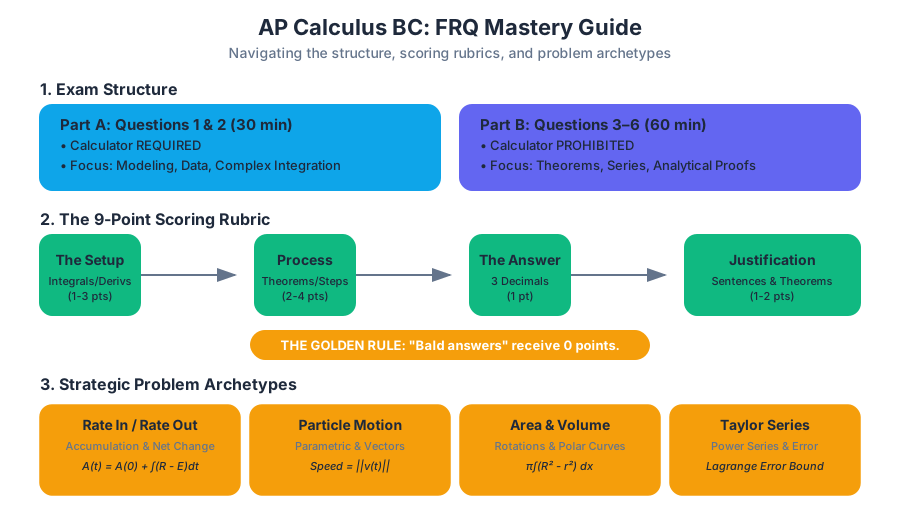
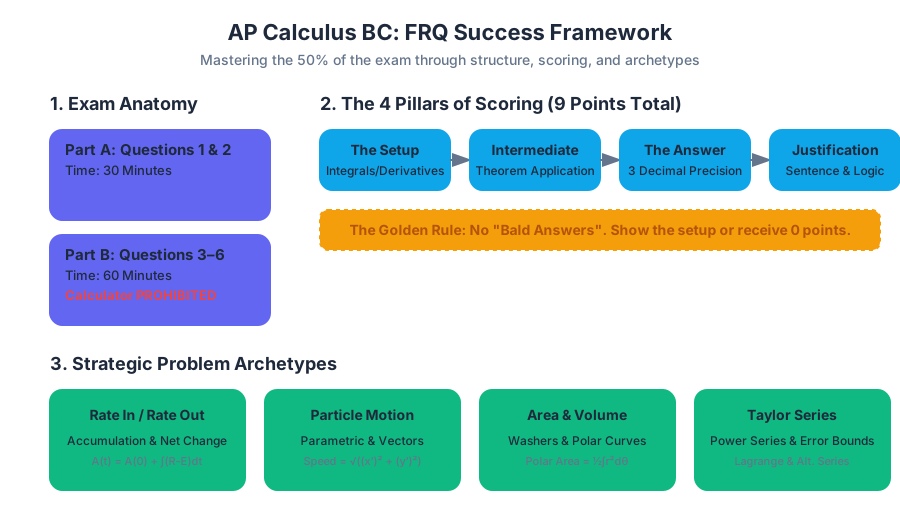
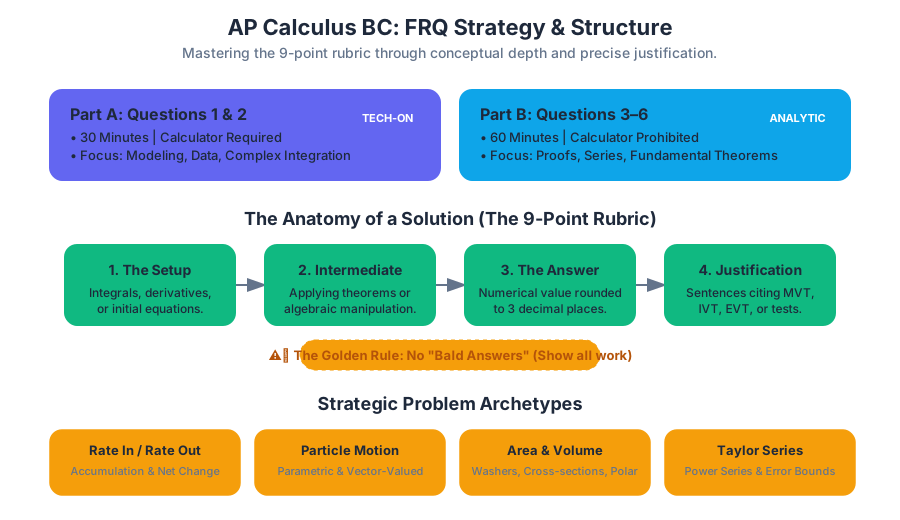
The FRQ section is divided into two distinct parts, structured to test both the student's ability to leverage technology and their fundamental analytical skills.
| Part | Questions | Time | Calculator Usage | Focus |
|---|---|---|---|---|
| Part A | 1 & 2 | 30 Minutes | Required | Modeling, complex integration, data analysis, and intersection of curves. |
| Part B | 3, 4, 5, & 6 | 60 Minutes | Prohibited | Theoretical proofs, slope fields, Taylor series, and fundamental theorems. |
The "Golden Rule" of FRQs: A "bald answer" (an answer with no supporting work) will almost always receive 0 points, even if numerically correct. The AP graders (Readers) are looking for the "setup"—the definite integral, the derivative expression, or the initial equation—that leads to the result.
Scoring Rubrics and the "Art of Justification"
Each FRQ is worth 9 points, regardless of difficulty. These points are distributed based on a specific rubric developed by the College Board. Understanding the rubric is as important as understanding the calculus itself.
Point Distribution Heuristics
Points are typically awarded for:
- The Setup: Writing the correct integral or derivative expression (e.g., $\int_{0}^{5} v(t) dt$).
- The Intermediate Step: Showing the application of a theorem (e.g., identifying that $f'(x)$ changes from positive to negative).
- The Answer: The final numerical value, usually rounded to three decimal places.
- The Justification: A sentence explaining why a conclusion was reached, often citing a specific theorem (MVT, IVT, EVT, or the Second Derivative Test).
Common Justification Requirements
| Scenario | Required Justification Language | Key Theorem/Test |
|---|---|---|
| Relative Extrema | "$f'(x)$ changes from positive to negative at $x=c$." | First Derivative Test |
| Absolute Extrema | "Check candidates (critical points) and endpoints in a table of values." | Extreme Value Theorem (EVT) |
| Existence of a Value | "Since $f(x)$ is continuous and $k$ is between $f(a)$ and $f(b)$..." | Intermediate Value Theorem (IVT) |
| Existence of a Slope | "Since $f(x)$ is differentiable on $(a, b)$ and continuous on $[a, b]$..." | Mean Value Theorem (MVT) |
| Convergence of Series | "The terms are positive, decreasing, and $\lim_{n \to \infty} a_n = 0$." | Alternating Series Test |
Strategic Problem-Solving Archetypes
The AP Calculus BC exam tends to cycle through several "Type" problems. Mastering these archetypes allows students to recognize the required "playbook" as soon as they read the prompt.
1. Rate In / Rate Out (Accumulation)
These problems involve a function $R(t)$ representing the rate at which something enters a system and $E(t)$ representing the rate at which it leaves.
- The Total Amount: $A(t) = A(0) + \int_{0}^{t} (R(s) - E(s)) ds$.
- Optimization: To find the maximum amount, find where $A'(t) = R(t) - E(t) = 0$.
2. Particle Motion (Parametric and Vector-Valued)
In Calculus BC, motion is often two-dimensional.
- Position: $x(t), y(t)$ or $\vec{r}(t) = \langle x(t), y(t) \rangle$.
- Velocity: $\vec{v}(t) = \langle x'(t), y'(t) \rangle$.
- Speed: $|\vec{v}(t)| = \sqrt{(x'(t))^2 + (y'(t))^2}$.
- Total Distance Traveled: $\int_{a}^{b} \sqrt{(x'(t))^2 + (y'(t))^2} dt$.
3. Area and Volume
These problems require finding the area between curves or the volume of a solid of revolution/cross-section.
- Area: $\int_{a}^{b} (\text{top} - \text{bottom}) dx$ or $\int_{c}^{d} (\text{right} - \text{left}) dy$.
- Volume (Washers): $\pi \int_{a}^{b} (R_{outer}^2 - R_{inner}^2) dx$.
- Polar Area: $\frac{1}{2} \int_{\alpha}^{\beta} [r(\theta)]^2 d\theta$.
4. Taylor and Maclaurin Series
The "Question 6" of the BC exam is almost always a power series problem.
- General Form: $P_n(x) = \sum_{n=0}^{\infty} \frac{f^{(n)}(c)}{n!}(x-c)^n$.
- Error Bounds: Using the Alternating Series Error Bound or the Lagrange Error Bound: $E_n(x) \leq \frac{\max|f^{(n+1)}(z)|}{(n+1)!}|x-c|^{n+1}$.
Numerical and Algorithmic Perspectives
For instance, the Trapezoidal Rule, a frequent FRQ requirement for estimating integrals from a table, is a simple linear interpolation algorithm.
Trapezoidal Rule
If given a set of points $(x, y)$, the area is the sum of the areas of trapezoids formed between each pair of points.
Mathematical Representation: Euler's Method
Euler's Method is the BC-specific numerical approach for approximating solutions to differential equations. It is essentially a sequence of tangent line approximations.
\begin{aligned}
&\text{Given } \frac{dy}{dx} = f(x, y) \text{ and initial point } (x_0, y_0): \\
&x_{n+1} = x_n + \Delta x \\
&y_{n+1} = y_n + f(x_n, y_n) \cdot \Delta x \\
\\
&\text{Algorithm Step-by-Step:} \\
&\text{1. Identify } \Delta x \text{ (step size).} \\
&\text{2. Calculate slope } m = f(x_n, y_n). \\
&\text{3. Update } y \text{ using } \Delta y = m \cdot \Delta x. \\
&\text{4. Repeat for } k \text{ steps.}
\end{aligned}
Past Exam Analysis (2008–2017)
Analyzing a decade of exams reveals consistent patterns in how the College Board tests BC-specific topics.
The "BC-Only" FRQ Topics
While AB and BC share about 60-70% of content, the BC exam consistently dedicates at least two full FRQs to:
- Series: Usually involving a Maclaurin series for a transcendental function, finding the interval of convergence, and using the error bound.
- Parametric/Polar/Vector: Often involving a particle moving in the $xy$-plane or the area inside a polar curve like a limaçon or rose curve.
| Year | Question Type | Focus | Difficulty Note |
|---|---|---|---|
| 2008 | Polar Curves | Area of $r = \theta + \sin(2\theta)$ | Required careful integration by parts. |
| 2011 | Taylor Series | $f(x) = \sin(x^2) + \cos(x)$ | Tested manipulation of known series. |
| 2015 | Differential Eq | $\frac{dy}{dx} = (y-1)^2 \cos(\pi x)$ | Separation of variables with a tricky trig integral. |
| 2017 | Parametric | $\langle x'(t), y'(t) \rangle$ | Focus on position at time $t$ using the Fundamental Theorem. |
Common Pitfalls and How to Avoid Them
Even the strongest students lose points on FRQs due to "unforced errors."
- Radian Mode: The AP exam always uses radians. A calculator in degree mode will produce incorrect answers for every trigonometric sub-part.
- Intermediate Rounding: Never round intermediate steps. Store values in your calculator variables ($A, B, C...$) and only round the final answer to three decimal places.
- The $+C$ Oblivion: In differential equation problems (Separation of Variables), forgetting the constant of integration $+C$ immediately caps your score at usually 2 or 3 out of 9 points. You cannot recover from this error.
- Units of Measure: If a question asks for "the rate of change of the temperature," and the temperature is in Celsius and time is in minutes, the units must be $^\circ C/\text{min}$. If the question asks for the "average temperature," the units are just $^\circ C$.
- Equality Abuse: Do not use the equals sign ($=$) to connect unrelated steps. Use arrows ($\to$) or start new lines. If you write $5+5 = 10 + 2 = 12$, you have written a mathematically false statement ($10=12$), and Readers may penalize "linked expressions."
Advanced Technique: The Fundamental Theorem of Calculus (FTC) in FRQs
The most common application of FTC in FRQs is the "Accumulation Function": $$g(x) = \int_{a}^{x} f(t) dt$$ Students are often given a graph of $f(t)$ and asked questions about $g(x)$.
- $g'(x) = f(x)$: The graph of $f$ is the derivative of $g$.
- $g''(x) = f'(x)$: The slope of the graph of $f$ is the second derivative of $g$.
- Critical Points of $g$: Occur where $f(x) = 0$.
- Inflection Points of $g$: Occur where $f(x)$ has a relative maximum or minimum.
Final Checklist for FRQ Success
Before the exam, ensure you can perform these "Big Four" calculator operations fluently:
- Graph a function in an arbitrary window.
- Find the zeros of a function (intersection with the x-axis).
- Calculate the derivative at a specific point (numerical derivative).
- Calculate the definite integral (numerical integration).
Expert Insight: When asked to find the "Average Value" of a function, use $\frac{1}{b-a} \int_{a}^{b} f(x) dx$. When asked for the "Average Rate of Change," use $\frac{f(b)-f(a)}{b-a}$. Confusing these two is one of the most frequent errors on the exam.
- Term: Lagrange Error Bound Definition: A formula used to find the maximum possible error when using a Taylor polynomial to approximate a function.
- Term: Euler's Method Definition: A numerical procedure for solving ordinary differential equations with a given initial value.
- Term: Interval of Convergence Definition: The set of all real numbers $x$ for which a power series converges.
- Term: Separation of Variables Definition: A method for solving differential equations where all terms involving $y$ are moved to one side and all terms involving $x$ to the other.
- Term: Riemann Sum Definition: A certain kind of approximation of an integral by a finite sum, using rectangles or trapezoids.
- Term: Speed (Vector) Definition: The magnitude of the velocity vector: $\sqrt{(x')^2 + (y')^2}$.
-
Scenario: You are given a table of velocity values $v(t)$ at various times $t$. The question asks for the "total distance" traveled from $t=0$ to $t=10$.
- Question: Which mathematical expression should you set up, and what numerical method is most likely required?
- Answer: $\int_{0}^{10} |v(t)| dt$; Trapezoidal or Riemann sum.
-
Scenario: A series $\sum a_n$ is given where $a_n = \frac{(-1)^n}{n}$.
- Question: Does the series converge absolutely, converge conditionally, or diverge? Justify.
- Answer: Converges conditionally. It converges by the Alternating Series Test, but the absolute value version $\sum \frac{1}{n}$ is the divergent harmonic series.
-
Scenario: You need to find the absolute maximum of $f(x)$ on the closed interval $[1, 5]$.
- Question: According to the Extreme Value Theorem, what specific points must you check?
- Answer: The endpoints ($x=1, x=5$) and any critical points where $f'(x)=0$ or is undefined within the interval $(1, 5)$.
-
Scenario: A polar curve is defined by $r = 3 - 2\cos\theta$.
- Question: What is the integral setup for the area of the region enclosed by this curve?
- Answer: $\frac{1}{2} \int_{0}^{2\pi} (3 - 2\cos\theta)^2 d\theta$.
AP Calculus BC FRQ Mastery Guide
1. The 15-Minute Rule You have an average of 15 minutes per question. If you are stuck on a justification, move to the next computational part. Parts (a), (b), and (c) are often independent.
2. Notation Rigor
- Never write $f(x) = \int f(x)$.
- Always include $dx$ or $dt$ in your integrals.
- Use "$\approx$" for approximations and "$=$" for exact setups.
- If you define a function in your work (e.g., "Let $R(t) = \dots$"), you can use the label $R(t)$ thereafter to save time.
3. Calculator Efficiency
- Store the functions given in the prompt into
Y1andY2immediately. - Use the
nDerivandfnInt(or equivalent) functions rather than trying to integrate complex functions by hand in Part A.
4. The "BC" Differentiators
- Integration by Parts: Remember $uv - \int v du$.
- Partial Fractions: Only required for linear non-repeating factors in the AP curriculum.
- Logistic Growth: Know the form $\frac{dP}{dt} = kP(1 - \frac{P}{L})$, where $L$ is the carrying capacity. The maximum growth rate occurs at $P = L/2$.
- Arc Length: $\int_{a}^{b} \sqrt{1 + [f'(x)]^2} dx$.
5. Final Review Strategy
- Review the 2012-2023 scoring guidelines specifically to see how "Justification Points" are awarded.
- Practice "Question 6" (Series) from at least five different years; it is the most predictable yet most failed question on the exam.
Source Materials
Study AP/College Calculus BC on Lykke
This course page is free to open: signed out, you can read its first two sections, and signing in, on any plan, opens the rest. The free Lykke Chrome extension syncs your own Canvas courses, so ChatGPT, Claude and Muse can answer from your classes and deadlines. It only reads Canvas.
Add the free extensionSign in to open every sectionAll sections of AP/College Calculus BC · Browse more course pages