From the free course AP/College Calculus BC on Lykke
Advanced Differentiation Techniques
Key concepts: Chain Rule · Implicit Differentiation · Inverse Functions · Higher-Order Derivatives
Techniques for differentiating complex functions, including composite and implicit equations.
Advanced Differentiation Techniques
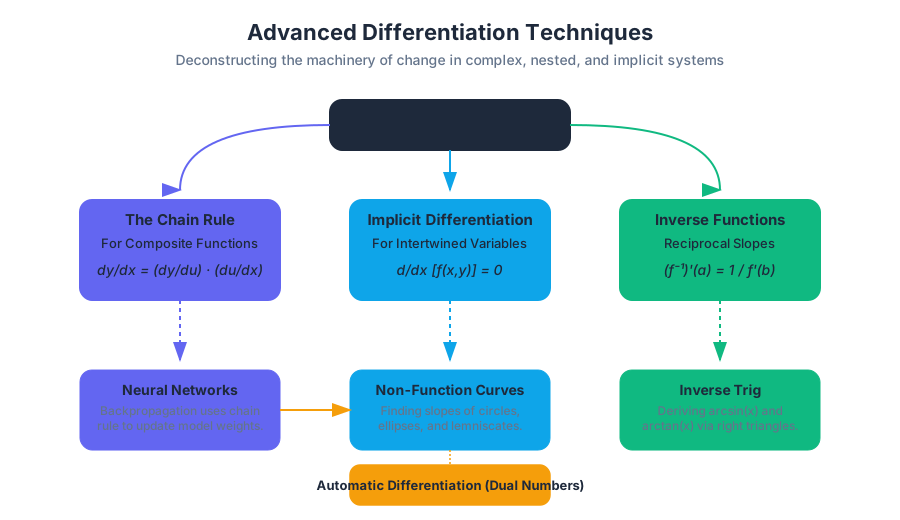
The transition from basic differentiation—applying the power, product, and quotient rules—to advanced techniques marks a pivotal shift in a mathematician's journey. We move from differentiating simple, explicit functions to deconstructing the "machinery of change" in complex systems. This section explores the tools required to handle nested dependencies, non-explicit relations, and the deep layers of change represented by higher-order derivatives.
The Chain Rule: The Engine of Composition
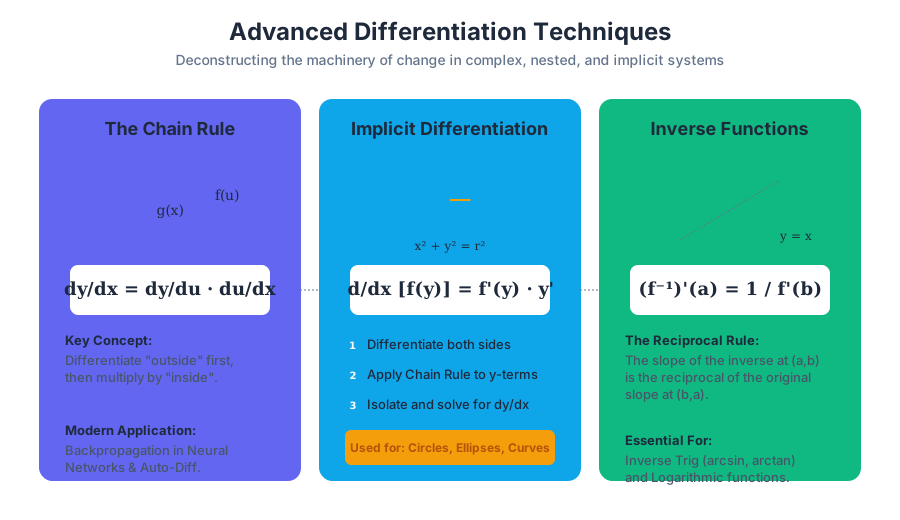
The Chain Rule is arguably the most important rule in all of calculus. It allows us to differentiate composite functions, which are functions where the output of one function becomes the input of another. In the modern era, the Chain Rule is the mathematical backbone of "backpropagation" in neural networks, allowing us to calculate how a change in a single weight affects the total error of a complex model.
Definition and Mechanics
If a variable $y$ depends on $u$, and $u$ in turn depends on $x$, then $y$ depends on $x$ through the intermediate variable $u$. Mathematically, if $y = f(g(x))$, the derivative of $y$ with respect to $x$ is:
$$\frac{dy}{dx} = \frac{dy}{du} \cdot \frac{du}{dx}$$
In Lagrange's notation, this is expressed as: $$(f \circ g)'(x) = f'(g(x)) \cdot g'(x)$$
The "Inside-Outside" Insight: To apply the Chain Rule effectively, always differentiate the "outside" function first (keeping the "inside" function untouched), then multiply by the derivative of the "inside" function.
Notation Comparison
| Notation Type | Expression | Best Use Case |
|---|---|---|
| Leibniz | $\frac{dy}{dx} = \frac{dy}{du} \cdot \frac{du}{dx}$ | Physics, dimensional analysis, and related rates. |
| Lagrange | $f'(g(x)) \cdot g'(x)$ | Theoretical proofs and functional analysis. |
| Operator | $D_x[f(g(x))]$ | Computational logic and symbolic manipulation. |
Implementation in Computational Logic
In modern software engineering, specifically in Machine Learning frameworks like PyTorch or JAX, the Chain Rule is implemented via Automatic Differentiation. Below is a low-level conceptualization of how a "Dual Number" system tracks derivatives using the Chain Rule.
Implicit Differentiation: Handling Hidden Relations
Most introductory calculus problems involve explicit functions, where $y$ is isolated on one side (e.g., $y = x^2 + 1$). However, many mathematical and physical relationships are implicit—the variables are intertwined in a way that is difficult or impossible to solve for $y$ (e.g., $x^2 + y^2 = 25$ or $e^y + \sin(y) = x$).
The Methodology
Implicit differentiation treats $y$ as an implicit function of $x$. When we differentiate a term containing $y$ with respect to $x$, we must apply the Chain Rule, resulting in a $\frac{dy}{dx}$ term.
- Differentiate both sides of the equation with respect to $x$.
- Apply the Chain Rule to every term involving $y$ (multiply by $y'$).
- Collect all terms containing $\frac{dy}{dx}$ on one side.
- Factor out $\frac{dy}{dx}$ and solve.
Comparison: Explicit vs. Implicit
| Feature | Explicit ($y = f(x)$) | Implicit ($F(x, y) = 0$) |
|---|---|---|
| Structure | $y$ is isolated. | $y$ is embedded. |
| Derivation | Direct application of rules. | Requires Chain Rule for $y$ terms. |
| Geometry | Usually represents a single function. | Can represent circles, ellipses, or self-intersecting curves. |
| Difficulty | Generally lower. | Higher; requires algebraic isolation of $y'$. |
Mathematical Derivation of a Circle
Consider the unit circle $x^2 + y^2 = 1$. To find the slope of the tangent line at any point $(x, y)$:
\begin{aligned}
\frac{d}{dx}[x^2 + y^2] &= \frac{d}{dx}[1] \\
2x + 2y \cdot \frac{dy}{dx} &= 0 \\
2y \cdot \frac{dy}{dx} &= -2x \\
\frac{dy}{dx} &= -\frac{x}{y}
\end{aligned}
Derivatives of Inverse Functions
The relationship between a function $f$ and its inverse $f^{-1}$ is a reflection across the line $y=x$. This geometric symmetry implies a specific relationship between their derivatives.
The Inverse Function Theorem
If $f$ is a differentiable function that is one-to-one on an interval, and $f'(f^{-1}(a)) \neq 0$, then the derivative of the inverse function at $a$ is:
$$(f^{-1})'(a) = \frac{1}{f'(f^{-1}(a))}$$
Key Insight: The slope of the inverse function at point $(a, b)$ is the reciprocal of the slope of the original function at point $(b, a)$.
Inverse Trigonometric Functions
Inverse trigonometric functions (like $\arcsin(x)$ or $\arctan(x)$) are essential in integration and physics. Their derivatives are derived using implicit differentiation and right-triangle trigonometry.
Example: Deriving $\frac{d}{dx} \arcsin(x)$
- Let $y = \arcsin(x)$, which implies $\sin(y) = x$.
- Differentiate implicitly: $\cos(y) \cdot \frac{dy}{dx} = 1$.
- Solve for $\frac{dy}{dx} = \frac{1}{\cos(y)}$.
- Use the identity $\cos(y) = \sqrt{1 - \sin^2(y)}$. Since $\sin(y) = x$, then $\cos(y) = \sqrt{1 - x^2}$.
- Result: $\frac{d}{dx} \arcsin(x) = \frac{1}{\sqrt{1 - x^2}}$.
Common Inverse Trig Derivatives
| Function | Derivative | Domain Restriction |
|---|---|---|
| $\arcsin(u)$ | $\frac{u'}{\sqrt{1-u^2}}$ | $\vert u\vert < 1$ |
| $\arccos(u)$ | $-\frac{u'}{\sqrt{1-u^2}}$ | $\vert u\vert < 1$ |
| $\arctan(u)$ | $\frac{u'}{1+u^2}$ | All real $u$ |
| $\text{arcsec}(u)$ | $\frac{u'}{\vert u\vert \sqrt{u^2-1}}$ | $\vert u\vert > 1$ |
Higher-Order Derivatives
A derivative is itself a function, meaning it can be differentiated again. These subsequent derivatives provide deeper insights into the behavior of the original function.
Definitions and Notation
- First Derivative ($f'$ or $\frac{dy}{dx}$): The rate of change (velocity).
- Second Derivative ($f''$ or $\frac{d^2y}{dx^2}$): The rate of change of the rate of change (acceleration/concavity).
- Third Derivative ($f'''$ or $\frac{d^3y}{dx^3}$): Often called "jerk" in physics.
- $n$-th Derivative ($f^{(n)}$): Generalization for any order.
Physical Interpretations
| Order | Name | Physical Meaning |
|---|---|---|
| $s(t)$ | Position | Displacement from origin. |
| $v(t) = s'(t)$ | Velocity | Speed and direction. |
| $a(t) = v'(t) = s''(t)$ | Acceleration | Change in velocity. |
| $j(t) = a'(t) = s'''(t)$ | Jerk | Suddenness of acceleration change. |
Numerical Computation of Higher-Order Derivatives
In systems programming or numerical analysis, we often approximate higher-order derivatives using finite difference methods. This is common in simulations where an analytical derivative is unavailable.
Common Pitfalls and Edge Cases
- Forgetting the Chain Rule in Implicit Differentiation: A common error is differentiating $y^2$ as $2y$ instead of $2y \cdot y'$. Remember that $y$ is a function of $x$.
- Power Rule vs. Chain Rule: Students often misapply the power rule to composite functions, e.g., $\frac{d}{dx} (x^2+1)^3 = 3(x^2+1)^2$ (forgetting to multiply by $2x$).
- Inverse Trig Signs: Confusing the signs of $\arcsin(x)$ and $\arccos(x)$ derivatives. Note that "co-" functions usually have negative derivatives.
- Notation Confusion: $\frac{d^2y}{dx^2}$ is not $(\frac{dy}{dx})^2$. The former is the second derivative; the latter is the square of the first derivative.
Using Symbolic Tools
For complex implicit functions, manual differentiation is prone to error. Engineers often use symbolic math engines to verify results.
Generalizations: The Multivariable Context
While this section focuses on single-variable calculus, these techniques generalize to multivariable calculus. The Chain Rule becomes a sum of partial derivatives, and implicit differentiation leads to the Implicit Function Theorem, which provides conditions under which an implicit equation locally defines a function. Higher-order derivatives expand into the Hessian Matrix, which is used to find local extrema in high-dimensional spaces.
Source Materials
Study AP/College Calculus BC on Lykke
This course page is free to open: signed out, you can read its first two sections, and signing in, on any plan, opens the rest. The free Lykke Chrome extension syncs your own Canvas courses, so ChatGPT, Claude and Muse can answer from your classes and deadlines. It only reads Canvas.
Add the free extensionSign in to open every sectionAll sections of AP/College Calculus BC · Browse more course pages