From the free course AP/College Calculus AB on Lykke
Integration and Accumulation of Change
Key concepts: Definite Integrals · Fundamental Theorem of Calculus · Riemann Sums · Antidifferentiation · Accumulation Functions
Introduction to integration as the accumulation of quantities and the reverse of differentiation.
Integration and Accumulation of Change
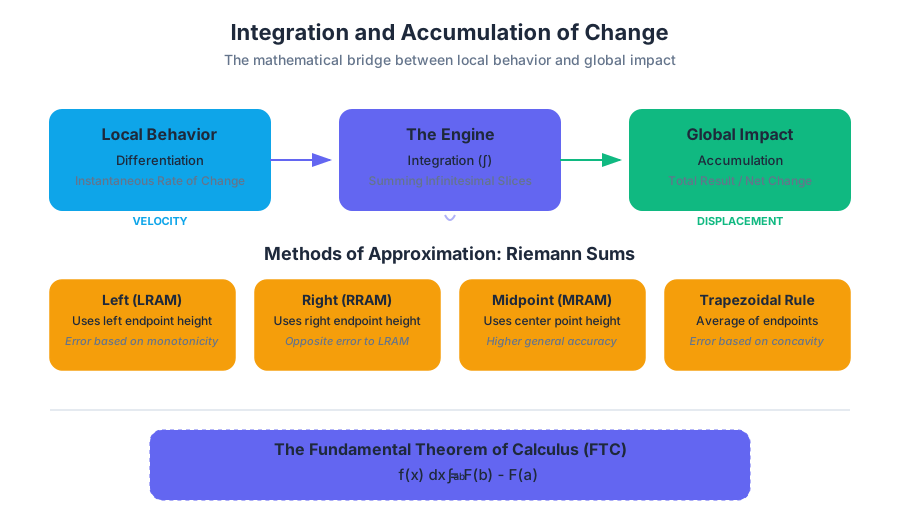
Integration is the mathematical engine of accumulation. While differentiation allows us to zoom in on a single point to find an instantaneous rate of change, integration allows us to zoom out, aggregating those infinitesimal changes to determine a total result. It is the bridge between the local behavior of a function and its global impact. In the context of physics, if the derivative takes us from position to velocity, the integral takes us from velocity back to the total displacement.
The Foundation: Riemann Sums and Approximation
Before we can define the integral formally, we must understand the process of partitioning. A Riemann Sum is a method for approximating the total area under a curve (the accumulation of a quantity) by dividing the region into several shapes (typically rectangles) whose areas are easy to calculate.
What it is
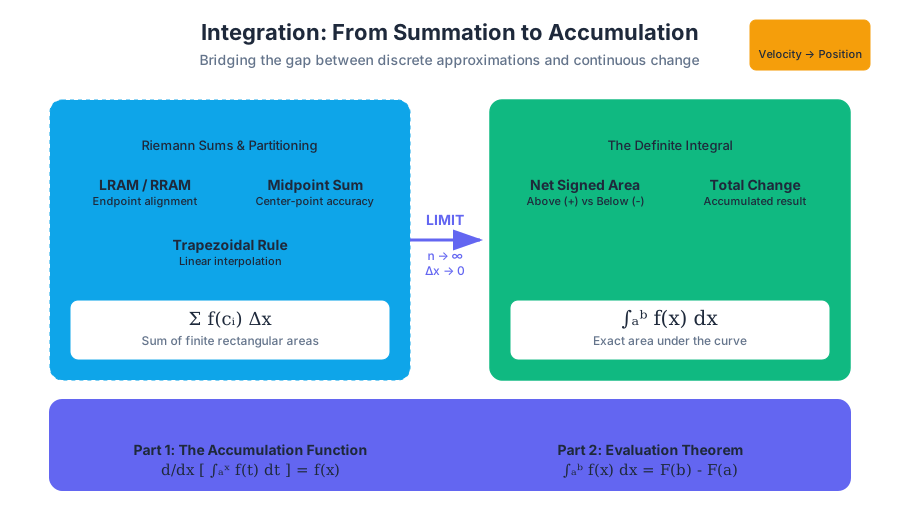
A Riemann sum approximates the definite integral $\int_a^b f(x) , dx$ by summing the areas of $n$ rectangles. The interval $[a, b]$ is divided into $n$ subintervals of width $\Delta x = \frac{b-a}{n}$. The height of each rectangle is determined by the value of the function at a specific point $c_i$ within each subinterval.
The Four Primary Summation Types
The choice of $c_i$ determines the type of Riemann sum and the nature of its error:
| Method | Selection of $c_i$ | Geometric Interpretation | Error Characteristic |
|---|---|---|---|
| Left Riemann Sum (LRAM) | $x_{i-1}$ (Left endpoint) | Rectangles align with the start of the interval. | Underestimates if $f(x)$ is increasing; Overestimates if decreasing. |
| Right Riemann Sum (RRAM) | $x_i$ (Right endpoint) | Rectangles align with the end of the interval. | Overestimates if $f(x)$ is increasing; Underestimates if decreasing. |
| Midpoint Sum (MRAM) | $\frac{x_{i-1} + x_i}{2}$ | Rectangles align with the center of the interval. | Generally more accurate than LRAM/RRAM; balances error. |
| Trapezoidal Rule | Average of endpoints | Uses trapezoids instead of rectangles. | Overestimates if $f(x)$ is concave up; Underestimates if concave down. |
The Definite Integral
The Definite Integral is the limit of the Riemann sum as the number of subintervals $n$ approaches infinity (and the width $\Delta x$ approaches zero).
Mathematical Definition
The Definite Integral: Let $f$ be a function defined on $[a, b]$. If the limit exists, the definite integral of $f$ from $a$ to $b$ is: $$\int_a^b f(x) , dx = \lim_{n \to \infty} \sum_{i=1}^n f(c_i) \Delta x$$ where $\Delta x = \frac{b-a}{n}$ and $c_i$ is any point in the $i$-th subinterval.
Why it Matters
The definite integral represents the net signed area between the function and the x-axis. Area above the axis is positive, while area below is negative. This distinction is vital in physics: the integral of velocity over time gives displacement (net change in position), whereas the integral of the absolute value of velocity gives total distance traveled.
Properties of Definite Integrals
Understanding the algebraic properties of integrals allows for the simplification of complex problems.
| Property | Notation | Description |
|---|---|---|
| Additivity | $\int_a^b f(x)dx + \int_b^c f(x)dx = \int_a^c f(x)dx$ | Integrals over adjacent intervals can be combined. |
| Linearity | $\int (kf(x) + g(x))dx = k\int f(x)dx + \int g(x)dx$ | Constants can be pulled out; integrals of sums are sums of integrals. |
| Reversal | $\int_a^b f(x)dx = -\int_b^a f(x)dx$ | Swapping bounds negates the result. |
| Zero Width | $\int_a^a f(x)dx = 0$ | No area exists over a single point. |
Antidifferentiation: Reversing the Derivative
To evaluate integrals without summing infinite rectangles, we use Antidifferentiation. An antiderivative $F(x)$ is a function such that $F'(x) = f(x)$.
The Indefinite Integral
The set of all antiderivatives of $f(x)$ is the Indefinite Integral, denoted as: $$\int f(x) , dx = F(x) + C$$ The Constant of Integration ($C$) is required because the derivative of any constant is zero; therefore, infinitely many functions share the same derivative.
Common Antidifferentiation Rules
\begin{aligned}
\text{Power Rule:} & \quad \int x^n \, dx = \frac{x^{n+1}}{n+1} + C \quad (n \neq -1) \\
\text{Exponential:} & \quad \int e^x \, dx = e^x + C \\
\text{Logarithmic:} & \quad \int \frac{1}{x} \, dx = \ln|x| + C \\
\text{Trigonometric:} & \quad \int \cos(x) \, dx = \sin(x) + C
\end{aligned}
The Fundamental Theorem of Calculus (FTC)
The Fundamental Theorem of Calculus is the "Great Unification" of mathematics. It links the concept of the derivative (slope) with the integral (area).
FTC Part 1: The Accumulation Function
The first part of the theorem states that if we define a function based on the area accumulating under another function, the rate at which that area grows is exactly the value of the original function.
FTC Part 1: If $f$ is continuous on $[a, b]$ and $g(x) = \int_a^x f(t) , dt$, then: $$g'(x) = f(x)$$
This implies that integration and differentiation are inverse processes. If you integrate a function and then differentiate the result, you return to the starting function.
FTC Part 2: The Evaluation Theorem
The second part provides a practical tool for calculating definite integrals using antiderivatives, removing the need for limits of Riemann sums.
FTC Part 2: If $f$ is continuous on $[a, b]$ and $F$ is any antiderivative of $f$, then: $$\int_a^b f(x) , dx = F(b) - F(a)$$
Derivation of FTC Part 1
To understand why the derivative of an accumulation function is the function itself, consider the definition of the derivative:
Let g(x) = ∫[a to x] f(t) dt.
By definition:
g'(x) = lim(h→0) [g(x + h) - g(x)] / h

Substitute the integral definition:
g'(x) = lim(h→0) [∫[a to x+h] f(t) dt - ∫[a to x] f(t) dt] / h

Using the property of additivity:
g'(x) = lim(h→0) [∫[x to x+h] f(t) dt] / h

By the Mean Value Theorem for Integrals, there exists a c in [x, x+h] such that:
∫[x to x+h] f(t) dt = f(c) * h

Substitute back:
g'(x) = lim(h→0) [f(c) * h] / h = lim(h→0) f(c)

As h → 0, c must approach x. Since f is continuous:
g'(x) = f(x)
Accumulation Functions in Context
Accumulation functions are not just abstract constructs; they model real-world systems where a "stock" is affected by a "flow."
- Physics (Kinematics): Position $s(x)$ is the accumulation of velocity $v(t)$. $s(x) = \int_0^x v(t) , dt + s(0)$.
- Engineering (Hydrology): The total volume of water in a reservoir is the integral of the flow rate (inflow minus outflow).
- Economics: Total cost is the accumulation of marginal cost.
Real-World Example: Energy Consumption
Suppose a sensor records the power consumption of a factory in kilowatts (kW) over 24 hours. To find the total energy used in kilowatt-hours (kWh), we must integrate the power function.
Advanced Variations: Integration by Substitution
When an integral involves a composite function, we use u-substitution, which is essentially the Chain Rule in reverse.
The Mechanics of u-Substitution
- Identify an "inner" function $u = g(x)$ whose derivative $du = g'(x)dx$ is also present in the integrand.
- Substitute $u$ and $du$ into the integral.
- Change the bounds of integration (for definite integrals) to correspond to $u$.
- Integrate with respect to $u$.
- Substitute back or evaluate.
Example: Evaluate $\int_0^2 2x e^{x^2} , dx$
- Let $u = x^2$. Then $du = 2x , dx$.
- When $x=0, u=0$. When $x=2, u=4$.
- The integral becomes $\int_0^4 e^u , du = [e^u]_0^4 = e^4 - e^0 = e^4 - 1$.
Common Pitfalls and Misconceptions
| Pitfall | Explanation | Correction |
|---|---|---|
| Forgetting $+ C$ | In indefinite integrals, the constant is required to represent the family of functions. | Always add $+ C$ unless it is a definite integral. |
| Area vs. Net Change | $\int f(x)dx$ calculates signed area. If the curve is below the x-axis, it subtracts from the total. | To find "Total Area," integrate $ |
| Improper Bounds | Using $x$-bounds after substituting for $u$. | Either substitute back to $x$ at the end or update the bounds to $u$-values immediately. |
| Discontinuities | FTC requires the function to be continuous on $[a, b]$. | If $f(x)$ has a vertical asymptote (e.g., $1/x^2$ at $x=0$), the integral is "improper" and requires limits. |
Summary of Integration Techniques
To master accumulation, one must choose the right tool for the specific mathematical structure of the problem.
| Structure | Recommended Technique |
|---|---|
| Polynomials / Simple Powers | Power Rule ($\frac{x^{n+1}}{n+1}$) |
| Composite Functions ($f(g(x))g'(x)$) | u-Substitution |
| Products of Functions ($u \cdot v'$) | Integration by Parts (Inverse of Product Rule) |
| Rational Functions | Partial Fraction Decomposition |
| Discrete Data Points | Trapezoidal Rule or Simpson's Rule |
Final Insight for the Practitioner
Integration is the mathematical embodiment of "the whole is the sum of its parts." Whether you are a civil engineer calculating the stress accumulation on a bridge, a data scientist determining the cumulative distribution function of a dataset, or a physicist modeling the path of a particle, the principles of Riemann sums and the Fundamental Theorem of Calculus provide the rigorous framework necessary to move from instantaneous observations to total, accumulated truth.
Source Materials
Study AP/College Calculus AB on Lykke
This course page is free to open: signed out, you can read its first two sections, and signing in, on any plan, opens the rest. The free Lykke Chrome extension syncs your own Canvas courses, so ChatGPT, Claude and Muse can answer from your classes and deadlines. It only reads Canvas.
Add the free extensionSign in to open every sectionAll sections of AP/College Calculus AB · Browse more course pages