From the free course AP/College Calculus AB on Lykke
Differentiation: Definition and Fundamental Rules
Key concepts: Derivative as a Limit · Instantaneous Rate of Change · Power Rule · Product and Quotient Rules · Trigonometric and Exponential Derivatives
Defining the derivative as a rate of change and mastering basic rules for calculation.
Differentiation: Definition and Fundamental Rules
Differentiation is the mathematical process of determining the derivative of a function, a concept that serves as the cornerstone of modern calculus. While algebra allows us to calculate the average rate of change over a discrete interval, differentiation provides the tools to calculate the instantaneous rate of change at a single, infinitesimal point. This transition from the static to the dynamic is what enabled the scientific revolution, providing the language necessary to describe motion, electromagnetism, and the optimization of complex systems.
The Derivative as a Limit
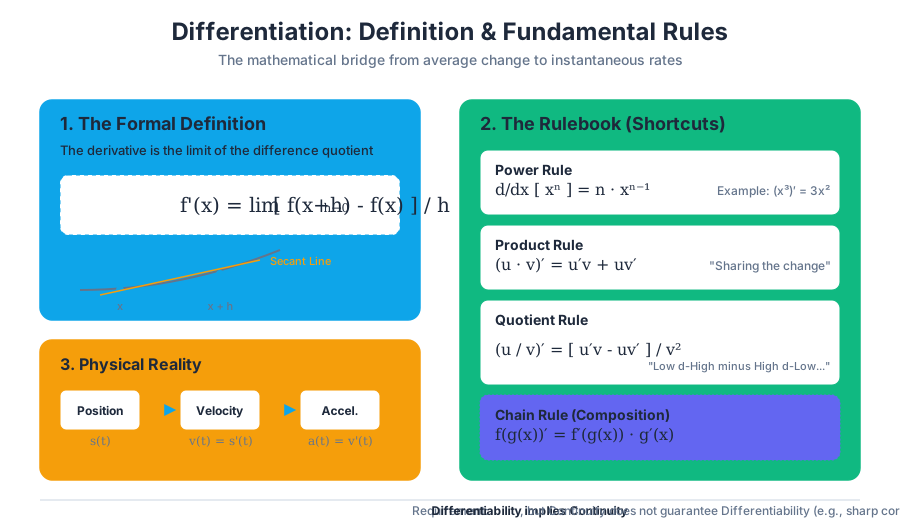
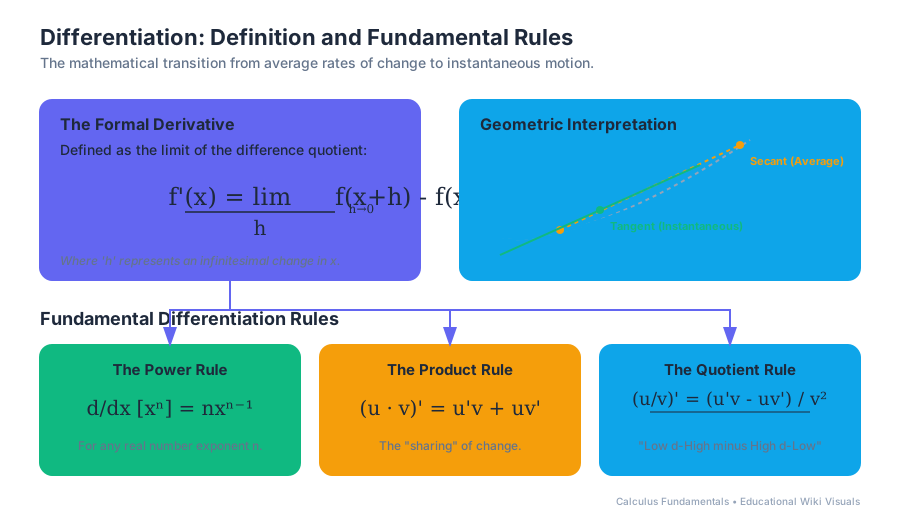
At its most fundamental level, the derivative is defined as the limit of the difference quotient. To understand this, imagine a curve defined by $f(x)$. If we pick two points on this curve, $(x, f(x))$ and $(x+h, f(x+h))$, the slope of the secant line connecting them is given by the ratio of the change in $y$ to the change in $x$.
Definition: The Formal Derivative The derivative of a function $f(x)$ with respect to $x$, denoted as $f'(x)$ or $\frac{dy}{dx}$, is defined as: $$f'(x) = \lim_{h \to 0} \frac{f(x+h) - f(x)}{h}$$ provided the limit exists.
Why the Limit Matters
The "problem" of the tangent line is that a single point does not have a slope; slope requires two points ($\frac{\Delta y}{\Delta x}$). By introducing the variable $h$ (the distance between two points) and shrinking it toward zero, we observe the behavior of the secant line as it converges into the tangent line. This limit allows us to capture the "slope" of the curve at a point where $\Delta x$ is effectively zero, yet the ratio remains finite and defined.
Numerical Implementation
In computational science, we often approximate this limit using a very small $h$. This is known as the Finite Difference Method.
Instantaneous Rate of Change
The derivative is not merely a geometric construct; it is a physical reality. In physics, if $s(t)$ represents the position of an object over time $t$, the derivative $s'(t)$ represents its instantaneous velocity. The second derivative $s''(t)$ represents acceleration.
Comparison of Rates
| Feature | Average Rate of Change | Instantaneous Rate of Change |
|---|---|---|
| Geometry | Slope of the Secant Line | Slope of the Tangent Line |
| Interval | Over a finite interval $[a, b]$ | At a specific point $x = a$ |
| Formula | $\frac{f(b) - f(a)}{b - a}$ | $\lim_{h \to 0} \frac{f(a+h) - f(a)}{h}$ |
| Example | Average speed of a car over an hour | Speedometer reading at a specific second |
Differentiability and Continuity
A common misconception is that all continuous functions are differentiable. While differentiability implies continuity, the reverse is not true. For a derivative to exist at a point $x=c$, the limit from the left must equal the limit from the right: $$\lim_{h \to 0^-} \frac{f(c+h) - f(c)}{h} = \lim_{h \to 0^+} \frac{f(c+h) - f(c)}{h}$$
Failure of Differentiability
There are three primary cases where a function is continuous but not differentiable:
- Corners/Cusps: Where the slope changes abruptly (e.g., $f(x) = |x|$ at $x=0$).
- Vertical Tangents: Where the slope approaches infinity (e.g., $f(x) = \sqrt[3]{x}$ at $x=0$).
- Discontinuities: Any point where the function is not continuous (holes, jumps, or asymptotes).
The Power Rule
Calculating derivatives using the limit definition is algebraically taxing. The Power Rule is the first major shortcut discovered through the binomial expansion of the difference quotient.
The Power Rule For any real number $n$: $$\frac{d}{dx}[x^n] = nx^{n-1}$$
Derivation Sketch
For $f(x) = x^n$, the difference quotient involves $(x+h)^n$. Expanding this using the Binomial Theorem: $$(x+h)^n = x^n + nx^{n-1}h + \frac{n(n-1)}{2}x^{n-2}h^2 + \dots$$ When we subtract $f(x) = x^n$ and divide by $h$, all terms except the first ($nx^{n-1}$) still contain at least one factor of $h$. As $h \to 0$, those terms vanish, leaving only $nx^{n-1}$.
Power Rule Applications
| Function $f(x)$ | Rewritten Form | Derivative $f'(x)$ |
|---|---|---|
| $x^5$ | $x^5$ | $5x^4$ |
| $1/x^2$ | $x^{-2}$ | $-2x^{-3}$ or $-2/x^3$ |
| $\sqrt{x}$ | $x^{1/2}$ | $\frac{1}{2}x^{-1/2}$ or $\frac{1}{2\sqrt{x}}$ |
| $7$ | $7x^0$ | $0$ |
\begin{aligned}
&\text{Example: Differentiate } f(x) = 4x^3 - \frac{2}{x} + 5 \\
&f(x) = 4x^3 - 2x^{-1} + 5 \\
&f'(x) = \frac{d}{dx}[4x^3] - \frac{d}{dx}[2x^{-1}] + \frac{d}{dx}[5] \\
&f'(x) = (4 \cdot 3)x^{3-1} - (2 \cdot -1)x^{-1-1} + 0 \\
&f'(x) = 12x^2 + 2x^{-2} = 12x^2 + \frac{2}{x^2}
\end{aligned}
The Product and Quotient Rules
When functions are multiplied or divided, the derivative is not simply the product or quotient of their individual derivatives. This is a frequent source of error for beginners.
The Product Rule
If $u$ and $v$ are differentiable functions of $x$: $$\frac{d}{dx}[u \cdot v] = u'v + uv'$$ Insight: Think of this as the "sharing" of change. The total change is the rate of change of the first times the second, plus the first times the rate of change of the second.
The Quotient Rule
If $u$ and $v$ are differentiable functions of $x$: $$\frac{d}{dx}\left[\frac{u}{v}\right] = \frac{u'v - uv'}{v^2}$$ Mnemonic: "Low d-High minus High d-Low, over the square of what's below."
Comparison of Rules
| Rule | Formula | When to Use |
|---|---|---|
| Product | $(uv)' = u'v + uv'$ | When $f(x)$ is a product of two variable expressions. |
| Quotient | $(u/v)' = \frac{u'v - uv'}{v^2}$ | When $f(x)$ is a fraction with variables in the denominator. |
Transcendental Functions
Transcendental functions—those that "transcend" algebra—have unique derivative properties. The most notable is the natural exponential function $e^x$.
Exponential and Logarithmic Derivatives
The function $f(x) = e^x$ is the only non-zero function that is its own derivative. This makes it the fundamental solution to growth-rate problems.
- $\frac{d}{dx}[e^x] = e^x$
- $\frac{d}{dx}[\ln(x)] = \frac{1}{x}$
- $\frac{d}{dx}[a^x] = a^x \ln(a)$
Trigonometric Derivatives
Trigonometric derivatives are periodic and cyclic. The derivative of sine is cosine, while the derivative of cosine is negative sine.
| Function | Derivative |
|---|---|
| $\sin(x)$ | $\cos(x)$ |
| $\cos(x)$ | $-\sin(x)$ |
| $\tan(x)$ | $\sec^2(x)$ |
| $\cot(x)$ | $-\csc^2(x)$ |
| $\sec(x)$ | $\sec(x)\tan(x)$ |
| $\csc(x)$ | $-\csc(x)\cot(x)$ |
Worked Example: Combining the Rules
Let us find the derivative of the complex function: $$y = \frac{x^2 e^x}{\sin(x)}$$
Step 1: Identify the structure. This is a quotient where the numerator is a product. Let $u = x^2 e^x$ and $v = \sin(x)$.
Step 2: Differentiate the numerator ($u$) using the Product Rule. $u = (x^2)(e^x)$ $u' = (2x)(e^x) + (x^2)(e^x) = e^x(2x + x^2)$
Step 3: Differentiate the denominator ($v$). $v = \sin(x)$ $v' = \cos(x)$
Step 4: Apply the Quotient Rule. $$y' = \frac{u'v - uv'}{v^2}$$ $$y' = \frac{[e^x(2x + x^2)]\sin(x) - [x^2 e^x]\cos(x)}{(\sin(x))^2}$$
Step 5: Simplify. $$y' = \frac{x e^x [(2+x)\sin(x) - x\cos(x)]}{\sin^2(x)}$$
Common Pitfalls and Edge Cases
- The Constant Rule Confusion: Beginners often try to apply the Power Rule to constants. Remember: $\frac{d}{dx}[5] = 0$, not $5x^{-1}$. A constant has no rate of change.
- The "Linearity" Trap: Thinking $\frac{d}{dx}[f(x)g(x)] = f'(x)g'(x)$. This is the most common error in calculus. Always use the Product Rule.
- Negative Exponents: When differentiating $x^{-3}$, the result is $-3x^{-4}$. Note that $-4$ is less than $-3$. Students often incorrectly write $-3x^{-2}$.
- The $e^x$ vs. $x^e$ Distinction:
- $\frac{d}{dx}[e^x] = e^x$ (Exponential Rule)
- $\frac{d}{dx}[x^e] = ex^{e-1}$ (Power Rule)
- Chain Rule Neglect: While not the focus of this section, many functions require the Chain Rule (e.g., $\sin(2x)$). Differentiating $\sin(2x)$ as $\cos(2x)$ is a common mistake; the correct answer is $2\cos(2x)$.
Summary of Rules for Quick Reference
| Rule Name | Mathematical Notation |
|---|---|
| Constant | $\frac{d}{dx}[c] = 0$ |
| Constant Multiple | $\frac{d}{dx}[cf(x)] = cf'(x)$ |
| Sum/Difference | $\frac{d}{dx}[f \pm g] = f' \pm g'$ |
| Power Rule | $\frac{d}{dx}[x^n] = nx^{n-1}$ |
| Product Rule | $\frac{d}{dx}[uv] = u'v + uv'$ |
| Quotient Rule | $\frac{d}{dx}[u/v] = \frac{u'v - uv'}{v^2}$ |
| Exponential | $\frac{d}{dx}[e^x] = e^x$ |
| Natural Log | $\frac{d}{dx}[\ln x] = 1/x$ |
| Sine | $\frac{d}{dx}[\sin x] = \cos x$ |
| Cosine | $\frac{d}{dx}[\cos x] = -\sin x$ |
Source Materials
Study AP/College Calculus AB on Lykke
This course page is free to open: signed out, you can read its first two sections, and signing in, on any plan, opens the rest. The free Lykke Chrome extension syncs your own Canvas courses, so ChatGPT, Claude and Muse can answer from your classes and deadlines. It only reads Canvas.
Add the free extensionSign in to open every sectionAll sections of AP/College Calculus AB · Browse more course pages