From the free course AP/College Calculus AB on Lykke
Course Challenge and Mastery
Key concepts: Mastery Points · Comprehensive Skill Assessment · Problem Solving Speed
A final assessment to test mastery of all AP Calculus AB units.
Course Challenge and Mastery
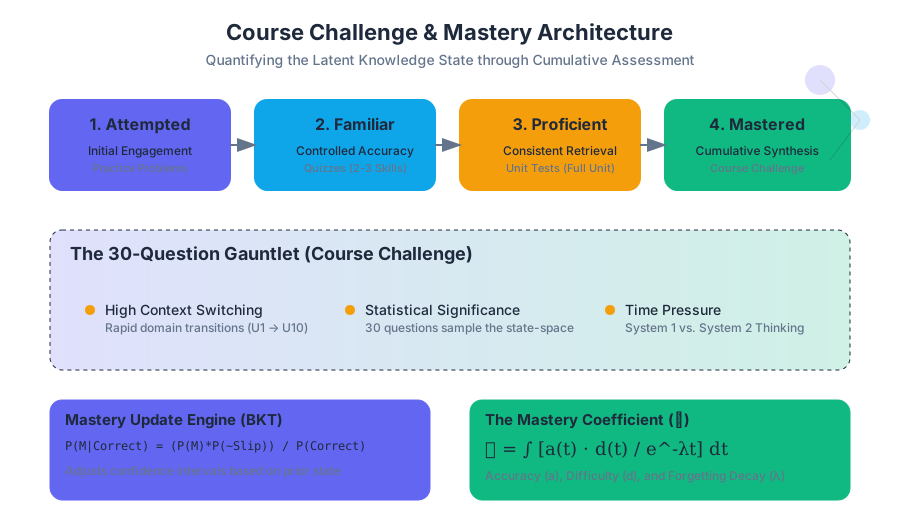
The Course Challenge represents the terminal phase of the pedagogical lifecycle in the AP Calculus AB curriculum. It is a high-fidelity, cumulative assessment designed to measure a learner's Latent Knowledge State across the entire spectrum of calculus—from the foundational epsilon-delta intuition of limits to the complex geometric rotations of solid volumes. Unlike modular unit tests, the Course Challenge serves as a "stress test" for cognitive retrieval, forcing the brain to switch contexts rapidly between disparate mathematical domains.
The Architecture of Mastery
In a modern digital learning environment, Mastery is not a binary state of "pass" or "fail." Instead, it is a quantified metric of proficiency, often represented by Mastery Points. These points act as a proxy for a student's probability of correctly solving a problem within a specific skill node under varying conditions.
Mastery Points and the Knowledge Graph
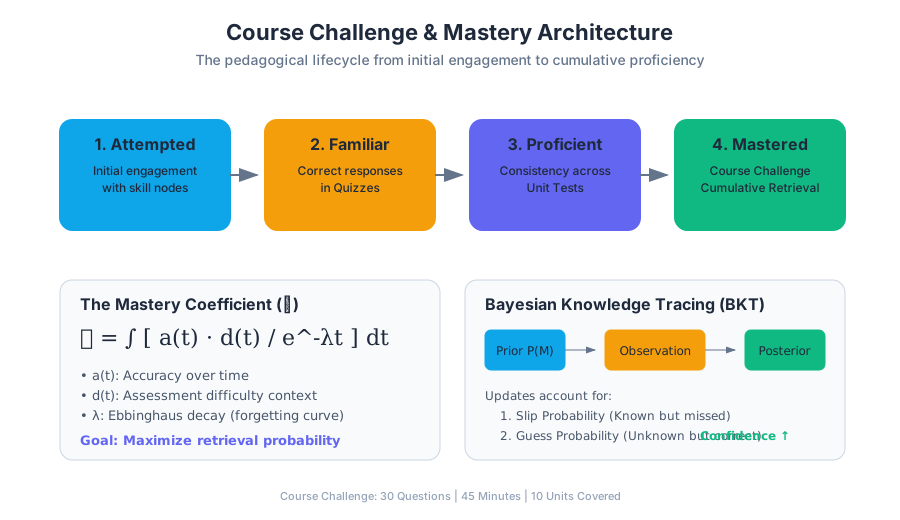
Each unit in the Calculus AB course—such as Differentiation Rules or Applications of Integration—is decomposed into granular skills. Mastery Points are accumulated through a tiered progression:
- Attempted: The learner has engaged with the material.
- Familiar: Initial correct responses in a controlled environment (Quizzes).
- Proficient: Consistent accuracy across multiple sessions (Unit Tests).
- Mastered: Successful retrieval during cumulative assessments (Course Challenge).
Definition: The Mastery Coefficient The Mastery Coefficient ($\mathcal{M}$) can be modeled as a function of accuracy ($a$), consistency over time ($t$), and the difficulty of the assessment context ($d$). Formally: $$\mathcal{M} = \int_{0}^{T} \frac{a(t) \cdot d(t)}{e^{-\lambda t}} dt$$ where $\lambda$ represents the decay constant of human forgetting (the Ebbinghaus curve).
Comparison of Assessment Tiers
| Feature | Quiz | Unit Test | Course Challenge |
|---|---|---|---|
| Scope | 2–3 specific skills | Single Unit (e.g., Integration) | Entire Curriculum (Units 1–10) |
| Question Count | 5–10 | 9–15 | 30 |
| Context Switching | Low | Moderate | High |
| Mastery Ceiling | Proficient | Proficient | Mastered |
| Time Pressure | Minimal | Moderate | Significant (30–45 mins) |
Comprehensive Skill Assessment: The 30-Question Gauntlet
The Course Challenge utilizes a 30-question heuristic to sample the vast state-space of the AP Calculus AB curriculum. To achieve statistical significance in assessing a student's readiness, the challenge must balance breadth (covering all 10 units) with depth (testing high-level synthesis).
The Distribution Logic
The assessment engine typically distributes questions according to the weighting of the AP Exam. A standard Course Challenge distribution might look like this:
| Unit ID | Topic Area | Question Weight | Key Concepts Tested |
|---|---|---|---|
| U1 | Limits & Continuity | 10% | IVT, Squeeze Theorem, Asymptotes |
| U2-U4 | Differentiation | 30% | Chain Rule, Implicit, Inverse Trig |
| U5-U6 | Analytical Apps of Derivatives | 20% | MVT, Optimization, Concavity |
| U7-U8 | Integration & Diff. Equations | 25% | Separation of Variables, FTC |
| U9-U10 | Applications of Integration | 15% | Disk/Washer Method, Area between curves |
Problem Solving Speed and Heuristics
In the context of the Course Challenge, Problem Solving Speed is not merely about "working fast"—it is about the transition from System 2 thinking (slow, effortful, rule-based) to System 1 thinking (fast, instinctive, pattern-based).
A senior engineer or mathematician does not "re-derive" the quotient rule every time they see a rational function; they recognize the pattern and execute the algorithm. The 30–45 minute time limit on 30 questions serves as a diagnostic for this fluency.
Heuristic: The "Disguised Derivative"
One of the most common speed-traps in the Course Challenge is the "Disguised Derivative"—a limit definition of a derivative that students often try to solve using L'Hôpital's Rule or algebraic manipulation, wasting valuable minutes.
\text{Evaluate: } \lim_{h \to 0} \frac{\sin(\frac{\pi}{3} + h) - \sin(\frac{\pi}{3})}{h}
The Slow Way (System 2):
- Recognize $0/0$ indeterminate form.
- Apply L'Hôpital's Rule.
- Differentiate numerator with respect to $h$: $\cos(\frac{\pi}{3} + h)$.
- Plug in $h=0$: $\cos(\frac{\pi}{3}) = 1/2$.
The Fast Way (System 1 - Mastery):
- Recognize the form $\lim_{h \to 0} \frac{f(x+h) - f(x)}{h}$.
- Identify $f(x) = \sin(x)$ and $x = \pi/3$.
- Recall $f'(x) = \cos(x)$.
- Result: $\cos(\pi/3) = 1/2$.
The "Mastery" level student identifies the pattern in $<3$ seconds, saving time for complex "Related Rates" or "Volume of Solids" problems.
Worked Example: The Multi-Step Integration Challenge
To demonstrate the depth of the Course Challenge, consider a problem that synthesizes Unit 7 (Differential Equations) and Unit 8 (Applications of Integration).
Problem: Find the particular solution $y = f(x)$ to the differential equation $\frac{dy}{dx} = \frac{x^2}{y}$ with the initial condition $f(0) = 2$. Then, calculate the average value of $f(x)$ on the interval $[0, 3]$.
Step 1: Separation of Variables
We must isolate $y$ and $x$ terms to integrate. $$y , dy = x^2 , dx$$ $$\int y , dy = \int x^2 , dx$$ $$\frac{1}{2}y^2 = \frac{1}{3}x^3 + C$$
Step 2: Solving for $C$ (Initial Condition)
Plug in $(0, 2)$: $$\frac{1}{2}(2)^2 = \frac{1}{3}(0)^3 + C \implies 2 = C$$ The general solution is $\frac{1}{2}y^2 = \frac{1}{3}x^3 + 2$, or $y = \sqrt{\frac{2}{3}x^3 + 4}$.
Step 3: Average Value of a Function
The average value formula is $\frac{1}{b-a} \int_{a}^{b} f(x) dx$. $$\text{Avg} = \frac{1}{3-0} \int_{0}^{3} \sqrt{\frac{2}{3}x^3 + 4} , dx$$ Note: In a Course Challenge, if this were a non-calculator section, the function would be designed for a cleaner u-substitution. If calculator-active, the student must demonstrate proficiency in numerical integration.
Common Pitfalls and Edge Cases
Even high-performing students often fail to reach 100% Mastery due to recurring "leaks" in their logic. The Course Challenge is designed to expose these specific vulnerabilities.
1. The "+C" Oblivion
In Unit 7 (Differential Equations), forgetting the constant of integration during separation of variables leads to a fundamentally different functional form.
- Incorrect: $y = \sqrt{\frac{2}{3}x^3} + 2$ (adding $C$ at the end)
- Correct: $y = \sqrt{\frac{2}{3}x^3 + 4}$ (adding $C$ before solving for $y$)
2. Chain Rule Neglect in Implicit Differentiation
When differentiating $y^3$ with respect to $x$, students often write $3y^2$ instead of $3y^2 \frac{dy}{dx}$. This error cascades through optimization and related rates problems.
3. Mean Value Theorem (MVT) Pre-conditions
Students often apply MVT or Rolle's Theorem without verifying that the function is continuous on $[a, b]$ and differentiable on $(a, b)$. The Course Challenge frequently includes "trap" questions with functions like $f(x) = |x|$ or functions with vertical asymptotes within the interval.
| Error Type | Frequency | Impact on Score | Remediation Strategy |
|---|---|---|---|
| Sign Errors | High | Low (per question) | Double-check distributive property with negatives. |
| Chain Rule Miss | Medium | High | Use "Outside-In" notation for nested functions. |
| Endpoint Neglect | Medium | High (EVT) | Always test $f(a)$ and $f(b)$ in optimization. |
| Limit Evaluation | Low | Medium | Verify if $0/0$ or $\infty/\infty$ before using L'Hôpital. |
Variations and Extensions
While the standard Course Challenge focuses on AP Calculus AB, the mastery framework extends into Calculus BC and Multivariable Calculus.
- Calculus BC Extension: Includes Taylor Series convergence, polar coordinates, and integration by parts. The mastery points for BC are weighted more heavily toward Unit 10 (Infinite Sequences and Series).
- The "Adaptive" Challenge: Some advanced implementations of the Course Challenge use Item Response Theory (IRT). If a student correctly answers a difficult "Volume by Cross-Sections" question, the system may bypass easier integration questions, assuming mastery of the underlying primitives.
Final Review: The Path to 100%
The Course Challenge is not just a test; it is a feedback loop. A score of 25/30 (83%) indicates that while the student is "Proficient," there are specific "Knowledge Gaps" that will be exploited in a high-pressure exam environment.
The mastery system identifies these gaps with surgical precision. If a student misses a question on Related Rates, the system doesn't just suggest "more math"—it points specifically to the relationship between $dV/dt$ and $dr/dt$ in spherical geometry.
Theorem: The Completeness of Mastery A learner is said to have achieved "Course Mastery" when the variance of their performance across all 10 units approaches zero, and the mean accuracy $\mu \geq 0.90$ under time-constrained, randomized sampling.
Summary of Mastery Progression
- Foundations: Master the limit definition of the derivative and the integral.
- Mechanics: Automate the Power, Product, Quotient, and Chain rules.
- Applications: Connect the derivative to rates of change and the integral to accumulation.
- Synthesis: Solve differential equations and model physical volumes.
- The Challenge: Prove fluency by navigating all 10 units in a single, timed session.
By treating the Course Challenge as a diagnostic tool rather than a final hurdle, students can refine their problem-solving speed and accuracy, ensuring they are not just "prepared" for the AP Exam, but have truly mastered the language of change.
Source Materials
Study AP/College Calculus AB on Lykke
This course page is free to open: signed out, you can read its first two sections, and signing in, on any plan, opens the rest. The free Lykke Chrome extension syncs your own Canvas courses, so ChatGPT, Claude and Muse can answer from your classes and deadlines. It only reads Canvas.
Add the free extensionSign in to open every sectionAll sections of AP/College Calculus AB · Browse more course pages