From the free course AP/College Calculus AB on Lykke
Contextual Applications of Differentiation
Key concepts: Straight-line Motion · Related Rates · Local Linearity · L'Hôpital's Rule · Position, Velocity, and Acceleration
Applying derivatives to solve real-world problems involving motion, rates, and approximations.
Contextual Applications of Differentiation
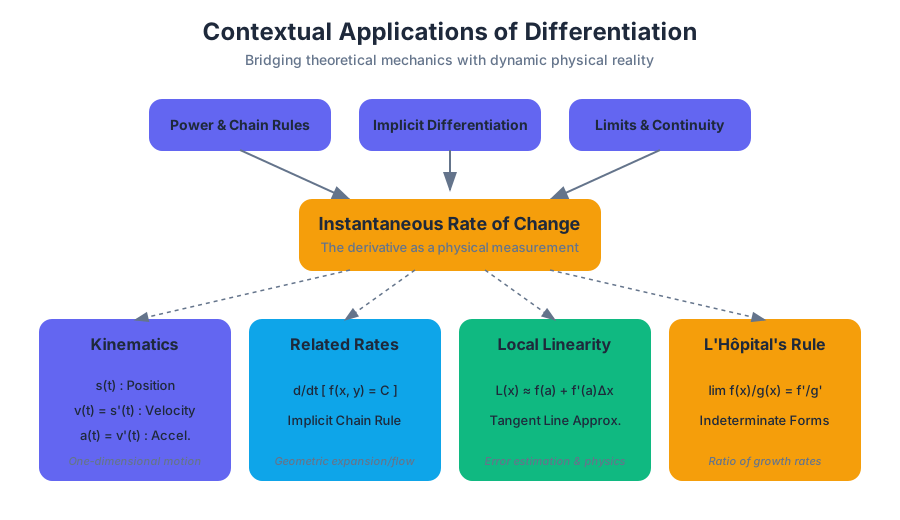
The transition from the theoretical mechanics of differentiation—the Power Rule, Chain Rule, and Implicit Differentiation—to their Contextual Applications represents the shift from pure mathematics to engineering, physics, and economics. In this domain, the derivative is no longer just a limit of a difference quotient; it is an instantaneous rate of change that governs the motion of satellites, the expansion of viral outbreaks, and the optimization of industrial processes.
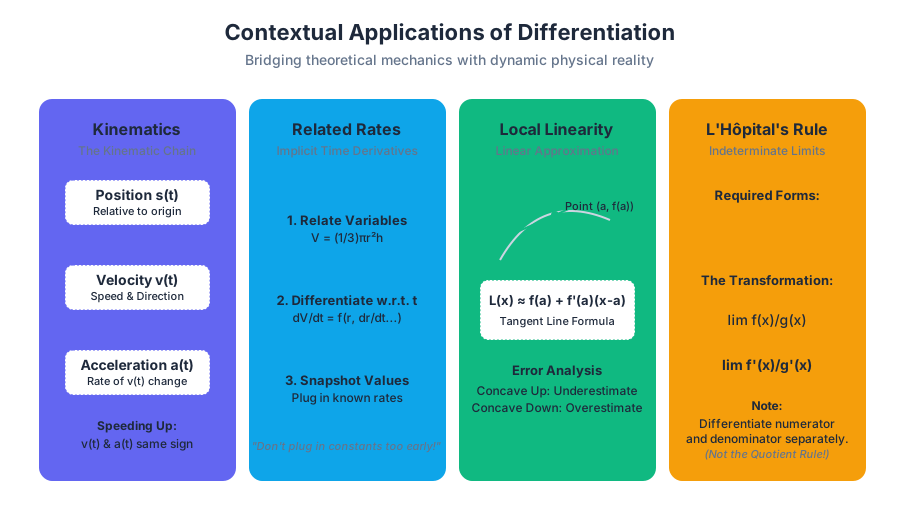
This article explores the four pillars of applied differentiation: Straight-line Motion, Related Rates, Local Linearity, and L'Hôpital's Rule. Each concept serves as a bridge between a static mathematical model and a dynamic physical reality.
Straight-line Motion: Kinematics in One Dimension
Straight-line motion, or rectilinear motion, is the study of an object moving along a fixed path (typically the x-axis or y-axis). In this context, we define three fundamental functions of time $t$: Position, Velocity, and Acceleration.
The Kinematic Hierarchy
The relationship between these quantities is hierarchical, defined by successive differentiation with respect to time.
Definition: The Kinematic Chain
- Position $s(t)$: The location of the particle relative to the origin at time $t$.
- Velocity $v(t) = s'(t)$: The instantaneous rate of change of position. It indicates both speed and direction.
- Acceleration $a(t) = v'(t) = s''(t)$: The instantaneous rate of change of velocity.
| Quantity | Notation | Relationship | Physical Interpretation |
|---|---|---|---|
| Position | $s(t)$ | $s(t)$ | Where the object is. |
| Velocity | $v(t)$ | $\frac{ds}{dt}$ | How fast and in what direction it is moving. |
| Acceleration | $a(t)$ | $\frac{dv}{dt} = \frac{d^2s}{dt^2}$ | How the velocity is changing. |
| Speed | $ | v(t) | $ |
| Displacement | $\Delta s$ | $s(t_2) - s(t_1)$ | Net change in position. |
Analyzing Particle Behavior
To fully describe motion, we must interpret the signs and zeros of these derivatives:
- Direction of Motion: If $v(t) > 0$, the particle moves in the positive direction (right/up). If $v(t) < 0$, it moves in the negative direction (left/down).
- Turning Points: A particle changes direction only when $v(t) = 0$ and $v(t)$ changes sign.
- Speeding Up vs. Slowing Down:
- Speeding Up: $v(t)$ and $a(t)$ have the same sign (both positive or both negative).
- Slowing Down: $v(t)$ and $a(t)$ have opposite signs.
Worked Example: Numerical Simulation
Consider a particle whose position is defined by $s(t) = t^3 - 6t^2 + 9t$ for $t \ge 0$.
- $v(t) = 3t^2 - 12t + 9 = 3(t-1)(t-3)$.
- $a(t) = 6t - 12 = 6(t-2)$.
- The particle is at rest at $t=1$ and $t=3$.
- At $t=1.5$, $v(1.5)$ is negative and $a(1.5)$ is negative. Since signs match, the particle is speeding up in the negative direction.
Related Rates: The Chain Rule in Context
Related Rates problems involve finding the rate at which one quantity changes by relating it to other quantities whose rates of change are known. This is a direct application of Implicit Differentiation with respect to time $t$.
The Procedural Framework
Solving these problems requires a disciplined approach to distinguish between "constants" (values that never change) and "instantaneous values" (values that are only true at a specific moment).
- Identify Variables: List all given rates (e.g., $dr/dt$) and the rate to be found (e.g., $dV/dt$).
- Relate the Variables: Write an equation that connects the variables (e.g., Geometry formulas like $V = \frac{4}{3}\pi r^3$).
- Differentiate: Use the Chain Rule to differentiate both sides with respect to $t$.
- Substitute and Solve: Plug in the "snapshot" values only after differentiation.
| Scenario | Primary Equation | Differentiated Equation (w.r.t $t$) |
|---|---|---|
| Expanding Circle | $A = \pi r^2$ | $\frac{dA}{dt} = 2\pi r \frac{dr}{dt}$ |
| Sliding Ladder | $x^2 + y^2 = L^2$ | $2x\frac{dx}{dt} + 2y\frac{dy}{dt} = 0$ |
| Conical Tank | $V = \frac{1}{3}\pi r^2 h$ | $\frac{dV}{dt} = \frac{1}{3}\pi (2rh \frac{dr}{dt} + r^2 \frac{dh}{dt})$ |
| Shadow Length | $\frac{x+s}{H} = \frac{s}{h}$ | (Use similar triangles to relate $dx/dt$ and $ds/dt$) |
The Cone Problem: A Classic Derivation
In many related rates problems, such as a leaking conical tank, we have too many variables ($r$ and $h$). We must use the geometry of the container to find a relationship between $r$ and $h$ (usually via similar triangles) to reduce the equation to a single variable before differentiating.
\text{Given: } V = \frac{1}{3}\pi r^2 h \text{ and } \frac{r}{h} = \frac{R_{max}}{H_{max}} = k \\
\text{Substitute } r = kh: \\
V = \frac{1}{3}\pi (kh)^2 h = \frac{\pi k^2}{3} h^3 \\
\text{Differentiate w.r.t } t: \\
\frac{dV}{dt} = \pi k^2 h^2 \frac{dh}{dt} \\
\text{Solve for } \frac{dh}{dt}: \\
\frac{dh}{dt} = \frac{dV/dt}{\pi k^2 h^2}
Common Pitfalls in Related Rates
- Premature Substitution: Plugging in a constant value for a variable before differentiating. If a value changes over time, it must remain a variable ($x, y, r$) until the derivative is taken.
- Sign Errors: If a distance is decreasing (e.g., water draining), the rate must be negative ($dV/dt < 0$).
- Units: Forgetting to reconcile units (e.g., mixing inches and feet).
Local Linearity and Linearization
Local Linearity is the principle that any differentiable function $f(x)$ looks like a straight line if you zoom in close enough to a point $(a, f(a))$. This line is the tangent line.
The Linearization Formula
The Linearization of $f$ at $a$, denoted $L(x)$, is simply the equation of the tangent line used as an approximation tool.
Theorem: Linearization For a function $f$ differentiable at $x=a$, the linear approximation is: $$L(x) = f(a) + f'(a)(x - a)$$ For $x$ values near $a$, $f(x) \approx L(x)$.
Differentials
While $L(x)$ approximates the function value, differentials approximate the change in the function value.
- Let $dx$ be an independent variable (the change in $x$).
- The differential $dy$ is defined as $dy = f'(x)dx$.
- $dy$ represents the change along the tangent line, whereas $\Delta y$ represents the actual change in the function.
| Term | Symbol | Definition |
|---|---|---|
| Actual Change | $\Delta y$ | $f(a + \Delta x) - f(a)$ |
| Approximate Change | $dy$ | $f'(a)dx$ |
| Error | $ | \Delta y - dy |
Real-World Application: Sensor Calibration
In embedded systems, calculating complex functions like $\sqrt{x}$ or $\ln(x)$ is computationally expensive. Engineers often use linearization to create "fast" approximations for sensors within a specific operating range.
Concavity and Error
The accuracy of a linear approximation depends on the concavity of the function:
- If $f''(x) > 0$ (Concave Up), the tangent line lies below the curve, so $L(x)$ is an underestimate.
- If $f''(x) < 0$ (Concave Down), the tangent line lies above the curve, so $L(x)$ is an overestimate.
L'Hôpital's Rule: Resolving Indeterminacy
When evaluating limits, we often encounter indeterminate forms like $0/0$ or $\infty/\infty$. These forms do not have a defined value; the limit depends on the "race" between the numerator and the denominator.
The Theorem
L'Hôpital's Rule Suppose $f$ and $g$ are differentiable and $g'(x) \neq 0$ near $a$ (except possibly at $a$). If: $$\lim_{x \to a} \frac{f(x)}{g(x)} = \frac{0}{0} \quad \text{or} \quad \lim_{x \to a} \frac{f(x)}{g(x)} = \frac{\pm \infty}{\pm \infty}$$ Then: $$\lim_{x \to a} \frac{f(x)}{g(x)} = \lim_{x \to a} \frac{f'(x)}{g'(x)}$$ provided the limit on the right exists.
Indeterminate Forms Summary
L'Hôpital's Rule applies directly only to quotients. Other indeterminate forms must be algebraically transformed into $0/0$ or $\infty/\infty$.
| Form | Type | Strategy |
|---|---|---|
| $0/0$ | Quotient | Apply L'Hôpital directly. |
| $\infty/\infty$ | Quotient | Apply L'Hôpital directly. |
| $0 \cdot \infty$ | Product | Rewrite as $\frac{f}{1/g}$ to get $0/0$ or $\infty/\infty$. |
| $\infty - \infty$ | Difference | Find a common denominator or factor out a term. |
| $1^\infty, 0^0, \infty^0$ | Power | Use natural logs: $y = f^g \implies \ln y = g \ln f$. |
Critical Warning: The Quotient Rule Trap
A common student error is to use the Quotient Rule when applying L'Hôpital's Rule.
- Correct: Differentiate the top and bottom separately: $\frac{f'(x)}{g'(x)}$.
- Incorrect: Differentiate the whole fraction: $\frac{f'g - fg'}{g^2}$.
Practical Example: Growth Rates
L'Hôpital's Rule is essential for comparing the growth of functions. For instance, to prove that exponential functions grow faster than any power function: $$\lim_{x \to \infty} \frac{e^x}{x^n}$$ Applying L'Hôpital's Rule $n$ times will eventually reduce the denominator to $n!$ (a constant) while the numerator remains $e^x$, showing the limit is $\infty$.
Synthesis: The Interconnectedness of Rates
The contextual applications of differentiation are not isolated topics; they are different perspectives on the same underlying truth: The derivative is the local linear behavior of a system.
- In Motion, we look at how position changes over time.
- In Related Rates, we look at how multiple geometric dimensions change over time.
- In Linearization, we use the rate of change to predict nearby values.
- In L'Hôpital's Rule, we compare the rates of change of two functions to determine their limiting ratio.
By mastering these applications, one gains the ability to decompose complex, dynamic systems into manageable, linear components—the hallmark of advanced scientific and engineering analysis.
- Position ($s(t)$): The location of an object at time $t$.
- Velocity ($v(t)$): $s'(t)$; the rate of change of position; includes direction.
- Acceleration ($a(t)$): $v'(t)$; the rate of change of velocity.
- Speeding Up: Occurs when velocity and acceleration have the same sign.
- Slowing Down: Occurs when velocity and acceleration have opposite signs.
- Related Rates: A method using implicit differentiation to find an unknown rate of change in terms of known rates.
- Linearization ($L(x)$): $f(a) + f'(a)(x-a)$; the tangent line approximation of a function near $x=a$.
- Differential ($dy$): $f'(x)dx$; the change in height along the tangent line.
- L'Hôpital's Rule: A limit evaluation method for $0/0$ or $\infty/\infty$ using $\lim f'(x)/g'(x)$.
- Indeterminate Form: A limit expression (like $0/0$) that requires further analysis to evaluate.
- True or False: If a particle's velocity is negative and its acceleration is positive, the particle is speeding up.
- Related Rates: A 10ft ladder leans against a wall. If the bottom slides away at 2ft/s, how fast is the top sliding down when the bottom is 6ft from the wall?
- Linearization: If $f(x) = \ln(x)$, what is the linearization $L(x)$ at $a=1$?
- L'Hôpital's: Evaluate $\lim_{x \to 0} \frac{\sin(5x)}{x}$.
- Concavity: If $f''(x) > 0$ on an interval, will the linear approximation $L(x)$ be an overestimate or an underestimate?
Answers: 1. False (Slowing down), 2. -1.5 ft/s, 3. $L(x) = x - 1$, 4. 5, 5. Underestimate.
Core Competencies for Contextual Differentiation:
- Kinematic Analysis:
- Be able to find when a particle is at rest ($v=0$).
- Determine intervals of motion (left/right).
- Calculate total distance traveled (sum of absolute displacements between turning points).
- Related Rates Mastery:
- Memorize volume/surface area for spheres, cones, and cylinders.
- Always differentiate with respect to $t$, not the variable itself (e.g., $\frac{d}{dt}[r^2] = 2r \frac{dr}{dt}$).
- Linearization & Differentials:
- Understand that $L(x)$ is just the tangent line.
- Recognize that $dy \approx \Delta y$ for small $dx$.
- L'Hôpital's Rule Proficiency:
- Always check for $0/0$ or $\infty/\infty$ before applying.
- Know how to convert $0 \cdot \infty$ and $1^\infty$ into quotient forms.
- Recognize when to stop (if the limit is no longer indeterminate).
Source Materials
Study AP/College Calculus AB on Lykke
This course page is free to open: signed out, you can read its first two sections, and signing in, on any plan, opens the rest. The free Lykke Chrome extension syncs your own Canvas courses, so ChatGPT, Claude and Muse can answer from your classes and deadlines. It only reads Canvas.
Add the free extensionSign in to open every sectionAll sections of AP/College Calculus AB · Browse more course pages