From the free course AP/College Calculus AB on Lykke
Applications of Integration: Area and Volume
Key concepts: Area Between Curves · Volumes with Cross Sections · Volumes of Revolution (Disk/Washer) · Average Value of a Function · Net Change
Using definite integrals to calculate area between curves and the volume of complex solids.
Applications of Integration: Area and Volume
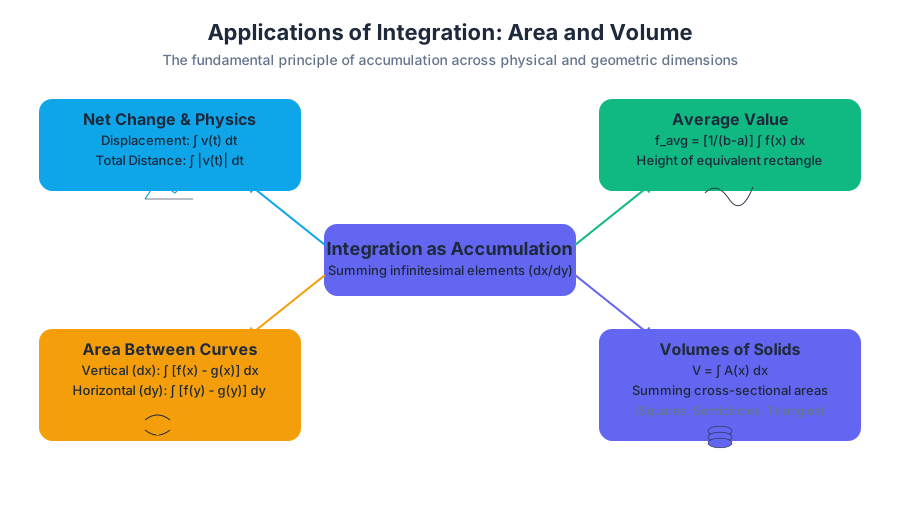
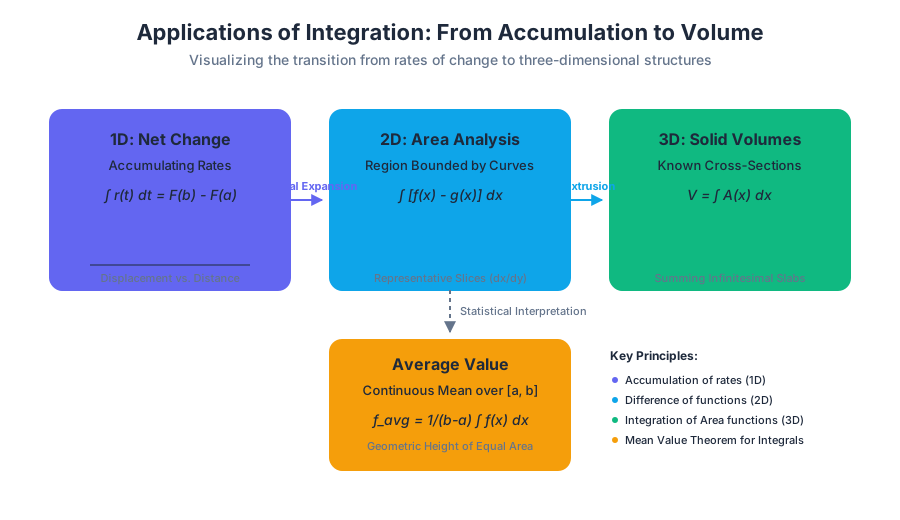
In the study of calculus, the definite integral is often introduced as the "area under a curve." However, this is a pedagogical simplification. In a broader engineering and mathematical context, integration is the ultimate tool for accumulation. Whether we are accumulating distance from velocity, mass from density, or three-dimensional slices into a solid volume, the underlying principle remains the same: we partition a complex whole into infinitesimal "representative elements," model those elements, and sum them using the Fundamental Theorem of Calculus.
This article explores the rigorous application of integration to determine the geometric properties of shapes and the physical accumulation of quantities.
Net Change and the Accumulation of Quantities
The Net Change Theorem is a direct application of the Fundamental Theorem of Calculus. It states that the integral of a rate of change is the net change in the original quantity.
The Net Change Theorem: If $f'(x)$ is the rate of change of a quantity $f(x)$, then the definite integral of $f'(x)$ from $a$ to $b$ gives the total change in $f(x)$: $$\int_{a}^{b} f'(x) , dx = f(b) - f(a)$$
Displacement vs. Total Distance
One of the most critical distinctions in physics and engineering is the difference between net change (displacement) and total accumulation (total distance traveled).
| Concept | Mathematical Definition | Physical Meaning |
|---|---|---|
| Displacement | $\int_{a}^{b} v(t) , dt$ | The change in position from $t=a$ to $t=b$. |
| Total Distance | $\int_{a}^{b} | v(t) |
| Net Change | $\int_{a}^{b} r(t) , dt$ | The total increase/decrease of a quantity (e.g., water in a tank). |
Pitfall: The Sign of the Function
When calculating net change, the sign of the rate function $r(t)$ matters. If $r(t)$ represents the rate of water flowing into a tank, a negative value implies water is flowing out. To find the total amount of water processed (in and out), one must integrate the absolute value of the rate.
Average Value of a Function
In discrete mathematics, the average of $n$ numbers is their sum divided by $n$. In the continuous domain, we use integration to find the Average Value of a function over an interval $[a, b]$.
Definition: Average Value The average value of a continuous function $f(x)$ on the interval $[a, b]$ is: $$f_{avg} = \frac{1}{b-a} \int_{a}^{b} f(x) , dx$$
Geometric Interpretation
The average value $f_{avg}$ represents the height of a rectangle with the same base $(b-a)$ that would yield the exact same area as the region under the curve $f(x)$. This is deeply tied to the Mean Value Theorem for Integrals, which guarantees that for a continuous function, there exists at least one point $c$ in $[a, b]$ such as $f(c) = f_{avg}$.
Area Between Curves
Calculating the area between two intersecting or bounding curves is the first step in moving from "area under a curve" to "area of a region."
Vertical Slicing ($dx$)
If a region is bounded above by $f(x)$ and below by $g(x)$ over an interval $[a, b]$, the area $A$ is found by integrating the "height" of a representative vertical rectangle: $$A = \int_{a}^{b} [f(x) - g(x)] , dx$$
Horizontal Slicing ($dy$)
In cases where functions are defined in terms of $y$, or where the boundaries change vertically, it is often more efficient to integrate with respect to $y$. If a region is bounded on the right by $x = f(y)$ and on the left by $x = g(y)$ from $y = c$ to $y = d$: $$A = \int_{c}^{d} [f(y) - g(y)] , dy$$
Comparison of Slicing Orientations
| Feature | Vertical Slicing ($dx$) | Horizontal Slicing ($dy$) |
|---|---|---|
| Representative Element | Vertical rectangle | Horizontal rectangle |
| Height/Width | $f(x) - g(x)$ (Top - Bottom) | $f(y) - g(y)$ (Right - Left) |
| Integration Limits | $x$-coordinates of boundaries | $y$-coordinates of boundaries |
| Best Used When... | Boundaries are $y = \dots$ | Boundaries are $x = \dots$ |
Volumes with Known Cross Sections
Before moving to solids of revolution, we must understand the general principle of volume: the integral of the cross-sectional area. If a solid has a base in the $xy$-plane and every cross-section perpendicular to the $x$-axis has a known area $A(x)$, the volume $V$ is: $$V = \int_{a}^{b} A(x) , dx$$
Common Cross-Sectional Geometries
The challenge in these problems is usually not the integration itself, but expressing the area $A(x)$ in terms of the side length $s$, which is determined by the distance between two curves $f(x)$ and $g(x)$.
| Cross-Section Shape | Area Formula $A(s)$ | $s$ in terms of curves |
|---|---|---|
| Square | $s^2$ | $f(x) - g(x)$ |
| Semicircle | $\frac{1}{8}\pi s^2$ | $f(x) - g(x)$ |
| Equilateral Triangle | $\frac{\sqrt{3}}{4} s^2$ | $f(x) - g(x)$ |
| Isosceles Rt. Triangle (Leg on base) | $\frac{1}{2} s^2$ | $f(x) - g(x)$ |
\text{Derivation of the Volume of a Pyramid with height } H \text{ and base area } B: \\
\text{By similar triangles, the side length } s \text{ at height } h \text{ is } s(h) = \sqrt{B} \frac{H-h}{H}. \\
\text{The area of the cross-section is } A(h) = s(h)^2 = B \frac{(H-h)^2}{H^2}. \\
V = \int_{0}^{H} B \frac{(H-h)^2}{H^2} dh = \frac{B}{H^2} \left[ -\frac{(H-h)^3}{3} \right]_{0}^{H} = \frac{1}{3}BH.
Volumes of Revolution: The Disk Method
When a two-dimensional region is rotated around an axis, it creates a three-dimensional solid. If the region is flush against the axis of rotation, we use the Disk Method.
Mechanics
Imagine a thin vertical rectangle of width $dx$ and height $R(x)$ being rotated around the $x$-axis. It forms a thin cylinder (a disk) with:
- Radius: $R(x)$
- Volume of one disk: $dV = \pi [R(x)]^2 dx$
Summing these disks from $a$ to $b$ gives the total volume: $$V = \pi \int_{a}^{b} [R(x)]^2 , dx$$
Rotation around the y-axis
If the region is rotated around the $y$-axis and bounded by $x = R(y)$, the formula becomes: $$V = \pi \int_{c}^{d} [R(y)]^2 , dy$$
Volumes of Revolution: The Washer Method
If there is a "gap" between the region and the axis of rotation, the resulting solid will have a hole in the middle. The cross-section perpendicular to the axis is a washer (an annulus).
The Formula
To find the volume, we subtract the volume of the inner "empty" solid from the volume of the outer "full" solid. $$V = \pi \int_{a}^{b} \left( [R_{out}(x)]^2 - [R_{in}(x)]^2 \right) , dx$$ Where:
- $R_{out}(x)$ is the distance from the axis to the outer curve.
- $R_{in}(x)$ is the distance from the axis to the inner curve.
Critical Warning: A common error is to write $\pi \int (R_{out} - R_{in})^2 dx$. This is algebraically incorrect. You must square the radii individually: $R_{out}^2 - R_{in}^2$.
Example: Rotating around a non-axis line
Suppose we rotate the region between $y = x^2$ and $y = x$ around the line $y = -1$.
- Outer Radius: $R_{out} = x - (-1) = x + 1$
- Inner Radius: $R_{in} = x^2 - (-1) = x^2 + 1$
- Integral: $V = \pi \int_{0}^{1} [(x+1)^2 - (x^2+1)^2] , dx$
Summary of Volume Methods
Choosing the correct method is often the most difficult part of an integration problem. The following table serves as a decision matrix for volume problems.
| Method | When to Use | Representative Element | Integral Setup |
|---|---|---|---|
| Cross-Sections | Solid built on a base with known shapes | Slabs of thickness $dx$ | $\int A(x) dx$ |
| Disk Method | Rotation around axis, no gap | Solid disk | $\pi \int [R(x)]^2 dx$ |
| Washer Method | Rotation around axis, with gap | Hollow washer | $\pi \int (R_{out}^2 - R_{in}^2) dx$ |
| Shell Method* | Rotation where slicing is parallel to axis | Cylindrical shell | $2\pi \int r \cdot h , dx$ |
*Note: The Shell Method is typically covered in Calculus BC or second-semester college calculus, but it is a powerful alternative when the Washer Method leads to difficult algebra.
Common Pitfalls and Expert Tips
- Incorrect Bounds: Always solve for the intersection points of the curves ($f(x) = g(x)$) to find your limits of integration. Do not rely solely on a visual sketch.
- The "Square of the Difference" Fallacy: In the washer method, remember that $(R_{out} - R_{in})^2 \neq R_{out}^2 - R_{in}^2$. The geometry requires the difference of the areas of two circles.
- Axis Shifts: When rotating around a line like $x = k$ or $y = k$, the radius is always $| \text{curve} - \text{axis} |$. If the axis is $y=5$ and the curve is $y=x^2$, the radius is $5 - x^2$ (if the curve is below the axis).
- Variable Mismatch: If you are rotating around a horizontal line (like the $x$-axis), your integral should usually be in terms of $x$ (for Disk/Washer). If rotating around a vertical line, use $y$.
Conclusion
The applications of integration to area and volume represent a transition from purely algebraic manipulation to spatial reasoning. By conceptualizing a volume as an infinite sum of infinitesimal area slices, we gain the ability to model everything from the capacity of a fuel tank to the mass distribution of a planetary body. Mastery of these techniques requires a dual focus: the geometric intuition to set up the "representative element" and the technical precision to evaluate the resulting definite integral.
Source Materials
Study AP/College Calculus AB on Lykke
This course page is free to open: signed out, you can read its first two sections, and signing in, on any plan, opens the rest. The free Lykke Chrome extension syncs your own Canvas courses, so ChatGPT, Claude and Muse can answer from your classes and deadlines. It only reads Canvas.
Add the free extensionSign in to open every sectionAll sections of AP/College Calculus AB · Browse more course pages