From the free course AP/College Calculus AB on Lykke
AP Calculus AB Exam Preparation
Key concepts: Free Response Questions (FRQs) · Step-by-step Problem Solving · Scoring Rubrics · Past Exam Analysis (2011, 2015, 2017)
Reviewing past Free Response Questions (FRQs) and mastering exam-taking strategies.
AP Calculus AB Exam Preparation
The AP Calculus AB exam represents the culmination of a rigorous study of single-variable calculus, focusing on limits, derivatives, integrals, and the Fundamental Theorem of Calculus. Success on this assessment requires more than mere computational fluency; it demands a high level of conceptual synthesis and the ability to communicate mathematical reasoning with precision. The exam is divided into two primary sections: Multiple Choice Questions (MCQ) and Free Response Questions (FRQ). While the MCQ tests breadth of knowledge, the FRQ section evaluates the depth of a student’s ability to model real-world scenarios, justify conclusions using named theorems, and navigate the interplay between analytical, graphical, and tabular representations.
The Architecture of the Free Response Question (FRQ)
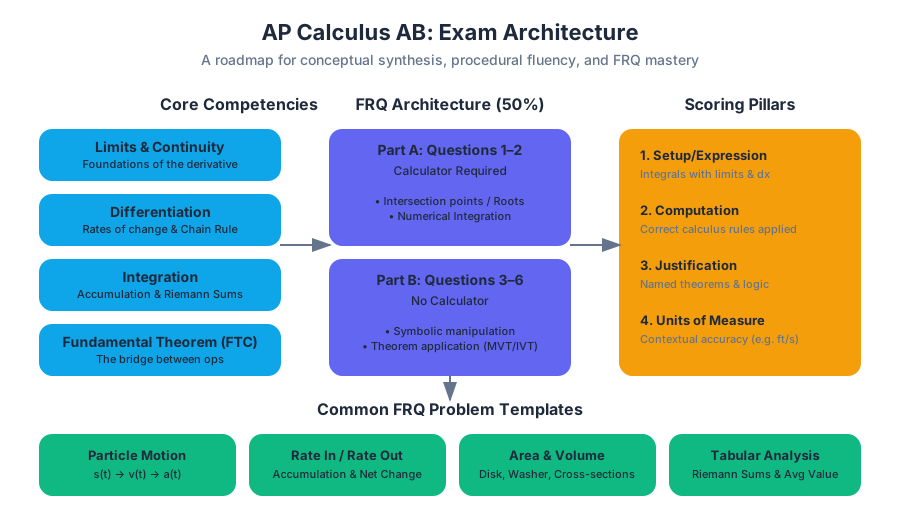
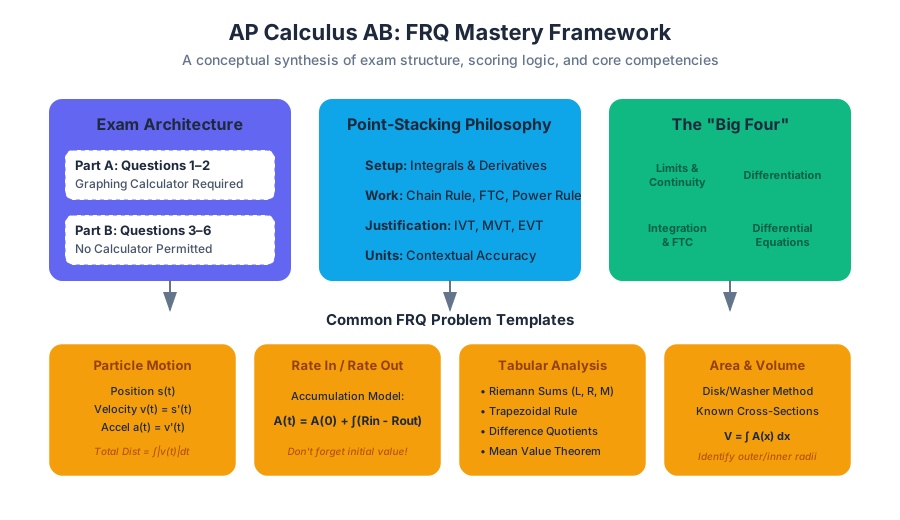
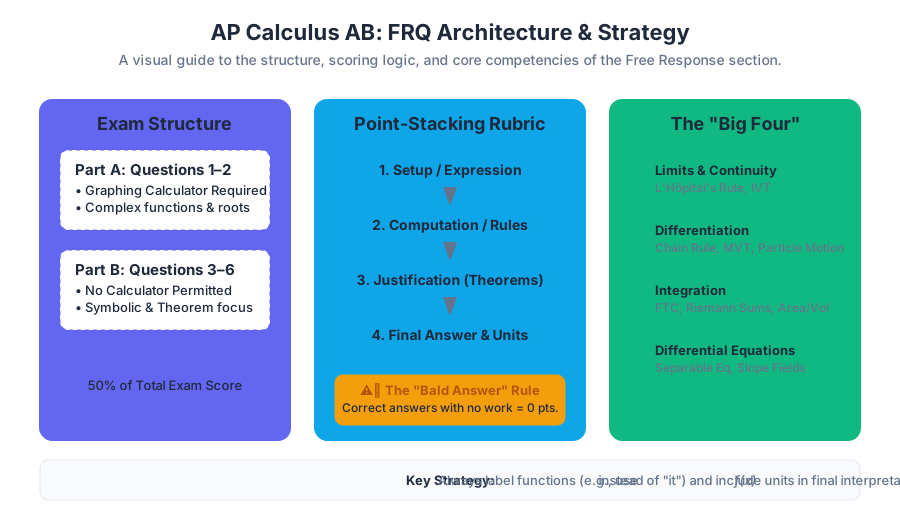
The FRQ section consists of six questions, each worth nine points, for a total of 54 points (weighted as 50% of the total exam score). These questions are split into two parts:
- Part A (Questions 1–2): Graphing calculator required. These problems often involve complex functions where manual integration or root-finding is impractical.
- Part B (Questions 3–6): No calculator permitted. These problems focus on symbolic manipulation, theorem application, and interpreting graphs or tables.
The Scoring Rubric Philosophy
The College Board employs a "point-stacking" rubric. Points are typically awarded for the setup (the definite integral or derivative expression), the intermediate steps (applying a rule or theorem), and the final answer (with correct units). A "bald answer"—an answer provided without supporting work—usually earns zero points, even if correct.
| Point Category | Requirement | Common Pitfall |
|---|---|---|
| Setup/Expression | Writing the integral or derivative with correct limits/variables. | Forgetting $dx$ or $dt$ in the integral. |
| Computation | Correct application of Power Rule, Chain Rule, or FTC. | Arithmetic errors in simple subtraction. |
| Justification | Verbal explanation using a named theorem (MVT, IVT, EVT). | Using "it" instead of the function name (e.g., "$f(x)$ increases"). |
| Units of Measure | Correct units (e.g., $ft/sec^2$ for acceleration). | Omitting units when specifically asked. |
Core Competencies in Problem Solving
To master the FRQ, a student must internalize the "Big Four" concepts: Limits/Continuity, Differentiation, Integration, and Differential Equations. Each of these is tested through specific lenses, such as Rate In/Rate Out problems or Particle Motion.
1. Numerical Integration and Riemann Sums
Often appearing in tabular problems, students must approximate the area under a curve using Left, Right, Midpoint, or Trapezoidal sums. This tests the understanding of the definite integral as an accumulation of change.
2. The Fundamental Theorem of Calculus (FTC)
The FTC is the bridge between the derivative and the integral. In FRQs, this often appears in the form of a "Function Defined by an Integral":
$g(x) = \int_{a}^{x} f(t) dt$
Students must recognize that $g'(x) = f(x)$ and $g''(x) = f'(x)$. This allows for the analysis of $g(x)$ (extrema, concavity) based solely on the graph of $f(t)$.
\text{Fundamental Theorem of Calculus (Part 1):} \\
\frac{d}{dx} \left[ \int_{a}^{g(x)} f(t) \, dt \right] = f(g(x)) \cdot g'(x) \\
\\
\text{Fundamental Theorem of Calculus (Part 2):} \\
\int_{a}^{b} f'(x) \, dx = f(b) - f(a)
Historical Analysis: Patterns in Past Exams
Analyzing past exams reveals a high degree of consistency in question types. By categorizing problems from 2011, 2015, and 2017, we can identify the "standard templates" used by the College Board.
2011 Exam: Focus on Particle Motion and Area/Volume
The 2011 exam featured a classic Particle Motion problem (Question 1). These problems require navigating between position $s(t)$, velocity $v(t)$, and acceleration $a(t)$ using differentiation and integration.
- Key Insight: "Total Distance" is $\int |v(t)| dt$, whereas "Displacement" is $\int v(t) dt$.
2015 Exam: Rate In/Rate Out and Accumulation
Question 1 of the 2015 exam (the "Drainage Pipe" problem) is a quintessential Rate In/Rate Out problem.
- The Model: $A(t) = A(0) + \int_{0}^{t} (\text{RateIn} - \text{RateOut}) dx$.
- Common Error: Forgetting the initial condition $A(0)$.
2017 Exam: Tabular Analysis and Differential Equations
The 2017 exam (Question 4) used a table representing the height of a tree over time. Students were asked to estimate $H'(6)$ using a difference quotient: $H'(6) \approx \frac{H(7) - H(5)}{7 - 5}$.
| Year | Problem Type | Core Concept | Calculator? |
|---|---|---|---|
| 2011 | Area/Volume | Revolving around a line (Disk/Washer Method) | Yes |
| 2015 | Accumulation | Rate of water flow into a pipe | Yes |
| 2017 | Diff. Equations | Separation of Variables: $\frac{dy}{dt} = \frac{1}{4}(10-y)$ | No |
| Common | Graph Analysis | Interpreting $f'$ to find extrema of $f$ | No |
Step-by-Step Problem Solving Strategy
When approaching an FRQ, a systematic pipeline ensures that no "easy" points are left on the table.
Phase 1: Decoding the Prompt
Identify the "Given" and the "Goal." If the prompt provides $f'(x)$ and asks for the maximum of $f(x)$, you are immediately in the territory of the Extreme Value Theorem (EVT).
Phase 2: The Setup
Write the calculus expression before plugging in numbers.
- Example: If asked for the average value of $f(x)$ on $[2, 5]$, write $\frac{1}{5-2} \int_{2}^{5} f(x) dx$.
Phase 3: Execution and Justification
Use formal language. Avoid vague pronouns.
- Incorrect: "The graph goes up so it's a max."
- Correct: "Since $f'(x)$ changes from positive to negative at $x=3$, $f(x)$ has a relative maximum at $x=3$ by the First Derivative Test."
Phase 4: Calculator Integration (Part A Only)
In the calculator section, you are expected to use the device for four specific tasks:
- Plotting a function in a meaningful window.
- Finding the roots of a function (solving $f(x) = 0$).
- Calculating the numerical derivative at a point.
- Calculating a definite integral.
Advanced Topic: Differential Equations and Separation of Variables
A staple of the non-calculator section (Part B) is the Separable Differential Equation. Students are given $\frac{dy}{dx} = f(x)g(y)$ and an initial condition $(x_0, y_0)$.
The Algorithmic Approach:
- Separate: Move all $y$ terms to the $dy$ side and $x$ terms to the $dx$ side.
- Integrate: Take the antiderivative of both sides. Do not forget $+C$.
- Solve for C: Use the initial condition immediately after integrating.
- Isolate y: Solve the resulting algebraic equation for $y$.
Theorem: Existence and Uniqueness If $f(x,y)$ and $\frac{\partial f}{\partial y}$ are continuous in a region, then there exists a unique solution to the differential equation passing through a given point in that region. In AP Calculus AB, we focus on finding this unique particular solution.
Common Pitfalls and Error Mitigation
Even high-performing students lose points to "linkage errors" and "over-rounding."
- Linkage Errors: Writing $f(x) = f'(x) = 3$. This is mathematically false and results in a point deduction for "communication."
- Rounding: Never round intermediate steps. Keep at least 6 decimal places in your calculator and only round the final answer to three decimal places (the AP standard).
- Initial Conditions: In accumulation problems (Rate In/Rate Out), students often calculate the net change $\int R(t) dt$ but forget to add the starting amount $S(0)$.
- Chain Rule Neglect: When integrating via u-substitution or differentiating composite functions, failing to account for the "inner" derivative is the most common source of algebraic error.
Comparative Analysis: Mean Value Theorem vs. Intermediate Value Theorem
| Feature | Intermediate Value Theorem (IVT) | Mean Value Theorem (MVT) |
|---|---|---|
| Prerequisite | $f(x)$ is continuous on $[a, b]$. | $f(x)$ is continuous on $[a, b]$ AND differentiable on $(a, b)$. |
| Guarantees... | A y-value (output) exists between $f(a)$ and $f(b)$. | A slope (derivative) exists equal to the average rate of change. |
| Equation | $f(c) = k$ | $f'(c) = \frac{f(b) - f(a)}{b - a}$ |
| Use Case | Proving a function has a zero (root). | Proving a car reached a specific speed. |
Final Preparation Checklist
As the exam approaches, focus on the "Justification Phrases" that graders look for. Memorize the conditions for each theorem. For example, you cannot use the Mean Value Theorem unless you explicitly state that the function is continuous and differentiable.
- Review the "Big Three" 2017 FRQs: Specifically the tree height (table), the tank volume (calculator), and the slope field (differential equations).
- Practice "Calculator Fluency": Ensure you can find intersections and integrals on your device in under 30 seconds.
- Units, Units, Units: Every time you see a "Rate" question, check if the answer requires units. If the question asks for "Rate of change of the rate of change," your units should be squared (e.g., $m/s^2$).
Source Materials
Study AP/College Calculus AB on Lykke
This course page is free to open: signed out, you can read its first two sections, and signing in, on any plan, opens the rest. The free Lykke Chrome extension syncs your own Canvas courses, so ChatGPT, Claude and Muse can answer from your classes and deadlines. It only reads Canvas.
Add the free extensionSign in to open every sectionAll sections of AP/College Calculus AB · Browse more course pages