From the free course American Government 3e on Lykke
Public Policy and Civic Engagement
Key concepts: Domestic Policy · Foreign Policy · Economic Policy · Civic Engagement
Examines the outputs of government, including domestic and foreign policy, and the role of the citizen in the policy cycle.
Public Policy and Civic Engagement
Public policy is the formal expression of government intent. It is the connective tissue between the theoretical constructs of political science and the lived reality of the citizenry. Far from being a static set of rules, public policy is a dynamic, iterative process of resource allocation, behavioral regulation, and social engineering. It represents the "output" of the political system—the tangible results of elections, lobbying, and institutional deliberation.
The Policy Cycle: The Mechanics of Governance
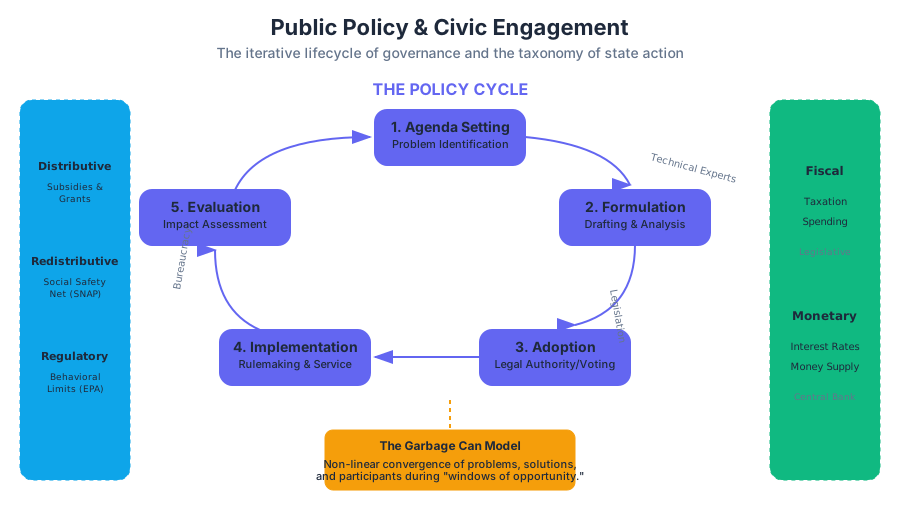
The creation of public policy is rarely a singular event. Instead, it follows a structured, though often messy, lifecycle known as the Policy Cycle. This framework allows analysts to decompose complex governmental actions into discrete, manageable stages.
1. Agenda Setting
The process begins with Agenda Setting, where problems are identified and prioritized. Not every social ill becomes a policy issue; a problem must reach a "critical mass" of public concern or interest group pressure to enter the Systemic Agenda (issues the public is discussing) and eventually the Institutional Agenda (issues legislators are actually considering).
2. Policy Formulation and Adoption
Once an issue is on the agenda, stakeholders engage in Policy Formulation. This involves the development of proposed courses of action. Technical experts, think tanks, and legislative staffers draft language, perform cost-benefit analyses, and debate trade-offs. Policy Adoption is the formal step where a proposal gains legal authority, typically through legislative a vote, executive order, or judicial ruling.
3. Implementation and Evaluation
Implementation is the "operational" phase where executive agencies translate statutory language into bureaucratic reality. This often involves Rulemaking, where agencies create specific regulations to fill in the gaps left by broad legislation. Finally, Policy Evaluation assesses whether the policy achieved its intended goals. This stage often feeds back into the first, as evaluations reveal new problems, restarting the cycle.
| Stage | Primary Actors | Key Activities | Output |
|---|---|---|---|
| Agenda Setting | Media, Interest Groups, Public | Problem identification, framing | The Policy Agenda |
| Formulation | Think Tanks, Staffers, Lobbyists | Drafting bills, impact modeling | Proposed Legislation |
| Adoption | Congress, President, Courts | Logrolling, voting, signing | Statutes / Executive Orders |
| Implementation | Bureaucracy (Agencies) | Rulemaking, enforcement | Public Services / Regulations |
| Evaluation | GAO, Academics, Auditors | Data analysis, cost-benefit review | Evaluation Reports |
The Garbage Can Model: In organizational theory, policy-making is often described not as a rational cycle but as a "garbage can" where problems, solutions, and participants move independently. A policy is adopted only when a "window of opportunity" opens, allowing these three streams to converge.
Domestic Policy: The Internal Social Contract
Domestic Policy encompasses all government actions and regulations that concern internal national affairs. It is the primary mechanism through which a state manages its economy, protects its citizens, and provides social services.
Taxonomy of Domestic Policy
Domestic policies are generally categorized by their intent and their impact on different segments of the population:
- Distributive Policy: Collects resources (usually through general taxation) and provides benefits to a specific group. Examples include agricultural subsidies or research grants. These are often "non-zero-sum" in the public perception.
- Redistributive Policy: Explicitly transfers resources from one group to another, typically from higher-income earners to lower-income earners. Programs like Medicaid or the Supplemental Nutrition Assistance Program (SNAP) fall into this category.
- Regulatory Policy: Limits the behavior of individuals or corporations to protect the public interest. This includes environmental protections (EPA) and labor laws (OSHA).
The Social Safety Net
A core component of domestic policy is the Social Safety Net, a collection of services provided by the state which prevent citizens from falling into destitution. This includes Social Insurance (contributory programs like Social Security) and Public Assistance (means-tested programs for the impoverished).
Economic Policy: Managing the Market
Economic policy is a subset of domestic policy focused on the stability and growth of the national economy. It operates through two primary levers: Fiscal Policy and Monetary Policy.
Fiscal Policy
Fiscal Policy involves the use of government spending and taxation to influence the economy. It is rooted in Keynesian Economics, which suggests that during a recession, the government should engage in deficit spending to stimulate demand. Conversely, Supply-Side Economics argues for tax cuts and deregulation to encourage production and investment.
The Multiplier Effect is a critical concept here: the idea that an initial injection of government spending leads to a larger overall increase in national income.
Monetary Policy
Monetary Policy is the management of the money supply and interest rates, typically handled by a central bank (e.g., the Federal Reserve in the U.S.). By adjusting the Federal Funds Rate, the "Fed" can either "heat up" the economy (by lowering rates to encourage borrowing) or "cool it down" (by raising rates to fight inflation).
| Feature | Fiscal Policy | Monetary Policy |
|---|---|---|
| Controlled By | Legislative and Executive branches | Central Bank (The Fed) |
| Primary Tools | Taxes, Government Spending | Interest Rates, Reserve Requirements |
| Implementation Speed | Slow (requires political consensus) | Fast (can be changed overnight) |
| Focus | Resource allocation, social equity | Inflation control, liquidity |
Analyzing Economic Inequality
To evaluate the effectiveness of economic policy, analysts often use the Gini Coefficient, a statistical measure of distribution.
Foreign Policy: The Global Arena
Foreign Policy consists of the strategies a nation uses to interact with other nations and international organizations. Unlike domestic policy, foreign policy must navigate an Anarchic International System—a world without a central governing authority.
Schools of Thought
- Realism: Views the international system as a struggle for power. States are rational actors pursuing their own National Interest, primarily defined as security and survival.
- Liberalism (Idealism): Emphasizes cooperation, international law, and global institutions (like the UN). It posits that democratic states are less likely to go to war with each other (Democratic Peace Theory).
- Constructivism: Argues that international relations are shaped by changing social norms and identities rather than just material power.
Tools of Foreign Policy
Governments use a spectrum of tools, ranging from "Soft Power" to "Hard Power":
- Diplomacy: The use of negotiations and treaties.
- Economic Sanctions: Penalizing a nation by restricting trade or freezing assets.
- Foreign Aid: Providing financial or technical assistance to bolster allies or improve stability.
- Military Force: The ultimate "hard power" tool, used for deterrence or direct intervention.
Game Theory in Foreign Policy
Foreign policy decisions are often modeled using Game Theory, specifically the Prisoner's Dilemma, to explain why two rational states might not cooperate even if it is in their best interest to do so.
\text{Let } C = \text{Cooperate (Disarm)}, D = \text{Defect (Arm)}
\text{Payoff Matrix (State A, State B):}
\begin{array}{c|cc}
 & C & D \\
\hline
C & (3, 3) & (0, 5) \\
D & (5, 0) & (1, 1) \\
\end{array}
\text{Where 5 is the highest benefit (Security Hegemony) and 0 is the lowest (Vulnerability).}
In this model, the Nash Equilibrium is $(D, D)$, where both states arm themselves, even though $(C, C)$ would result in a higher collective payoff. This explains the logic of arms races.
Civic Engagement: The Engine of Democracy
Civic Engagement is the participation of individuals in the collective life of a community to improve conditions for others or to help shape the community's future. It is the vital link that ensures public policy reflects the "will of the people."
Forms of Engagement
Engagement is not limited to voting. It exists on a spectrum of intensity and formality:
| Category | Examples | Purpose |
|---|---|---|
| Individual | Volunteering, ethical consumption | Direct social improvement |
| Collective | Joining a neighborhood watch, community gardening | Building Social Capital |
| Political | Voting, campaigning, donating to PACs | Influencing policy selection |
| Activisim | Protesting, boycotting, civil disobedience | Challenging the policy status quo |
The Rational Choice Model of Participation
Political scientists often use the Rational Choice Model to explain why people participate. The decision to vote, for instance, can be expressed as:
$$R = P \cdot B - C + D$$
- $R$: The reward/utility of voting.
- $P$: The probability that the individual's vote will affect the outcome.
- $B$: The perceived benefit of one candidate winning over the other.
- $C$: The cost of voting (time, effort, transportation).
- $D$: The Duty or psychological satisfaction derived from the act of voting.
Because $P$ is usually near zero in large elections, the $D$ term (Civic Duty) is the primary driver of turnout. Without a strong sense of civic duty, the "cost" of participation often outweighs the "benefit," leading to Voter Apathy.
Civic Tech and Digital Engagement
In the modern era, civic engagement has moved online. Civic Tech platforms allow citizens to track legislation, report local infrastructure issues (like potholes), and organize movements.
Obstacles to Effective Policy and Engagement
The bridge between civic engagement and public policy is often obstructed by several systemic factors:
- Collective Action Problem: When individuals would benefit from a policy but the cost of organizing to achieve it is too high, leading to "free-riding."
- Policy Feedback Loops: Existing policies can create "vested interests" (e.g., the "Iron Triangle" of interest groups, bureaucrats, and subcommittees) that make the policy extremely difficult to change, even if it is failing.
- Information Asymmetry: Policy-makers often have more information than the public, or interest groups have more technical expertise than legislators, leading to Regulatory Capture.
Comparison of Participation Barriers
| Barrier Type | Description | Policy Implication |
|---|---|---|
| Structural | Voter ID laws, limited polling hours | Lower turnout among marginalized groups |
| Cognitive | Complexity of policy language | Public disengagement from technical debates |
| Economic | Opportunity cost of time spent engaging | Policy bias toward the "Donor Class" |
| Social | Erosion of "Third Places" (community hubs) | Decline in Social Capital (Putnam's "Bowling Alone") |
Conclusion: The Synthesis of Policy and Participation
Public policy is not merely a technical exercise in management; it is a moral and political statement about a society's priorities. Domestic policy defines the internal social contract, economic policy manages the material conditions of life, and foreign policy secures the nation's place in the world. However, these policies are only as legitimate as the civic engagement that informs them.
When civic engagement is high, the policy cycle is responsive and accountable. When it is low, policy becomes the domain of narrow interests and bureaucratic inertia. The health of a democracy is ultimately measured by the degree to which its citizens can effectively intervene in the policy cycle to shape their collective destiny.
Source Materials
Study American Government 3e on Lykke
This course page is free to open: signed out, you can read its first two sections, and signing in, on any plan, opens the rest. The free Lykke Chrome extension syncs your own Canvas courses, so ChatGPT, Claude and Muse can answer from your classes and deadlines. It only reads Canvas.
Add the free extensionSign in to open every sectionAll sections of American Government 3e · Browse more course pages