From the free course American Government 3e on Lykke
Civil Liberties, Rights, and Political Participation
Key concepts: Civil Liberties · Civil Rights · Public Opinion · Political Socialization
Covers the protections afforded to individuals and the various ways citizens engage with the political process.
Civil Liberties, Rights, and Political Participation
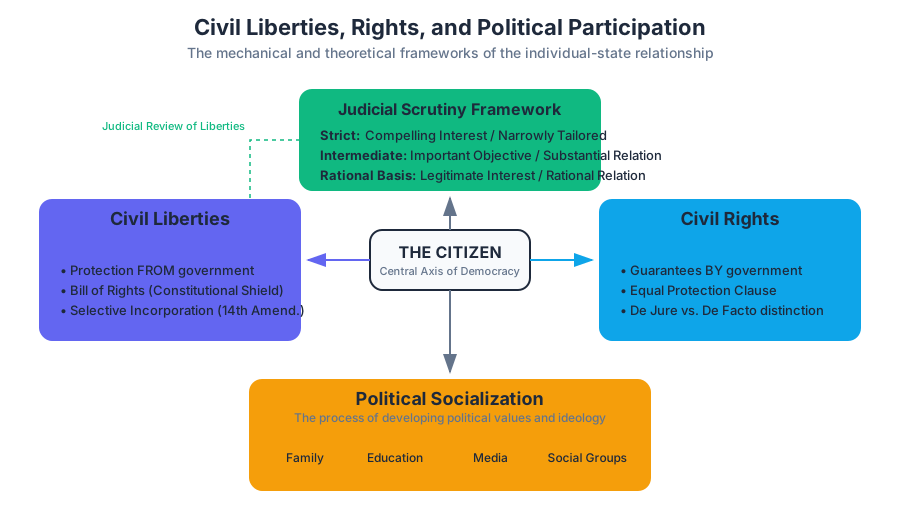
The relationship between the individual and the state is the central axis upon which democratic theory rotates. In the American context, this relationship is governed by a complex interplay of constitutional constraints, judicial interpretations, and the evolving collective consciousness of the citizenry. This article explores the mechanical and theoretical frameworks of Civil Liberties and Civil Rights, the processes of Political Socialization, and the metrics of Public Opinion and Participation.
1. Civil Liberties: The Architecture of Negative Liberty
Civil Liberties are the fundamental individual freedoms protected from government infringement. Conceptually, these are often referred to as "negative rights" because they define what the government cannot do. They act as a constitutional shield, primarily codified in the Bill of Rights.
1.1 The Mechanism of Selective Incorporation
Originally, the Bill of Rights applied only to the federal government (Barron v. Baltimore, 1833). The transformation of these liberties into universal protections against state-level interference occurred through the Due Process Clause of the Fourteenth Amendment. This process, known as Selective Incorporation, involves the Supreme Court deciding on a case-by-case basis which rights are "fundamental to the American scheme of justice."
1.2 The Judicial Scrutiny Framework
When a law is challenged for infringing upon a civil liberty, the judiciary applies different levels of "scrutiny" to determine the law's constitutionality.
| Level of Scrutiny | Application | Requirement for Government | Burden of Proof |
|---|---|---|---|
| Strict Scrutiny | Fundamental rights (speech, religion) or "suspect classifications" (race). | Must prove a "compelling state interest" and the law must be "narrowly tailored" using the "least restrictive means." | Government |
| Intermediate Scrutiny | Gender-based classifications or commercial speech. | Must prove an "important governmental objective" and the law must be "substantially related" to that objective. | Government |
| Rational Basis Test | Economic regulations, age, or disability. | Must prove the law is "rationally related" to a "legitimate government interest." | Challenger |
2. Civil Rights: The Mandate for Positive Liberty
While liberties are protections from government, Civil Rights are guarantees by the government that it will treat people equally and that decisions will be based on merit rather than personal characteristics. These are "positive rights" that require state action to enforce.
2.1 The Equal Protection Clause
The core of civil rights in the U.S. is the Equal Protection Clause of the Fourteenth Amendment. This clause prohibits states from denying any person within their jurisdiction the equal protection of the laws.
Definition: De Jure vs. De Facto Discrimination
- De Jure Discrimination: Discrimination that is mandated by law (e.g., Jim Crow laws).
- De Facto Discrimination: Discrimination that occurs in practice, often due to social or economic conditions, rather than legal requirements (e.g., residential segregation leading to school segregation).
2.2 Measuring Disparate Impact
In civil rights litigation, particularly in employment or housing, the "Four-Fifths Rule" is often used to identify potential discrimination.
\text{Impact Ratio} = \frac{\text{Selection Rate of Protected Group}}{\text{Selection Rate of Majority Group}}
If the ratio is less than 0.80 (80%), it is considered evidence of Disparate Impact, shifting the burden to the defendant to prove the practice is a "business necessity."
3. Political Socialization: The Genesis of Ideology
Political Socialization is the process by which individuals develop their political values, beliefs, and orientations. It is the "programming" phase of the political system, ensuring the persistence of political culture across generations.
3.1 Agents of Socialization
The primary agents of socialization function as data inputs that shape an individual's political heuristic.
- Family: The most influential agent. Children often adopt the party identification of their parents.
- Education: Schools introduce concepts of civic duty and national identity.
- Social Groups: Peer groups, religious organizations, and professional associations provide reinforcement or "echo chambers."
- The Media: Acts as a "gatekeeper" and "agenda-setter," determining which issues are perceived as important.
3.2 The Persistence vs. Lifelong Openness Models
Social scientists debate how fixed these views are. The Persistence Model suggests that political orientations acquired in late adolescence and early adulthood remain remarkably stable. The Lifelong Openness Model suggests that individuals continue to adapt their views based on significant life events (e.g., economic recessions, wars).
| Model | Core Assumption | Primary Driver |
|---|---|---|
| Persistence | Political identity is an "unshakable" core trait. | Early childhood/adolescent environment. |
| Impressionable Years | High volatility in youth, stability in adulthood. | First 2-3 election cycles of adulthood. |
| Lifelong Openness | Identity is fluid and reactive. | Current events, personal economic status. |
4. Public Opinion: The Pulse of the Body Politic
Public Opinion is the aggregate of individual attitudes or beliefs shared by some portion of the adult population. In a representative democracy, it serves as a feedback loop between the governed and the governors.
4.1 Measurement and the Margin of Error
Public opinion is measured through scientific polling. The accuracy of a poll depends on Random Sampling, where every member of the population has an equal chance of being selected.
The Margin of Error (MoE) is a statistical expression of the amount of random sampling error in a survey's results. It is calculated based on the sample size ($n$).
MoE = z \times \sqrt{\frac{\hat{p}(1-\hat{p})}{n}}
Where $z$ is the z-score (e.g., 1.96 for 95% confidence), $\hat{p}$ is the sample proportion, and $n$ is the sample size.
4.2 Heuristics and Information Shortcuts
Most citizens do not possess detailed knowledge of policy. Instead, they use Heuristics—mental shortcuts—to make political decisions. Common heuristics include:
- Party Identification: Voting for a candidate simply because they belong to a specific party.
- Retrospective Voting: Judging a candidate based on past performance (e.g., "Am I better off now than I was four years ago?").
- Endorsements: Following the lead of trusted interest groups or public figures.
5. Political Participation: The Cost-Benefit of Engagement
Political Participation encompasses all activities by which citizens attempt to influence the selection of political leaders and the policies they pursue.
5.1 The Calculus of Voting
Economist Anthony Downs proposed a rational choice model to explain why people vote. The "Paradox of Voting" suggests that since the probability of one's vote being the tie-breaker is near zero, the rational choice is often to abstain.
V = P(B) - C + D
- $V$: The reward from voting.
- $P$: Probability that the vote affects the outcome.
- $B$: The perceived benefit of one candidate winning over another.
- $C$: The cost of voting (time, effort, registration).
- $D$: The "Duty" or "Civic Duty" factor (the psychological benefit of participating).
5.2 Modes of Participation
Participation is not limited to voting. It exists on a spectrum of intensity and institutionalization.
| Type | Examples | Level of Effort | System Impact |
|---|---|---|---|
| Conventional | Voting, donating to campaigns, contacting reps. | Low to Moderate | Reinforces existing structures. |
| Unconventional | Protests, boycotts, civil disobedience. | High | Challenges existing structures. |
| Digital | Social media activism, online petitions. | Low ("Slightly-activism") | High reach, low depth. |
5.3 Institutional Barriers to Participation
Participation rates are heavily influenced by institutional design. Factors that lower the "cost" ($C$) of voting generally increase turnout:
- Voter Registration: Automatic vs. manual registration.
- Election Timing: Tuesday elections vs. weekend/holiday voting.
- Voter ID Laws: Requirements for specific forms of identification.
- Mail-in Ballots: Increasing accessibility for those with mobility or time constraints.
7. Modern Challenges: The Digital Frontier
The digital age has introduced new complexities to civil liberties and rights.
- The Third-Party Doctrine: A civil liberties challenge where the government can access data held by third parties (ISPs, social media) without a warrant, as users "voluntarily" shared it.
- Algorithmic Bias: A civil rights challenge where automated systems (for hiring or sentencing) inadvertently replicate human biases, leading to de facto discrimination.
- Micro-targeting: A political socialization challenge where data-driven campaigns create highly specific "information bubbles," fragmenting public opinion.
8. Summary of Interconnections
The concepts in this section are not isolated; they form a feedback loop. Civil Liberties provide the space for Political Socialization to occur without state coercion. This socialization forms the basis of Public Opinion, which in turn drives Political Participation. When participation leads to the election of new leaders, they may pass laws that expand Civil Rights, which are then protected by the judiciary using the frameworks of Civil Liberties.
Source Materials
Study American Government 3e on Lykke
This course page is free to open: signed out, you can read its first two sections, and signing in, on any plan, opens the rest. The free Lykke Chrome extension syncs your own Canvas courses, so ChatGPT, Claude and Muse can answer from your classes and deadlines. It only reads Canvas.
Add the free extensionSign in to open every sectionAll sections of American Government 3e · Browse more course pages