American Government 3e
Institution: MIT
1 study materials · 4 sections
OpenStax American Government 3e provides a comprehensive exploration of the United States political system, focusing on the intersection of institutional design and active citizenship. The course covers the historical foundations of the Constitution, the mechanics of political participation, and the functions of the branches of government. By integrating diverse perspectives and real-world applications, it aims to equip students with the knowledge necessary for informed civic engagement in a modern democracy.
Course Sections
Foundations of American Government
Key concepts: Institutional Design · Social Contract · Federalism · Separation of Powers
Explores the philosophical origins, the creation of the Constitution, and the framework of Federalism.
Foundations of American Government
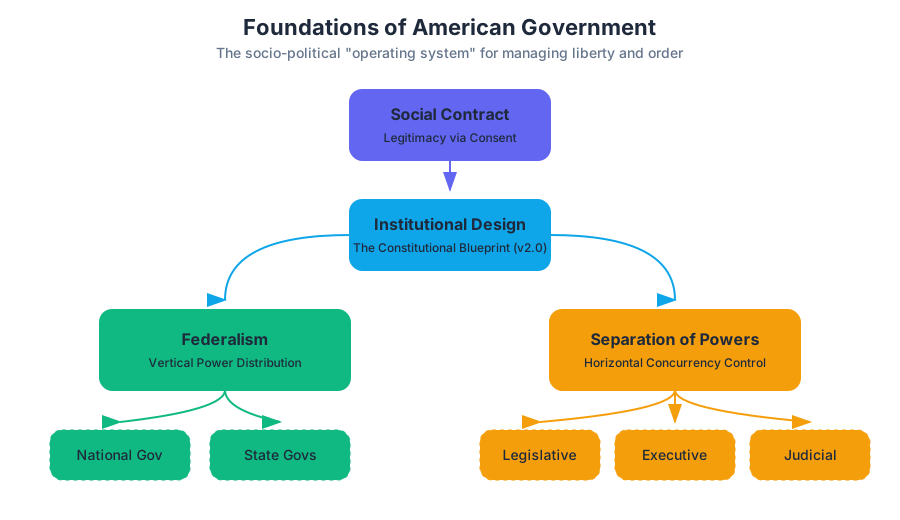
The American political system is not merely a collection of laws, but a complex Institutional Design—a socio-political "operating system" engineered to manage the inherent tensions between collective order and individual liberty. At its core, the foundation rests upon the transition from monarchical "divine right" to the Social Contract, where legitimacy is derived from the consent of the governed. This architecture is operationalized through Federalism (a distributed power model) and the Separation of Powers (a concurrency control mechanism), ensuring that no single entity can achieve total state capture.
The Social Contract: The Logic of Legitimacy
The Social Contract is the theoretical framework justifying the existence of the state and the limits of its authority. It posits that individuals in a "state of nature" (a hypothetical condition without government) would rationally agree to surrender certain absolute freedoms in exchange for the protection of their remaining rights.
Philosophical Lineage
The American implementation of the Social Contract is primarily a synthesis of Enlightenment thought, specifically the transition from Hobbesian absolutism to Lockean liberalism.
| Philosopher | State of Nature | Purpose of Government | Right to Revolt? | Influence on U.S. Foundations |
|---|---|---|---|---|
| Thomas Hobbes | "Nasty, brutish, and short"; a war of all against all. | To provide security and prevent violent death. | No; the Sovereign's power is absolute. | The necessity of a strong central executive to prevent anarchy. |
| John Locke | Mostly peaceful, but property rights are insecure. | To protect "Life, Liberty, and Estate." | Yes; if the government violates the contract. | The Declaration of Independence; Natural Rights; Limited Government. |
| Jean-Jacques Rousseau | Noble savages corrupted by societal inequality. | To enact the "General Will" of the people. | Yes; the people are the sovereign. | Popular sovereignty; "We the People." |
Definition: Popular Sovereignty The principle that the authority of a state and its government are created and sustained by the consent of its people, through their elected representatives (Rule by the People), who are the source of all political power.
Implementation as "Source Code"
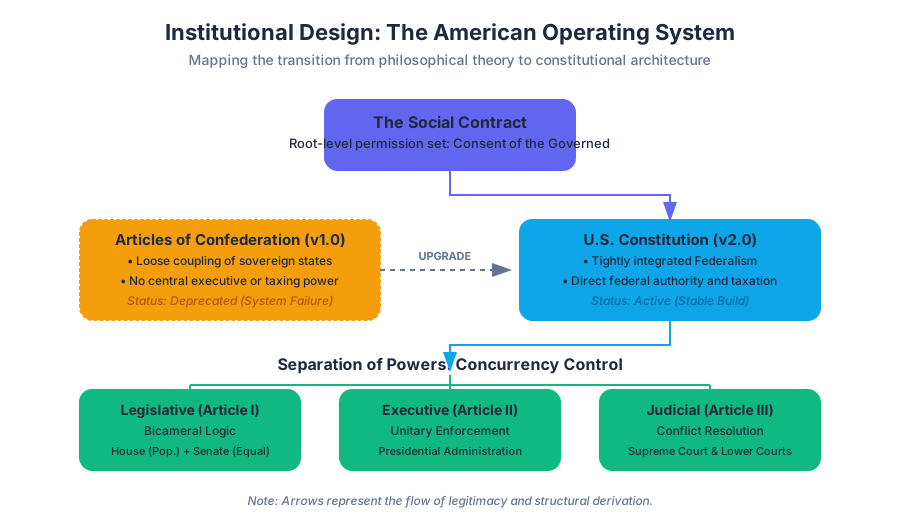
In a technical sense, the Social Contract acts as the root-level permission set for the state. If the government (the agent) exceeds the bounds defined by the people (the principal), a "contract violation" occurs.
/*
 * social_contract.c
 * A low-level representation of the Lockean Social Contract logic.
 * This simulates the conditional legitimacy of state power.
 */

#include <stdio.h>
#include <stdbool.h>

typedef struct {
    bool protects_life;
    bool protects_liberty;
    bool protects_property;
    bool requires_consent;
} GovernmentState;

bool check_legitimacy(GovernmentState gov) {
    // The "Lockean Condition": Government is only valid if it satisfies
    // the protection of natural rights AND has consent.
    if (gov.protects_life && gov.protects_liberty &&
        gov.protects_property && gov.requires_consent) {
        return true; // Legitimate
    }
    return false; // Contract Breach: Right to Revolt triggered
}

int main() {
    GovernmentState tyranny = {true, false, true, false};

    if (!check_legitimacy(tyranny)) {
        printf("Status: Breach of Social Contract. Dissolving political bands...\n");
    }

    return 0;
}
Institutional Design: The Architecture of Compromise
Institutional Design refers to the deliberate arrangement of rules, roles, and structures that define how a government functions. The U.S. Constitution is the "technical specification" for this design, born out of the failure of the Articles of Confederation—the first, highly decentralized iteration of American government.
The Articles of Confederation vs. The Constitution
The transition from the Articles to the Constitution represents a shift from a "loose coupling" of sovereign states to a "tightly integrated" federal system.
| Feature | Articles of Confederation (v1.0) | U.S. Constitution (v2.0) |
|---|---|---|
| Sovereignty | Resided in the states. | Resided in the people (Federalism). |
| Legislature | Unicameral (one house); one vote per state. | Bicameral (House and Senate); proportional and equal. |
| Executive | None; no presiding officer with power. | Strong President (Article II). |
| Judiciary | No national court system. | Supreme Court and lower federal courts (Article III). |
| Taxation | States could refuse federal requests for funds. | Federal government has direct power to tax. |
| Amendment | Required unanimous consent of all states. | Required 2/3 of Congress and 3/4 of states. |
The Great Compromise (Connecticut Compromise)
The most critical design challenge was balancing the interests of large vs. small states. This was solved through a bicameral legislative structure:
- The House of Representatives: Proportional representation (favoring large states like Virginia).
- The Senate: Equal representation (favoring small states like New Jersey).
Separation of Powers and Checks and Balances
To prevent the concentration of power—which James Madison defined as the "very definition of tyranny"—the design employs Separation of Powers. This divides the functions of government into three distinct branches, each with its own "namespace" of authority.
The Madisonian Model
The system is further reinforced by Checks and Balances, which provides each branch with the "constitutional means and personal motives" to resist encroachments by the others. This is not a system of "separated powers" so much as "separate institutions sharing power."
Mathematical Representation of Power Indices
In political science, we can model the influence of these branches using the Banzhaf Power Index ($\beta$), which measures the probability of a player (branch) being "pivotal" in a winning coalition.
In a simplified model where $W$ is a winning policy outcome: $$ \beta_i = \frac{\text{Number of swings for player } i}{2^{n-1}} $$
Where a "swing" occurs if the outcome changes from "Pass" to "Fail" when player $i$ changes their vote. In the U.S. system, the President’s veto power significantly increases their $\beta$ value relative to a single legislator, but the 2/3 override requirement in Congress acts as a "threshold function" that rebalances the system.
\text{Policy Outcome} =
\begin{cases}
1 & \text{if } (Leg_{House} \land Leg_{Senate} \land Exec_{Sign}) \\
1 & \text{if } (Leg_{House}^{2/3} \land Leg_{Senate}^{2/3}) \\
0 & \text{otherwise}
\end{cases}
The Matrix of Checks
| Branch | Power Over Legislative | Power Over Executive | Power Over Judicial |
|---|---|---|---|
| Legislative | N/A | Impeachment; Override Veto; Approve Appointments; Power of the Purse. | Confirm Judges; Impeach Judges; Establish lower courts; Propose Amendments. |
| Executive | Veto Legislation; Call special sessions. | N/A | Appoint Judges; Grant Pardons. |
| Judicial | Judicial Review (declare laws unconstitutional). | Judicial Review (declare executive acts unconstitutional). | N/A |
Federalism: Distributed Governance
Federalism is a system of government in which power is divided between a central (national) authority and constituent political units (states). It is a "multi-tier" architecture designed to bring government closer to the people while maintaining a unified national front for trade and defense.
The Constitutional Basis of Federalism
The "API" for federal-state relations is defined by several key clauses:
- The Supremacy Clause (Article VI): Establishes that the Constitution and federal laws take precedence over state laws.
- The Tenth Amendment: The "Reserved Powers" clause, stating that any power not delegated to the federal government is reserved for the states.
- The Necessary and Proper Clause (Article I, Section 8): Also known as the "Elastic Clause," it allows the federal government to scale its powers to meet new challenges.
Types of Federalism
Federalism has evolved through several "versions":
- Dual Federalism (Layer Cake): Clear separation of powers. States and the federal government operate in distinct spheres with little overlap (1789–1930s).
- Cooperative Federalism (Marble Cake): Blurring of lines. The federal government and states work together on programs like infrastructure and social welfare (1930s–1960s).
- New Federalism (Devolution): An attempt to return power to the states through "block grants" and reduced federal oversight (1980s–Present).
Federalism as Infrastructure as Code (IaC)
We can think of Federalism as a configuration file where certain "variables" are set globally (Federal) and others are set locally (State).
# federal_system_config.yaml
# Global Federal Settings (Article I, Section 8)
federal_government:
  capabilities:
    - declare_war
    - coin_money
    - regulate_interstate_commerce
    - establish_post_offices
  constraints:
    - cannot_violate_bill_of_rights
    - supremacy_clause: enabled

# Local State Settings (10th Amendment)
state_governments:
  reserved_powers:
    - conduct_elections
    - public_health_and_safety
    - education_standards
    - intrastate_commerce
  shared_powers: # Concurrent Powers
    - taxation
    - law_enforcement
    - borrowing_money

# Conflict Resolution Logic
conflict_resolution:
  if_overlap:
    priority: federal_government # Per Article VI
Common Pitfalls and Misconceptions
- The "Slow" Government Fallacy: Many view the gridlock of the U.S. government as a bug. In terms of institutional design, it is a feature. The system was built with high "transaction costs" for passing laws to ensure that only policies with broad consensus could survive the "veto points."
- Federalism vs. Unitary Systems: A common mistake is confusing a federal system with a unitary one (like the UK or France). In a unitary system, sub-national governments are merely administrative arms of the center. In the U.S., states have independent constitutional existence.
- The Scope of Judicial Review: Judicial review is not explicitly mentioned in the Constitution. It was "discovered" or established in the landmark case Marbury v. Madison (1803), effectively completing the system of checks and balances.
Concrete Example: The Legislative Pipeline
To see these foundations in action, consider the passage of a controversial environmental regulation.
- Institutional Design: The bill must pass both the House (representing the people's immediate will) and the Senate (representing state interests).
- Federalism: If the law regulates "intrastate" pollution, a state might challenge it in court, arguing it violates the 10th Amendment.
- Separation of Powers: The President might veto the bill if it interferes with executive energy policy.
- Judicial Review: Even if signed, the Supreme Court might strike it down if it exceeds the "Commerce Clause" powers granted in Article I.
Real-World CLI Simulation
Using a command-line analogy, we can see how a law is "compiled" and "executed" within the system.
# 1. Propose a law (Legislative Branch)
$ congress --propose "Clean Air Act v2" --house-vote 218 --senate-vote 51

# 2. Executive Review
$ president --review "Clean Air Act v2"
> Status: VETO (Reason: Economic impact too high)

# 3. Legislative Override Attempt
$ congress --override "Clean Air Act v2" --house-vote 290 --senate-vote 67
> Status: OVERRIDE SUCCESSFUL (2/3 threshold met)

# 4. Judicial Challenge (The "Debugger")
$ scotus --evaluate "Clean Air Act v2" --constitution-check
> Result: CONSTITUTIONAL (Valid exercise of Commerce Clause)
> Output: Law deployed to 50 states.
Summary of Foundational Principles
The American experiment is a high-stakes exercise in Institutional Design. By acknowledging the flaws of human nature ("If men were angels, no government would be necessary"), the founders built a system of Separation of Powers and Federalism that relies on friction to protect liberty. The Social Contract remains the underlying "legal tender" of the system—as long as the government protects the rights of the people, it retains the authority to govern.
Civil Liberties, Rights, and Political Participation
Key concepts: Civil Liberties · Civil Rights · Public Opinion · Political Socialization
Covers the protections afforded to individuals and the various ways citizens engage with the political process.
Civil Liberties, Rights, and Political Participation
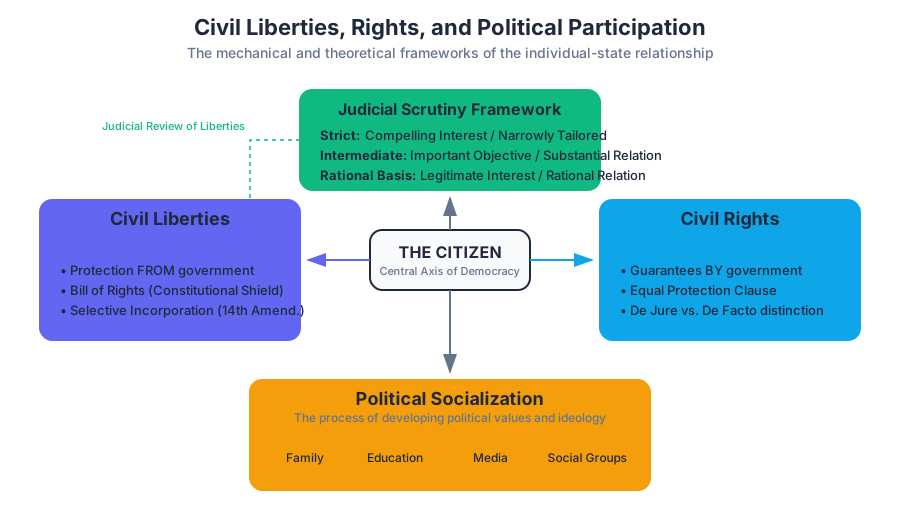
The relationship between the individual and the state is the central axis upon which democratic theory rotates. In the American context, this relationship is governed by a complex interplay of constitutional constraints, judicial interpretations, and the evolving collective consciousness of the citizenry. This article explores the mechanical and theoretical frameworks of Civil Liberties and Civil Rights, the processes of Political Socialization, and the metrics of Public Opinion and Participation.
1. Civil Liberties: The Architecture of Negative Liberty
Civil Liberties are the fundamental individual freedoms protected from government infringement. Conceptually, these are often referred to as "negative rights" because they define what the government cannot do. They act as a constitutional shield, primarily codified in the Bill of Rights.
1.1 The Mechanism of Selective Incorporation
Originally, the Bill of Rights applied only to the federal government (Barron v. Baltimore, 1833). The transformation of these liberties into universal protections against state-level interference occurred through the Due Process Clause of the Fourteenth Amendment. This process, known as Selective Incorporation, involves the Supreme Court deciding on a case-by-case basis which rights are "fundamental to the American scheme of justice."
1.2 The Judicial Scrutiny Framework
When a law is challenged for infringing upon a civil liberty, the judiciary applies different levels of "scrutiny" to determine the law's constitutionality.
| Level of Scrutiny | Application | Requirement for Government | Burden of Proof |
|---|---|---|---|
| Strict Scrutiny | Fundamental rights (speech, religion) or "suspect classifications" (race). | Must prove a "compelling state interest" and the law must be "narrowly tailored" using the "least restrictive means." | Government |
| Intermediate Scrutiny | Gender-based classifications or commercial speech. | Must prove an "important governmental objective" and the law must be "substantially related" to that objective. | Government |
| Rational Basis Test | Economic regulations, age, or disability. | Must prove the law is "rationally related" to a "legitimate government interest." | Challenger |
1.3 Implementation Logic: The Strict Scrutiny Algorithm
To understand how the court evaluates a restriction on liberty, we can model the logic of Strict Scrutiny as a decision-making algorithm.
def evaluate_constitutionality(law):
    """
    Evaluates a law under the Strict Scrutiny framework.
    Returns True if the law is likely constitutional, False otherwise.
    """
    compelling_interest = law.has_compelling_state_interest()
    narrowly_tailored = law.is_narrowly_tailored()
    least_restrictive = law.is_least_restrictive_means()

    # Strict Scrutiny requires all three conditions to be met
    if compelling_interest and narrowly_tailored and least_restrictive:
        return {
            "status": "Constitutional",
            "reasoning": "The state demonstrated a compelling interest using the narrowest possible scope."
        }
    else:
        failures = []
        if not compelling_interest: failures.append("No compelling interest")
        if not narrowly_tailored: failures.append("Overbroad application")
        if not least_restrictive: failures.append("More restrictive than necessary")

        return {
            "status": "Unconstitutional",
            "reasoning": f"Failed on: {', '.join(failures)}"
        }
2. Civil Rights: The Mandate for Positive Liberty
While liberties are protections from government, Civil Rights are guarantees by the government that it will treat people equally and that decisions will be based on merit rather than personal characteristics. These are "positive rights" that require state action to enforce.
2.1 The Equal Protection Clause
The core of civil rights in the U.S. is the Equal Protection Clause of the Fourteenth Amendment. This clause prohibits states from denying any person within their jurisdiction the equal protection of the laws.
Definition: De Jure vs. De Facto Discrimination
- De Jure Discrimination: Discrimination that is mandated by law (e.g., Jim Crow laws).
- De Facto Discrimination: Discrimination that occurs in practice, often due to social or economic conditions, rather than legal requirements (e.g., residential segregation leading to school segregation).
2.2 Measuring Disparate Impact
In civil rights litigation, particularly in employment or housing, the "Four-Fifths Rule" is often used to identify potential discrimination.
\text{Impact Ratio} = \frac{\text{Selection Rate of Protected Group}}{\text{Selection Rate of Majority Group}}
If the ratio is less than 0.80 (80%), it is considered evidence of Disparate Impact, shifting the burden to the defendant to prove the practice is a "business necessity."
3. Political Socialization: The Genesis of Ideology
Political Socialization is the process by which individuals develop their political values, beliefs, and orientations. It is the "programming" phase of the political system, ensuring the persistence of political culture across generations.
3.1 Agents of Socialization
The primary agents of socialization function as data inputs that shape an individual's political heuristic.
- Family: The most influential agent. Children often adopt the party identification of their parents.
- Education: Schools introduce concepts of civic duty and national identity.
- Social Groups: Peer groups, religious organizations, and professional associations provide reinforcement or "echo chambers."
- The Media: Acts as a "gatekeeper" and "agenda-setter," determining which issues are perceived as important.
3.2 The Persistence vs. Lifelong Openness Models
Social scientists debate how fixed these views are. The Persistence Model suggests that political orientations acquired in late adolescence and early adulthood remain remarkably stable. The Lifelong Openness Model suggests that individuals continue to adapt their views based on significant life events (e.g., economic recessions, wars).
| Model | Core Assumption | Primary Driver |
|---|---|---|
| Persistence | Political identity is an "unshakable" core trait. | Early childhood/adolescent environment. |
| Impressionable Years | High volatility in youth, stability in adulthood. | First 2-3 election cycles of adulthood. |
| Lifelong Openness | Identity is fluid and reactive. | Current events, personal economic status. |
4. Public Opinion: The Pulse of the Body Politic
Public Opinion is the aggregate of individual attitudes or beliefs shared by some portion of the adult population. In a representative democracy, it serves as a feedback loop between the governed and the governors.
4.1 Measurement and the Margin of Error
Public opinion is measured through scientific polling. The accuracy of a poll depends on Random Sampling, where every member of the population has an equal chance of being selected.
The Margin of Error (MoE) is a statistical expression of the amount of random sampling error in a survey's results. It is calculated based on the sample size ($n$).
MoE = z \times \sqrt{\frac{\hat{p}(1-\hat{p})}{n}}
Where $z$ is the z-score (e.g., 1.96 for 95% confidence), $\hat{p}$ is the sample proportion, and $n$ is the sample size.
4.2 Heuristics and Information Shortcuts
Most citizens do not possess detailed knowledge of policy. Instead, they use Heuristics—mental shortcuts—to make political decisions. Common heuristics include:
- Party Identification: Voting for a candidate simply because they belong to a specific party.
- Retrospective Voting: Judging a candidate based on past performance (e.g., "Am I better off now than I was four years ago?").
- Endorsements: Following the lead of trusted interest groups or public figures.
5. Political Participation: The Cost-Benefit of Engagement
Political Participation encompasses all activities by which citizens attempt to influence the selection of political leaders and the policies they pursue.
5.1 The Calculus of Voting
Economist Anthony Downs proposed a rational choice model to explain why people vote. The "Paradox of Voting" suggests that since the probability of one's vote being the tie-breaker is near zero, the rational choice is often to abstain.
V = P(B) - C + D
- $V$: The reward from voting.
- $P$: Probability that the vote affects the outcome.
- $B$: The perceived benefit of one candidate winning over another.
- $C$: The cost of voting (time, effort, registration).
- $D$: The "Duty" or "Civic Duty" factor (the psychological benefit of participating).
5.2 Modes of Participation
Participation is not limited to voting. It exists on a spectrum of intensity and institutionalization.
| Type | Examples | Level of Effort | System Impact |
|---|---|---|---|
| Conventional | Voting, donating to campaigns, contacting reps. | Low to Moderate | Reinforces existing structures. |
| Unconventional | Protests, boycotts, civil disobedience. | High | Challenges existing structures. |
| Digital | Social media activism, online petitions. | Low ("Slightly-activism") | High reach, low depth. |
5.3 Institutional Barriers to Participation
Participation rates are heavily influenced by institutional design. Factors that lower the "cost" ($C$) of voting generally increase turnout:
- Voter Registration: Automatic vs. manual registration.
- Election Timing: Tuesday elections vs. weekend/holiday voting.
- Voter ID Laws: Requirements for specific forms of identification.
- Mail-in Ballots: Increasing accessibility for those with mobility or time constraints.
6. Data Modeling: Tracking Civil Rights and Participation
To manage and analyze the intersection of these concepts, researchers often use relational databases to track litigation, demographic shifts, and participation rates.
-- Schema for tracking Civil Rights Litigation and Outcomes
CREATE TABLE CivilRightsCases (
    case_id INT PRIMARY KEY,
    case_name VARCHAR(255) NOT NULL,
    protected_class VARCHAR(100), -- e.g., Race, Gender, Religion
    legal_basis VARCHAR(100),    -- e.g., 14th Amendment, Title VII
    court_level VARCHAR(50),     -- e.g., District, Circuit, Supreme
    scrutiny_applied VARCHAR(50), -- e.g., Strict, Intermediate, Rational
    outcome_for_plaintiff BOOLEAN,
    precedent_set TEXT
);

-- Query to find success rate of Strict Scrutiny cases
SELECT
    protected_class,
    COUNT(*) as total_cases,
    SUM(CASE WHEN outcome_for_plaintiff THEN 1 ELSE 0 END) * 100.0 / COUNT(*) as success_percentage
FROM CivilRightsCases
WHERE scrutiny_applied = 'Strict'
GROUP BY protected_class;
7. Modern Challenges: The Digital Frontier
The digital age has introduced new complexities to civil liberties and rights.
- The Third-Party Doctrine: A civil liberties challenge where the government can access data held by third parties (ISPs, social media) without a warrant, as users "voluntarily" shared it.
- Algorithmic Bias: A civil rights challenge where automated systems (for hiring or sentencing) inadvertently replicate human biases, leading to de facto discrimination.
- Micro-targeting: A political socialization challenge where data-driven campaigns create highly specific "information bubbles," fragmenting public opinion.
Configuration Example: Sentiment Analysis for Public Opinion
Modern political scientists use Natural Language Processing (NLP) to gauge public opinion in real-time. Below is a conceptual configuration for a sentiment analysis pipeline.
# sentiment_pipeline_config.yml
pipeline_name: "PublicOpinionPulse_v2"
data_sources:
  - source_name: "Twitter_API"
    keywords: ["Election2024", "CivilRights", "Healthcare"]
    sample_rate: 0.05
  - source_name: "Reddit_Politics"
    subreddits: ["politics", "neutralpolitics"]

processing_engine:
  model: "bert-large-uncased-political-sentiment"
  thresholds:
    positive: > 0.75
    negative: < 0.25
  entities_to_track:
    - "Department of Justice"
    - "Supreme Court"
    - "Voting Rights Act"

output:
  format: "json"
  destination: "s3://political-data-lake/sentiment-daily/"
8. Summary of Interconnections
The concepts in this section are not isolated; they form a feedback loop. Civil Liberties provide the space for Political Socialization to occur without state coercion. This socialization forms the basis of Public Opinion, which in turn drives Political Participation. When participation leads to the election of new leaders, they may pass laws that expand Civil Rights, which are then protected by the judiciary using the frameworks of Civil Liberties.
The Institutions of Government
Key concepts: Congress · The Presidency · Judicial Review · Bureaucracy
An in-depth look at the three branches of government and the federal bureaucracy.
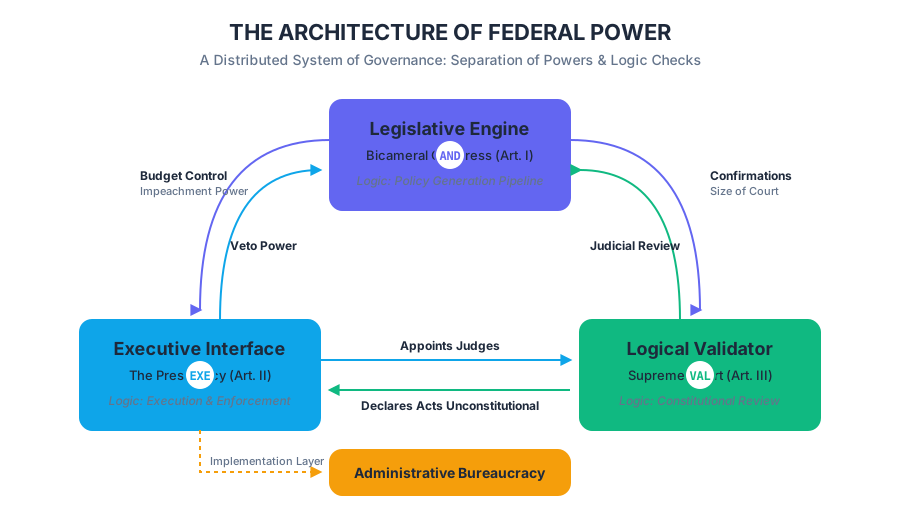
The Institutions of Government: The Architecture of Federal Power
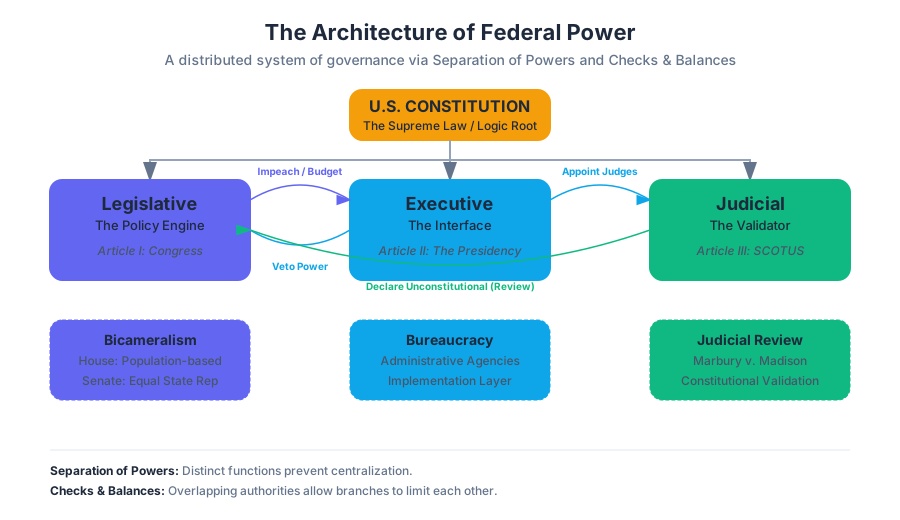
The United States government is structured as a distributed system of governance, designed to prevent the centralization of authority through a rigorous framework of Separation of Powers and Checks and Balances. This architecture is not merely a legal formality but a functional requirement for managing a continental republic. By partitioning the state's functions into three distinct branches—Legislative, Executive, and Judicial—and supporting them with a massive administrative Bureaucracy, the system ensures that no single entity can execute, legislate, and adjudicate simultaneously.
1. Congress: The Legislative Engine
Congress serves as the primary "state-machine" for policy generation. It is a bicameral legislature, a design choice resulting from the Great Compromise of 1787, intended to balance the interests of populous states (represented in the House) and smaller states (represented in the Senate).
1.1 The Architecture of Bicameralism
The House of Representatives and the Senate operate on different logic gates. The House is designed for rapid response to public sentiment, while the Senate is intended as a "cooling saucer" to provide stability and long-term deliberation.
| Feature | House of Representatives | U.S. Senate |
|---|---|---|
| Membership | 435 members (apportioned by population) | 100 members (2 per state) |
| Term Length | 2 years | 6 years (staggered) |
| Constituency | Local districts | Entire states |
| Core Logic | Majoritarian; highly structured rules | Individualistic; relies on unanimous consent |
| Unique Power | Initiation of revenue bills; Impeachment | Advice and Consent; Treaty ratification; Trials |
1.2 The Legislative Pipeline
The process of transforming a bill into law is a high-latency, multi-stage pipeline with numerous "kill switches." Most legislation fails at the Committee Stage, which acts as a filter for the thousands of proposals introduced each session.
Definition: The Filibuster A procedural tactic in the Senate where a minority of senators can delay or prevent a vote on a piece of legislation by speaking for an extended period. Breaking a filibuster requires a Cloture vote of 60 senators.
# A simplified simulation of the Legislative Pipeline Logic
class LegislativeProcess:
    def __init__(self, bill):
        self.bill = bill
        self.status = "Introduced"

    def committee_review(self, support_threshold=0.5):
        # Most bills die here (The 'Gatekeeper' phase)
        if self.bill.viability > support_threshold:
            self.status = "Reported to Floor"
            return True
        self.status = "Dead in Committee"
        return False

    def floor_vote(self, chamber, cloture_met=True):
        if chamber == "Senate" and not cloture_met:
            self.status = "Filibustered"
            return False

        if self.bill.votes > (0.5 * chamber.size):
            return True
        return False

    def reconciliation(self, house_version, senate_version):
        # Resolve differences between two versions of the same bill
        if house_version == senate_version:
            return "Sent to President"
        return "Conference Committee"

# Example Bill Object
infrastructure_bill = type('Bill', (object,), {'viability': 0.8, 'votes': 220})
2. The Presidency: The Executive Interface
The Presidency is the "head of state" and "head of government," functioning as the executive interface for the federal system. While Article II of the Constitution is shorter and more ambiguous than Article I (Congress), the office has expanded significantly through Inherent Powers and the growth of the modern administrative state.
2.1 Taxonomy of Presidential Power
Presidential authority can be categorized into formal (expressed) and informal (persuasive) powers.
| Power Category | Source | Examples |
|---|---|---|
| Expressed | Constitution (Art. II) | Commander-in-Chief, Veto, Pardon, Appointments |
| Implied | Necessary for Expressed | Removal of officials, Executive Agreements |
| Inherent | Derived from Sovereignty | Emergency powers, Border control |
| Delegated | Granted by Congress | Budgetary implementation, Regulatory enforcement |
2.2 The Executive Order as a Configuration Script
An Executive Order is a directive issued by the President that manages operations of the federal government. While it has the force of law, it cannot override existing statutes and can be rescinded by subsequent administrations or struck down by the courts.
# Conceptual representation of an Executive Order as a system configuration
executive_order:
  id: "EO-14028"
  title: "Improving the Nation's Cybersecurity"
  issuer: "President of the United States"
  target_entities:
    - Department of Defense
    - Department of Homeland Security
    - All Federal Agencies
  directives:
    - action: "Implement Multi-Factor Authentication"
      deadline: "180 days"
      priority: "CRITICAL"
    - action: "Transition to Zero Trust Architecture"
      framework: "NIST SP 800-207"
  legal_basis: "U.S. Constitution, Article II"
3. Judicial Review: The Logical Validator
The Judiciary, led by the Supreme Court of the United States (SCOTUS), serves as the system's validator. Its primary mechanism is Judicial Review—the power to declare acts of Congress or the Executive unconstitutional.
3.1 Marbury v. Madison and the Power of Review
The power of Judicial Review is not explicitly stated in the Constitution. It was established in the landmark case Marbury v. Madison (1803). Chief Justice John Marshall reasoned that if the Constitution is the "supreme law of the land," any statute in conflict with it must be void.
Theorem: The Supremacy Clause Logic If $C$ is the set of Constitutional principles and $L$ is a legislative act, then $L$ is valid if and only if $L \subseteq C$. If $L \cap \neg C \neq \emptyset$, the Judiciary must invalidate $L$.
3.2 The Court Hierarchy
The federal court system is organized into a three-tier hierarchy, ensuring multiple layers of review for legal disputes.
| Level | Function | Scope |
|---|---|---|
| U.S. District Courts | Trial courts; Fact-finding | 94 districts; Original jurisdiction |
| U.S. Circuit Courts | Appellate review; Law-finding | 13 circuits; Mandatory appeals |
| Supreme Court | Final arbiter; Constitutional focus | 1 court; Discretionary (Writ of Certiorari) |
3.3 Judicial Philosophies
How judges interpret the "source code" of the Constitution varies based on their interpretive philosophy:
- Originalism: Interpreting the text as it was understood at the time of its writing.
- Living Constitution: Interpreting the text in the context of modern societal values and technological changes.
4. The Bureaucracy: The Runtime Environment
The Federal Bureaucracy is the administrative arm that implements the laws passed by Congress and the directives issued by the President. It is often referred to as the "Fourth Branch" due to its vast size and its role in Administrative Rulemaking.
4.1 The Structure of the Bureaucracy
The bureaucracy is composed of several types of entities, each with a different level of independence from the Executive.
| Entity Type | Description | Example |
|---|---|---|
| Cabinet Departments | Major service organizations; headed by Secretaries | Dept. of State, Dept. of Treasury |
| Independent Agencies | Narrower focus; outside cabinet structure | NASA, CIA |
| Regulatory Commissions | Protect public interest; quasi-judicial powers | SEC, FCC, Federal Reserve |
| Gov. Corporations | Provide market-based services | USPS, Amtrak |
4.2 The Rulemaking Process
When Congress passes a law, it often lacks the technical specificity required for implementation. The Bureaucracy fills these gaps through a process governed by the Administrative Procedure Act (APA).
- Notice: The agency publishes a proposed rule in the Federal Register.
- Comment: The public, lobbyists, and experts provide feedback.
- Final Rule: The agency publishes the final version, which has the force of law.
# Interacting with the Bureaucracy (Conceptual CLI)
# Fetching the latest rules from the Federal Register API

curl -X GET "https://www.federalregister.gov/api/v1/documents.json?conditions[agencies][]=epa&conditions[type][]=RULE" \
     -H "accept: application/json"

# Response might include:
# {
#   "title": "National Emission Standards for Hazardous Air Pollutants",
#   "action": "Final Rule",
#   "effective_date": "2023-12-01",
#   "legal_authority": "42 U.S.C. 7401 et seq."
# }
4.3 Pitfalls: The Iron Triangle
A common critique of the bureaucracy is the Iron Triangle, a three-way relationship between a congressional committee, an administrative agency, and an interest group. This feedback loop can lead to "regulatory capture," where the agency serves the interests of the industry it is supposed to regulate rather than the public.
5. Synthesis: The Interplay of Institutions
The institutions of government do not operate in isolation. They are linked through a series of "API calls" (checks and balances):
- Legislative $\rightarrow$ Executive: Congress passes a budget; the President can veto it. Congress can override the veto with a 2/3 majority.
- Executive $\rightarrow$ Judicial: The President appoints federal judges; the Senate must confirm them.
- Judicial $\rightarrow$ Legislative: The Supreme Court can strike down a law as unconstitutional.
- Bureaucracy $\rightarrow$ All: The Bureaucracy provides the technical expertise and implementation power that the other branches lack, but it is subject to Congressional oversight and Judicial review.
Common Pitfalls in Understanding
- Misconception: The President can do anything via Executive Order.
- Reality: Executive orders are limited to the management of the executive branch and must be rooted in statutory or constitutional authority.
- Misconception: The Supreme Court hears every case appealed to it.
- Reality: The Court receives ~7,000-8,000 petitions annually but grants a Writ of Certiorari to only about 70-80 cases (approx. 1%).
- Misconception: The Bureaucracy is "unelected" and therefore "unaccountable."
- Reality: While civil servants are not elected, the heads of agencies are appointed by the President, and their budgets and legal authorities are strictly controlled by Congress.
Public Policy and Civic Engagement
Key concepts: Domestic Policy · Foreign Policy · Economic Policy · Civic Engagement
Examines the outputs of government, including domestic and foreign policy, and the role of the citizen in the policy cycle.
Public Policy and Civic Engagement
Public policy is the formal expression of government intent. It is the connective tissue between the theoretical constructs of political science and the lived reality of the citizenry. Far from being a static set of rules, public policy is a dynamic, iterative process of resource allocation, behavioral regulation, and social engineering. It represents the "output" of the political system—the tangible results of elections, lobbying, and institutional deliberation.
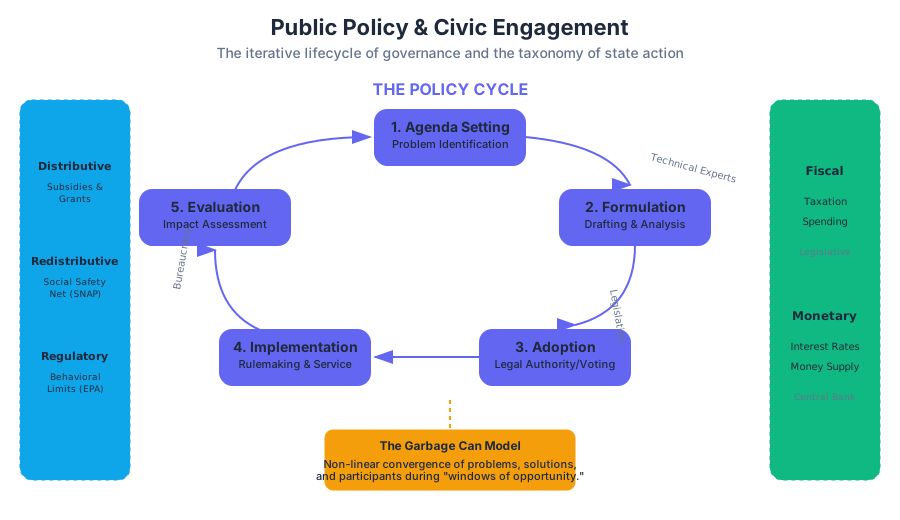
The Policy Cycle: The Mechanics of Governance
The creation of public policy is rarely a singular event. Instead, it follows a structured, though often messy, lifecycle known as the Policy Cycle. This framework allows analysts to decompose complex governmental actions into discrete, manageable stages.
1. Agenda Setting
The process begins with Agenda Setting, where problems are identified and prioritized. Not every social ill becomes a policy issue; a problem must reach a "critical mass" of public concern or interest group pressure to enter the Systemic Agenda (issues the public is discussing) and eventually the Institutional Agenda (issues legislators are actually considering).
2. Policy Formulation and Adoption
Once an issue is on the agenda, stakeholders engage in Policy Formulation. This involves the development of proposed courses of action. Technical experts, think tanks, and legislative staffers draft language, perform cost-benefit analyses, and debate trade-offs. Policy Adoption is the formal step where a proposal gains legal authority, typically through legislative a vote, executive order, or judicial ruling.
3. Implementation and Evaluation
Implementation is the "operational" phase where executive agencies translate statutory language into bureaucratic reality. This often involves Rulemaking, where agencies create specific regulations to fill in the gaps left by broad legislation. Finally, Policy Evaluation assesses whether the policy achieved its intended goals. This stage often feeds back into the first, as evaluations reveal new problems, restarting the cycle.
| Stage | Primary Actors | Key Activities | Output |
|---|---|---|---|
| Agenda Setting | Media, Interest Groups, Public | Problem identification, framing | The Policy Agenda |
| Formulation | Think Tanks, Staffers, Lobbyists | Drafting bills, impact modeling | Proposed Legislation |
| Adoption | Congress, President, Courts | Logrolling, voting, signing | Statutes / Executive Orders |
| Implementation | Bureaucracy (Agencies) | Rulemaking, enforcement | Public Services / Regulations |
| Evaluation | GAO, Academics, Auditors | Data analysis, cost-benefit review | Evaluation Reports |
The Garbage Can Model: In organizational theory, policy-making is often described not as a rational cycle but as a "garbage can" where problems, solutions, and participants move independently. A policy is adopted only when a "window of opportunity" opens, allowing these three streams to converge.
Domestic Policy: The Internal Social Contract
Domestic Policy encompasses all government actions and regulations that concern internal national affairs. It is the primary mechanism through which a state manages its economy, protects its citizens, and provides social services.
Taxonomy of Domestic Policy
Domestic policies are generally categorized by their intent and their impact on different segments of the population:
- Distributive Policy: Collects resources (usually through general taxation) and provides benefits to a specific group. Examples include agricultural subsidies or research grants. These are often "non-zero-sum" in the public perception.
- Redistributive Policy: Explicitly transfers resources from one group to another, typically from higher-income earners to lower-income earners. Programs like Medicaid or the Supplemental Nutrition Assistance Program (SNAP) fall into this category.
- Regulatory Policy: Limits the behavior of individuals or corporations to protect the public interest. This includes environmental protections (EPA) and labor laws (OSHA).
The Social Safety Net
A core component of domestic policy is the Social Safety Net, a collection of services provided by the state which prevent citizens from falling into destitution. This includes Social Insurance (contributory programs like Social Security) and Public Assistance (means-tested programs for the impoverished).
Economic Policy: Managing the Market
Economic policy is a subset of domestic policy focused on the stability and growth of the national economy. It operates through two primary levers: Fiscal Policy and Monetary Policy.
Fiscal Policy
Fiscal Policy involves the use of government spending and taxation to influence the economy. It is rooted in Keynesian Economics, which suggests that during a recession, the government should engage in deficit spending to stimulate demand. Conversely, Supply-Side Economics argues for tax cuts and deregulation to encourage production and investment.
The Multiplier Effect is a critical concept here: the idea that an initial injection of government spending leads to a larger overall increase in national income.
Monetary Policy
Monetary Policy is the management of the money supply and interest rates, typically handled by a central bank (e.g., the Federal Reserve in the U.S.). By adjusting the Federal Funds Rate, the "Fed" can either "heat up" the economy (by lowering rates to encourage borrowing) or "cool it down" (by raising rates to fight inflation).
| Feature | Fiscal Policy | Monetary Policy |
|---|---|---|
| Controlled By | Legislative and Executive branches | Central Bank (The Fed) |
| Primary Tools | Taxes, Government Spending | Interest Rates, Reserve Requirements |
| Implementation Speed | Slow (requires political consensus) | Fast (can be changed overnight) |
| Focus | Resource allocation, social equity | Inflation control, liquidity |
Technical Implementation: Analyzing Economic Inequality
To evaluate the effectiveness of economic policy, analysts often use the Gini Coefficient, a statistical measure of distribution. Below is a Python implementation of the Gini calculation, which is used to quantify income inequality.
import numpy as np

def calculate_gini(income_distribution):
    """
    Calculates the Gini Coefficient for a given list of incomes.
    A Gini of 0 represents perfect equality, 1 represents perfect inequality.
    """
    # Sort the incomes in ascending order
    data = np.sort(np.array(income_distribution, dtype=np.float64))
    n = len(data)

    # Calculate the cumulative share of income
    index = np.arange(1, n + 1)

    # Gini formula: (2 * sum(i * y_i) / (n * sum(y_i))) - (n + 1) / n
    gini = (2 * np.sum(index * data) / (n * np.sum(data))) - (n + 1) / n
    return gini

# Example usage: Comparing two policy scenarios
pre_tax_incomes = [10000, 20000, 50000, 100000, 500000]
post_tax_incomes = [15000, 25000, 45000, 80000, 300000]

print(f"Pre-tax Gini: {calculate_gini(pre_tax_incomes):.4f}")
print(f"Post-tax Gini: {calculate_gini(post_tax_incomes):.4f}")
Foreign Policy: The Global Arena
Foreign Policy consists of the strategies a nation uses to interact with other nations and international organizations. Unlike domestic policy, foreign policy must navigate an Anarchic International System—a world without a central governing authority.
Schools of Thought
- Realism: Views the international system as a struggle for power. States are rational actors pursuing their own National Interest, primarily defined as security and survival.
- Liberalism (Idealism): Emphasizes cooperation, international law, and global institutions (like the UN). It posits that democratic states are less likely to go to war with each other (Democratic Peace Theory).
- Constructivism: Argues that international relations are shaped by changing social norms and identities rather than just material power.
Tools of Foreign Policy
Governments use a spectrum of tools, ranging from "Soft Power" to "Hard Power":
- Diplomacy: The use of negotiations and treaties.
- Economic Sanctions: Penalizing a nation by restricting trade or freezing assets.
- Foreign Aid: Providing financial or technical assistance to bolster allies or improve stability.
- Military Force: The ultimate "hard power" tool, used for deterrence or direct intervention.
Game Theory in Foreign Policy
Foreign policy decisions are often modeled using Game Theory, specifically the Prisoner's Dilemma, to explain why two rational states might not cooperate even if it is in their best interest to do so.
\text{Let } C = \text{Cooperate (Disarm)}, D = \text{Defect (Arm)}
\text{Payoff Matrix (State A, State B):}
\begin{array}{c|cc}
 & C & D \\
\hline
C & (3, 3) & (0, 5) \\
D & (5, 0) & (1, 1) \\
\end{array}
\text{Where 5 is the highest benefit (Security Hegemony) and 0 is the lowest (Vulnerability).}
In this model, the Nash Equilibrium is $(D, D)$, where both states arm themselves, even though $(C, C)$ would result in a higher collective payoff. This explains the logic of arms races.
Civic Engagement: The Engine of Democracy
Civic Engagement is the participation of individuals in the collective life of a community to improve conditions for others or to help shape the community's future. It is the vital link that ensures public policy reflects the "will of the people."
Forms of Engagement
Engagement is not limited to voting. It exists on a spectrum of intensity and formality:
| Category | Examples | Purpose |
|---|---|---|
| Individual | Volunteering, ethical consumption | Direct social improvement |
| Collective | Joining a neighborhood watch, community gardening | Building Social Capital |
| Political | Voting, campaigning, donating to PACs | Influencing policy selection |
| Activisim | Protesting, boycotting, civil disobedience | Challenging the policy status quo |
The Rational Choice Model of Participation
Political scientists often use the Rational Choice Model to explain why people participate. The decision to vote, for instance, can be expressed as:
$$R = P \cdot B - C + D$$
- $R$: The reward/utility of voting.
- $P$: The probability that the individual's vote will affect the outcome.
- $B$: The perceived benefit of one candidate winning over the other.
- $C$: The cost of voting (time, effort, transportation).
- $D$: The Duty or psychological satisfaction derived from the act of voting.
Because $P$ is usually near zero in large elections, the $D$ term (Civic Duty) is the primary driver of turnout. Without a strong sense of civic duty, the "cost" of participation often outweighs the "benefit," leading to Voter Apathy.
Civic Tech and Digital Engagement
In the modern era, civic engagement has moved online. Civic Tech platforms allow citizens to track legislation, report local infrastructure issues (like potholes), and organize movements.
-- Example: Querying a civic engagement database to find
-- high-impact volunteers for a local policy campaign.

SELECT
    u.user_id,
    u.name,
    COUNT(a.action_id) AS total_actions,
    SUM(a.impact_score) AS aggregate_impact
FROM
    users u
JOIN
    civic_actions a ON u.user_id = a.user_id
WHERE
    a.action_date > DATE_SUB(NOW(), INTERVAL 1 YEAR)
    AND u.location_zip = '20001'
GROUP BY
    u.user_id
HAVING
    total_actions > 10 OR aggregate_impact > 500
ORDER BY
    aggregate_impact DESC;
Obstacles to Effective Policy and Engagement
The bridge between civic engagement and public policy is often obstructed by several systemic factors:
- Collective Action Problem: When individuals would benefit from a policy but the cost of organizing to achieve it is too high, leading to "free-riding."
- Policy Feedback Loops: Existing policies can create "vested interests" (e.g., the "Iron Triangle" of interest groups, bureaucrats, and subcommittees) that make the policy extremely difficult to change, even if it is failing.
- Information Asymmetry: Policy-makers often have more information than the public, or interest groups have more technical expertise than legislators, leading to Regulatory Capture.
Comparison of Participation Barriers
| Barrier Type | Description | Policy Implication |
|---|---|---|
| Structural | Voter ID laws, limited polling hours | Lower turnout among marginalized groups |
| Cognitive | Complexity of policy language | Public disengagement from technical debates |
| Economic | Opportunity cost of time spent engaging | Policy bias toward the "Donor Class" |
| Social | Erosion of "Third Places" (community hubs) | Decline in Social Capital (Putnam's "Bowling Alone") |
Conclusion: The Synthesis of Policy and Participation
Public policy is not merely a technical exercise in management; it is a moral and political statement about a society's priorities. Domestic policy defines the internal social contract, economic policy manages the material conditions of life, and foreign policy secures the nation's place in the world. However, these policies are only as legitimate as the civic engagement that informs them.
When civic engagement is high, the policy cycle is responsive and accountable. When it is low, policy becomes the domain of narrow interests and bureaucratic inertia. The health of a democracy is ultimately measured by the degree to which its citizens can effectively intervene in the policy cycle to shape their collective destiny.
Source Materials
Study American Government 3e with AI — Free on Lykke
Sign up for free to generate personalized flashcards, quizzes, and study guides from this course. Chat with an AI tutor that knows the material.
Get Started FreeView this course wiki on Lykke · Browse all public course wikis