From the free course American Government 3e on Lykke
Foundations of American Government
Key concepts: Institutional Design · Social Contract · Federalism · Separation of Powers
Explores the philosophical origins, the creation of the Constitution, and the framework of Federalism.
Foundations of American Government
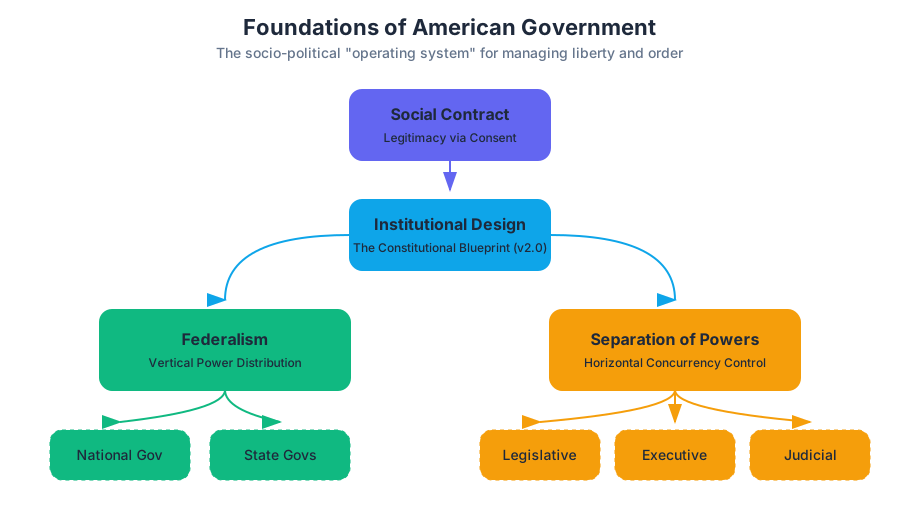
The American political system is not merely a collection of laws, but a complex Institutional Design—a socio-political "operating system" engineered to manage the inherent tensions between collective order and individual liberty. At its core, the foundation rests upon the transition from monarchical "divine right" to the Social Contract, where legitimacy is derived from the consent of the governed. This architecture is operationalized through Federalism (a distributed power model) and the Separation of Powers (a concurrency control mechanism), ensuring that no single entity can achieve total state capture.
The Social Contract: The Logic of Legitimacy
The Social Contract is the theoretical framework justifying the existence of the state and the limits of its authority. It posits that individuals in a "state of nature" (a hypothetical condition without government) would rationally agree to surrender certain absolute freedoms in exchange for the protection of their remaining rights.
Philosophical Lineage
The American implementation of the Social Contract is primarily a synthesis of Enlightenment thought, specifically the transition from Hobbesian absolutism to Lockean liberalism.
| Philosopher | State of Nature | Purpose of Government | Right to Revolt? | Influence on U.S. Foundations |
|---|---|---|---|---|
| Thomas Hobbes | "Nasty, brutish, and short"; a war of all against all. | To provide security and prevent violent death. | No; the Sovereign's power is absolute. | The necessity of a strong central executive to prevent anarchy. |
| John Locke | Mostly peaceful, but property rights are insecure. | To protect "Life, Liberty, and Estate." | Yes; if the government violates the contract. | The Declaration of Independence; Natural Rights; Limited Government. |
| Jean-Jacques Rousseau | Noble savages corrupted by societal inequality. | To enact the "General Will" of the people. | Yes; the people are the sovereign. | Popular sovereignty; "We the People." |
Definition: Popular Sovereignty The principle that the authority of a state and its government are created and sustained by the consent of its people, through their elected representatives (Rule by the People), who are the source of all political power.
Institutional Design: The Architecture of Compromise
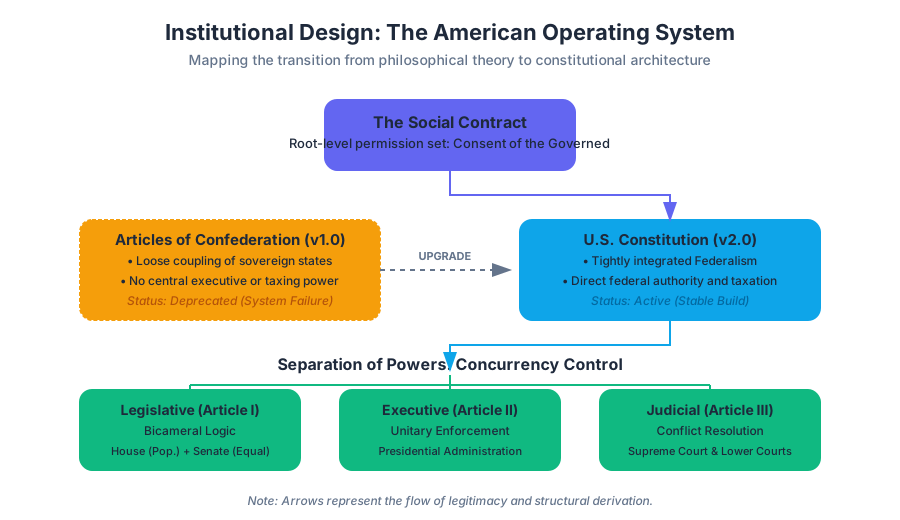
Institutional Design refers to the deliberate arrangement of rules, roles, and structures that define how a government functions. The U.S. Constitution is the "technical specification" for this design, born out of the failure of the Articles of Confederation—the first, highly decentralized iteration of American government.
The Articles of Confederation vs. The Constitution
The transition from the Articles to the Constitution represents a shift from a "loose coupling" of sovereign states to a "tightly integrated" federal system.
| Feature | Articles of Confederation (v1.0) | U.S. Constitution (v2.0) |
|---|---|---|
| Sovereignty | Resided in the states. | Resided in the people (Federalism). |
| Legislature | Unicameral (one house); one vote per state. | Bicameral (House and Senate); proportional and equal. |
| Executive | None; no presiding officer with power. | Strong President (Article II). |
| Judiciary | No national court system. | Supreme Court and lower federal courts (Article III). |
| Taxation | States could refuse federal requests for funds. | Federal government has direct power to tax. |
| Amendment | Required unanimous consent of all states. | Required 2/3 of Congress and 3/4 of states. |
The Great Compromise (Connecticut Compromise)
The most critical design challenge was balancing the interests of large vs. small states. This was solved through a bicameral legislative structure:
- The House of Representatives: Proportional representation (favoring large states like Virginia).
- The Senate: Equal representation (favoring small states like New Jersey).
Separation of Powers and Checks and Balances
To prevent the concentration of power—which James Madison defined as the "very definition of tyranny"—the design employs Separation of Powers. This divides the functions of government into three distinct branches, each with its own "namespace" of authority.
The Madisonian Model
The system is further reinforced by Checks and Balances, which provides each branch with the "constitutional means and personal motives" to resist encroachments by the others. This is not a system of "separated powers" so much as "separate institutions sharing power."
Mathematical Representation of Power Indices
In political science, we can model the influence of these branches using the Banzhaf Power Index ($\beta$), which measures the probability of a player (branch) being "pivotal" in a winning coalition.
In a simplified model where $W$ is a winning policy outcome: $$ \beta_i = \frac{\text{Number of swings for player } i}{2^{n-1}} $$
Where a "swing" occurs if the outcome changes from "Pass" to "Fail" when player $i$ changes their vote. In the U.S. system, the President’s veto power significantly increases their $\beta$ value relative to a single legislator, but the 2/3 override requirement in Congress acts as a "threshold function" that rebalances the system.
\text{Policy Outcome} =
\begin{cases}
1 & \text{if } (Leg_{House} \land Leg_{Senate} \land Exec_{Sign}) \\
1 & \text{if } (Leg_{House}^{2/3} \land Leg_{Senate}^{2/3}) \\
0 & \text{otherwise}
\end{cases}
The Matrix of Checks
| Branch | Power Over Legislative | Power Over Executive | Power Over Judicial |
|---|---|---|---|
| Legislative | N/A | Impeachment; Override Veto; Approve Appointments; Power of the Purse. | Confirm Judges; Impeach Judges; Establish lower courts; Propose Amendments. |
| Executive | Veto Legislation; Call special sessions. | N/A | Appoint Judges; Grant Pardons. |
| Judicial | Judicial Review (declare laws unconstitutional). | Judicial Review (declare executive acts unconstitutional). | N/A |
Federalism: Distributed Governance
Federalism is a system of government in which power is divided between a central (national) authority and constituent political units (states). It is a "multi-tier" architecture designed to bring government closer to the people while maintaining a unified national front for trade and defense.
The Constitutional Basis of Federalism
The "API" for federal-state relations is defined by several key clauses:
- The Supremacy Clause (Article VI): Establishes that the Constitution and federal laws take precedence over state laws.
- The Tenth Amendment: The "Reserved Powers" clause, stating that any power not delegated to the federal government is reserved for the states.
- The Necessary and Proper Clause (Article I, Section 8): Also known as the "Elastic Clause," it allows the federal government to scale its powers to meet new challenges.
Types of Federalism
Federalism has evolved through several "versions":
- Dual Federalism (Layer Cake): Clear separation of powers. States and the federal government operate in distinct spheres with little overlap (1789–1930s).
- Cooperative Federalism (Marble Cake): Blurring of lines. The federal government and states work together on programs like infrastructure and social welfare (1930s–1960s).
- New Federalism (Devolution): An attempt to return power to the states through "block grants" and reduced federal oversight (1980s–Present).
Common Pitfalls and Misconceptions
- The "Slow" Government Fallacy: Many view the gridlock of the U.S. government as a bug. In terms of institutional design, it is a feature. The system was built with high "transaction costs" for passing laws to ensure that only policies with broad consensus could survive the "veto points."
- Federalism vs. Unitary Systems: A common mistake is confusing a federal system with a unitary one (like the UK or France). In a unitary system, sub-national governments are merely administrative arms of the center. In the U.S., states have independent constitutional existence.
- The Scope of Judicial Review: Judicial review is not explicitly mentioned in the Constitution. It was "discovered" or established in the landmark case Marbury v. Madison (1803), effectively completing the system of checks and balances.
Concrete Example: The Legislative Pipeline
To see these foundations in action, consider the passage of a controversial environmental regulation.
- Institutional Design: The bill must pass both the House (representing the people's immediate will) and the Senate (representing state interests).
- Federalism: If the law regulates "intrastate" pollution, a state might challenge it in court, arguing it violates the 10th Amendment.
- Separation of Powers: The President might veto the bill if it interferes with executive energy policy.
- Judicial Review: Even if signed, the Supreme Court might strike it down if it exceeds the "Commerce Clause" powers granted in Article I.
Summary of Foundational Principles
The American experiment is a high-stakes exercise in Institutional Design. By acknowledging the flaws of human nature ("If men were angels, no government would be necessary"), the founders built a system of Separation of Powers and Federalism that relies on friction to protect liberty. The Social Contract remains the underlying "legal tender" of the system—as long as the government protects the rights of the people, it retains the authority to govern.
Source Materials
Study American Government 3e on Lykke
This course page is free to open: signed out, you can read its first two sections, and signing in, on any plan, opens the rest. The free Lykke Chrome extension syncs your own Canvas courses, so ChatGPT, Claude and Muse can answer from your classes and deadlines. It only reads Canvas.
Add the free extensionSign in to open every sectionAll sections of American Government 3e · Browse more course pages