From the free course 14 01 Principles Of Microeconomics Fall 2018 on Lykke
Welfare Economics and Public Policy
Key concepts: Externalities · Public Goods · Market Failure · Taxation · Asymmetric Information
This final section evaluates market outcomes from a societal perspective and discusses when and how the government should intervene.
Welfare Economics and Public Policy
Welfare economics is the normative branch of economics that evaluates the well-being of society as a whole. While microeconomics often focuses on how individual agents (firms and consumers) maximize their own utility or profit, welfare economics asks a higher-order question: Under what conditions does the pursuit of individual self-interest lead to a socially optimal outcome?
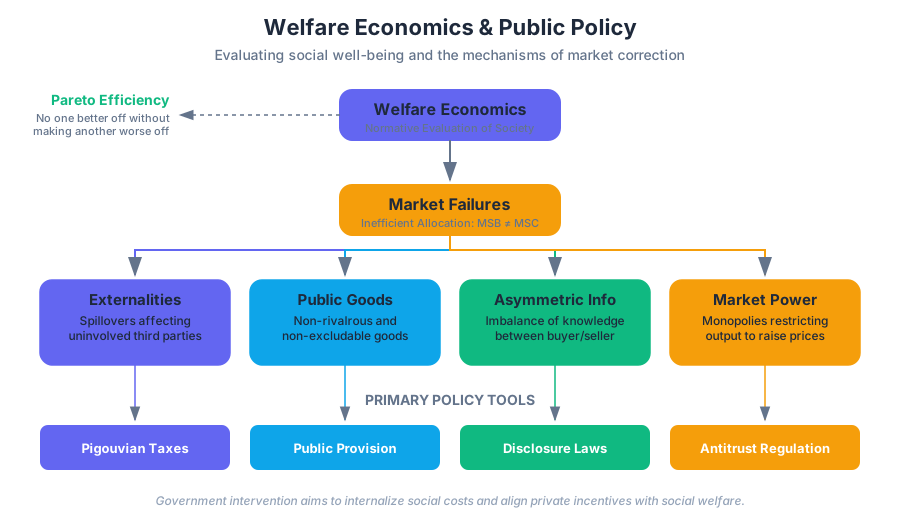
The foundational pillars of this field are the First and Second Fundamental Theorems of Welfare Economics. The First Theorem states that under certain idealized conditions (perfect competition, no externalities, symmetric information), a competitive equilibrium is Pareto Efficient—meaning no one can be made better off without making someone else worse off. However, in the real world, these conditions are rarely met. These deviations are known as Market Failures, and they provide the primary justification for government intervention through public policy.
The Framework of Market Failure
A market failure occurs when the price mechanism fails to account for all costs and benefits associated with a transaction. This results in an inefficient allocation of resources, where the marginal social benefit (MSB) does not equal the marginal social cost (MSC).
| Failure Type | Description | Primary Policy Tool |
|---|---|---|
| Externalities | Spillovers affecting third parties not involved in the transaction. | Pigouvian Taxes / Subsidies |
| Public Goods | Goods that are non-rivalrous and non-excludable. | Public Provision / Taxation |
| Asymmetric Information | One party has superior information, leading to market collapse. | Regulation / Disclosure Laws |
| Market Power | Monopolies or oligopolies restricting output to raise prices. | Antitrust Laws / Price Caps |
Externalities: The Divergence of Private and Social Costs
An externality occurs when the production or consumption of a good imposes an unintended cost or benefit on a third party. Because these "spillovers" are not reflected in market prices, the equilibrium quantity ($Q_{mkt}$) deviates from the socially optimal quantity ($Q_{opt}$).
Negative Externalities and Pigouvian Taxes
In the case of pollution (a negative externality), the Marginal Private Cost (MPC) of a firm is lower than the Marginal Social Cost (MSC). The MSC is the sum of the MPC and the Marginal External Cost (MEC).
The Social Optimality Condition: $MSC = MPC + MEC = MSB$
To correct this, economists propose a Pigouvian Tax—a tax set exactly equal to the MEC at the optimal level of output. This "internalizes" the externality, forcing the firm to treat the social cost as a private cost.
The Coase Theorem
Coase argued that if transaction costs are zero and property rights are well-defined, private parties can bargain to reach the efficient outcome regardless of who holds the initial property rights. However, in practice, transaction costs (legal fees, coordination issues) often prevent this, necessitating government intervention.
Public Goods and the Free Rider Problem
Public goods are defined by two technical characteristics:
- Non-rivalry: One person’s consumption does not reduce the amount available to others.
- Non-excludability: It is impossible (or prohibitively expensive) to prevent non-payers from consuming the good.
The Samuelson Condition
For private goods, we sum individual demand curves horizontally (adding quantities at each price). For public goods, we sum them vertically (adding the marginal willingness to pay at each quantity). The optimal provision of a public good is reached when the sum of individual marginal benefits equals the marginal cost of production.
\sum_{i=1}^{n} MRS_i = MRT
Where $MRS$ is the Marginal Rate of Substitution (individual benefit) and $MRT$ is the Marginal Rate of Transformation (social cost).
The Tragedy of the Commons
This is a specific subset of public goods (Common Pool Resources) that are rivalrous but non-excludable (e.g., fisheries). Because users do not pay for the depletion of the resource, they over-exploit it, leading to total collapse.
| Good Category | Rivalrous | Non-Rivalrous |
|---|---|---|
| Excludable | Private Goods (Food, Clothing) | Club Goods (Netflix, Gyms) |
| Non-Excludable | Common Resources (Fish stocks) | Public Goods (Defense, Air) |
Asymmetric Information: Lemons, Signaling, and Moral Hazard
Market failure often stems from an imbalance of information. This manifests in two primary ways: Adverse Selection (hidden characteristics) and Moral Hazard (hidden actions).
Adverse Selection (The Lemons Problem)
George Akerlof demonstrated that if buyers cannot distinguish between high-quality ("peaches") and low-quality ("lemons") used cars, they will only offer a price reflecting the average quality. High-quality sellers will exit the market, further lowering the average quality, until the market potentially collapses.
Mathematical Derivation of Market Collapse
Consider a market where quality $\theta$ is uniformly distributed between 0 and 1. Sellers value their car at $\theta$, and buyers value it at $1.5\theta$.
1. If buyers cannot observe theta, they assume E[theta] = 0.5.
2. Buyers offer Price P = 1.5 * E[theta | seller accepts].
3. A seller accepts if theta <= P.
4. If P is offered, the average quality of cars sold is E[theta | theta <= P] = P/2.
5. Equilibrium requires P = 1.5 * (P/2) = 0.75P.
6. This equation only holds if P = 0.
7. Result: The market for high-quality goods collapses entirely.
Moral Hazard
Moral hazard occurs after a contract is signed. For example, an insured person may take more risks because they do not bear the full cost of a negative outcome. This is why insurance companies use deductibles and co-pays to re-align incentives.
Taxation and Deadweight Loss
Governments must raise revenue to provide public goods and correct externalities. However, taxes (except for Pigouvian taxes) generally create a Deadweight Loss (DWL) by driving a wedge between the price buyers pay and the price sellers receive.
The Harberger Triangle
The DWL is represented by a triangle in the supply-demand framework. Its size is proportional to the square of the tax rate and the elasticities of supply and demand.
DWL Formula (Approximation): $DWL = 0.5 \times \epsilon \times P \times Q \times \tau^2$ Where $\epsilon$ is the elasticity and $\tau$ is the tax rate.
Optimal Taxation (The Ramsey Rule)
To minimize total DWL across a whole economy, the government should tax goods with inelastic demand more heavily. This is because consumers of inelastic goods (like insulin or salt) do not change their behavior significantly in response to price changes, minimizing the "wedge" effect.
| Elasticity Condition | Tax Burden (Incidence) | Efficiency Impact |
|---|---|---|
| Inelastic Demand | Consumers bear most of the tax. | Low Deadweight Loss. |
| Elastic Demand | Producers bear most of the tax. | High Deadweight Loss. |
| Inelastic Supply | Producers bear most of the tax. | Low Deadweight Loss. |
Social Welfare Functions: How to Aggregate Well-being
Even if a policy is efficient, is it "fair"? Welfare economics uses Social Welfare Functions (SWF) to aggregate individual utilities ($U_i$) into a single measure of social well-being ($W$).
- Utilitarian (Benthamite): $W = \sum U_i$. The goal is to maximize the total sum of utility, regardless of distribution.
- Rawlsian (Maximin): $W = \min(U_1, U_2, \dots, U_n)$. Social welfare is only as high as the utility of the least well-off member. This justifies significant redistribution.
- Bergson-Samuelson: A generalized form where $W = f(U_1, U_2, \dots, U_n)$, allowing for different weights on different individuals.
Comparison of Welfare Philosophies
| Philosophy | Objective | Policy Implication |
|---|---|---|
| Pareto | No one worse off | Only "win-win" moves allowed. |
| Utilitarian | Maximize total $U$ | Redistribute if $MU$ of poor > $MU$ of rich. |
| Rawlsian | Maximize $U_{min}$ | Heavy safety nets and progressive taxes. |
| Kaldor-Hicks | Winners can compensate losers | Efficiency-focused; compensation is theoretical. |
Common Pitfalls in Public Policy Analysis
- Ignoring General Equilibrium Effects: A tax on plastic bags might increase the use of paper bags, which have a higher carbon footprint to produce. Policy must look beyond the immediate market.
- The "Nirvana Fallacy": Comparing a "failed" market to an "ideal" government. Governments also face failures (rent-seeking, bureaucracy, and lack of information).
- Confusing Equity with Efficiency: A policy can be perfectly efficient (no DWL) but highly inequitable (all wealth goes to one person). Welfare economics requires balancing both.
- Tax Salience: Assuming consumers respond to taxes the same way they respond to price changes. Behavioral economics shows that "hidden" taxes (like those included in the price) have different effects than taxes added at the register.
Source Materials
Study 14 01 Principles Of Microeconomics Fall 2018 on Lykke
This course page is free to open: signed out, you can read its first two sections, and signing in, on any plan, opens the rest. The free Lykke Chrome extension syncs your own Canvas courses, so ChatGPT, Claude and Muse can answer from your classes and deadlines. It only reads Canvas.
Add the free extensionSign in to open every sectionAll sections of 14 01 Principles Of Microeconomics Fall 2018 · Browse more course pages