Principles Management
Institution: MIT
1 study materials · 4 sections
This course introduces the foundational 'Principles of Management' through the lens of the OpenStax Open Educational Resource (OER). It utilizes the traditional management framework—Planning, Organizing, Leading, and Controlling (POLC)—to provide a comprehensive overview of how organizations function. Students will explore diverse topics ranging from strategic management and human resources to behavioral motivation and leadership. The course is designed by academic specialists to make high-quality management education accessible and affordable for all learners.
Course Sections
Foundations of Management and the POLC Framework
Key concepts: Planning · Organizing · Leading · Controlling · Traditional Management Framework
An introduction to the core functions of management and the traditional framework used to categorize managerial tasks.
Foundations of Management and the POLC Framework
Management is the systematic process of coordinating resources—human, financial, physical, and informational—to achieve organizational goals efficiently and effectively. In the context of modern enterprise, management functions as the "operating system" of the organization, providing the logic and protocols required to transform abstract strategy into concrete execution.
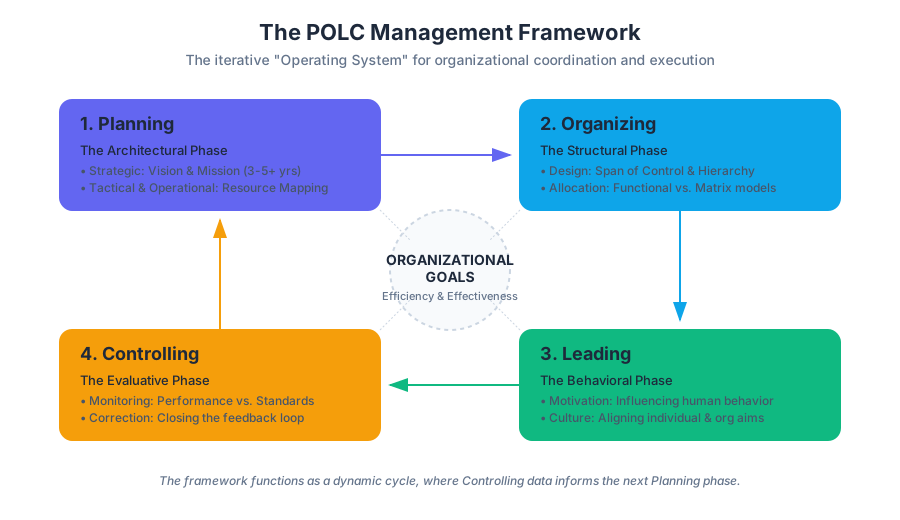
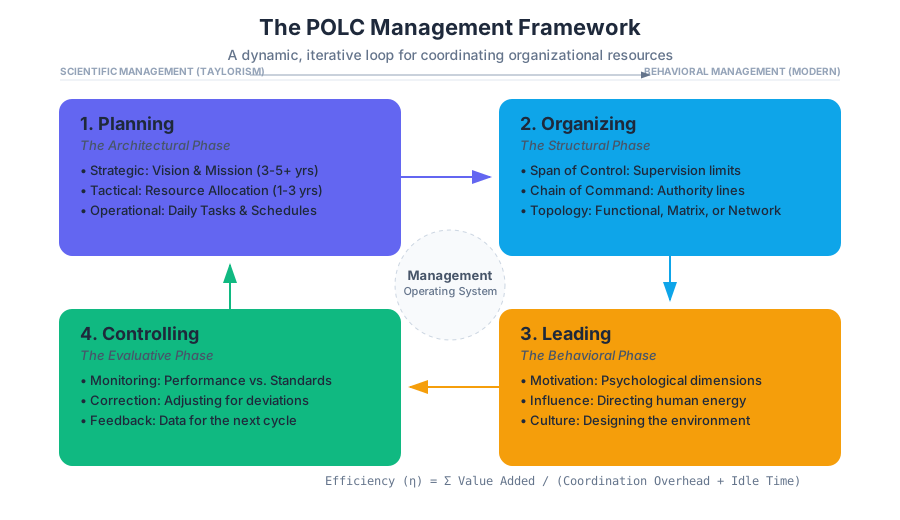
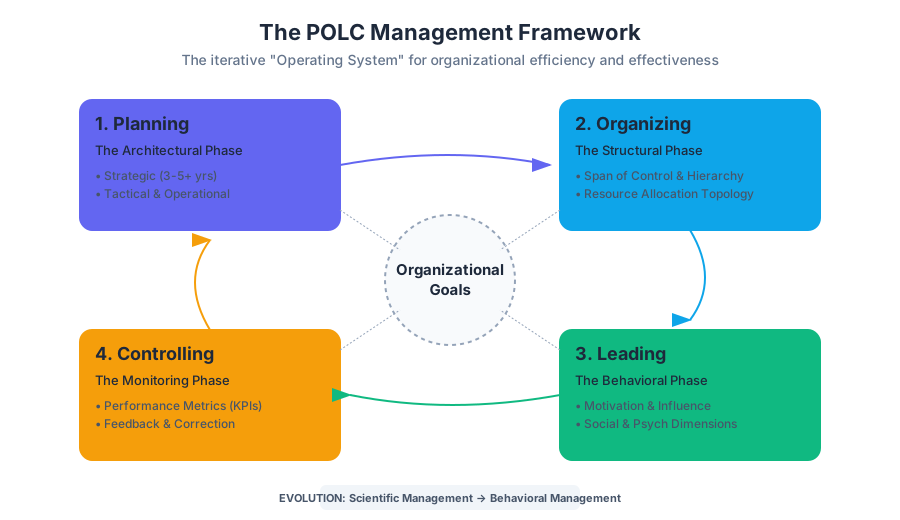
The most enduring architecture for understanding this process is the POLC Framework: Planning, Organizing, Leading, and Controlling. Originally derived from Henri Fayol’s early 20th-century "Administrative Theory," the POLC model has evolved from a rigid set of industrial commands into a dynamic, iterative loop that accounts for behavioral psychology, strategic agility, and complex systems theory.
The Traditional Management Framework: An Evolution
Before diving into the specific functions, it is essential to understand the shift from Scientific Management (Taylorism), which viewed workers as components of a machine, to the Behavioral Management approach, which recognizes the social and psychological dimensions of work. The modern POLC framework synthesizes these views, balancing the "hard" metrics of production with the "soft" requirements of human motivation.
Definition: Management The process of designing and maintaining an environment in which individuals, working together in groups, efficiently accomplish selected aims. It is characterized by the optimization of the ratio between input and output (efficiency) and the degree to which objectives are realized (effectiveness).
### Planning: The Architectural Phase
Planning is the foundational function of management. It involves defining the organization’s vision and mission, setting specific objectives, and mapping out the actions required to achieve them. Without planning, the subsequent functions of organizing, leading, and controlling lack a reference point.
The Hierarchy of Planning
Planning occurs at multiple levels of abstraction, ranging from high-level "why" to granular "how."
| Planning Level | Horizon | Focus | Primary Actor |
|---|---|---|---|
| Strategic | 3–5+ Years | Vision, Mission, Long-term Competitive Advantage | Top Management (C-Suite) |
| Tactical | 1–3 Years | Resource Allocation, Departmental Goals | Middle Management |
| Operational | Daily–1 Year | Specific Tasks, Schedules, Quality Control | Front-line Managers |
The Algorithm of Strategic Choice
In a technical sense, planning can be viewed as a multi-criteria decision-making (MCDM) problem. Managers must evaluate various paths based on risk, cost, and potential ROI.
# A weighted decision matrix for Strategic Planning
# Used to evaluate different project initiatives based on key business drivers

import numpy as np

def evaluate_strategic_initiatives(initiatives, criteria_weights):
    """
    Calculates the strategic fit score for various initiatives.

    :param initiatives: Dictionary of {name: [scores_for_each_criterion]}
    :param criteria_weights: List of weights for each criterion (must sum to 1.0)
    :return: Sorted list of initiatives by strategic score
    """
    results = {}
    for name, scores in initiatives.items():
        # Weighted sum: Σ (score_i * weight_i)
        weighted_score = np.dot(scores, criteria_weights)
        results[name] = round(weighted_score, 2)

    # Sort by score descending
    return sorted(results.items(), key=lambda x: x[1], reverse=True)

# Criteria: [Market Growth, Operational Ease, Cost Efficiency, Risk Mitigation]
weights = [0.4, 0.2, 0.1, 0.3]

projects = {
    "Cloud Migration": [9, 4, 3, 8],
    "Legacy System Patch": [2, 9, 8, 5],
    "AI Integration": [10, 2, 2, 4]
}

print(evaluate_strategic_initiatives(projects, weights))
### Organizing: The Structural Phase
Organizing is the process of creating a structure that enables the execution of the plan. This involves the "division of labor"—breaking down complex tasks into manageable jobs—and "departmentalization"—grouping those jobs into logical units.
Key Parameters of Organizational Design
- Span of Control: The number of subordinates a manager can effectively supervise.
- Centralization vs. Decentralization: The degree to which decision-making authority is concentrated at the top.
- Chain of Command: The continuous line of authority that links every individual in the organization.
| Structure Type | Best For | Pros | Cons |
|---|---|---|---|
| Functional | Stable environments | High specialization, efficiency | Siloed communication |
| Divisional | Large, diverse product lines | High autonomy, market focus | Resource duplication |
| Matrix | Complex, project-based work | Cross-functional synergy | Dual reporting confusion |
| Network | Highly volatile/tech sectors | Extreme flexibility, low overhead | Loss of direct control |
Resource Allocation Logic
Organizing is not just about people; it is about the flow of information and resources. In a system-theoretic view, organizing is the definition of the topology of the organization.
\text{Organizational Efficiency} (\eta) = \frac{\sum \text{Value Added by Nodes}}{\text{Coordination Overhead} + \text{Resource Idle Time}}
As the number of nodes (employees) increases, the coordination overhead typically grows non-linearly ($O(n^2)$ in a fully connected network), which is why hierarchical structures are used to prune communication paths to $O(log n)$.
### Leading: The Behavioral Phase
Leading is the most "human-centric" function. It involves influencing others to work toward organizational objectives. Unlike the mechanical nature of organizing, leading requires an understanding of Behavioral Management and motivation.
Motivation Theory: The Expectancy Model
A manager’s ability to lead is often tied to their ability to manipulate the variables of motivation. Victor Vroom’s Expectancy Theory provides a mathematical framework for this:
The Motivation Formula $$M = E \times I \times V$$
- Expectancy (E): The belief that effort will lead to performance.
- Instrumentality (I): The belief that performance will lead to a reward.
- Valence (V): The value the individual places on that reward.
If any of these variables is zero, total motivation is zero. Leading, therefore, is the act of ensuring $E$, $I$, and $V$ are all non-zero and aligned with organizational goals.
Leadership Styles and Situational Leadership
Effective leading requires adapting one's style to the maturity of the team and the urgency of the task.
ALGORITHM: Situational_Leadership_Selection
INPUT: Team_Maturity (Low to High), Task_Urgency (Low to High)

IF Task_Urgency IS Critical:
    USE Autocratic_Style (Directing)
ELSE IF Team_Maturity IS Low:
    USE Coaching_Style (High Support, High Direction)
ELSE IF Team_Maturity IS Moderate:
    USE Participative_Style (High Support, Low Direction)
ELSE IF Team_Maturity IS High:
    USE Delegating_Style (Low Support, Low Direction)
END IF
### Controlling: The Feedback Phase
Controlling is the process of monitoring performance, comparing it against goals, and taking corrective action. It is the "feedback loop" of the management system. Without control, planning is a one-way street with no way to verify if the destination was reached.
The Control Process Cycle
- Establish Standards: Define what "success" looks like (KPIs).
- Measure Performance: Collect data on current operations.
- Compare: Analyze the variance between actual performance and the standard.
- Correct: Implement changes to close the gap or adjust the standards.
Types of Control
- Feedforward Control: Anticipating problems before they occur (e.g., rigorous hiring processes).
- Concurrent Control: Monitoring activities as they happen (e.g., real-time dashboards).
- Feedback Control: Correcting problems after they occur (e.g., end-of-quarter financial reviews).
Implementation: Monitoring KPIs via SQL
In a modern data-driven environment, the "Controlling" function is often automated through business intelligence.
-- Query to identify departments where actual spend exceeds budget by > 10%
-- This represents the 'Comparison' and 'Identification' phase of Controlling

SELECT
    dept_name,
    budgeted_amount,
    actual_spend,
    (actual_spend - budgeted_amount) AS variance,
    ROUND(((actual_spend - budgeted_amount) / budgeted_amount) * 100, 2) AS pct_over_budget
FROM
    department_finances
WHERE
    actual_spend > (budgeted_amount * 1.10)
ORDER BY
    pct_over_budget DESC;
### Strategic Management and Human Resources (HRM)
The POLC framework does not exist in a vacuum. It is supported by two critical pillars: Strategic Management and Human Resource Management (HRM).
Strategic Management
Strategic management is the continuous planning, monitoring, analysis, and assessment of all that is necessary for an organization to meet its goals and objectives. It involves the use of tools like SWOT Analysis (Strengths, Weaknesses, Opportunities, Threats) to align the POLC functions with the external environment.
Human Resource Management (HRM)
HRM is the "Organizing" and "Leading" functions applied specifically to the workforce. It covers:
- Job Design: Defining the requirements of a role.
- Staffing: Recruiting and selecting the right talent.
- Training and Development: Enhancing the "Human Capital" of the organization.
- Compensation: Managing the "Valence" ($V$) in the motivation equation.
| HRM Component | POLC Connection | Objective |
|---|---|---|
| Recruitment | Organizing | Ensuring nodes in the structure are filled with capable agents. |
| Performance Appraisal | Controlling | Measuring individual output against standards. |
| Incentive Systems | Leading | Driving motivation through reward alignment. |
| Succession Planning | Planning | Ensuring long-term continuity of leadership. |
### Common Pitfalls in the POLC Framework
- The Planning Fallacy: Managers often underestimate the time and resources needed for a project, leading to unrealistic operational plans.
- Micromanagement (Leading/Organizing Error): A failure to delegate (Organizing) and an over-reliance on autocratic direction (Leading) leads to "bottlenecking" and reduced morale.
- Control Lag: If the feedback loop (Controlling) takes too long to process data, the corrective action may be applied to a situation that has already changed.
- Siloing: Over-organizing into rigid departments can prevent the cross-pollination of ideas, hurting the "Leading" function's ability to inspire innovation.
Key Insight: The Interdependence of POLC POLC is not a linear checklist but a circular system. A failure in Controlling (e.g., not noticing a drop in quality) usually points back to a failure in Planning (e.g., poor quality standards) or Leading (e.g., lack of employee engagement).
Strategic and Human Resource Management
Key concepts: Strategic Management · Human Resource Management · Competitive Advantage
Explores how organizations position themselves for success and manage their most valuable asset: people.
Strategic and Human Resource Management
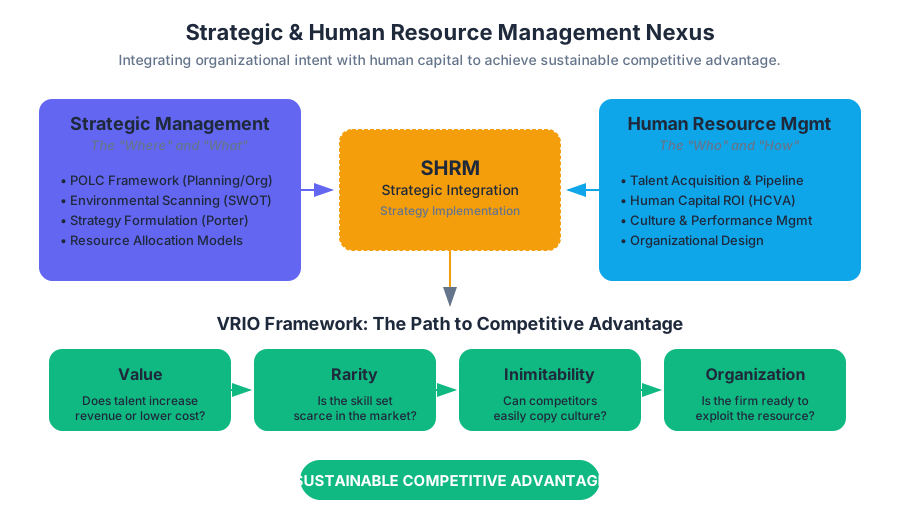
The modern enterprise is no longer a static collection of assets and labor; it is a dynamic system of human capital directed by strategic intent. The intersection of Strategic Management and Human Resource Management (HRM) represents the most critical nexus in organizational theory. While strategy defines the "where" and "what" of an organization’s future, HRM provides the "who" and "how." This deep dive explores the frameworks, mathematical underpinnings, and operational mechanics that allow organizations to transform abstract goals into sustainable Competitive Advantage.
The Strategic Management Framework
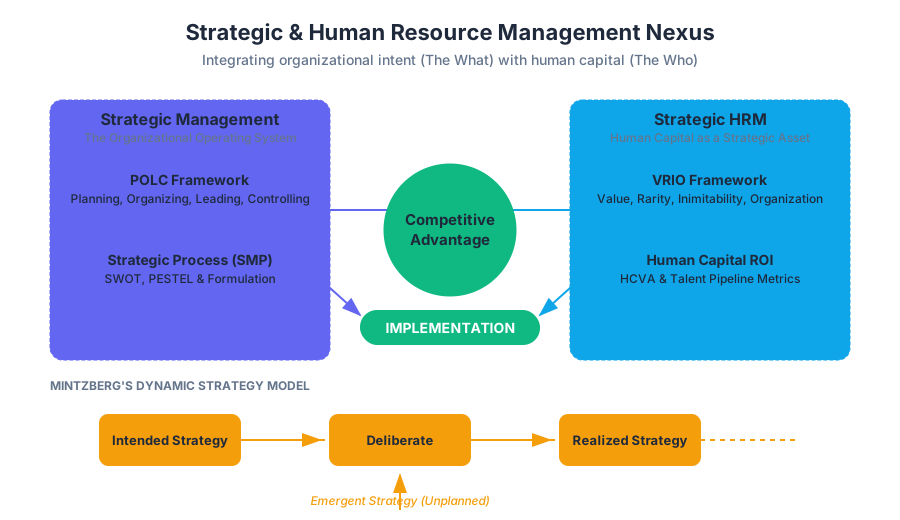
Strategic Management is the continuous process of planning, monitoring, analyzing, and assessing all necessities an organization needs to meet its goals and objectives. It is the high-level "operating system" of the firm.
The POLC Framework
At the core of traditional management lies the POLC Framework, which categorizes the primary functions of a manager.
| Function | Focus Area | Key Activities | Output |
|---|---|---|---|
| Planning | Vision & Strategy | Environmental scanning, goal setting, identifying resources. | Strategic Plan |
| Organizing | Structure & Design | Allocating resources, defining roles, departmentalization. | Organizational Chart |
| Leading | People & Culture | Motivating employees, communicating, resolving conflicts. | High Morale/Performance |
| Controlling | Monitoring & Adjustment | Setting standards, measuring performance, corrective action. | Quality/Efficiency |
The Strategic Management Process (SMP)
The SMP is a recursive cycle that ensures the organization remains aligned with its environment. It typically follows a five-stage pipeline:
- Mission and Objectives: Defining the "North Star."
- Environmental Scanning: Utilizing tools like SWOT (Strengths, Weaknesses, Opportunities, Threats) and PESTEL (Political, Economic, Social, Technological, Environmental, Legal).
- Strategy Formulation: Choosing between Cost Leadership, Differentiation, or Niche Focus (Porter’s Generic Strategies).
- Strategy Implementation: The point where HRM becomes critical.
- Strategy Evaluation: Measuring the gap between intended and realized strategy.
The Mintzberg Insight: Strategy is rarely a straight line. Henry Mintzberg distinguished between Intended Strategy (what we plan), Deliberate Strategy (what we actually do), and Emergent Strategy (unplanned responses to the environment). The final Realized Strategy is often a hybrid of the deliberate and the emergent.
Implementation: Resource Allocation Simulation
To understand how strategic priorities translate into resource distribution, consider a Python implementation of a weighted scoring model for project prioritization.
import numpy as np

def calculate_strategic_alignment(projects, weights):
    """
    Calculates the strategic score for a portfolio of projects.

    :param projects: Dict of projects with scores for [Profitability, Risk, Innovation, Talent Growth]
    :param weights: Array of weights for each criterion (must sum to 1.0)
    :return: Sorted list of projects by strategic value
    """
    results = []
    for name, scores in projects.items():
        # Dot product of scores and weights
        weighted_score = np.dot(scores, weights)
        results.append((name, round(weighted_score, 2)))

    # Sort by score descending
    return sorted(results, key=lambda x: x[1], reverse=True)

# Example: Weights favor Innovation and Talent Growth (Strategic HRM focus)
# Criteria: [Profitability, Risk_Mitigation, Innovation, Talent_Growth]
strategic_weights = np.array([0.2, 0.1, 0.4, 0.3])

project_portfolio = {
    "Legacy_System_Update": [0.8, 0.9, 0.1, 0.2],
    "AI_R&D_Lab": [0.4, 0.2, 0.9, 0.8],
    "Market_Expansion_EU": [0.7, 0.5, 0.4, 0.4]
}

prioritized = calculate_strategic_alignment(project_portfolio, strategic_weights)
print(f"Strategic Priority: {prioritized}")
Strategic Human Resource Management (SHRM)
Human Resource Management (HRM) is the strategic approach to the effective management of people such that they help a business gain a competitive advantage. When HRM is integrated with the strategic goals of the firm, it becomes Strategic HRM (SHRM).
The Evolution of the HR Function
The transition from "Personnel Management" to "SHRM" reflects a shift from administrative overhead to strategic partnership.
| Attribute | Traditional Personnel Management | Strategic HRM |
|---|---|---|
| Time Horizon | Short-term (reactive) | Long-term (proactive) |
| Role of HR | Administrative/Transactional | Strategic Partner/Change Agent |
| Accountability | Cost Center | Investment Center |
| Key Metric | Compliance & Headcount | ROI, Talent Pipeline, Culture |
| Employee View | Replaceable Labor | Strategic Asset (Human Capital) |
Human Capital ROI (HCROI)
In SHRM, we quantify the value of the workforce. A common metric is the Human Capital Revenue Factor and the Human Capital Value Added (HCVA).
The mathematical representation of HCVA is:
HCVA = \frac{Revenue - (Operating Expenses - Total Compensation Costs)}{Total Full-Time Equivalents (FTE)}
This formula isolates the value created by the human element by removing non-people-related operating expenses from the revenue calculation.
Talent Acquisition and the VRIO Framework
To achieve a Competitive Advantage, the resources provided by HRM must satisfy the VRIO Framework:
- Value: Does the talent provide a service that increases revenue or decreases cost?
- Rarity: Is the skill set difficult to find in the labor market?
- Inimitability: Can competitors easily copy the organizational culture or specific team dynamics?
- Organization: Is the firm organized to capture the value of this talent?
Behavioral Management and Motivation
Strategy fails when the workforce is not motivated to execute it. Behavioral management focuses on the psychological and social aspects of work.
Key Motivation Theories
Understanding why people work is essential for designing compensation and performance management systems.
- Maslow’s Hierarchy of Needs: Suggests a progression from physiological needs to self-actualization.
- Herzberg’s Two-Factor Theory: Distinguishes between Hygiene Factors (salary, conditions) which prevent dissatisfaction, and Motivators (recognition, growth) which create satisfaction.
- Expectancy Theory (Vroom): Proposes that motivation is a product of three factors:
- Expectancy: Effort → Performance
- Instrumentality: Performance → Reward
- Valence: Reward → Personal Goals
Formalizing Expectancy Theory
We can express the Force of Motivation ($F$) as:
F = E \cdot (\sum I \cdot V)
Where:
- $E$ = Expectancy (0 to 1)
- $I$ = Instrumentality (0 to 1)
- $V$ = Valence (-1 to 1)
Technical Implementation: Talent Analytics Schema
Modern HRM relies on data. To manage a global workforce strategically, an organization needs a robust data schema that links employee performance to strategic initiatives.
-- Schema for Strategic Talent Mapping
CREATE TABLE employees (
    emp_id UUID PRIMARY KEY,
    full_name VARCHAR(255),
    department_id INT,
    hire_date DATE,
    current_role VARCHAR(100)
);

CREATE TABLE skills_inventory (
    skill_id SERIAL PRIMARY KEY,
    skill_name VARCHAR(100),
    category VARCHAR(50) -- e.g., 'Technical', 'Leadership', 'Soft Skills'
);

CREATE TABLE employee_skills (
    emp_id UUID REFERENCES employees(emp_id),
    skill_id INT REFERENCES skills_inventory(skill_id),
    proficiency_level INT CHECK (proficiency_level BETWEEN 1 AND 5),
    is_strategic_priority BOOLEAN DEFAULT FALSE,
    last_assessed DATE
);

-- Query to find 'Skill Gaps' in strategic areas
SELECT
    si.skill_name,
    COUNT(es.emp_id) as current_headcount,
    AVG(es.proficiency_level) as avg_proficiency
FROM
    skills_inventory si
LEFT JOIN
    employee_skills es ON si.skill_id = es.skill_id
WHERE
    es.is_strategic_priority = TRUE
GROUP BY
    si.skill_name
HAVING
    AVG(es.proficiency_level) < 4.0;
Common Pitfalls in Strategic HRM
Even with sophisticated frameworks, organizations often fail in the execution of Strategic HRM.
- The "Strategy-Culture" Gap: Peter Drucker famously noted that "Culture eats strategy for breakfast." If the strategic goal is "Innovation" but the HRM system punishes failure, the strategy will fail.
- Metric Overload: Focusing on "Vanity Metrics" (e.g., number of training hours) instead of "Impact Metrics" (e.g., increase in sales per trained employee).
- Siloed Planning: When the C-suite develops a 5-year strategy without consulting HR regarding labor market trends or internal skill gaps.
- The "War for Talent" Fallacy: Over-focusing on external hiring while neglecting the development and retention of internal talent (the "Make vs. Buy" decision).
Integration: The HR Value Chain
The HR Value Chain demonstrates how HR activities lead to organizational performance. It is a causal chain:
- HR Activities: Recruitment, Training, Compensation.
- HR Outcomes: Employee engagement, Competence, Retention.
- Organizational Outcomes: Innovation, Quality, Customer Satisfaction.
- Financial Outcomes: Profits, Market Share, ROI.
DevOps for HR: Infrastructure as People
In high-tech environments, the management of people mirrors the management of infrastructure. We can think of "Onboarding" as a deployment pipeline.
# Conceptual Pipeline for Employee Onboarding (onboarding-pipeline.yml)
stages:
  - provisioning:
      steps:
        - create_identity: LDAP/Okta
        - allocate_hardware: MacBook Pro 16"
        - assign_mentor: Senior Engineer
  - configuration:
      steps:
        - security_training: Mandatory
        - culture_immersion: CEO Welcome Session
        - environment_setup: Access to GitHub/AWS
  - verification:
      steps:
        - 30_day_review: Manager Feedback
        - probation_check: Performance Metrics
  - production:
      description: "Employee is now a fully contributing member of the strategic unit."
Summary of Strategic Alignment
The ultimate goal of combining Strategic Management and HRM is to create a "Fit." Vertical Fit ensures that HR practices are aligned with the business strategy (e.g., a "Cost Leadership" strategy aligned with efficiency-based incentives). Horizontal Fit ensures that all HR practices (hiring, training, pay) are consistent with each other.
Further Reading and References
- Porter, M. E. (1985). Competitive Advantage: Creating and Sustaining Superior Performance.
- Barney, J. B. (1991). Firm Resources and Sustained Competitive Advantage.
- Huselid, M. A. (1995). The Impact of Human Resource Management Practices on Turnover, Productivity, and Corporate Financial Performance.
- OpenStax Principles of Management.
Behavioral Management and Motivation
Key concepts: Behavioral Management · Motivation · Organizational Behavior
Focuses on the psychological and behavioral aspects of management, including how to motivate diverse teams.
Behavioral Management and Motivation
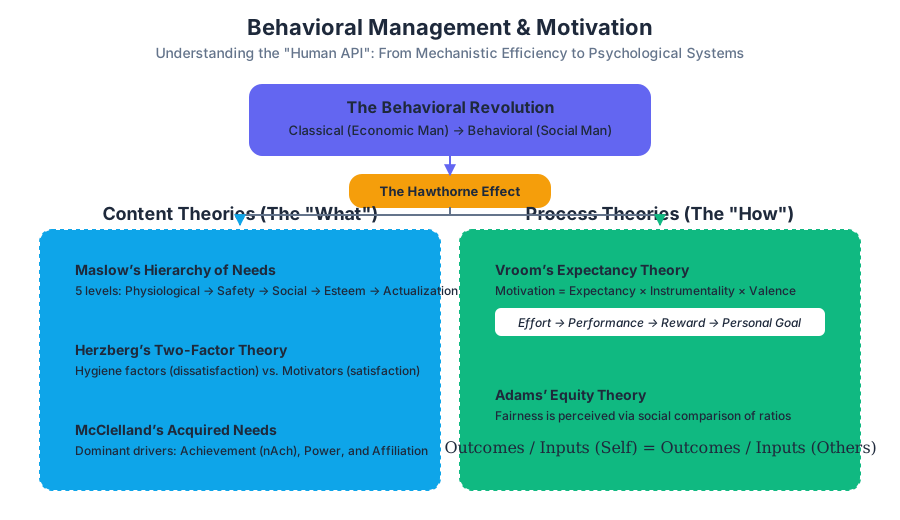
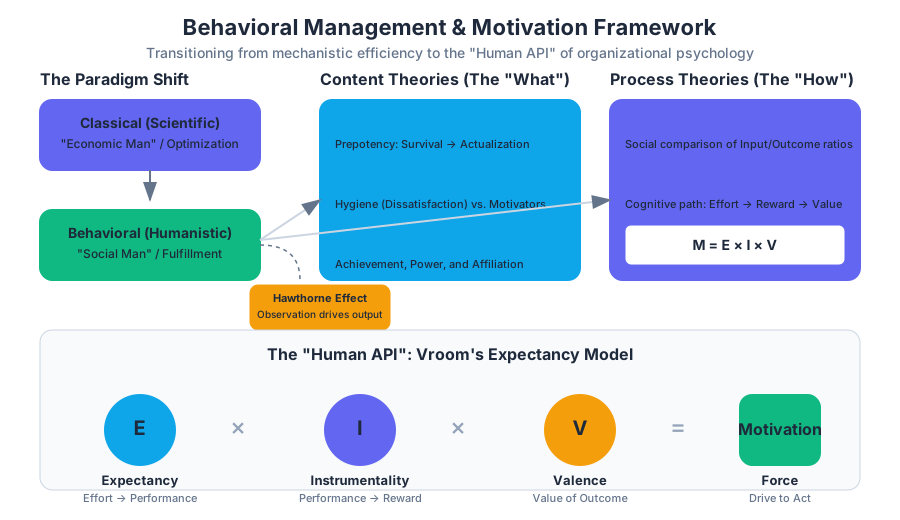
Behavioral management represents a paradigm shift in organizational theory, transitioning from the "mechanistic" view of workers as interchangeable parts to a "humanistic" view of employees as complex psychological entities. While classical management (Taylorism) focused on the optimization of physical movements and economic incentives, behavioral management posits that productivity is inextricably linked to social relations, personal fulfillment, and the internal psychological state of the workforce.
In the modern enterprise, understanding motivation is not merely a "soft skill" but a technical requirement for systems design. Whether designing an Agile workflow or an algorithmic performance-tracking system, the underlying "human API" must be understood to prevent system failure in the form of turnover, burnout, or quiet quitting.
The Behavioral Revolution: From Scientific to Humanistic Management
The transition to behavioral management was catalyzed by the realization that economic incentives alone have diminishing returns. This movement, often termed the Human Relations Movement, emerged from the tension between industrial efficiency and human limitations.
The Hawthorne Studies and the "Hawthorne Effect"
The most significant inflection point in behavioral management was the Hawthorne Studies (1924–1932) conducted at Western Electric. Researchers initially sought to find the optimal level of illumination for productivity. However, they discovered that productivity increased regardless of whether light levels were raised or lowered.
The Hawthorne Effect: The phenomenon where individuals improve or modify an aspect of their behavior in response to their awareness of being observed.
This discovery shifted the focus of management from environmental engineering to social engineering. It proved that psychological factors—such as feeling valued or being part of a cohesive group—outweighed physical conditions in driving output.
Comparison of Management Paradigms
| Feature | Classical Management (Scientific) | Behavioral Management (Humanistic) |
|---|---|---|
| Primary Focus | Task efficiency and standardization | Employee well-being and social needs |
| View of Worker | "Economic Man" (motivated by money) | "Social Man" (motivated by recognition) |
| Organizational Structure | Rigid hierarchy / Centralized | Flexible / Participative |
| Communication | Top-down / Formal | Multi-directional / Informal included |
| Key Metric | Units per hour / Physical throughput | Engagement / Job satisfaction / Retention |
Content Theories of Motivation: Identifying the "What"
Content theories focus on the internal factors that energize and direct human behavior. They answer the question: What specific needs do people have that must be met to motivate them?
Maslow’s Hierarchy of Needs
Abraham Maslow proposed that human needs are arranged in a prepotency hierarchy. An individual cannot effectively focus on higher-level needs until lower-level "deficiency needs" are satisfied.
- Physiological: Base survival (food, water, shelter).
- Safety: Security, stability, and protection from physical/emotional harm.
- Social (Belongingness): Affection, acceptance, and friendship.
- Esteem: Internal (self-respect, autonomy) and external (status, recognition).
- Self-Actualization: The drive to become what one is capable of becoming; achieving potential.
Herzberg’s Two-Factor Theory
Frederick Herzberg’s research suggested that job satisfaction and job dissatisfaction are not opposite ends of the same continuum but are driven by entirely different factors.
- Hygiene Factors: Elements that do not give positive satisfaction but whose absence leads to dissatisfaction (e.g., salary, company policies, physical working conditions).
- Motivators: Elements that yield positive satisfaction and high motivation (e.g., achievement, recognition, the work itself, responsibility).
| Factor Type | Impact if Absent | Impact if Present | Examples |
|---|---|---|---|
| Hygiene | High Dissatisfaction | Neutrality (No Dissatisfaction) | Salary, Job Security, Lighting |
| Motivator | Neutrality | High Satisfaction / Engagement | Promotion, Personal Growth |
McClelland’s Acquired Needs Theory
David McClelland argued that people develop three specific needs through their life experiences:
- Need for Achievement (nAch): The drive to excel and succeed in relation to a set of standards.
- Need for Power (nPow): The need to make others behave in a way they would not have otherwise.
- Need for Affiliation (nAff): The desire for friendly and close interpersonal relationships.
Process Theories of Motivation: Modeling the "How"
Process theories describe the cognitive mechanisms through which motivation is generated. They treat motivation as a dynamic system of inputs, expectations, and perceived outcomes.
Vroom’s Expectancy Theory
Victor Vroom proposed that the strength of a tendency to act in a certain way depends on the strength of an expectation that the act will be followed by a given outcome and on the attractiveness of that outcome to the individual.
The fundamental equation of motivation is:
$Motivation = Expectancy \times Instrumentality \times Valence$
- Expectancy ($E \to P$): The belief that effort will lead to performance.
- Instrumentality ($P \to R$): The belief that performance will lead to a reward.
- Valence ($V$): The value the individual places on the reward.
Equity Theory
Developed by J. Stacy Adams, Equity Theory posits that individuals compare their job inputs (effort, experience, education) and outcomes (salary, recognition) with those of others.
If the ratio $\frac{Outcomes_{Self}}{Inputs_{Self}}$ is perceived as unequal to $\frac{Outcomes_{Other}}{Inputs_{Other}}$, the individual experiences "equity tension" and will take action to resolve it (e.g., reducing effort, asking for a raise, or leaving the job).
Implementation: Modeling Motivation as a Utility Function
In a computational or systemic context, we can model an employee's motivation state to predict the likelihood of "churn" or "peak performance."
class EmployeeMotivationModel:
    """
    A low-level implementation of Vroom's Expectancy Theory
    to calculate the Motivation Force of an individual.
    """
    def __init__(self, expectancy, instrumentality, valence_vector):
        # Expectancy: Probability (0-1) that effort leads to performance
        self.e = expectancy
        # Instrumentality: Probability (0-1) that performance leads to rewards
        self.i = instrumentality
        # Valence: A list of values the employee assigns to different rewards
        self.v = sum(valence_vector) / len(valence_vector)

    def calculate_motivation_force(self):
        """Returns the scalar Motivation Force (MF)."""
        mf = self.e * self.i * self.v
        return round(mf, 4)

    def predict_behavior(self, threshold=0.5):
        force = self.calculate_motivation_force()
        if force > threshold:
            return "High Engagement: Likely to exceed KPIs."
        elif force > threshold * 0.5:
            return "Maintenance: Likely to meet minimum requirements."
        else:
            return "At Risk: High probability of social loafing or turnover."

# Example usage:
# Employee believes effort yields results (0.9),
# but doubts the company will actually promote them (0.3).
# They highly value the potential rewards (0.8).
dev_1 = EmployeeMotivationModel(0.9, 0.3, [0.8, 0.9, 0.7])
print(f"Motivation Score: {dev_1.calculate_motivation_force()}")
print(f"Status: {dev_1.predict_behavior()}")
Behavioral Modification and Reinforcement
While content and process theories focus on internal cognition, Reinforcement Theory (B.F. Skinner) ignores the inner state of the individual and focuses solely on what happens when he or she takes some action.
Operant Conditioning
Behavior is a function of its consequences. Managers can shape behavior using four primary tools:
- Positive Reinforcement: Providing a desirable reward following a behavior (e.g., a bonus for finishing a project early).
- Negative Reinforcement: Removing an unpleasant consequence when a behavior is performed (e.g., stopping micromanagement when a junior dev proves their competence).
- Punishment: Applying an undesirable consequence to decrease a behavior (e.g., a formal reprimand for safety violations).
- Extinction: Withholding reinforcement for a behavior that was previously reinforced, causing the behavior to eventually stop.
Schedules of Reinforcement
The timing of reinforcement is as critical as the reinforcement itself.
| Schedule | Description | Effect on Behavior | Example |
|---|---|---|---|
| Fixed-Interval | Reward after a set amount of time. | Average/Irregular performance. | Monthly paycheck. |
| Variable-Interval | Reward after unpredictable time. | Moderately high/Stable performance. | Pop quizzes or random spot checks. |
| Fixed-Ratio | Reward after a set number of responses. | High/Stable performance. | Piece-rate pay (commission per sale). |
| Variable-Ratio | Reward after unpredictable responses. | Very high performance; resistant to extinction. | Slot machines or "Gambification" of tasks. |
Mathematical Derivation of Equity Tension
The psychological state of inequity can be represented as a delta between subjective ratios.
\text{Equity Tension} (\Delta) = \left| \frac{\sum O_{i}}{\sum I_{i}} - \frac{\sum O_{j}}{\sum I_{j}} \right|
Where:
- $O_i$: Outcomes for the individual.
- $I_i$: Inputs for the individual.
- $O_j$: Outcomes for the referent "other."
- $I_j$: Inputs for the referent "other."
When $\Delta > \epsilon$ (where $\epsilon$ is the individual's threshold for perceived unfairness), behavioral adjustments occur.
Group Dynamics and Organizational Behavior (OB)
Behavioral management extends beyond the individual to the group. A group is defined as two or more individuals, interacting and interdependent, who have come together to achieve particular objectives.
Tuckman’s Stages of Group Development
Groups do not start at peak performance; they evolve through a predictable lifecycle:
- Forming: Characterized by uncertainty about purpose, structure, and leadership.
- Storming: Intragroup conflict as members resist constraints and jockey for position.
- Norming: Development of close relationships and cohesiveness; "the rules of the game" are established.
- Performing: The structure is fully functional and accepted. Energy moves from getting to know each other to performing the task.
- Adjourning: Wrapping up activities and preparing to disband.
The Ringelmann Effect (Social Loafing)
One of the primary challenges in group dynamics is Social Loafing: the tendency for individuals to expend less effort when working collectively than when working individually.
Technical Solution to Loafing: To mitigate this, managers must ensure individual contributions are identifiable and measurable, and provide rewards based on both individual and group performance.
Strategic Integration: Behavioral Management in the POLC Framework
Modern management integrates behavioral insights into the Planning, Organizing, Leading, and Controlling (POLC) framework.
- Planning: Setting goals that are challenging yet attainable (Goal-Setting Theory).
- Organizing: Designing jobs that provide autonomy and feedback (Job Characteristics Model).
- Leading: Using transformational leadership to inspire and meet self-actualization needs.
- Controlling: Implementing performance management systems that use positive reinforcement rather than punitive measures.
Real-World Usage: Performance Management Configuration
In a modern HRIS (Human Resource Information System), behavioral management principles are codified into configuration files that determine how feedback is triggered.
# performance_policy_config.yaml
# Codifying Behavioral Management Principles

motivation_strategy:
  framework: "Herzberg_Two_Factor"
  hygiene_factors:
    - base_salary_adjustment: "annual_market_indexed"
    - remote_work_allowance: true
    - health_benefits_tier: "gold"

  motivators:
    - recognition_program:
        type: "peer_to_peer"
        reward_trigger: "threshold_reached"
        threshold: 50_points
    - professional_development:
        budget_per_employee: 2500
        approval_workflow: "automated_on_relevance"

reinforcement_schedule:
  type: "variable_ratio"
  description: "Spot bonuses for high-impact code commits"
  probability: 0.15
  max_per_quarter: 3

equity_monitoring:
  alert_threshold_delta: 0.12 # Flag if salary/experience ratio deviates by 12%
  referent_group: "department_peers"
Common Pitfalls in Behavioral Management
- The "One Size Fits All" Fallacy: Assuming all employees are motivated by the same factors (e.g., assuming everyone wants a promotion when some may prefer autonomy).
- Neglecting Hygiene Factors: Attempting to motivate employees with "employee of the month" awards while their base salary is below market rate. This leads to cynicism.
- Over-Reliance on Extrinsic Rewards: Excessive use of monetary bonuses can lead to the Overjustification Effect, where intrinsic interest in a task decreases because it is seen as a means to an end.
- Ignoring Informal Groups: Failing to recognize that informal social networks within a company often have more influence over behavior than the formal org chart.
Conclusion: The Synthesis of Human and System
Behavioral management is the bridge between the rigid requirements of organizational structure and the fluid reality of human psychology. By mastering the theories of motivation—from Maslow’s needs to Vroom’s expectations—and understanding the dynamics of group evolution, managers can build resilient systems that do not just extract labor, but foster genuine engagement.
In the era of knowledge work, where the "means of production" resides within the minds of the employees, behavioral management is no longer an elective strategy—it is the core operating system of the successful enterprise.
- Hawthorne Effect: The tendency of individuals to change their behavior because they are being studied.
- Prepotency Principle: The idea in Maslow's hierarchy that a lower-level need must be satisfied before a higher-level need becomes a motivator.
- Hygiene Factors: Job elements (like pay and conditions) that prevent dissatisfaction but do not create satisfaction.
- Expectancy: The belief that one's effort will result in a specific level of performance ($E \to P$).
- Instrumentality: The belief that performance will lead to a specific outcome or reward ($P \to R$).
- Social Loafing: The phenomenon where individuals exert less effort in a group than when working alone.
- Operant Conditioning: A learning process through which the strength of a behavior is modified by reinforcement or punishment.
- Valence: The subjective value or attractiveness an individual assigns to a specific reward.
-
Scenario: An employee is paid a high salary but works in a toxic environment with no chance for growth. According to Herzberg, what is the likely outcome?
- A) High Satisfaction
- B) No Dissatisfaction, but No Motivation
- C) High Motivation
- D) High Dissatisfaction (Correct: B — Salary is a hygiene factor; its presence removes dissatisfaction, but growth/environment are motivators required for satisfaction.)
-
Which theory is expressed by the formula $M = E \times I \times V$?
- A) Equity Theory
- B) Maslow's Hierarchy
- C) Expectancy Theory
- D) Reinforcement Theory (Correct: C)
-
In Tuckman's stages of group development, which stage is characterized by "intragroup conflict"?
- A) Forming
- B) Norming
- C) Storming
- D) Performing (Correct: C)
-
Equity Theory suggests that if an employee feels under-rewarded compared to a peer, they might:
- A) Increase their effort to "catch up"
- B) Distort their perception of the peer's work
- C) Experience no change in behavior
- D) Both B and potentially reducing their own effort (Correct: D)
-
A "Variable-Ratio" reinforcement schedule is most similar to which real-world activity?
- A) Receiving a monthly salary
- B) Checking a slot machine
- C) Taking a scheduled final exam
- D) Getting a bonus for every 10 items sold (Correct: B)
Core Objectives
- Differentiate between classical and behavioral management approaches.
- Explain the significance of the Hawthorne Studies in the history of management.
- Compare and contrast Content vs. Process theories of motivation.
- Identify the four types of reinforcement in Operant Conditioning.
- Describe the five stages of group development and the challenge of social loafing.
Key Equations to Remember
- Motivation Force: $MF = E \times I \times V$
- Equity Ratio: $\frac{O}{I} (Self) \approx \frac{O}{I} (Other)$
Critical Thinking Questions
- How does the "remote work" era change the application of the Hawthorne Effect?
- Can an organization rely solely on hygiene factors to maintain a competitive advantage?
- Why is the "Variable-Ratio" schedule the most resistant to extinction, and how can that be applied ethically in a workplace?

Open Educational Resources (OER) in Management
Key concepts: Open Educational Resources (OER) · Accessibility · Affordability
An overview of how OpenStax utilizes OER to provide high-quality, accessible management education.
Open Educational Resources (OER) in Management
The landscape of management education is undergoing a fundamental shift from proprietary, closed-loop knowledge distribution to an open-source, decentralized model. Open Educational Resources (OER) represent the technical and philosophical backbone of this transition. In the context of management—a field defined by the optimization of resources—OER serves as both a subject of study and a methodology for delivery. By leveraging open licenses, institutions can bypass the "broken market" of traditional publishing, ensuring that the Planning, Organizing, Leading, and Controlling (POLC) framework is accessible to a global cohort of learners regardless of socioeconomic status.
The Taxonomy of Openness: The 5Rs Framework
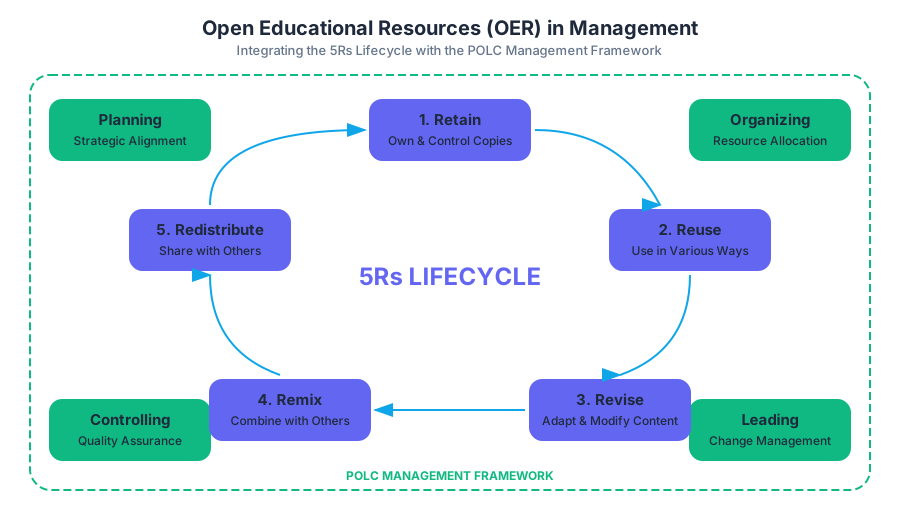
To understand OER in a management context, one must move beyond the "free of charge" definition. True OER is defined by the legal and technical permissions granted to the user. These are codified in the 5Rs Framework, which dictates the lifecycle of a management textbook or case study.
Definition: The 5Rs of OER A set of rights proposed by David Wiley that defines the "openness" of a resource:
- Retain: The right to make, own, and control copies of the content.
- Reuse: The right to use the content in a wide range of ways (e.g., in a class, on a website, in a video).
- Revise: The right to adapt, adjust, modify, or alter the content itself (e.g., translating a management case study into another language).
- Remix: The right to combine the original or revised content with other material to create something new.
- Redistribute: The right to share copies of the original content, your revisions, or your remixes with others.
Comparison: Traditional vs. Open Management Resources
| Feature | Traditional Textbooks | Open Educational Resources (OER) |
|---|---|---|
| Cost to Student | High ($100 - $300+) | $0 (Digital) / At-cost (Print) |
| Legal Status | All Rights Reserved (Copyright) | Creative Commons / Public Domain |
| Adaptability | Static; updates require new editions | Dynamic; real-time revision possible |
| Accessibility | Limited by paywalls and DRM | Universal; multi-format (HTML, PDF, EPUB) |
| Distribution | Controlled by publishers | Decentralized; Peer-to-peer |
Accessibility vs. Affordability: The Economic Engineering of OER
While often used interchangeably, Accessibility and Affordability represent distinct vectors in the management of educational equity.
- Affordability is a quantitative metric. It measures the reduction of financial friction. In management education, where students often balance work and study, high textbook costs act as a "regressive tax" that disproportionately affects lower-income students.
- Accessibility is a qualitative and technical metric. It refers to the Universal Design for Learning (UDL)—ensuring that a management student with visual impairments can use a screen reader on a
Principles of Managementchapter, or that a student with low bandwidth can download a text-only version of a strategic analysis.
Technical Standards for OER Accessibility
| Standard | Requirement | Management Application |
|---|---|---|
| WCAG 2.1 (AA) | Contrast, Alt-text, Keyboard Nav | Ensuring complex Org Charts are readable by screen readers. |
| EPUB3 | Reflowable text, semantic HTML | Allowing SWOT analysis tables to scale on mobile devices. |
| LTI (Learning Tools Interoperability) | Seamless LMS integration | Connecting OER quizzes directly to the Canvas/Moodle gradebook. |
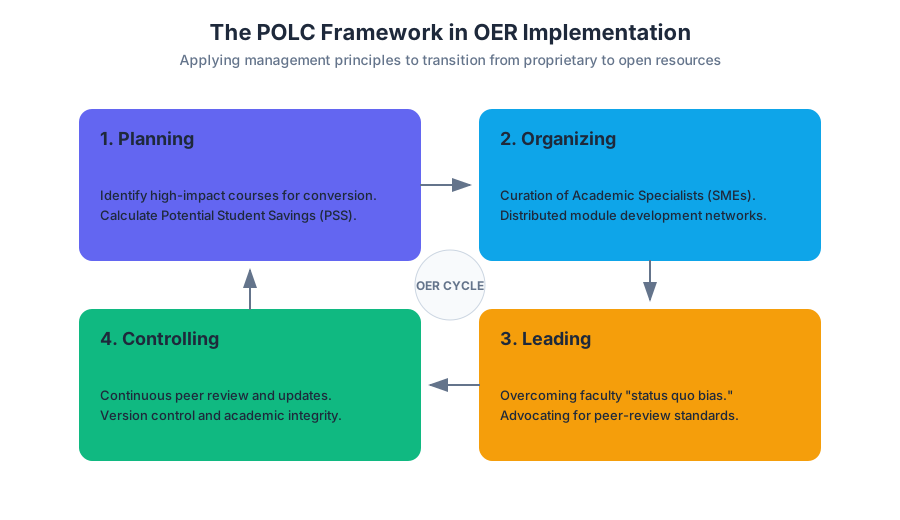
The POLC Framework in OER Implementation
The "Principles of Management" course material, such as that provided by OpenStax, is structured around the POLC Framework. Implementing OER within a university department requires applying these very management principles to the curriculum itself.
1. Planning (Strategic Alignment)
Management must decide which courses are "high-impact" for OER conversion. This usually involves analyzing enrollment data and textbook costs to calculate the Potential Student Savings (PSS).
2. Organizing (Resource Allocation)
This involves the curation of Academic Specialists. Unlike traditional publishing, where a single author might hold the "keys," OER organizing involves a distributed network of subject matter experts (SMEs) who contribute modules on Human Resource Management, Organizational Behavior, and Supply Chain Logistics.
3. Leading (Change Management)
Transitioning a faculty from a "standard" textbook to OER requires leadership. It involves overcoming "status quo bias" and demonstrating that open resources meet or exceed the peer-review standards of legacy publishers.
4. Controlling (Quality Assurance)
In OER, "controlling" is not about restricting access, but about maintaining academic integrity. This is achieved through continuous peer review and version control.
Implementation Mechanics: Metadata and Version Control
From a technical standpoint, managing OER is similar to managing an open-source software project. Content is often stored in structured formats (Markdown, XML, or LaTeX) to allow for easy "remixing."
Code Block 1: Python-based Metadata Analysis
This script demonstrates how an administrator might parse a library of OER management modules to ensure they meet specific licensing requirements (e.g., ensuring no "Non-Commercial" (NC) tags exist if the institution requires "Commercial" (CC-BY) compatibility).
import json
import os

class OERLibraryManager:
    def __init__(self, library_path):
        self.library_path = library_path
        self.compliant_resources = []

    def audit_licenses(self, required_license="CC BY"):
        """
        Scans OER metadata files to ensure license compliance.
        """
        for root, dirs, files in os.walk(self.library_path):
            for file in files:
                if file.endswith(".json"):
                    with open(os.path.join(root, file), 'r') as f:
                        metadata = json.load(f)
                        resource_id = metadata.get("id", "Unknown")
                        license_type = metadata.get("license", "Proprietary")

                        if required_license in license_type:
                            self.compliant_resources.append(resource_id)
                        else:
                            print(f"ALERT: Resource {resource_id} non-compliant ({license_type})")

        return len(self.compliant_resources)

# Usage
manager = OERLibraryManager("./management_modules")
count = manager.audit_licenses("CC BY")
print(f"Total CC-BY compliant modules: {count}")
The Economic Theory of OER: The Z-Degree Model
The ultimate goal of OER in management is the creation of the Z-Degree (Zero-Textbook-Cost Degree). The economic logic follows a cost-displacement model where the high upfront cost of content creation is amortized over a massive, global user base, eventually driving the marginal cost of distribution to near zero.
Mathematical Derivation of OER Cost-Efficiency
The total cost of ownership ($TCO$) for traditional materials vs. OER can be expressed as:
$$TCO_{trad} = \sum_{i=1}^{n} (C_{textbook} \times S_i)$$ $$TCO_{oer} = C_{dev} + \sum_{i=1}^{n} (C_{infra} \times S_i)$$
Where:
- $n$ = Number of semesters
- $S_i$ = Number of students in semester $i$
- $C_{textbook}$ = Price of a traditional textbook
- $C_{dev}$ = One-time cost of OER development/curation
- $C_{infra}$ = Cost of hosting/printing per student (usually $\approx 0$)
In this model, OER becomes exponentially more efficient as $n$ and $S$ increase, whereas traditional costs scale linearly with the number of students.
Code Block 2: Mathematical Simulation of Savings (Pseudocode)
% Algorithm: Calculate Break-Even Point for OER Investment
% Inputs: Development Cost (D), Avg Textbook Price (P), Students per Year (N)

\begin{algorithm}
\caption{OER Break-Even Analysis}
\begin{algorithmic}
\STATE $TotalSavings \leftarrow 0$
\STATE $Year \leftarrow 0$
\WHILE{$TotalSavings < D$}
    \STATE $Year \leftarrow Year + 1$
    \STATE $AnnualSavings \leftarrow N \times P$
    \STATE $TotalSavings \leftarrow TotalSavings + AnnualSavings$
\ENDWHILE
\RETURN $Year$
\end{algorithmic}
\end{algorithm}
Strategic Management and Human Resource Management (HRM) in OER
OER isn't just a product; it's a strategic asset. In the context of Strategic Management, OER allows institutions to differentiate themselves by offering lower "Total Cost of Attendance."
In Human Resource Management (HRM), OER principles are applied to corporate training. Instead of paying per-head licensing fees for leadership training modules, companies are increasingly developing internal OER. This allows for:
- Contextualization: A retail company can "remix" an open management textbook to include specific scenarios relevant to floor managers.
- Continuous Improvement: Employees can provide feedback that is immediately integrated into the next version of the training module.
Table: Creative Commons Licenses in Management OER
| License | Symbol | Permissions | Best For |
|---|---|---|---|
| CC BY | Attribution | Any use, even commercial. Must credit author. | Standard textbooks (OpenStax). |
| CC BY-SA | ShareAlike | Must share derivative works under same license. | Collaborative case study repositories. |
| CC BY-NC | Non-Commercial | Cannot be used for profit. | Niche academic research. |
| CC BY-ND | NoDerivatives | Can share, but cannot change content. | Official certification standards. |
Technical Deployment: The OER Pipeline
Modern OER management utilizes a "Docs-as-Code" approach. This ensures that the Controlling aspect of management is handled by automated systems.
- Source: Content is written in Markdown.
- Version Control: Managed via Git (GitHub/GitLab).
- Continuous Integration (CI): Automated checks for broken links and accessibility (WCAG) compliance.
- Deployment: Static Site Generators (Hugo, Jekyll) push content to a CDN (Content Delivery Network).
Code Block 3: CI/CD Configuration for OER Deployment
This YAML snippet (GitHub Actions) shows how a management department might automate the deployment of an updated "Strategic Management" handbook.
name: Deploy OER Handbook
on:
  push:
    branches:
      - main

jobs:
  build-and-deploy:
    runs-on: ubuntu-latest
    steps:
      - name: Checkout Code
        uses: actions/checkout@v3

      - name: Validate Accessibility (pa11y)
        run: |
          npm install -g pa11y
          pa11y ./dist/index.html

      - name: Build Static Site (Hugo)
        run: hugo --minify

      - name: Deploy to AWS S3
        run: |
          aws s3 sync ./public s3://management-oer-bucket --acl public-read
Common Pitfalls in OER Management
Despite the benefits, several "management failures" can occur during OER adoption:
- The "Ghost Resource" Problem: Creating an OER and failing to plan for its long-term maintenance. Without a Controlling mechanism, the data (e.g., market statistics in a management text) becomes obsolete.
- Licensing Incompatibility: Remixing a CC BY-SA module with a CC BY-NC module creates a legal "dead end" where the resulting work cannot be legally licensed.
- Discovery Friction: Even the best OER is useless if students and faculty cannot find it. This requires robust Metadata Management (using Schema.org/LRMI).
Conclusion: The Future of Management Education
OER is not merely a cost-saving measure; it is a fundamental re-imagining of how management knowledge is curated and distributed. By applying the POLC framework to the creation and maintenance of educational materials, the academic community can ensure that the principles of effective leadership and strategic thinking are available to everyone, everywhere. As AI and machine learning continue to evolve, the "Open" nature of these resources will allow for even more sophisticated personalization, transforming the static textbook into a dynamic, intelligent mentor.
Source Materials
Study Principles Management with AI — Free on Lykke
Sign up for free to generate personalized flashcards, quizzes, and study guides from this course. Chat with an AI tutor that knows the material.
Get Started FreeView this course wiki on Lykke · Browse all public course wikis