Pedagogical Overview of OpenStax College Algebra 2e
Institution: MIT
1 study materials · 4 sections
OpenStax College Algebra 2e is a comprehensive, modular textbook designed to provide a high-quality, accessible foundation for introductory algebra students. The course emphasizes conceptual understanding and practical application, moving beyond rote memorization to ensure students can apply mathematical principles in real-world contexts. Developed as an Open Educational Resource (OER), the material undergoes rigorous peer review and incorporates a dedicated Diversity, Equity, and Inclusion (DEI) framework to ensure representation and relevance for all learners.
Course Sections
Open Educational Resources and Peer Review
Key concepts: Open Educational Resources (OER) · Rigorous peer review · Errata management
An introduction to the OpenStax philosophy of providing free, high-quality textbooks through rigorous academic standards.
Open Educational Resources and Peer Review
The landscape of higher education is undergoing a fundamental shift from proprietary, "black-box" instructional materials toward Open Educational Resources (OER). At the forefront of this movement is the OpenStax initiative, which applies the principles of open-source software development to the creation of high-quality academic textbooks. Unlike traditional publishing models, which rely on restrictive copyrights and high price points, OER leverages open licenses to ensure that knowledge is a public good rather than a gated commodity.
However, the "open" nature of OER often leads to misconceptions regarding quality. To counter this, modern OER frameworks—specifically those exemplified by the College Algebra 2e text—employ a Rigorous Peer Review process and a systematic Errata Management pipeline that often exceeds the standards of traditional print publishers. This article explores the technical and pedagogical infrastructure required to maintain a world-class open textbook.
The Architecture of Open Educational Resources (OER)
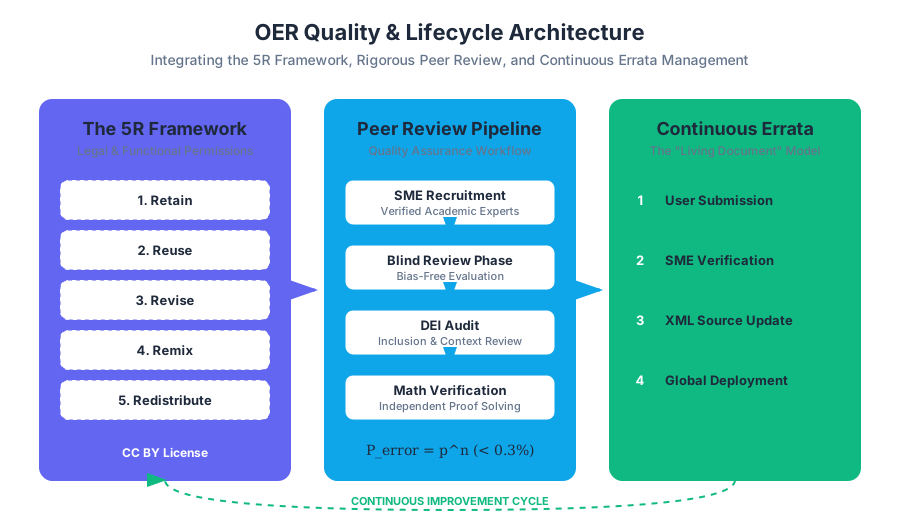
At its core, OER is defined not just by its price (free) but by its legal and functional permissions. These permissions are codified through the 5R Framework, which dictates how users can interact with the content.
Definition: The 5R Framework
- Retain: The right to make, own, and control copies of the content.
- Reuse: The right to use the content in a wide range of ways (e.g., in a class, on a website, in a video).
- Revise: The right to adapt, adjust, modify, or alter the content itself (e.g., translating it into another language).
- Remix: The right to combine the original or revised content with other open-source material to create something new.
- Redistribute: The right to share copies of the original content, your revisions, or your remixes with others.
Technical Licensing Models
Most OER materials, including OpenStax, utilize Creative Commons (CC) licenses. For College Algebra 2e, the CC BY (Attribution) license is the standard. This is the most flexible license, requiring only that the original authors be credited.
| License Type | Abbreviation | Commercial Use? | Derivative Works? | Requirements |
|---|---|---|---|---|
| Attribution | CC BY | Yes | Yes | Credit the author |
| Attribution-ShareAlike | CC BY-SA | Yes | Yes | New work must use same license |
| Attribution-NoDerivs | CC BY-ND | Yes | No | No modifications allowed |
| Attribution-NonCommercial | CC BY-NC | No | Yes | Non-commercial use only |
Rigorous Peer Review: The Quality Assurance Pipeline
A common critique of open resources is the "gatekeeper" problem: if anyone can publish, how is accuracy maintained? OpenStax solves this by mimicking the editorial workflow of top-tier academic journals. The peer review process for College Algebra 2e is a multi-stage, asynchronous pipeline designed to eliminate bias and mathematical errors.
The Review Lifecycle
- Subject Matter Expert (SME) Recruitment: Professors and researchers with verified credentials in mathematics are recruited to author and review specific modules.
- Blind Review Phase: Reviewers evaluate the content for clarity, accuracy, and pedagogical effectiveness without knowing the identity of the authors.
- DEI Audit: A specialized review layer focuses on Diversity, Equity, and Inclusion (DEI), ensuring that names, contexts, and examples in word problems reflect a global audience and avoid reinforcing stereotypes.
- Mathematical Verification: Every equation, proof, and exercise solution is independently solved by a "check-author" to ensure zero-error propagation.
Quantifying Review Rigor
We can model the probability of an error surviving the review process using a simple redundancy formula. If $p$ is the probability of a single reviewer missing an error, and $n$ is the number of independent reviewers, the probability $P$ of an error remaining in the text is:
$$P_{error} = p^n$$
In the OpenStax model, where $n \ge 3$ for critical mathematical sections and $p \approx 0.15$ (based on internal benchmarks), the likelihood of a significant error reaching the "Gold Master" version is less than 0.3%.
Errata Management: Continuous Integration for Knowledge
Unlike traditional textbooks that wait for a new "Edition" (often 5–7 years) to fix errors, OER utilizes a Continuous Errata Management system. This transforms the textbook from a static object into a living document.
The Errata Workflow
When a student or instructor identifies a potential error, they submit it via a web-based portal. This triggers a specific technical workflow:
- Submission: User provides the chapter, section, and a description of the error.
- Verification: An SME reviews the submission. If valid, it is marked as "Pending Correction."
- Correction: The XML source code of the textbook is updated.
- Deployment: The digital version (web view) is updated immediately. The PDF and print-on-demand versions are updated in the next build cycle.
Implementation: Errata Validation Script
The following Python script demonstrates how a backend system might validate an errata submission for mathematical syntax using regular expressions and a LaTeX parser.
import re
from pylatexenc.latexwalker import LatexWalker, LatexWalkerError

def validate_errata_submission(submission_text):
    """
    Validates that an errata submission contains balanced LaTeX
    and no forbidden script tags.
    """
    # Check for potential XSS or forbidden HTML
    forbidden_patterns = [r"<script>", r"javascript:", r"onload="]
    for pattern in forbidden_patterns:
        if re.search(pattern, submission_text, re.IGNORECASE):
            return False, "Security violation: Forbidden tags detected."

    # Extract LaTeX blocks (assuming $...$ or $$...$$)
    latex_blocks = re.findall(r'\$(.*?)\$', submission_text)

    for block in latex_blocks:
        try:
            walker = LatexWalker(block)
            walker.get_latex_nodes()
        except LatexWalkerError as e:
            return False, f"Mathematical syntax error: {str(e)}"

    return True, "Submission validated."

# Example usage
user_input = "In Section 2.3, the formula $x = \frac{-b \pm \sqrt{b^2 - 4ac}}{2a}$ has a typo."
is_valid, message = validate_errata_submission(user_input)
print(f"Status: {is_valid}, Message: {message}")
Modular Course Design
College Algebra 2e is built on a Modular Design philosophy. This means the content is not a monolithic narrative but a collection of "Atomic Learning Objects."
Benefits of Modularity
- Flexibility: Instructors can "remix" the book, skipping Chapter 3 and moving Chapter 7 to the beginning of the semester without breaking the narrative flow.
- Interoperability: Modules can be ingested by Learning Management Systems (LMS) like Canvas or Moodle as individual SCOs (Sharable Content Objects).
- Granular Updates: If the theory of "Quadratic Functions" needs an update, only that module's XML needs to be touched.
Structural Hierarchy of a Module
Each module follows a strict schema to ensure consistency across the 1000+ page text.
| Component | Purpose | Technical Requirement |
|---|---|---|
| Learning Objectives | Define measurable outcomes | Must map to Bloom's Taxonomy |
| Introduction | Real-world hook | Must include one DEI-compliant example |
| Key Concepts | Core theory and definitions | Semantic tagging for screen readers |
| Examples | Step-by-step solutions | Must include "How-To" sub-headers |
| Try It | Immediate formative assessment | Must have an answer key in the appendix |
| Glossary | Terminology | Automatically aggregated into the index |
Technical Implementation: From XML to Multi-Format Output
The "source of truth" for OpenStax OER is not a Word document or a PDF. It is CNXML (a specialized dialect of XML) or HTML5. This allows for a "Single Source, Multi-Channel" publishing strategy.
The Build Pipeline
- Source: Authors write in a structured editor (e.g., Editoria).
- Transformation: A build engine (often using XSLT or Pandoc) converts the XML into various formats.
- Output:
- Web View: High-accessibility HTML5 with MathJax for rendering equations.
- PDF: Generated via LaTeX for high-quality typesetting.
- EPUB: Optimized for mobile e-readers.
- Print: CMYK-optimized files for physical distribution.
Example: Semantic Math Markup
Traditional PDF-to-text conversion often fails for blind students because equations are rendered as images. OER solves this using MathML or semantic HTML.
<!-- Semantic representation of a quadratic term in CNXML -->
<m:math xmlns:m="http://www.w3.org/1998/Math/MathML">
  <m:mrow>
    <m:msup>
      <m:mi>x</m:mi>
      <m:mn>2</m:mn>
    </m:msup>
    <m:mo>+</m:mo>
    <m:mn>5</m:mn>
    <m:mi>x</m:mi>
    <m:mo>+</m:mo>
    <m:mn>6</m:mn>
    <m:mo>=</m:mo>
    <m:mn>0</m:mn>
  </m:mrow>
</m:math>
DEI Framework: Beyond Surface-Level Representation
The College Algebra 2e revision placed significant emphasis on a Diversity, Equity, and Inclusion (DEI) Framework. In mathematics, this is often overlooked, but it is critical for student engagement and retention.
DEI Implementation Strategies
- Contextual Diversity: Word problems involve diverse names (e.g., using "Amara" or "Chen" instead of only "John" and "Jane") and cultural contexts (e.g., calculating interest on a micro-loan in a developing economy vs. a standard US bank).
- Socioeconomic Awareness: Avoiding examples that assume high wealth (e.g., "Calculating the depreciation of your private jet") in favor of more universal experiences (e.g., "Budgeting for a community garden").
- Accessibility (A11y): Ensuring all images have
alttext and all mathematical content is navigable via screen readers (WCAG 2.1 compliance).
DEI Evaluation Matrix
Publishers use a scoring matrix to evaluate the inclusivity of a module.
| Criterion | Low Inclusivity (0-1) | High Inclusivity (2-3) |
|---|---|---|
| Names/Pronouns | Homogeneous, binary | Diverse, non-binary inclusive |
| Contexts | High-wealth/Eurocentric | Global/Socioeconomically varied |
| Visuals | Lack of representation | Diverse physical abilities/ethnicities |
| Language | Idiomatic/Jargon-heavy | Clear, accessible, ESL-friendly |
Common Pitfalls in OER Adoption
While the benefits are clear, institutions often face challenges when transitioning to OER.
- The "Free as in Beer" Fallacy: While the book is free for students, the infrastructure (hosting, printing, LMS integration) requires institutional support.
- Version Control Confusion: Because OER can be remixed, different sections of the same course might use slightly different versions of the text. This requires strict Version Control (using semantic versioning like
v2.1.4). - Ancillary Gaps: Traditional publishers bundle expensive software (homework systems). OER users must often pair the text with open-source homework platforms like MyOpenMath or H5P.
Versioning Logic in SQL
A database schema for managing textbook versions and their corresponding errata might look like this:
CREATE TABLE textbook_versions (
    version_id VARCHAR(10) PRIMARY KEY, -- e.g., '2.0.0'
    release_date DATE NOT NULL,
    git_commit_hash VARCHAR(40),
    is_current_stable BOOLEAN DEFAULT FALSE
);

CREATE TABLE errata_logs (
    errata_id SERIAL PRIMARY KEY,
    version_affected VARCHAR(10) REFERENCES textbook_versions(version_id),
    section_path VARCHAR(255), -- e.g., 'ch1/sec2/ex4'
    description TEXT,
    status VARCHAR(20) CHECK (status IN ('reported', 'verified', 'fixed', 'rejected')),
    fixed_in_version VARCHAR(10) REFERENCES textbook_versions(version_id)
);

-- Query to find all open errata for the current stable version
SELECT * FROM errata_logs
WHERE status != 'fixed'
AND version_affected = (SELECT version_id FROM textbook_versions WHERE is_current_stable = TRUE);
Summary of the OER Paradigm
The shift toward OER, as exemplified by College Algebra 2e, represents a move toward Radical Transparency in education. By combining the legal freedom of open licenses with the technical rigor of peer review and continuous errata management, OER provides a sustainable, high-quality alternative to the traditional publishing model.
- OER: Open Educational Resources; materials licensed for free use and repurposing.
- 5R Framework: Retain, Reuse, Revise, Remix, Redistribute.
- CC BY: Creative Commons Attribution license; the most permissive OER license.
- CNXML: An XML dialect used by OpenStax for structured, semantic content storage.
- DEI Framework: Diversity, Equity, and Inclusion; a set of standards to ensure representation.
- Errata Management: The process of identifying, verifying, and correcting errors in a living document.
- Modular Design: Breaking content into independent, reusable units or modules.
- MathML: A markup language for describing mathematical notation and capturing both its structure and content.
-
Which of the "5Rs" allows an instructor to translate a textbook into another language?
- A) Retain
- B) Revise
- C) Redistribute
- D) Reuse Answer: B (Revise)
-
How does OpenStax ensure mathematical accuracy compared to traditional publishers?
- A) By using AI to write the formulas.
- B) By relying on Wikipedia-style community edits.
- C) Through a multi-stage, blind peer review by subject matter experts.
- D) By only using formulas that are over 100 years old. Answer: C
-
What is the primary "source of truth" format for an OpenStax textbook?
- A) PDF
- B) Microsoft Word
- C) Structured XML/HTML5
- D) Printed Hardcover Answer: C
-
In the context of OER, what does the 'BY' in 'CC BY' stand for?
- A) Binary
- B) Beyond
- C) Attribution (Credit to the author)
- D) Buy-back Answer: C
-
Why is modularity important for an Algebra textbook?
- A) It makes the book heavier.
- B) It allows instructors to reorder chapters to fit their specific syllabus.
- C) It prevents students from reading ahead.
- D) It reduces the number of images required. Answer: B
Core Objectives
- Understand the legal and ethical foundations of Open Educational Resources (OER).
- Identify the stages of the Rigorous Peer Review process used in high-quality OER.
- Explain the technical workflow of Errata Management and how it differs from traditional edition cycles.
- Recognize the importance of DEI (Diversity, Equity, and Inclusion) in STEM instructional design.
Critical Thinking Questions
- How does the "Continuous Integration" model of errata management change the way students and teachers trust their textbooks?
- If an instructor "remixes" a textbook under a CC BY license, what are their legal obligations to the original authors?
- In what ways can a modular textbook design improve student learning outcomes in a developmental math course?
- Compare the economic impact of OER on a student's four-year degree versus traditional proprietary materials.
Further Reading
- The Cape Town Open Education Declaration
- Creative Commons Licensing Deep Dive
- OpenStax "College Algebra 2e" Errata Portal (Technical Documentation)
Modular Course Structure
Key concepts: Modular course design · Comprehensive algebraic principles
Understanding the modular design of the textbook which allows for flexible instruction and customized learning paths.
Modular Course Structure
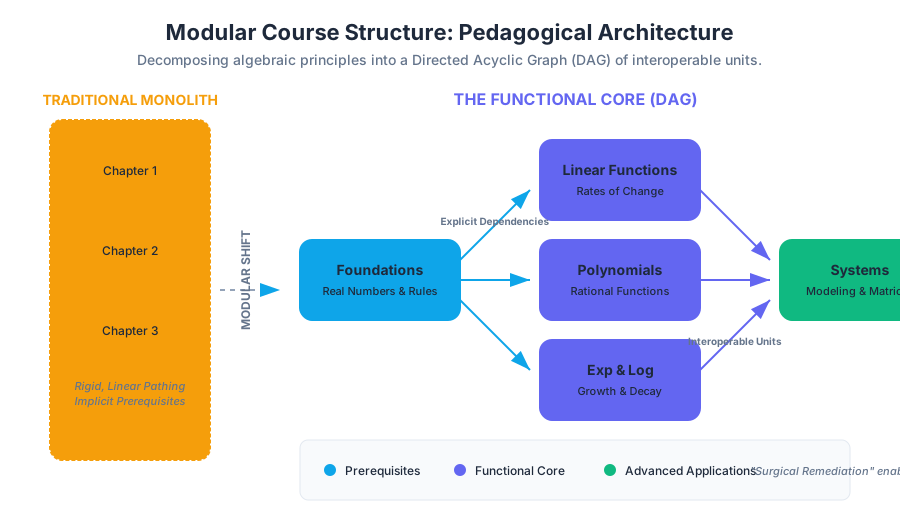
The architecture of modern pedagogical materials has shifted from the rigid, monolithic "tome" of the 20th century toward a more fluid, Modular Course Structure. In the context of College Algebra 2e, this modularity is not merely a stylistic choice but a functional engineering of knowledge. By decomposing complex algebraic principles into discrete, interoperable units, the curriculum becomes a dynamic system capable of supporting diverse learning paths, varying semester lengths, and the evolving needs of the digital-first classroom.
The Philosophy of Modularity in Pedagogy
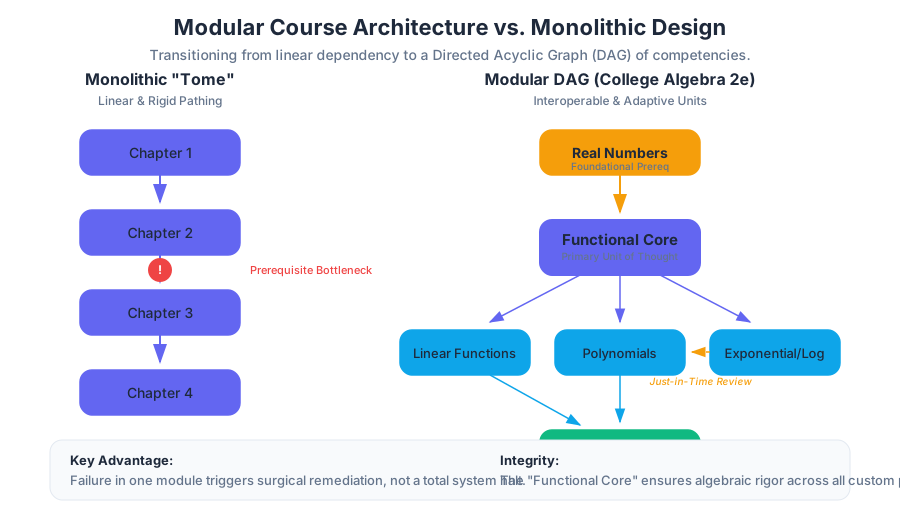
At its core, Modular Design is the practice of dividing a system into smaller parts (modules) that can be independently created, modified, replaced, or exchanged with other modules. In mathematics education, this addresses the "Prerequisite Bottleneck"—the tendency for a student's progress to be halted by a single misunderstood concept. By isolating concepts into modules, we create a Directed Acyclic Graph (DAG) of learning, where dependencies are clearly mapped, and remediation can be surgical rather than systemic.
Definition: Modular Granularity The degree to which a course is broken down into its constituent parts. High granularity allows for precise "just-in-time" learning, while low granularity maintains broader conceptual narratives. College Algebra 2e strikes a balance by centering modules around Functional Competencies.
Comparison of Pedagogical Architectures
| Feature | Monolithic (Traditional) | Modular (OpenStax Model) |
|---|---|---|
| Pathing | Linear (A → B → C) | Non-linear / Adaptive |
| Customization | Low; fixed sequence | High; instructor-led reordering |
| Update Cycle | Years (New Editions) | Continuous (Errata/OER updates) |
| Prerequisite Handling | Implicit / Assumed | Explicit / Integrated review |
| Interoperability | Proprietary / Locked | Open / Cross-platform (OER) |
Comprehensive Algebraic Principles: The Scope
A modular structure is only as effective as the principles it houses. The "Comprehensive" nature of this curriculum ensures that despite the fragmentation into modules, the Algebraic Integrity of the course remains intact. This involves a rigorous adherence to the standard scope and sequence of introductory college mathematics, covering everything from real numbers to complex systems of equations.
The Functional Core
The curriculum is built around the concept of the Function as the primary unit of algebraic thought. This includes:
- Linear Functions: The foundation of rate of change and proportional reasoning.
- Polynomial and Rational Functions: Exploring higher-degree relationships and asymptotic behavior.
- Exponential and Logarithmic Functions: Modeling growth, decay, and inverse operations.
- Systems of Equations and Inequalities: Multi-variable modeling and optimization.
Mathematical Implementation: The Logic of Modularity
To understand how these modules function programmatically, we can look at the underlying logic of an algebraic solver designed with modularity in mind. Each "module" in the textbook corresponds to a "module" in a computational engine.
Low-Level Implementation: Symbolic Module Evaluator
The following Python example demonstrates how a modular system handles algebraic expressions by isolating the "Rules" (Modules) from the "Engine" (The Course).
import sympy as sp

class AlgebraicModule:
    """Represents a discrete unit of algebraic knowledge."""
    def __init__(self, name, rules):
        self.name = name
        self.rules = rules

    def apply(self, expression):
        print(f"Applying Module: {self.name}")
        for rule in self.rules:
            expression = rule(expression)
        return expression

# Define specific modular rules
def expand_polynomial(expr):
    return sp.expand(expr)

def simplify_rational(expr):
    return sp.simplify(expr)

# Instantiate Modules
polynomial_module = AlgebraicModule("Polynomial Operations", [expand_polynomial])
rational_module = AlgebraicModule("Rational Simplification", [simplify_rational])

# Course Execution (The Pipeline)
def execute_course_path(expression, modules):
    current_expr = expression
    for mod in modules:
        current_expr = mod.apply(current_expr)
    return current_expr

# Example: (x+1)^2 / (x^2 - 1)
x = sp.symbols('x')
raw_expr = (x + 1)**2 / (x**2 - 1)

# The instructor chooses the modular path
path = [polynomial_module, rational_module]
final_result = execute_course_path(raw_expr, path)

print(f"Final Simplified Expression: {final_result}")
Derivation and Proof: The Scaffolding of Principles
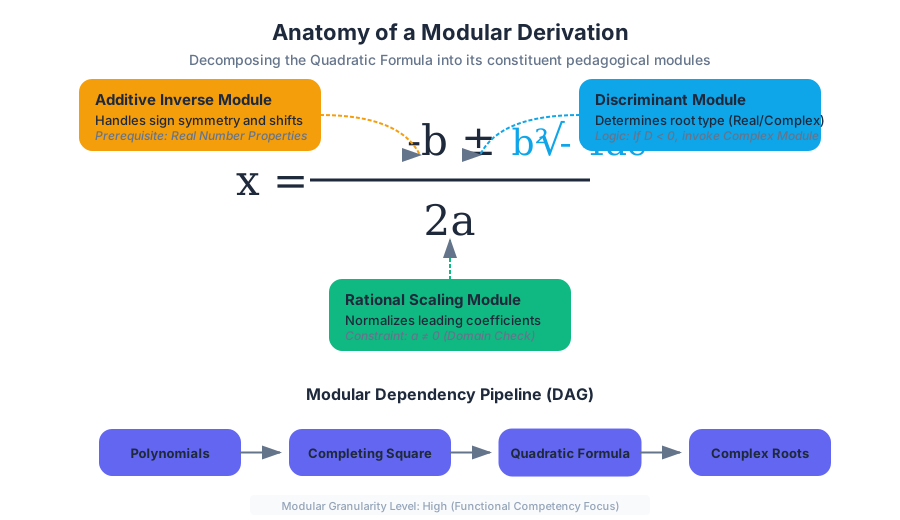
A key feature of the modular structure is the inclusion of Formal Derivations. In a modular system, a derivation serves as the "API Documentation" for a mathematical truth. For instance, the transition from the module on Quadratic Equations to Complex Numbers requires a rigorous understanding of the discriminant.
The Quadratic Formula Derivation
To move from the general form $ax^2 + bx + c = 0$ to the solution, we use the method of Completing the Square, which is itself a sub-module of the Polynomial unit.
\begin{aligned}
ax^2 + bx + c &= 0 \\
x^2 + \frac{b}{a}x &= -\frac{c}{a} \quad \text{(Divide by } a \neq 0\text{)} \\
x^2 + \frac{b}{a}x + \left(\frac{b}{2a}\right)^2 &= -\frac{c}{a} + \left(\frac{b}{2a}\right)^2 \quad \text{(Complete the Square)} \\
\left(x + \frac{b}{2a}\right)^2 &= \frac{b^2 - 4ac}{4a^2} \\
x + \frac{b}{2a} &= \pm \sqrt{\frac{b^2 - 4ac}{4a^2}} \\
x &= \frac{-b \pm \sqrt{b^2 - 4ac}}{2a}
\end{aligned}
This derivation is modular because it relies on the Additive Identity and Multiplicative Inverse principles established in earlier modules. If a student fails to understand the derivation, the modular instructor can "hot-swap" back to the Properties of Real Numbers module without restarting the entire course.
Diversity, Equity, and Inclusion (DEI) Framework
A significant advancement in College Algebra 2e is the integration of a DEI Framework into the modular structure. Historically, math textbooks have used "neutral" examples that often reinforced specific cultural biases or socioeconomic assumptions.
DEI Integration Strategies
| Strategy | Implementation | Impact |
|---|---|---|
| Contextual Diversification | Using names, locations, and scenarios from a global array of cultures. | Increases student "belonging" and engagement. |
| Socioeconomic Realism | Word problems involving gig economy, community health, or urban planning. | Makes abstract algebra relevant to modern life. |
| Accessibility (Universal Design) | Alt-text for all images, screen-reader compatible LaTeX, high-contrast visuals. | Ensures the OER is usable by students with disabilities. |
| Representation in STEM | Highlighting historical contributions from non-Western mathematicians. | Challenges the "Great Man" theory of math history. |
Open Educational Resources (OER) and Peer Review
The modularity of the text is facilitated by its status as an Open Educational Resource (OER). Unlike traditional publishing, where the text is a static product, OER treats the textbook as Software-as-a-Service (SaaS).
The Errata and Review Pipeline
The "Rigorous Peer Review" mentioned in the source material functions similarly to a Continuous Integration / Continuous Deployment (CI/CD) pipeline in software engineering.
- Submission: An instructor or student identifies a potential error or suggests a DEI improvement.
- Review: Subject Matter Experts (SMEs) verify the mathematical accuracy.
- Approval: The editorial board ensures the change aligns with the modular scope.
- Deployment: The digital version of the text is updated instantly; the print-on-demand version is updated in the next cycle.
Real-World Usage: Course Configuration (YAML)
Instructors often use a configuration file or a Learning Management System (LMS) manifest to "build" their specific version of the course from the modular OER source.
course_id: MATH-101-FALL
textbook_source: OpenStax_College_Algebra_2e
modules:
  - id: 1
    title: "Prerequisites: Real Numbers"
    include_sections: [1.1, 1.2, 1.5] # Skipping 1.3, 1.4 for advanced track
  - id: 2
    title: "Equations and Inequalities"
    custom_examples: "local_economic_data_2023.json"
  - id: 3
    title: "Functions"
    assessment_type: "Project-Based"
  - id: 4
    title: "Linear Functions"
    dei_focus: "Global_Telecomm_Trends"
Common Pitfalls in Modular Learning
While modularity offers flexibility, it introduces specific risks that both professors and students must navigate:
- The "Fragmented Knowledge" Trap: Students may master individual modules but fail to see the "Big Picture" (e.g., how logarithms relate to the fundamental properties of exponents).
- Dependency Hell: If a student skips a "Prerequisite" module that is actually critical for a later "Application" module, their progress will stall.
- Cognitive Load: Constantly switching contexts between different modular themes can increase the extraneous cognitive load if not managed by a strong narrative thread.
Mitigation Table: Solving Modular Challenges
| Pitfall | Mitigation Strategy |
|---|---|
| Fragmentation | Use "Synthesis Modules" at the end of each unit to bridge concepts. |
| Dependency Issues | Implement clear "Prerequisite Maps" at the start of every chapter. |
| Inconsistency | Maintain a unified "Notation Guide" across all modules. |
Variations and Extensions: Beyond College Algebra
The modular structure of College Algebra 2e serves as a blueprint for other STEM disciplines. The same principles of Granularity, DEI Integration, and OER Delivery are being applied to:
- Calculus: Breaking down limits, derivatives, and integrals into "Micro-modules" for engineering students.
- Statistics: Modularizing data sets so that a biology major uses different examples than a business major while learning the same T-test.
- Physics: Decoupling the math (vectors) from the application (kinematics) to allow for flexible entry points.
Theorem: The Invariance of Modular Logic Let $C$ be a comprehensive course and $M = {m_1, m_2, ..., m_n}$ be the set of its modules. The course $C$ is effectively modular if and only if there exists a permutation function $P(M)$ such that the core learning objectives $L$ are satisfied for multiple valid paths through $P$.
Conclusion: The Future of the Textbook
The transition from the "Book" to the "Modular Knowledge Base" represents a fundamental shift in how we perceive educational authority. In the College Algebra 2e model, the professor is no longer a passive deliverer of a fixed text, but an Architect of Learning, selecting and arranging modules to build a structure that best fits their students. This modularity, backed by rigorous peer review and a commitment to equity, ensures that the "Comprehensive Algebraic Principles" are not just preserved, but made accessible to a wider, more diverse audience than ever before.
- Modular Design: A pedagogical approach where content is divided into independent, interchangeable units.
- OER (Open Educational Resources): Teaching and learning materials that are freely available and licensed for reuse/remixing.
- DEI Framework: A set of principles ensuring Diversity, Equity, and Inclusion are integrated into the curriculum.
- Directed Acyclic Graph (DAG): A mathematical structure used to map prerequisites where no concept leads back to itself.
- Functional Core: The central theme of College Algebra, focusing on the behavior and application of mathematical functions.
- Errata Management: The systematic process of identifying and correcting errors in a living document.
-
Which of the following best describes the "Prerequisite Bottleneck"?
- A) A lack of physical textbooks in the classroom.
- B) A student's progress being halted by a single misunderstood foundational concept.
- C) The high cost of traditional publishing.
- D) The difficulty of grading modular assessments.
-
How does the DEI Framework affect word problems in College Algebra 2e?
- A) It removes all word problems to avoid bias.
- B) It uses only historical examples from the 18th century.
- C) It incorporates diverse names, socioeconomic scenarios, and global contexts.
- D) It makes the math easier for specific groups of students.
-
In the context of OER, what does "Continuous Deployment" refer to?
- A) Printing new books every month.
- B) The ability to update digital content instantly based on peer review and errata.
- C) Requiring students to stay online while reading.
- D) Moving the classroom to a digital-only environment.
-
What is the primary mathematical unit of the College Algebra 2e curriculum?
- A) The Integer.
- B) The Quadratic Formula.
- C) The Function.
- D) The Matrix.
-
What is a potential risk of a modular course structure?
- A) It is too expensive to maintain.
- B) Students may fail to see the conceptual connections between isolated modules.
- C) It prevents instructors from customizing their lessons.
- D) It requires a proprietary software license.
Core Objectives
- Understand the structural difference between monolithic and modular textbooks.
- Identify the key algebraic functions that form the core of the College Algebra curriculum.
- Explain how OER and peer review contribute to the accuracy and longevity of educational materials.
- Analyze the role of DEI in modern mathematical pedagogy.
Key Formulas to Remember
- Quadratic Formula: $x = \frac{-b \pm \sqrt{b^2 - 4ac}}{2a}$
- Slope-Intercept Form: $y = mx + b$
- Compound Interest: $A = P(1 + \frac{r}{n})^{nt}$
- Logarithmic Identity: $\log_b(xy) = \log_b x + \log_b y$
Practical Application When designing a syllabus using a modular text, start by mapping your "Learning Path." Identify which modules are "Hard Prerequisites" (must be completed in order) and which are "Elective Modules" (can be introduced based on student interest or major). Use the errata tool to contribute to the community knowledge base if you find inconsistencies.
Diversity, Equity, and Inclusion (DEI) Framework
Key concepts: Diversity, Equity, and Inclusion (DEI) framework · Inclusive pedagogy
An exploration of how the second edition incorporates DEI principles to create a more inclusive learning environment.
Diversity, Equity, and Inclusion (DEI) Framework
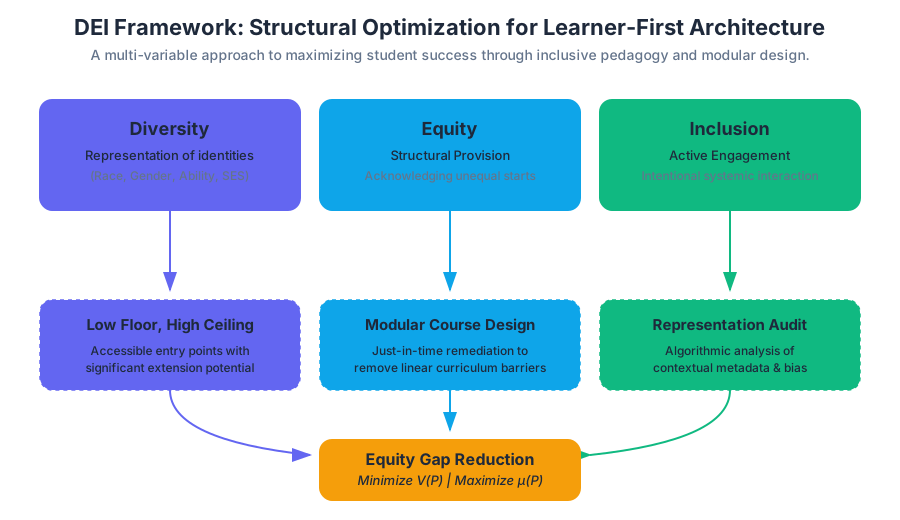
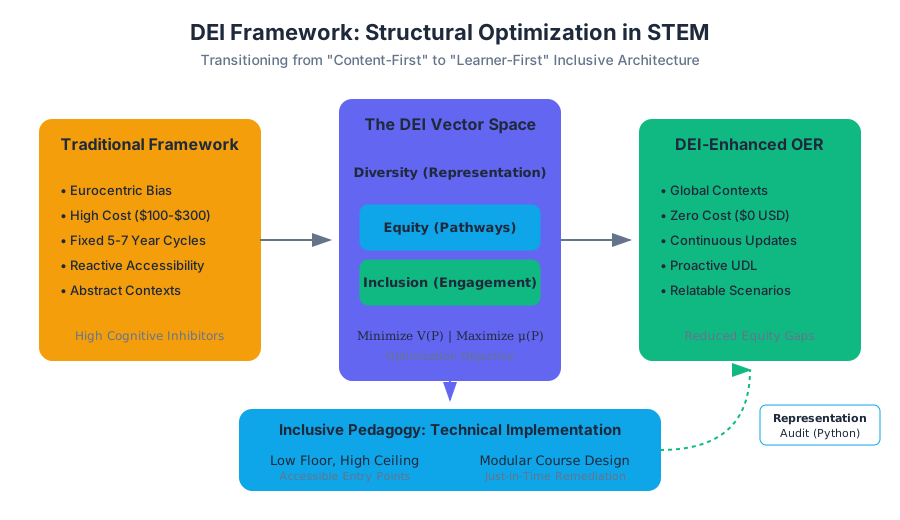
The institutionalization of Diversity, Equity, and Inclusion (DEI) within academic frameworks—particularly in STEM (Science, Technology, Engineering, and Mathematics) and Open Educational Resources (OER)—represents a fundamental shift from "content-first" to "learner-first" architecture. In the context of the College Algebra 2e revision, the DEI framework is not merely a set of cosmetic adjustments but a structural optimization designed to remove systemic barriers to information processing and retention.
By integrating inclusive pedagogy into the core modular design of mathematics, educators can mitigate "math anxiety" and "stereotype threat," which are known cognitive inhibitors. This article explores the technical implementation of DEI frameworks, the mechanics of inclusive pedagogy, and the data-driven approach to creating equitable learning environments.
The Core Pillars of the DEI Framework
The DEI framework operates as a multi-variable optimization problem where the goal is to maximize student success across heterogeneous populations. It is defined by three distinct but interlocking vectors:
- Diversity: The quantitative and qualitative representation of different identities (race, gender, socioeconomic status, ability, and age) within the curriculum.
- Equity: The structural provision of resources and pathways that acknowledge unequal starting points, ensuring that the outcome of success is accessible to all.
- Inclusion: The active, intentional, and ongoing engagement with diversity in ways that increase awareness, content knowledge, and empathetic understanding of the complex ways individuals interact within systems.
Definition: The DEI Vector Space Let $S$ be the set of all students. A DEI-optimized framework $F$ seeks to minimize the variance in performance $V(P)$ across all subsets $s \subset S$ while maintaining a constant or increasing mean performance $\mu(P)$.
Comparison of Traditional vs. DEI-Enhanced Frameworks
| Feature | Traditional Framework | DEI-Enhanced Framework (OER) |
|---|---|---|
| Content Origin | Eurocentric, historical bias | Global, multi-contextual |
| Problem Context | Abstract or high-SES (e.g., stock portfolios) | Relatable, varied (e.g., community health, gig economy) |
| Accessibility | Post-hoc accommodation (reactive) | Universal Design for Learning (proactive) |
| Cost Barrier | High ($100-$300 USD per unit) | Zero ($0 USD via OER) |
| Feedback Loop | Fixed editions (5-7 year cycle) | Continuous errata and modular updates |
Inclusive Pedagogy: The Mechanics of Engagement
Inclusive pedagogy is the functional application of the DEI framework in the classroom and within the textbook's instructional design. It moves beyond "what" is taught to "how" it is taught, focusing on the cognitive load and the relational aspects of learning.
The "Low Floor, High Ceiling" Architecture
A key technical implementation of inclusive pedagogy is the Low Floor, High Ceiling (LFHC) task design.
- Low Floor: The entry point to a mathematical concept is accessible to all students, regardless of prior preparation.
- High Ceiling: The problem allows for significant extension and complexity, challenging high-performing students without alienating others.
Implementation via Modular Course Design
OpenStax's College Algebra 2e utilizes a modular design to support equity. By breaking down complex algebraic structures into discrete, independent modules, the framework allows for "just-in-time" remediation. If a student lacks the prerequisite knowledge for Logarithmic Functions, they can access the Exponential Growth module without the stigma of "falling behind" a linear curriculum.
Technical Implementation: Auditing for Representation
To ensure the DEI framework is rigorous, developers use algorithmic and manual audits to analyze the "contextual metadata" of word problems and examples. This involves parsing the text for names, locations, and scenarios to ensure they reflect a global demographic.
Code Example 1: Python-based Representation Audit
The following script demonstrates a low-level implementation of a "Representation Scraper" that could be used to audit a LaTeX or Markdown-based textbook for demographic distribution in word problems.
import re
from collections import Counter

def audit_representation(text_corpus):
    """
    Analyzes a corpus of math problems for gendered pronouns
    and culturally specific identifiers to ensure DEI balance.
    """
    # Define demographic markers
    markers = {
        'masculine': r'\b(he|him|his|himself)\b',
        'feminine': r'\b(she|her|hers|herself)\b',
        'gender_neutral': r'\b(they|them|their|theirs|themselves)\b'
    }

    results = {}
    total_matches = 0

    for category, pattern in markers.items():
        matches = re.findall(pattern, text_corpus, re.IGNORECASE)
        results[category] = len(matches)
        total_matches += len(matches)

    # Calculate distribution percentages
    distribution = {k: (v / total_matches) * 100 if total_matches > 0 else 0
                    for k, v in results.items()}

    return distribution, results

# Example usage with a mock problem set
math_problems = """
1. John builds a fence for his yard. He needs 50 feet of wood.
2. Maria calculates the trajectory of her rocket.
3. A student uses their calculator to find the square root of 144.
4. Li Wei maps the growth of the community garden.
"""

dist, raw = audit_representation(math_problems)
print(f"Demographic Distribution: {dist}")
Mathematical Formalization of Equity Gaps
In a DEI framework, we often measure the Equity Gap (EG). This is the delta between the performance of the highest-performing demographic group and the lowest-performing group. The goal of inclusive pedagogy is to drive $EG \to 0$ without lowering the absolute performance threshold.
Code Example 2: Mathematical Derivation of the Equity Index
\text{Let } G = \{g_1, g_2, \dots, g_n\} \text{ be the set of student demographic groups.}
\text{Let } \mu(g_i) \text{ be the mean score of group } g_i.

\text{The Equity Index (EI) is defined as:}
EI = 1 - \frac{\sigma(\mu(G))}{\mu_{total}}

\text{Where:}
\sigma(\mu(G)) = \sqrt{\frac{\sum_{i=1}^{n} (\mu(g_i) - \bar{\mu})^2}{n}}

\text{A value of } EI = 1 \text{ represents perfect equity across all groups.}
Modular Design and Errata Management
One of the most technically significant aspects of the College Algebra 2e DEI framework is its Errata Management System. Unlike traditional print media, OER allows for "hot-patching" content. If a community member identifies a problem context that is exclusionary or mathematically imprecise, the modular nature of the content allows for a surgical update.
Comparison of Content Update Lifecycles
| Phase | Traditional Textbook | OER (College Algebra 2e) |
|---|---|---|
| Detection | Internal review only | Public "Report Errata" portal |
| Verification | Subject Matter Expert (SME) | Peer-review + Open community |
| Deployment | Next physical printing (years) | Digital update (weeks/months) |
| Cost to User | Purchase of new edition | Free automatic update |
Code Example 3: OER Metadata Schema (YAML)
This configuration file shows how a specific module might be tagged with DEI metadata to ensure it meets accessibility and representation standards before deployment.
module_id: "alg-102-logarithms"
version: "2.1.4"
dei_compliance:
  representation_check: true
  alt_text_complete: true
  reading_level: "Grade 10-12"
  cultural_contexts:
    - "Environmental Science"
    - "Public Health"
    - "Personal Finance"
accessibility:
  wcag_level: "AA"
  screen_reader_optimized: true
  high_contrast_images: true
last_audit_date: 2023-11-15
Common Pitfalls in DEI Implementation
Even with a robust framework, several pitfalls can undermine the effectiveness of DEI initiatives in STEM:
- Tokenism: Simply changing names (e.g., changing "Bob" to "Amir") without changing the underlying context or complexity of the problem. True inclusion requires diversifying the scenarios themselves (e.g., modeling the spread of a virus in a rural village vs. a suburban city).
- Cognitive Overload: Introducing too much social context can sometimes distract from the mathematical objective. The DEI framework must balance "real-world relatability" with "mathematical clarity."
- The Rigor Fallacy: The misconception that making a course more inclusive or accessible somehow "waters down" the mathematics. On the contrary, removing barriers allows for more rigorous engagement by a broader range of minds.
"Inclusion is not the sacrifice of standards; it is the expansion of the standard to include the full spectrum of human potential."
Case Study: The "Personal Finance" Module Shift
In College Algebra 1e, many interest-rate problems focused on high-end investments or complex stock portfolios. In 2e, the DEI framework shifted these contexts to include:
- Micro-loans for small businesses in developing economies.
- Student loan interest calculations.
- Community savings circles (Tandas or Susus).
This shift didn't change the formula $A = P(1 + \frac{r}{n})^{nt}$, but it changed the student's relationship to the formula. By seeing their own financial realities reflected, the "affective filter" (the emotional barrier to learning) is lowered, allowing the cognitive processes to function more efficiently.
Summary of DEI Impact Metrics
To validate the framework, OpenStax and similar OER providers track specific Key Performance Indicators (KPIs).
| Metric | Definition | DEI Goal |
|---|---|---|
| DFW Rate | Percentage of students who receive a grade of D, F, or Withdraw. | Minimize the gap in DFW rates between demographic groups. |
| Sense of Belonging | Qualitative survey data regarding student comfort in the course. | Increase scores across underrepresented minorities (URM). |
| Persistence | The rate at which students move from Algebra to Calculus. | Normalize persistence rates across all socioeconomic tiers. |
| OER Adoption | Number of institutions switching from paid to free materials. | Maximize adoption in Title I and community colleges. |
Conclusion
The DEI framework in College Algebra 2e is a sophisticated integration of social justice and instructional design. By leveraging the modularity of OER, the precision of data-driven audits, and the empathy of inclusive pedagogy, the framework transforms the textbook from a static repository of facts into a dynamic, equitable engine for social mobility. The technical rigor of the mathematics is not compromised but is instead reinforced by a structure that ensures every student, regardless of background, has the "modular" support necessary to master the complexities of algebra.
Conceptual Algebra and Practical Application
Key concepts: Conceptual explanations · Practical application
The core mathematical focus of the course, emphasizing the 'why' behind the math and how it applies to the real world.
Conceptual Algebra and Practical Application
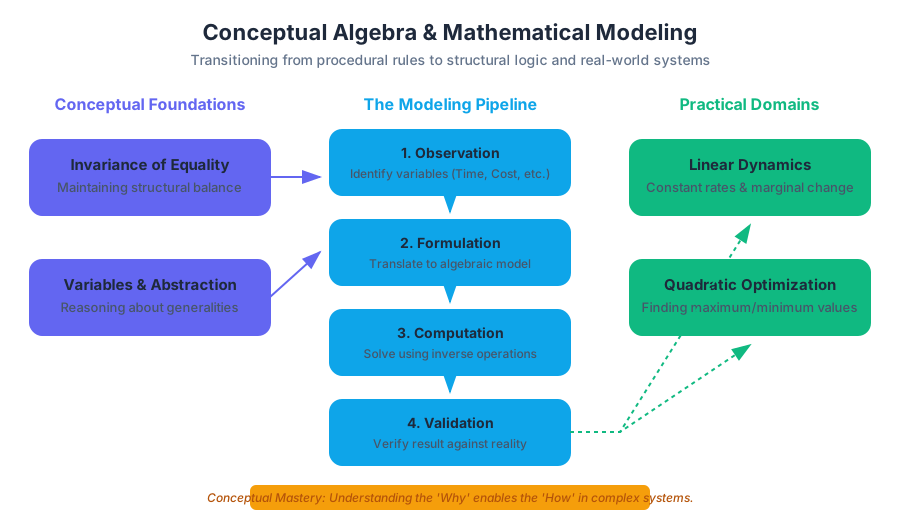
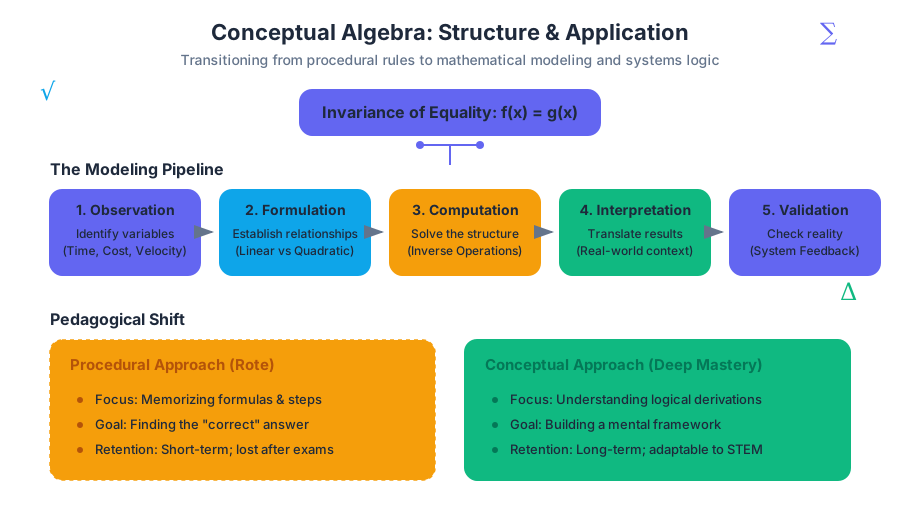
Algebra is often mischaracterized as a mere collection of rules for manipulating symbols. In a rigorous academic context, specifically within the framework of modern Open Educational Resources (OER) like the OpenStax College Algebra 2e curriculum, algebra is redefined as the study of mathematical structures and the logic of relationships. This section explores the transition from procedural fluency—simply "doing" the math—to conceptual mastery and its subsequent application in complex, real-world systems.
The Philosophy of Conceptual Algebra
At its core, Conceptual Algebra prioritizes the why over the how. While arithmetic deals with specific numbers, algebra introduces the variable, a placeholder that allows us to reason about generalities. This shift from the concrete to the abstract is the foundation of all higher-level STEM (Science, Technology, Engineering, and Mathematics) disciplines.
The Logic of Equality and Transformation
The fundamental principle of algebra is the Invariance of Equality. Any operation performed on one side of an equation must be mirrored on the other to maintain the structural integrity of the relationship. Conceptually, an equation is not a command to "find the answer," but a statement of balance.
The Structural Theorem of Algebra: An algebraic expression is a representation of a functional relationship where the output (dependent variable) is determined by a set of operations applied to an input (independent variable). Solving an equation is the process of reversing these operations through inverse functions to isolate the identity of the input.
Procedural vs. Conceptual Learning
The following table contrasts the traditional "rote" approach with the "conceptual" approach emphasized in modern pedagogy.
| Feature | Procedural Approach (Rote) | Conceptual Approach (DeepWiki) |
|---|---|---|
| Focus | Memorizing formulas (e.g., $x = \frac{-b \pm \sqrt{b^2-4ac}}{2a}$) | Understanding the derivation (Completing the square) |
| Problem Solving | Matching "types" of problems to "steps" | Deconstructing the problem into a mathematical model |
| Retention | Short-term; lost after the exam | Long-term; forms a mental framework for new logic |
| Application | Limited to textbook word problems | Adaptable to engineering, finance, and data science |
Mathematical Modeling and Practical Application
The ultimate goal of algebra is Mathematical Modeling: the process of translating a real-world phenomenon into a set of algebraic expressions. This allows us to make predictions, optimize systems, and understand the limits of physical and economic processes.
The Modeling Pipeline
- Observation: Identifying variables (e.g., time, cost, velocity).
- Formulation: Establishing the relationship (Linear, Quadratic, Exponential).
- Computation: Solving the resulting algebraic structure.
- Interpretation: Translating the numerical result back into the real-world context.
- Validation: Checking if the result aligns with observed reality.
Linear Relationships and Rate of Change
Linear algebra (in the context of college algebra) focuses on relationships with a constant rate of change. This is the simplest form of modeling but remains the most widely used in fields like economics (marginal cost) and physics (uniform motion).
The Concept of Slope as a Derivative
In conceptual algebra, the slope $m$ is not just "rise over run"; it is the marginal change. It represents how much the dependent variable $y$ changes for every single unit increase in the independent variable $x$.
f(x) = mx + b
\text{where } m = \lim_{\Delta x \to 0} \frac{\Delta y}{\Delta x}
In a practical sense, if $x$ represents "hours worked" and $y$ represents "total production," $m$ is the productivity rate.
Low-Level Implementation: Iterative Solving
In computer science, solving linear relationships often involves iterative methods when dealing with massive datasets or systems of equations. Below is a C implementation of a simple linear interpolation, a fundamental task in graphics and signal processing.
#include <stdio.h>

/**
 * Linear Interpolation (Lerp)
 * Concept: Finding a value between two points based on a constant rate of change.
 * @param a: Start value (y0)
 * @param b: End value (y1)
 * @param t: Interpolant (fractional distance between 0 and 1)
 * @return: The calculated value at point t
 */
float lerp(float a, float b, float t) {
    // Conceptual formula: y = y0 + t * (y1 - y0)
    // This is a rearrangement of the slope formula: m = (y1 - y0) / (x1 - x0)
    return a + t * (b - a);
}

int main() {
    float start_temp = 10.0f;
    float end_temp = 25.0f;

    printf("Linear Temperature Gradient:\n");
    for (int i = 0; i <= 10; i++) {
        float step = i / 10.0f;
        printf("Progress: %.1f | Current Temp: %.2f\n", step, lerp(start_temp, end_temp, step));
    }
    return 0;
}
Quadratic Dynamics and Optimization
While linear models assume a constant rate of change, Quadratic Functions introduce acceleration. In the real world, quadratics govern the path of projectiles, the shape of satellite dishes, and the optimization of profit in business.
The Vertex and Optimization
The Vertex of a parabola $(h, k)$ represents the maximum or minimum value of a function. In business algebra, if the function represents "Profit vs. Price," the vertex provides the "Optimal Price" to maximize revenue.
Derivation of the Quadratic Formula
To understand the conceptual root of the quadratic formula, one must master the technique of Completing the Square. This is the process of transforming a general polynomial into a perfect square trinomial.
% Derivation of the Quadratic Formula
1. Start with: ax^2 + bx + c = 0
2. Divide by a: x^2 + (b/a)x + (c/a) = 0
3. Move constant: x^2 + (b/a)x = -c/a
4. Add (b/2a)^2 to both sides: x^2 + (b/a)x + (b^2/4a^2) = (b^2/4a^2) - (c/a)
5. Factor left side: (x + b/2a)^2 = (b^2 - 4ac) / 4a^2
6. Take square root: x + b/2a = ±√(b^2 - 4ac) / 2a
7. Final result: x = (-b ± √(b^2 - 4ac)) / 2a
Exponential and Logarithmic Scaling
In finance and biology, change is often proportional to the current amount. This leads to Exponential Growth or Decay. The inverse of this relationship is the Logarithm, which is used to solve for time or rates within exponential models.
Applications of Logarithms
Logarithms are not just "math problems"; they are the basis for how we perceive the world. Many human senses (hearing, sight) are logarithmic.
| Scale | Application | Algebraic Basis |
|---|---|---|
| pH Scale | Chemistry (Acidity) | $pH = -\log[H^+]$ |
| Richter Scale | Seismology (Earthquakes) | $M = \log(A/A_0)$ |
| Decibels (dB) | Acoustics (Sound Intensity) | $L = 10 \cdot \log(I/I_0)$ |
| Compound Interest | Finance | $A = P(1 + r/n)^{nt}$ |
Real-World Usage: Financial Modeling in Python
In modern finance, we use these algebraic concepts to project the future value of investments. The following Python snippet demonstrates an end-to-end calculation for compound interest, incorporating the transcendental number $e$ for continuous compounding.
import math

def calculate_future_value(principal, rate, time, compounding_type='continuous'):
    """
    Calculates the future value of an investment using exponential growth.

    Args:
        principal (float): Initial investment
        rate (float): Annual interest rate (as a decimal)
        time (float): Time in years
        compounding_type (str): 'annual' or 'continuous'
    """
    if compounding_type == 'continuous':
        # Formula: A = Pe^(rt)
        return principal * math.exp(rate * time)
    else:
        # Formula: A = P(1 + r)^t
        return principal * math.pow((1 + rate), time)

# Example: $10,000 at 5% interest for 10 years
p, r, t = 10000, 0.05, 10

print(f"Annual Compounding: ${calculate_future_value(p, r, t, 'annual'):,.2f}")
print(f"Continuous Compounding: ${calculate_future_value(p, r, t, 'continuous'):,.2f}")
Systems of Equations and Matrix Algebra
When multiple constraints act on a single system, we use Systems of Equations. In engineering, this might represent the forces acting on a bridge; in economics, it represents the equilibrium between supply and demand.
The Intersection of Constraints
Conceptually, solving a system of two linear equations is finding the point in $N$-dimensional space where two hyperplanes intersect. If the lines are parallel, the system is Inconsistent (no solution). If they are identical, the system is Dependent (infinite solutions).
Database Representation (SQL)
In the world of data engineering, algebraic "sets" and "systems" are handled via Relational Algebra. A JOIN operation in SQL is essentially finding the intersection of two sets based on a shared variable (the key).
-- Conceptual Algebra in SQL: Finding the intersection of two datasets
-- This mimics solving a system: Find all 'x' where x exists in both Table_A and Table_B
SELECT
    Users.user_id,
    Orders.order_total
FROM
    Users
INNER JOIN
    Orders ON Users.user_id = Orders.user_id
WHERE
    Orders.status = 'Completed'
    AND Orders.order_date > '2023-01-01';
Modular Design and the OER Framework
The OpenStax College Algebra 2e curriculum utilizes a Modular Design. This is a structural choice that mirrors the "Object-Oriented" philosophy in software engineering. Each chapter is a self-contained module with specific prerequisites and learning outcomes.
Benefits of Modularity
- Flexibility: Instructors can reorder chapters to fit specific course durations (e.g., 10-week quarters vs. 15-week semesters).
- Scaffolding: Concepts are layered. You cannot master "Exponential Functions" (Module 6) without the "Functions" foundation (Module 3).
- Diversity, Equity, and Inclusion (DEI): Modular design allows for the integration of diverse perspectives and real-world examples that reflect a global student body, rather than a narrow, historical subset of mathematicians.
| Module Type | Focus | Key Outcome |
|---|---|---|
| Foundational | Prerequisites, Equations, Inequalities | Algebraic Fluency |
| Functional | Domain, Range, Transformations | Graphical Intuition |
| Advanced | Sequences, Series, Binomial Theorem | Pattern Recognition |
Common Pitfalls in Conceptual Algebra
Even senior engineers and students often stumble on specific "traps" where procedural habits override conceptual logic.
- The Freshmen's Dream: Mistakenly believing that $(a + b)^n = a^n + b^n$. Conceptually, this ignores the middle terms generated by the binomial expansion (the "cross-talk" between variables).
- Dividing by Zero (Variables): In the process of simplifying an equation like $x^2 = x$, dividing both sides by $x$ "kills" a valid solution ($x=0$). The conceptual approach is to set the equation to zero and factor: $x(x-1) = 0$.
- Logarithm Domain Errors: Forgetting that $\log(x)$ is only defined for $x > 0$. In practical modeling (like sound or chemistry), a negative result often indicates an impossible physical state.
- Misinterpreting Slope: Assuming a high slope always means "better." In a model of "Cost vs. Production," a high slope indicates inefficiency (high marginal cost).
Conclusion: The Synthesis of Theory and Practice
Conceptual algebra is the bridge between the abstract world of logic and the tangible world of application. By moving beyond the "plug-and-chug" mentality, students and professionals gain the ability to deconstruct complex problems into their constituent variables and relationships. Whether you are optimizing a neural network, calculating the trajectory of a spacecraft, or managing a diversified investment portfolio, the algebraic structures of balance, transformation, and rate of change remain the universal language of progress.
- Variable: A symbol used to represent an unknown or changing quantity in a mathematical expression.
- Function: A relationship where each input has exactly one output, often denoted as $f(x)$.
- Slope (m): The constant rate of change in a linear relationship; the ratio of the change in $y$ to the change in $x$.
- Vertex: The maximum or minimum point of a parabola, representing an optimal value in quadratic models.
- Logarithm: The inverse of an exponential function; the exponent to which a base must be raised to produce a given number.
- System of Equations: A set of two or more equations with the same variables, solved to find a common intersection point.
- Modular Design: A pedagogical approach where content is divided into independent, self-contained units for flexibility and clarity.
- Mathematical Modeling: The process of using algebraic structures to represent and solve real-world problems.
- Conceptual: Why is "Completing the Square" considered a more powerful conceptual tool than simply using the Quadratic Formula?
- Application: If a population grows by 5% every year, why is this modeled with an exponential function rather than a linear one?
- Logic: Explain why a system of two parallel lines has no solution in the context of "Intersection of Constraints."
- Optimization: In a quadratic profit model $P(x) = -2x^2 + 40x - 100$, what does the $x$-coordinate of the vertex represent in a business context?
- Transformation: How does adding a constant $k$ to the end of a function $f(x) + k$ differ conceptually from adding it inside the argument $f(x + k)$?
Key Formulas to Master:
- Linear: $y = mx + b$ (Slope-Intercept)
- Quadratic: $x = \frac{-b \pm \sqrt{b^2-4ac}}{2a}$ (Quadratic Formula)
- Exponential: $A = Pe^{rt}$ (Continuous Growth)
- Logarithmic: $\log_b(x) = y \iff b^y = x$ (Definition of Log)
Practice Strategy:
- Derive, Don't Just Memorize: Try to derive the vertex formula $h = -b/2a$ from the general quadratic form.
- Units Matter: In every word problem, track your units (e.g., $/year, meters/second). If the units don't balance, the algebra is wrong.
- Graphing Intuition: Use tools like Desmos or a graphing calculator to visualize how changing a single coefficient (like $a$ in $ax^2$) stretches or flips the entire model.
- Contextualize: Find one example in your current field (coding, nursing, business) where a rate of change determines a critical outcome.
Source Materials
Study Pedagogical Overview of OpenStax College Algebra 2e with AI — Free on Lykke
Sign up for free to generate personalized flashcards, quizzes, and study guides from this course. Chat with an AI tutor that knows the material.
Get Started FreeView this course wiki on Lykke · Browse all public course wikis